
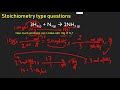
Stoichiometry and Molar Ratios

Interactive Video
•
Chemistry
•
9th - 10th Grade
•
Practice Problem
•
Hard

Patricia Brown
FREE Resource
Read more
10 questions
Show all answers
1.
MULTIPLE CHOICE QUESTION
30 sec • 1 pt
What is the first step in stoichiometry when converting grams to moles?
Balance the chemical equation.
Convert grams to liters.
Find the molar mass of the substance.
Use the molar ratio directly.
2.
MULTIPLE CHOICE QUESTION
30 sec • 1 pt
Why can't you directly convert grams of one substance to grams of another using molar ratios?
Because grams are the same for all substances.
Because molar ratios only apply to moles, not grams.
Because molar ratios are only for gases.
Because grams are not used in stoichiometry.
3.
MULTIPLE CHOICE QUESTION
30 sec • 1 pt
What is the molar ratio of hydrogen to ammonia in the given reaction?
1:1
1:2
2:3
3:2
4.
MULTIPLE CHOICE QUESTION
30 sec • 1 pt
How do you determine the number of moles of NH3 from moles of H2?
Add the moles of H2 and NH3.
Multiply by the molar mass of NH3.
Use the molar ratio from the balanced equation.
Divide by the molar mass of H2.
5.
MULTIPLE CHOICE QUESTION
30 sec • 1 pt
What is the molar mass of ammonia (NH3)?
14 g/mol
17 g/mol
18 g/mol
16 g/mol
6.
MULTIPLE CHOICE QUESTION
30 sec • 1 pt
How many grams of ammonia can be produced from 3.3 moles of NH3?
33.0 grams
56.1 grams
17.0 grams
10.0 grams
7.
MULTIPLE CHOICE QUESTION
30 sec • 1 pt
What is the first step in solving a complex stoichiometry problem?
Convert all quantities to liters.
Use the molar ratio directly.
Balance the chemical equation.
Convert all quantities to grams.
Access all questions and much more by creating a free account
Create resources
Host any resource
Get auto-graded reports

Continue with Google

Continue with Email

Continue with Classlink

Continue with Clever
or continue with

Microsoft
%20(1).png)
Apple

Others
Already have an account?


