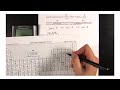
Stoichiometry Concepts and Applications

Interactive Video
•
Chemistry, Science, Mathematics
•
9th - 10th Grade
•
Practice Problem
•
Hard

Patricia Brown
FREE Resource
Read more
10 questions
Show all answers
1.
MULTIPLE CHOICE QUESTION
30 sec • 1 pt
Why is it crucial to start with a balanced chemical equation in stoichiometry problems?
To make the problem look more complex.
To simplify the conversion factors.
To ensure the correct molar ratios are used.
To avoid using a periodic table.
2.
MULTIPLE CHOICE QUESTION
30 sec • 1 pt
What do the coefficients in a balanced chemical equation represent?
The number of atoms in a molecule.
The molar ratios of the substances.
The total mass of the reactants.
The speed of the reaction.
3.
MULTIPLE CHOICE QUESTION
30 sec • 1 pt
Why is a periodic table necessary when solving stoichiometry problems?
To balance chemical equations.
To predict reaction outcomes.
To determine the molar masses of elements.
To find the chemical symbols.
4.
MULTIPLE CHOICE QUESTION
30 sec • 1 pt
In the given problem, what is the starting substance?
Sodium hydroxide
Oxygen
Phosphoric acid
Water
5.
MULTIPLE CHOICE QUESTION
30 sec • 1 pt
What is the molar mass of phosphoric acid (H3PO4) as calculated in the video?
3.03 grams per mole
98 grams per mole
30.97 grams per mole
64 grams per mole
6.
MULTIPLE CHOICE QUESTION
30 sec • 1 pt
What is the final step in converting grams to moles in the problem discussed?
Multiplying by the atomic number.
Dividing by the number of moles.
Using the molar ratio from the balanced equation.
Adding the masses of all elements.
7.
MULTIPLE CHOICE QUESTION
30 sec • 1 pt
What is the final answer for the moles of water produced in the problem?
1.5 moles
0.857 moles
2.0 moles
3.0 moles
Access all questions and much more by creating a free account
Create resources
Host any resource
Get auto-graded reports

Continue with Google

Continue with Email

Continue with Classlink

Continue with Clever
or continue with

Microsoft
%20(1).png)
Apple

Others
Already have an account?
Popular Resources on Wayground

15 questions
Fractions on a Number Line

Quiz
•
3rd Grade
20 questions
Equivalent Fractions
Quiz
•
3rd Grade
25 questions
Multiplication Facts
Quiz
•
5th Grade
22 questions
fractions
Quiz
•
3rd Grade
20 questions
Main Idea and Details
Quiz
•
5th Grade
20 questions
Context Clues
Quiz
•
6th Grade
15 questions
Equivalent Fractions
Quiz
•
4th Grade
20 questions
Figurative Language Review
Quiz
•
6th Grade
Discover more resources for Chemistry
20 questions
Types of Chemical Reactions
Quiz
•
9th - 12th Grade
20 questions
Energy Transformations
Quiz
•
9th - 12th Grade
20 questions
Periodic Table & Trends
Quiz
•
10th Grade
20 questions
Periodic Trends
Quiz
•
10th Grade
24 questions
Identifying Types of Chemical Reactions
Quiz
•
10th - 12th Grade
20 questions
Naming & Writing Chemical Formulas
Quiz
•
10th Grade
20 questions
Atomic Structure
Quiz
•
10th - 12th Grade
10 questions
Identifying Types of Chemical Reactions
Interactive video
•
6th - 10th Grade