
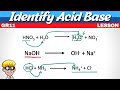
Arrhenius and Brønsted Acid-Base Concepts

Interactive Video
•
Chemistry
•
9th - 10th Grade
•
Practice Problem
•
Hard

Patricia Brown
FREE Resource
Read more
10 questions
Show all answers
1.
MULTIPLE CHOICE QUESTION
30 sec • 1 pt
What happens to HF when it reacts with H2O according to the Arrhenius theory?
It produces OH- in water.
It produces H3O+ in water.
It remains unchanged.
It becomes a base.
2.
MULTIPLE CHOICE QUESTION
30 sec • 1 pt
In the reaction between HF and H2O, what role does HF play according to the Brønsted theory?
It remains neutral.
It produces OH-.
It donates a proton.
It accepts a proton.
3.
MULTIPLE CHOICE QUESTION
30 sec • 1 pt
Why does a water molecule become positively charged when it gains a proton?
Because it releases energy.
Because it becomes a base.
Because it gains a positive charge.
Because it loses an electron.
4.
MULTIPLE CHOICE QUESTION
30 sec • 1 pt
What is the charge of HF after it loses a proton?
Negative
It remains unchanged
Neutral
Positive
5.
MULTIPLE CHOICE QUESTION
30 sec • 1 pt
Why is H2O not considered an Arrhenius base in the given example?
It does not produce OH- in water.
It does not accept a proton.
It does not donate a proton.
It produces H3O+ in water.
6.
MULTIPLE CHOICE QUESTION
30 sec • 1 pt
What does HNO3 become after donating a proton?
H2O
OH-
H3O+
NO3-
7.
MULTIPLE CHOICE QUESTION
30 sec • 1 pt
Why is NaOH considered an Arrhenius base?
It donates a proton.
It produces OH- in water.
It accepts a proton.
It produces H3O+ in water.
Access all questions and much more by creating a free account
Create resources
Host any resource
Get auto-graded reports

Continue with Google

Continue with Email

Continue with Classlink

Continue with Clever
or continue with

Microsoft
%20(1).png)
Apple

Others
Already have an account?

