
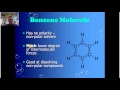
Solvents and Solutions Concepts

Interactive Video
•
Chemistry
•
9th - 10th Grade
•
Practice Problem
•
Hard

Patricia Brown
FREE Resource
Read more
10 questions
Show all answers
1.
MULTIPLE CHOICE QUESTION
30 sec • 1 pt
What is the term for the substance that gets dissolved in a solution?
Solvent
Solute
Solvation
Solution
2.
MULTIPLE CHOICE QUESTION
30 sec • 1 pt
Which type of solvent is effective at dissolving ionic compounds?
Non-polar solvent
Polar solvent
Amphipathic solvent
Neutral solvent
3.
MULTIPLE CHOICE QUESTION
30 sec • 1 pt
What is the role of water in an aqueous solution?
It acts as an inhibitor.
It acts as a catalyst.
It acts as the solvent.
It acts as the solute.
4.
MULTIPLE CHOICE QUESTION
30 sec • 1 pt
Why are non-polar solvents poor conductors of electricity?
They dissolve too many ions.
They do not dissolve polar compounds to produce ions.
They have high intermolecular forces.
They are too volatile.
5.
MULTIPLE CHOICE QUESTION
30 sec • 1 pt
Which of the following is a strong electrolyte?
Benzene
Sugar
HCl
Acetic acid
6.
MULTIPLE CHOICE QUESTION
30 sec • 1 pt
What is a hydrate?
A compound that is completely dry.
A compound that conducts electricity.
A compound that contains water in its crystal structure.
A compound that dissolves in oil.
7.
MULTIPLE CHOICE QUESTION
30 sec • 1 pt
What is the term for the water molecules associated with a crystal structure in hydrates?
Water of solvation
Water of hydration
Water of dissolution
Water of crystallization
Access all questions and much more by creating a free account
Create resources
Host any resource
Get auto-graded reports

Continue with Google

Continue with Email

Continue with Classlink

Continue with Clever
or continue with

Microsoft
%20(1).png)
Apple

Others
Already have an account?
Popular Resources on Wayground

8 questions
Spartan Way - Classroom Responsible

Quiz
•
9th - 12th Grade
15 questions
Fractions on a Number Line
Quiz
•
3rd Grade
14 questions
Boundaries & Healthy Relationships

Lesson
•
6th - 8th Grade
20 questions
Equivalent Fractions
Quiz
•
3rd Grade
3 questions
Integrity and Your Health
Lesson
•
6th - 8th Grade
25 questions
Multiplication Facts
Quiz
•
5th Grade
9 questions
FOREST Perception
Lesson
•
KG
20 questions
Main Idea and Details
Quiz
•
5th Grade
Discover more resources for Chemistry
22 questions
Unit 9 Gas Law Quiz
Quiz
•
10th Grade
20 questions
Types of Chemical Reactions
Quiz
•
9th - 12th Grade
13 questions
Solubility Curves
Quiz
•
10th Grade
20 questions
momentum and impulse
Quiz
•
9th - 12th Grade
22 questions
Solubility Curve Practice
Quiz
•
10th Grade
40 questions
Unit 3 (Part 1) Chemical Equations & Reactions Review Game
Quiz
•
8th - 12th Grade
35 questions
Types of Chemical Reactions
Quiz
•
9th - 12th Grade
15 questions
Ionic Bonding
Quiz
•
10th - 11th Grade