
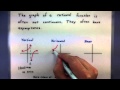
Understanding Rational Functions and Asymptotes

Interactive Video
•
Mathematics
•
9th - 10th Grade
•
Practice Problem
•
Hard

Thomas White
FREE Resource
Read more
11 questions
Show all answers
1.
MULTIPLE CHOICE QUESTION
30 sec • 1 pt
What is the main topic introduced in the video?
Calculus
Trigonometric functions
Rational functions
Algebraic equations
2.
MULTIPLE CHOICE QUESTION
30 sec • 1 pt
What are the two components needed to form a rational function?
Two constants
Two variables
Two polynomials
Two integers
3.
MULTIPLE CHOICE QUESTION
30 sec • 1 pt
Why is division by zero a concern in rational functions?
It simplifies the function
It has no effect
It makes the function undefined
It makes the function continuous
4.
MULTIPLE CHOICE QUESTION
30 sec • 1 pt
What is the term for the top part of a fraction in rational functions?
Dividend
Numerator
Quotient
Denominator
5.
MULTIPLE CHOICE QUESTION
30 sec • 1 pt
What is a common feature of the graphs of rational functions?
They have gaps or asymptotes
They are always continuous
They are always linear
They are always quadratic
6.
MULTIPLE CHOICE QUESTION
30 sec • 1 pt
What is an asymptote in the context of rational functions?
A line the function crosses
A point where the function is undefined
A line the function approaches but never reaches
A point where the function is zero
7.
MULTIPLE CHOICE QUESTION
30 sec • 1 pt
What happens to the function value near a vertical asymptote?
It approaches zero
It approaches infinity
It becomes negative
It remains constant
Access all questions and much more by creating a free account
Create resources
Host any resource
Get auto-graded reports

Continue with Google

Continue with Email

Continue with Classlink

Continue with Clever
or continue with

Microsoft
%20(1).png)
Apple

Others
Already have an account?

