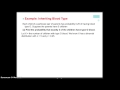
Binomial Distribution Concepts

Interactive Video
•
Mathematics
•
9th - 10th Grade
•
Practice Problem
•
Hard

Thomas White
FREE Resource
Read more
13 questions
Show all answers
1.
MULTIPLE CHOICE QUESTION
30 sec • 1 pt
What are the main objectives of learning about binomial and geometric random variables?
To understand the conditions for normal distribution
To explore the history of probability theory
To calculate and interpret probabilities and mean for binomial and geometric distributions
To learn about continuous random variables
2.
MULTIPLE CHOICE QUESTION
30 sec • 1 pt
Which of the following is NOT a condition for a binomial distribution?
The probability of success can vary between trials
There must be a fixed number of trials
Trials must be independent
Each trial results in a success or failure
3.
MULTIPLE CHOICE QUESTION
30 sec • 1 pt
In a binomial distribution, what does the parameter 'n' represent?
The number of successes
The number of trials
The probability of success
The probability of failure
4.
MULTIPLE CHOICE QUESTION
30 sec • 1 pt
In the blood type example, what is the probability of exactly two children having blood type O?
0.25
0.75
0.1875
0.3125
5.
MULTIPLE CHOICE QUESTION
30 sec • 1 pt
What is the binomial coefficient used for?
To find the probability of failure
To calculate the variance of a distribution
To calculate the mean of a distribution
To determine the number of ways a specific outcome can occur
6.
MULTIPLE CHOICE QUESTION
30 sec • 1 pt
How do you calculate the probability of a specific number of successes in a binomial distribution?
By using the normal distribution formula
By multiplying the binomial coefficient with the probability of success and failure
By adding the probabilities of all possible outcomes
By using the geometric distribution formula
7.
MULTIPLE CHOICE QUESTION
30 sec • 1 pt
In the example of three children having type O blood, what is the probability of this event?
0.421875
0.234375
0.15625
0.3125
Access all questions and much more by creating a free account
Create resources
Host any resource
Get auto-graded reports

Continue with Google

Continue with Email

Continue with Classlink

Continue with Clever
or continue with

Microsoft
%20(1).png)
Apple

Others
Already have an account?
Popular Resources on Wayground

15 questions
Fractions on a Number Line

Quiz
•
3rd Grade
20 questions
Equivalent Fractions
Quiz
•
3rd Grade
25 questions
Multiplication Facts
Quiz
•
5th Grade
54 questions
Analyzing Line Graphs & Tables
Quiz
•
4th Grade
22 questions
fractions
Quiz
•
3rd Grade
20 questions
Main Idea and Details
Quiz
•
5th Grade
20 questions
Context Clues
Quiz
•
6th Grade
15 questions
Equivalent Fractions
Quiz
•
4th Grade
Discover more resources for Mathematics
20 questions
Graphing Inequalities on a Number Line
Quiz
•
6th - 9th Grade
18 questions
SAT Prep: Ratios, Proportions, & Percents
Quiz
•
9th - 10th Grade
12 questions
Exponential Growth and Decay
Quiz
•
9th Grade
12 questions
Parallel Lines Cut by a Transversal
Quiz
•
10th Grade
12 questions
Add and Subtract Polynomials
Quiz
•
9th - 12th Grade
15 questions
Combine Like Terms and Distributive Property
Quiz
•
8th - 9th Grade
20 questions
Function or Not a Function
Quiz
•
8th - 9th Grade
10 questions
Elijah McCoy: Innovations and Impact in Black History
Interactive video
•
6th - 10th Grade