
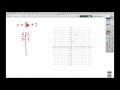
Understanding Slope Intercept Form

Interactive Video
•
Mathematics
•
9th - 10th Grade
•
Practice Problem
•
Hard

Thomas White
FREE Resource
Read more
7 questions
Show all answers
1.
MULTIPLE CHOICE QUESTION
30 sec • 1 pt
What is the primary focus of the lesson on slope intercept form?
Discussing quadratic equations
Learning about slope intercept form
Exploring proportional relationships
Understanding direct variation equations
2.
MULTIPLE CHOICE QUESTION
30 sec • 1 pt
How does the equation y = 1/3x + 2 differ from a direct variation equation?
It represents a circle
It has a variable slope
It is a quadratic equation
It includes a constant term
3.
MULTIPLE CHOICE QUESTION
30 sec • 1 pt
What type of relationships does slope intercept form address?
Logarithmic relationships
Exponential relationships
Non-proportional relationships
Proportional relationships
4.
MULTIPLE CHOICE QUESTION
30 sec • 1 pt
What is the purpose of using a table of values in understanding slope intercept form?
To visualize the relationship between x and y
To solve quadratic equations
To find the roots of a polynomial
To calculate the area under a curve
5.
MULTIPLE CHOICE QUESTION
30 sec • 1 pt
In the equation y = 1/3x + 2, what does the '2' represent?
The x-intercept
The slope of the line
The rate of change
The y-intercept
6.
MULTIPLE CHOICE QUESTION
30 sec • 1 pt
How is the slope represented in the graph of the equation y = 1/3x + 2?
As the ratio of rise over run
As the intersection with the y-axis
As a vertical line
As a horizontal line
7.
MULTIPLE CHOICE QUESTION
30 sec • 1 pt
What will the next video focus on regarding slope intercept form?
Solving quadratic equations
Graphing techniques without a table
Understanding exponential growth
Calculating derivatives
Access all questions and much more by creating a free account
Create resources
Host any resource
Get auto-graded reports

Continue with Google

Continue with Email

Continue with Microsoft
or continue with

%20(1).png)
Apple

Others
Already have an account?


