
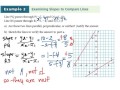
Understanding Slopes and Line Relationships

Interactive Video
•
Mathematics
•
9th - 10th Grade
•
Practice Problem
•
Hard

Thomas White
FREE Resource
Read more
12 questions
Show all answers
1.
MULTIPLE CHOICE QUESTION
30 sec • 1 pt
What is the main focus of this lesson?
Studying the properties of circles
Exploring the concept of angles
Learning about slopes of parallel and perpendicular lines
Understanding the properties of triangles
2.
MULTIPLE CHOICE QUESTION
30 sec • 1 pt
What is a key characteristic of parallel lines?
They form a triangle
They never meet and have equal slopes
They have different slopes
They intersect at a 90° angle
3.
MULTIPLE CHOICE QUESTION
30 sec • 1 pt
How do you determine if two lines are perpendicular?
Their slopes are equal
Their slopes are negative reciprocals
They never intersect
They form a circle
4.
MULTIPLE CHOICE QUESTION
30 sec • 1 pt
In Example 1, what is the slope of line GH?
12
3/4
1/2
-3/6
5.
MULTIPLE CHOICE QUESTION
30 sec • 1 pt
Which lines in Example 1 are parallel?
GH and MN
JK and MN
None of the lines
GH and JK
6.
MULTIPLE CHOICE QUESTION
30 sec • 1 pt
In Example 2, what mistake is commonly made when calculating the slope?
Forgetting to subtract the y-coordinates
Misplacing negative signs
Incorrectly adding the x-coordinates
Not using the slope formula
7.
MULTIPLE CHOICE QUESTION
30 sec • 1 pt
What is the relationship between lines PQ and RS in Example 2?
They are parallel
They are neither parallel nor perpendicular
They are perpendicular
They form a triangle
Access all questions and much more by creating a free account
Create resources
Host any resource
Get auto-graded reports

Continue with Google

Continue with Email

Continue with Classlink

Continue with Clever
or continue with

Microsoft
%20(1).png)
Apple

Others
Already have an account?

