
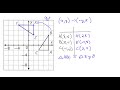
Transformations and Congruence in Geometry

Interactive Video
•
Mathematics
•
9th - 10th Grade
•
Practice Problem
•
Hard
Thomas White
FREE Resource
Read more
13 questions
Show all answers
1.
MULTIPLE CHOICE QUESTION
30 sec • 1 pt
What does it mean for two figures to be congruent?
They have the same size but different shapes.
They are mirror images of each other.
They have the same shape but different sizes.
They are exactly the same size and shape.
2.
MULTIPLE CHOICE QUESTION
30 sec • 1 pt
Which of the following is a rigid motion?
Scaling
Reflection
Shearing
Dilation
3.
MULTIPLE CHOICE QUESTION
30 sec • 1 pt
How can you prove that two quadrilaterals are congruent using rigid motions?
By comparing their areas.
By changing their size.
By mapping one onto the other using reflection, rotation, or translation.
By altering their shape.
4.
MULTIPLE CHOICE QUESTION
30 sec • 1 pt
What happens to the coordinates of a point when it is reflected across the y-axis?
The coordinates remain unchanged.
Both coordinates are negated.
The y-coordinate is negated.
The x-coordinate is negated.
5.
MULTIPLE CHOICE QUESTION
30 sec • 1 pt
In the example of quadrilaterals, which rigid motion was used to prove congruence?
Dilation
Reflection
Translation
Rotation
6.
MULTIPLE CHOICE QUESTION
30 sec • 1 pt
What is the result of a 90-degree counterclockwise rotation on the coordinates (x, y)?
(x, y)
(-x, -y)
(-y, x)
(y, -x)
7.
MULTIPLE CHOICE QUESTION
30 sec • 1 pt
Which transformation was used to map triangle ABC onto triangle XYZ?
Dilation
Rotation
Translation
Reflection
Access all questions and much more by creating a free account
Create resources
Host any resource
Get auto-graded reports

Continue with Google

Continue with Email

Continue with Classlink

Continue with Clever
or continue with

Microsoft
%20(1).png)
Apple

Others
Already have an account?

