
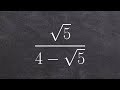
Radical Expressions and Their Properties

Interactive Video
•
Mathematics
•
9th - 10th Grade
•
Hard

Thomas White
FREE Resource
Read more
15 questions
Show all answers
1.
MULTIPLE CHOICE QUESTION
30 sec • 1 pt
What is the main goal of the video tutorial?
To learn how to multiply fractions
To simplify a radical expression
To solve quadratic equations
To understand the Pythagorean theorem
2.
MULTIPLE CHOICE QUESTION
30 sec • 1 pt
Why is dividing by an irrational number not preferred?
It results in a complex number
It is not allowed in mathematics
It is difficult to simplify
It makes calculations easier
3.
MULTIPLE CHOICE QUESTION
30 sec • 1 pt
What is the conjugate of 4 - √5?
5 + √4
4 - √5
5 - √4
4 + √5
4.
MULTIPLE CHOICE QUESTION
30 sec • 1 pt
What is the purpose of multiplying by the conjugate?
To add more radicals
To make the expression more complex
To eliminate the radical in the denominator
To change the expression to a fraction
5.
MULTIPLE CHOICE QUESTION
30 sec • 1 pt
What is the first step in simplifying the expression?
Multiply by the conjugate
Divide by the conjugate
Subtract the radicals
Add the radicals
6.
MULTIPLE CHOICE QUESTION
30 sec • 1 pt
What happens when you multiply a radical by itself?
It remains the same
It becomes a whole number
It becomes zero
It becomes a complex number
7.
MULTIPLE CHOICE QUESTION
30 sec • 1 pt
What is the result of multiplying the radicands?
The sum of the radicands
The product of the radicands
The difference of the radicands
The quotient of the radicands
Access all questions and much more by creating a free account
Create resources
Host any resource
Get auto-graded reports

Continue with Google

Continue with Email

Continue with Classlink

Continue with Clever
or continue with

Microsoft
%20(1).png)
Apple

Others
Already have an account?

