
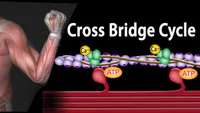
Muscle contraction quiz/video

Interactive Video
•
Biology
•
11th - 12th Grade
•
Practice Problem
•
Medium

Ruby Swales
Used 4+ times
FREE Resource
8 questions
Show all answers
1.
MULTIPLE CHOICE QUESTION
30 sec • 1 pt
Which type of muscle tissue is characterized by branched, striated fibers with intercalated discs and involuntary control?
Skeletal muscle
Smooth muscle
Cardiac muscle
Connective muscle
2.
MULTIPLE CHOICE QUESTION
30 sec • 1 pt
Which statement is correct?
HINT- involuntary doesn't require conscious control, voluntary you chose to contract
Smooth muscle is involuntary while cardiac and skeletal are voluntary
Smooth muscle is voluntary while cardiac and skeletal are involuntary
Smooth & cardiac are involuntary muscles while skeletal muscles are voluntary.
Skeletal is involuntary while cardiac and smooth muscle is voluntary
3.
MULTIPLE CHOICE QUESTION
30 sec • 1 pt
Which of the following is NOT a general characteristic of all muscle tissue?
Extensibility
Elasticity
Voluntary control
Excitability
4.
MULTIPLE CHOICE QUESTION
30 sec • 1 pt
What are the long, cylindrical structures found inside a muscle fiber that contain repeating sections called sarcomeres?
Myofibrils
Tendons
Ligaments
Fascicles
5.
MULTIPLE CHOICE QUESTION
30 sec • 1 pt
What are the thin filaments in a sarcomere primarily composed of?
Myosin
Actin
Troponin
Tropomyosin
6.
MULTIPLE CHOICE QUESTION
30 sec • 1 pt
What happens to the thick and thin filaments themselves during muscle contraction according to the sliding filament model?
They shorten significantly.
They lengthen to increase muscle size.
They slide past each other without shortening.
They break down and reform.
7.
MULTIPLE CHOICE QUESTION
30 sec • 1 pt
What is the primary role of ATP in the cross-bridge cycle of muscle contraction?
To cause the myosin head to bind to actin.
To provide energy for the power stroke.
To cause the myosin head to detach from actin.
To block the actin binding sites.
Access all questions and much more by creating a free account
Create resources
Host any resource
Get auto-graded reports

Continue with Google

Continue with Email

Continue with Classlink

Continue with Clever
or continue with

Microsoft
%20(1).png)
Apple

Others
Already have an account?

