
Exploring Newton's Third Law: Action and Reaction

Interactive Video
•
Science
•
6th - 10th Grade
•
Practice Problem
•
Medium
Standards-aligned

A Yantz
Used 3+ times
FREE Resource
Standards-aligned
Read more
10 questions
Show all answers
1.
MULTIPLE CHOICE QUESTION
30 sec • 1 pt
What is Newton's third law of motion commonly stated as?
An object in motion stays in motion.
For every action, there is an equal and opposite reaction.
Force equals mass times acceleration.
Energy cannot be created or destroyed.
2.
MULTIPLE CHOICE QUESTION
30 sec • 1 pt
In the context of physics, what does Newton's third law specifically mean?
Forces can exist in isolation.
Forces are always attractive.
Forces are always repulsive.
Interacting objects exert forces of equal magnitude and opposite direction on each other.
3.
MULTIPLE CHOICE QUESTION
30 sec • 1 pt
What happens when a car hits a brick wall according to Newton's third law?
The car and the wall exert equal and opposite forces on each other.
The car stops because the wall absorbs all the force.
The wall exerts no force on the car.
The car continues moving through the wall.
4.
MULTIPLE CHOICE QUESTION
30 sec • 1 pt
Why can there never be a single isolated force?
Because forces are always attractive.
Because forces must always exist in pairs.
Because forces are always repulsive.
Because forces can only act on one object at a time.
5.
MULTIPLE CHOICE QUESTION
30 sec • 1 pt
What is the normal force?
A force that acts in the direction of motion.
A force that acts in the opposite direction of motion.
A force that acts perpendicular to the surface.
A force that acts parallel to the surface.
6.
MULTIPLE CHOICE QUESTION
30 sec • 1 pt
When assessing the motion of an object, what should we consider?
Only the forces acting upon that object.
The forces it applies on other objects.
None of the forces.
Both the forces acting upon it and the forces it applies on other objects.
Tags
NGSS.HS-PS2-1
NGSS.HS-PS2-2
NGSS.HS-PS2-4
7.
MULTIPLE CHOICE QUESTION
30 sec • 1 pt
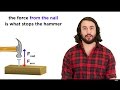
Why does the hammer stop moving when it strikes the nail?
Because the hammer's force is less than the nail's force.
Because the forces from the nail and the hammer balance each other out.
Because the hammer's force is greater than the nail's force.
Because the nail absorbs all the force.
Tags
NGSS.HS-PS2-1
Access all questions and much more by creating a free account
Create resources
Host any resource
Get auto-graded reports

Continue with Google

Continue with Email

Continue with Microsoft
or continue with

%20(1).png)
Apple

Others
Already have an account?

