
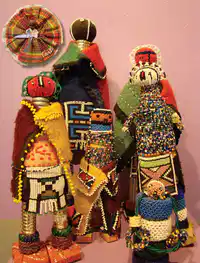
A Guided Tour of "The Calling: The Transformative Power of Afric

Interactive Video
•
History
•
8th Grade
•
Practice Problem
•
Hard

Lorrie Foley
FREE Resource
9 questions
Show all answers
1.
MULTIPLE CHOICE QUESTION
30 sec • 1 pt
What historical event is represented by the quilt "Indigo, Okra, Blood Sweat and Tears"?
The journey of African spices to the Americas
The Trans-Atlantic Slave Trade
The development of agricultural practices in Africa
The history of indigo dyeing techniques
2.
MULTIPLE CHOICE QUESTION
30 sec • 1 pt
What is the primary cultural significance of the Akuaba doll from the Akan/Asante people of Ghana?
It represents a powerful warrior spirit.
It is a fertility doll, symbolizing the desire for children.
It depicts a revered historical leader.
It is used in traditional storytelling.
3.
MULTIPLE CHOICE QUESTION
30 sec • 1 pt
What was the original purpose of the Abayomi dolls created by enslaved African women?
To be used as currency for trade.
To comfort children who had lost family or were in distress during the Trans-Atlantic journey.
To serve as religious idols in new lands.
To teach sewing skills to young girls.
4.
MULTIPLE CHOICE QUESTION
30 sec • 1 pt
How did the "Topsy Turvy" doll serve enslaved Black mothers and their children?
It was a popular toy that promoted racial harmony.
It was used to secretly affirm Black identity by having a Black head hidden beneath a white doll.
It taught children about the history of slavery through play.
It was a decorative item to brighten their living quarters.
5.
MULTIPLE CHOICE QUESTION
30 sec • Ungraded
Are you enjoying the video lesson?
Yes
No
6.
MULTIPLE CHOICE QUESTION
30 sec • 1 pt
What does Francine Haskins' "Urban Village the Great Migration Installation" represent?
The diverse architecture of urban areas.
The types of people found in urban areas during the Great Migration.
The challenges faced by migrants in new cities.
The historical figures who led the Great Migration.
7.
MULTIPLE CHOICE QUESTION
30 sec • 1 pt
What does the doll "Grandma Justice" by Camila Bryce-Laporte symbolize?
Women who fought for political rights in the city.
Women who brought traditional folk medicine and moral guidance to the city.
Women who established new businesses in urban areas.
Women who preserved traditional crafts and arts.
Access all questions and much more by creating a free account
Create resources
Host any resource
Get auto-graded reports

Continue with Google

Continue with Email

Continue with Microsoft
or continue with

%20(1).png)
Apple

Others
Already have an account?

