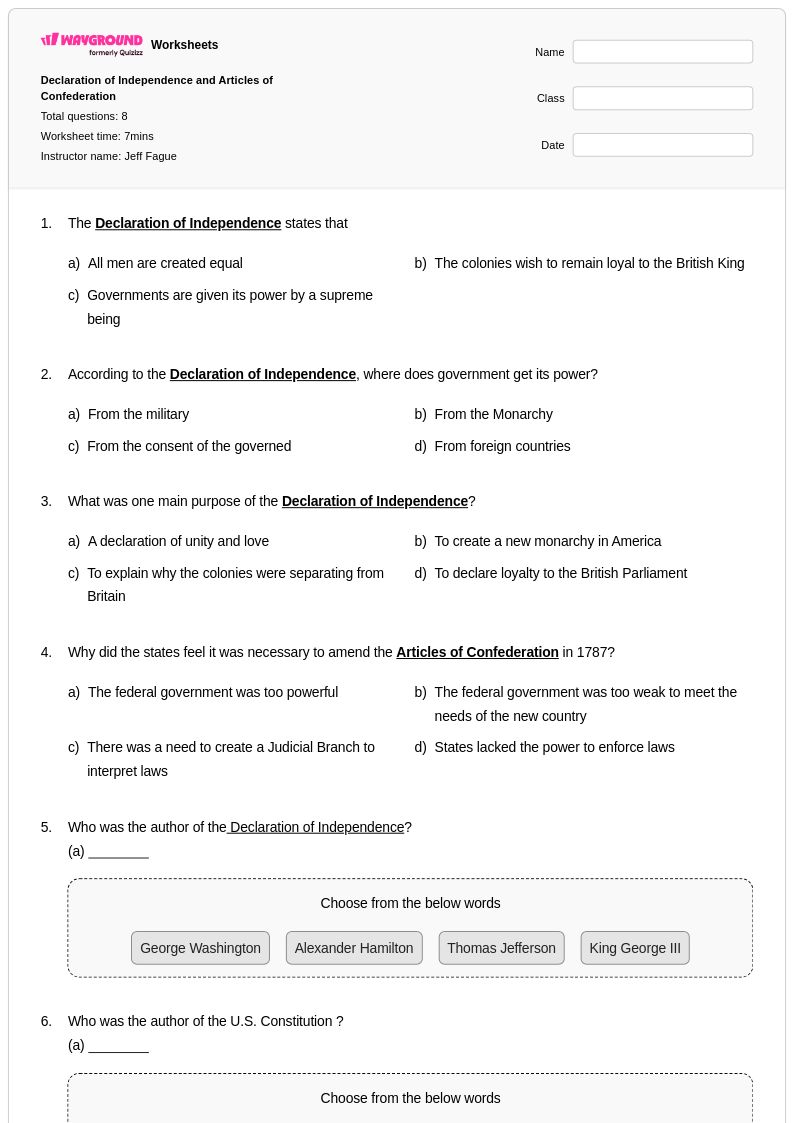
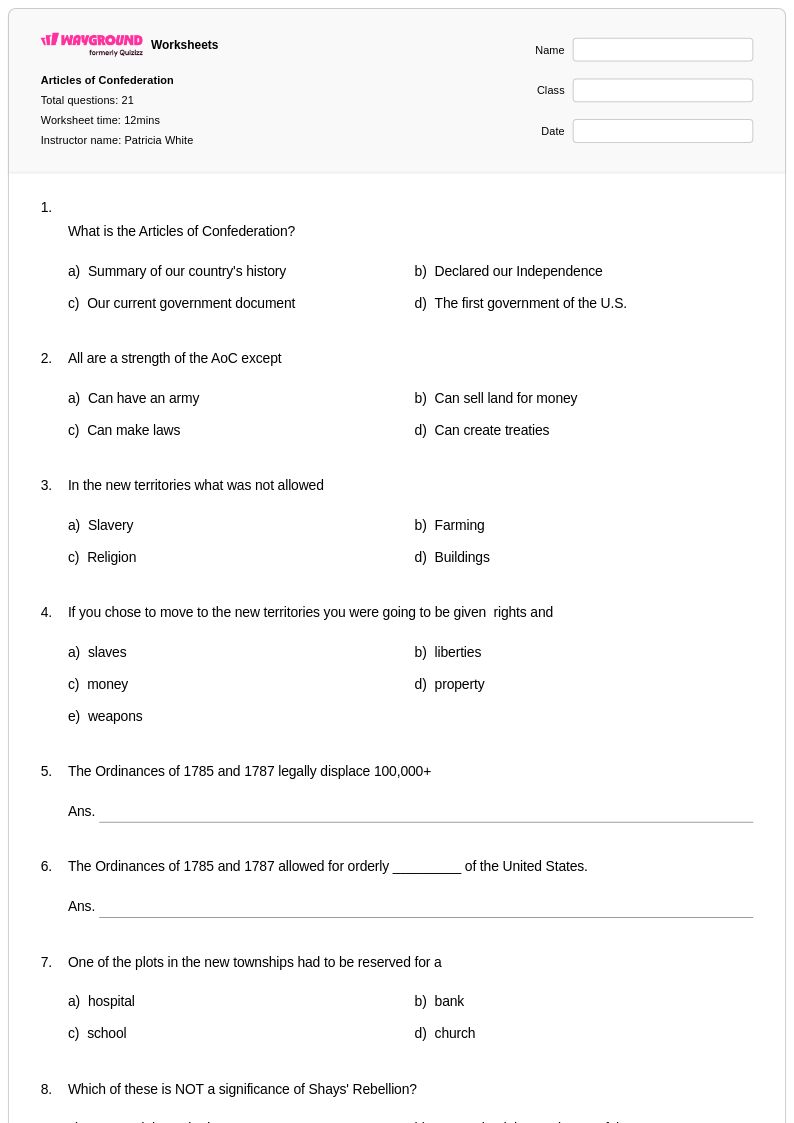
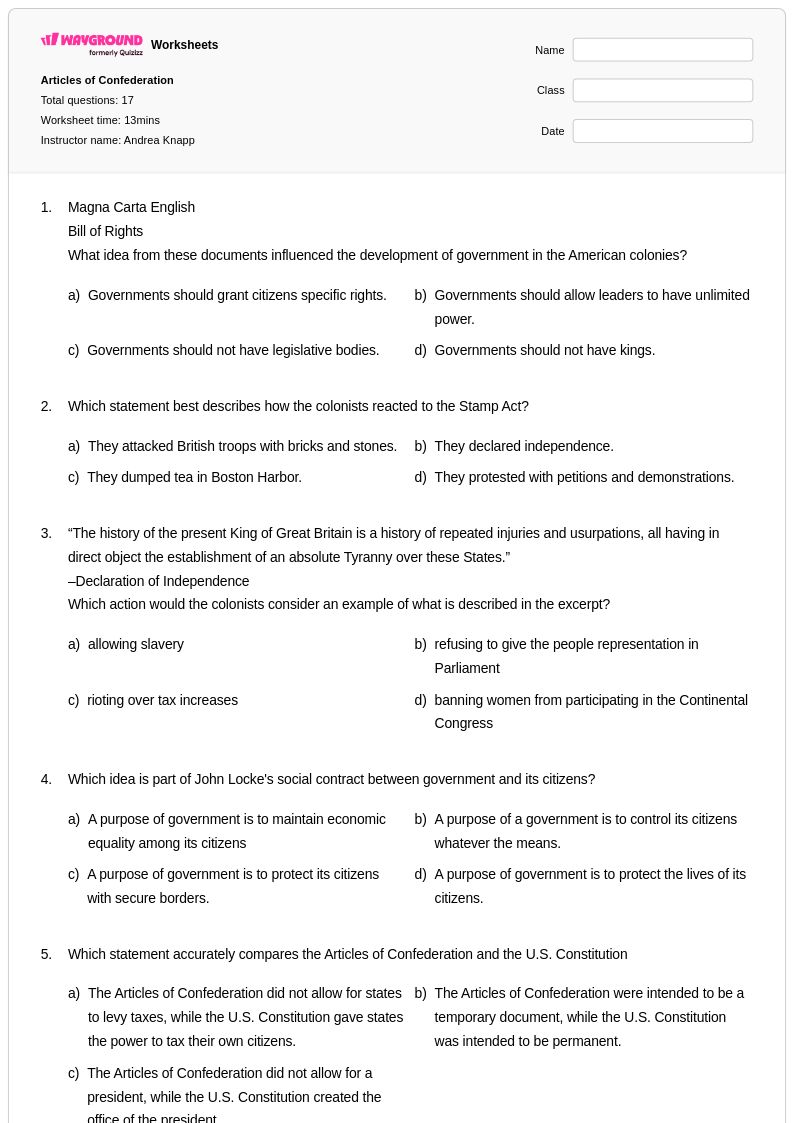
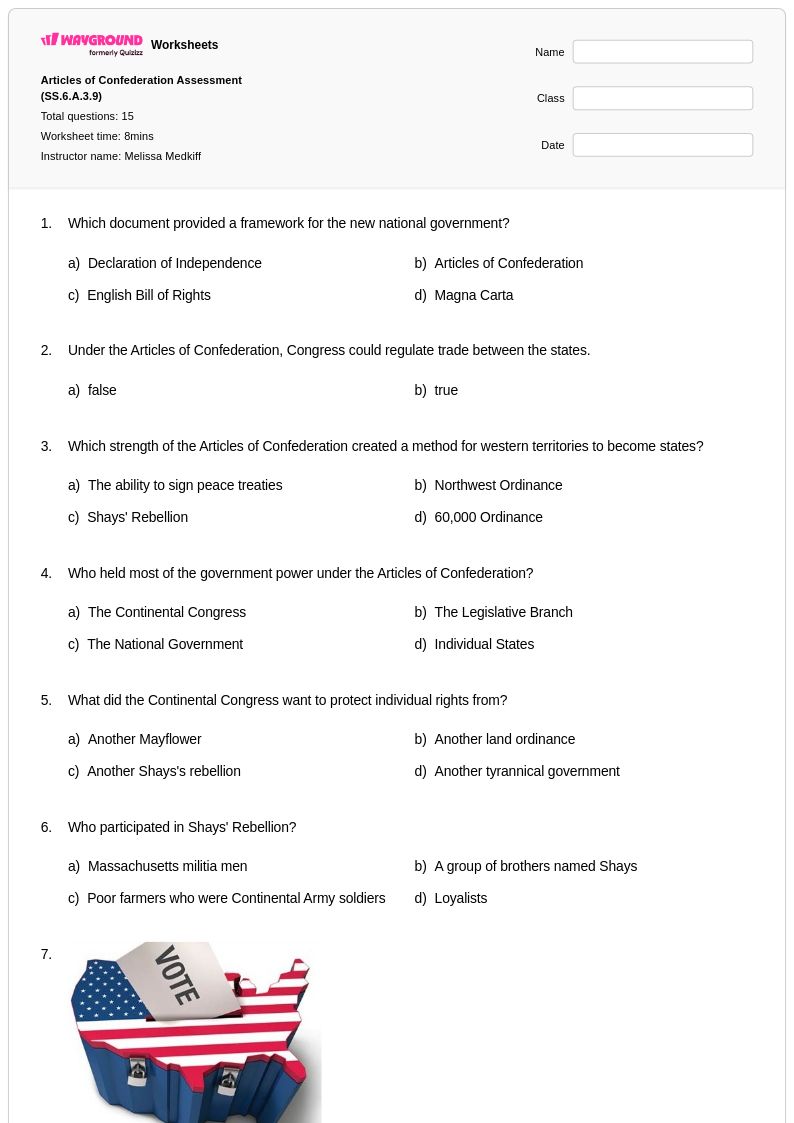
Free Printable Articles of Confederation Worksheets for Year 6
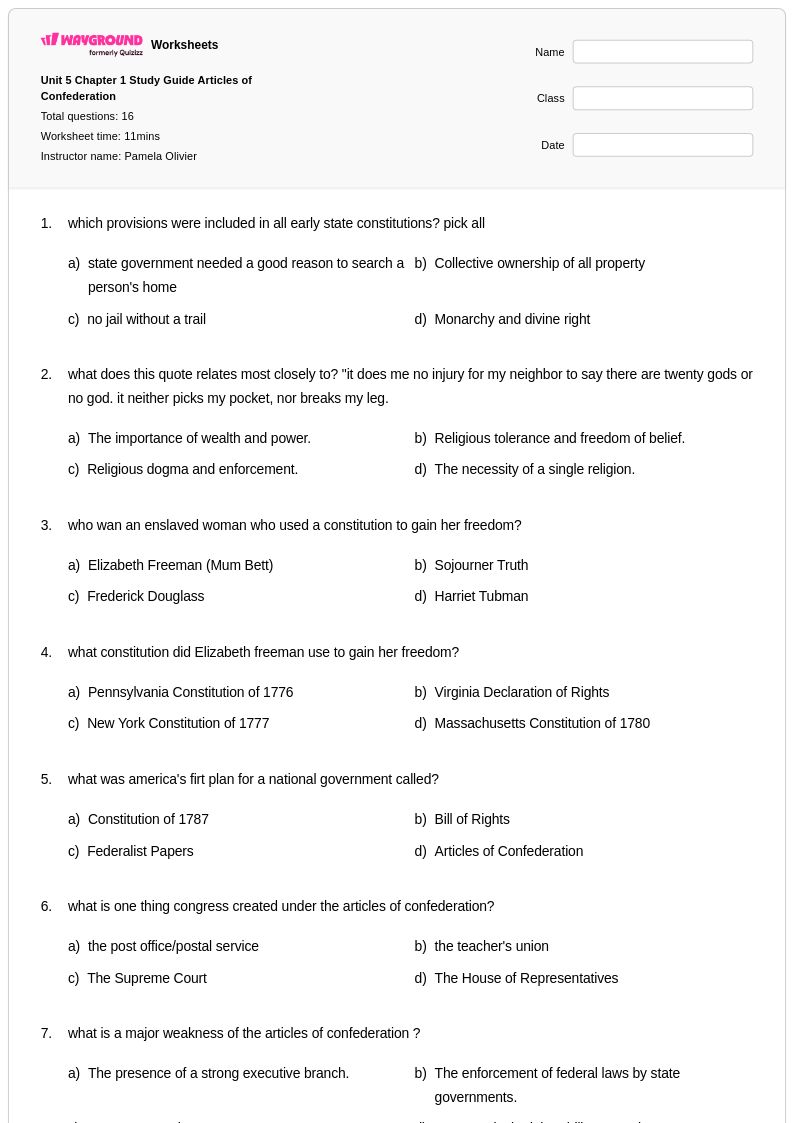
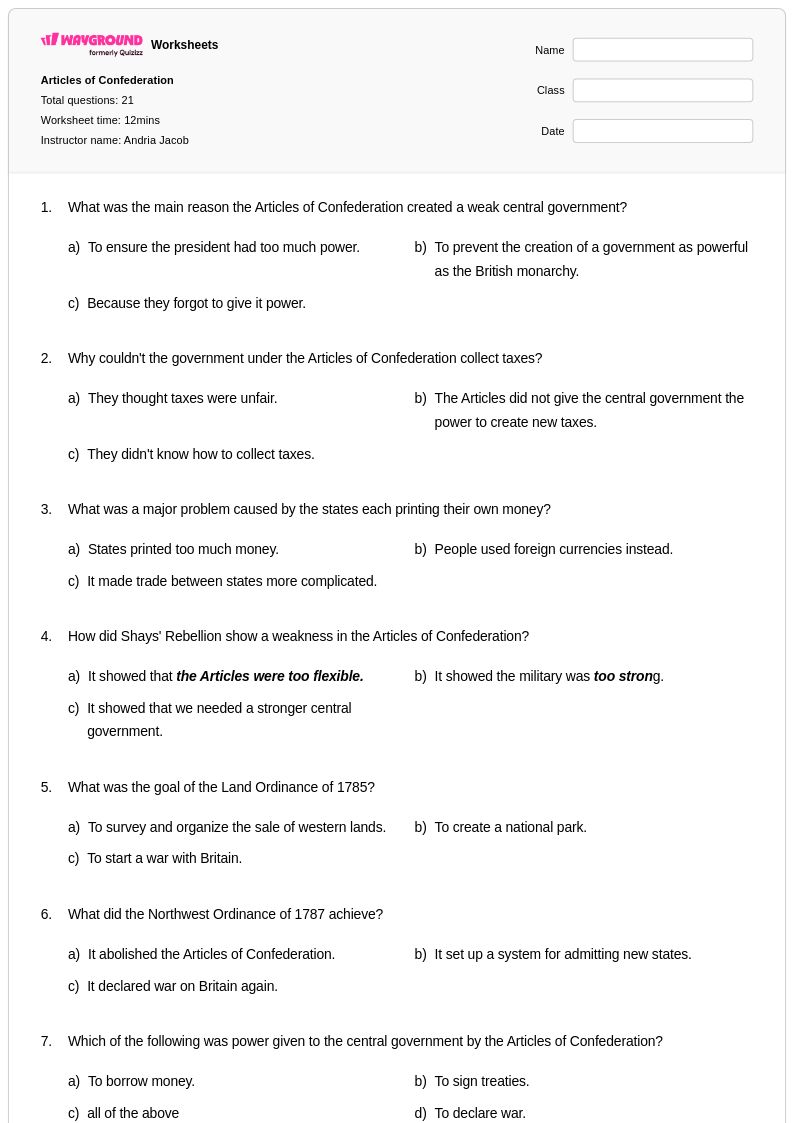
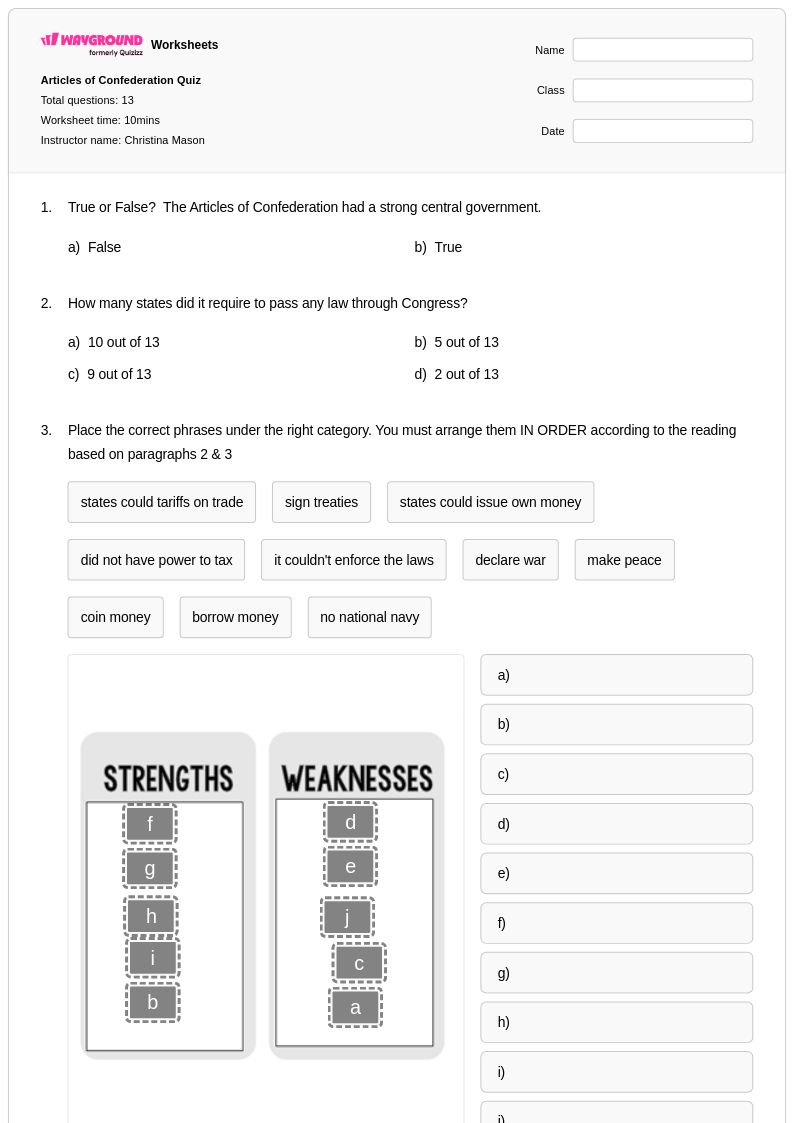
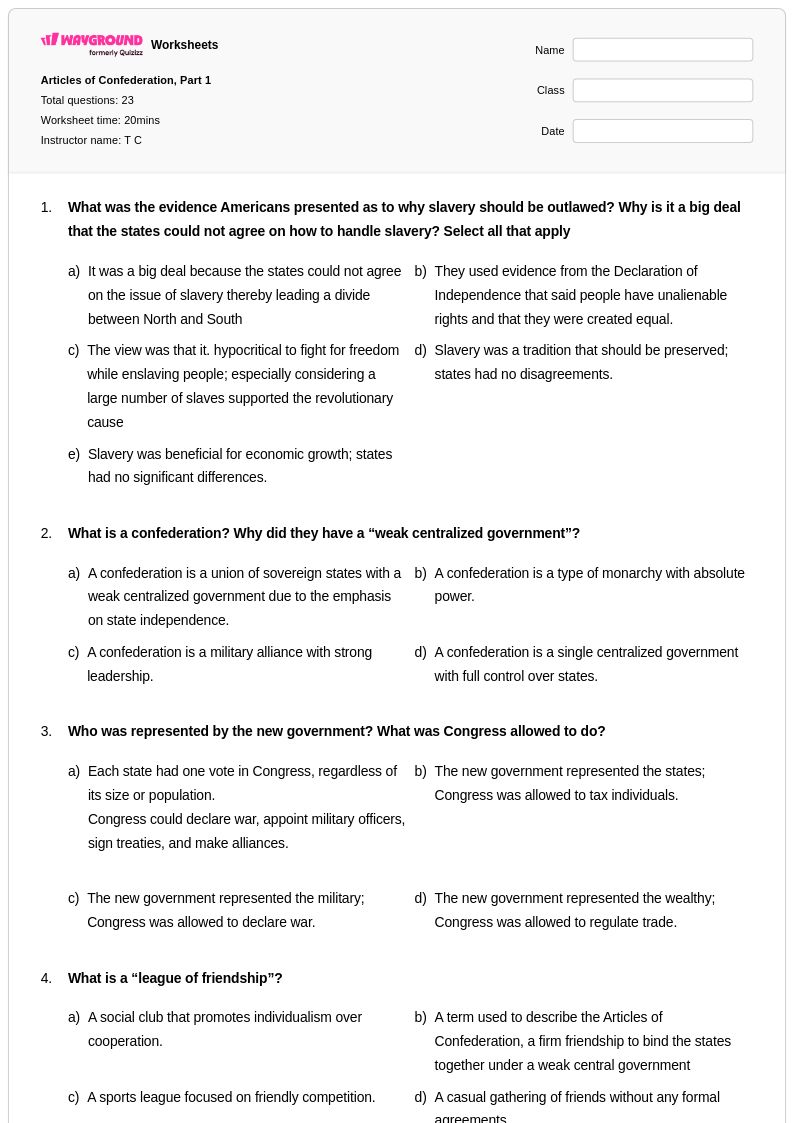
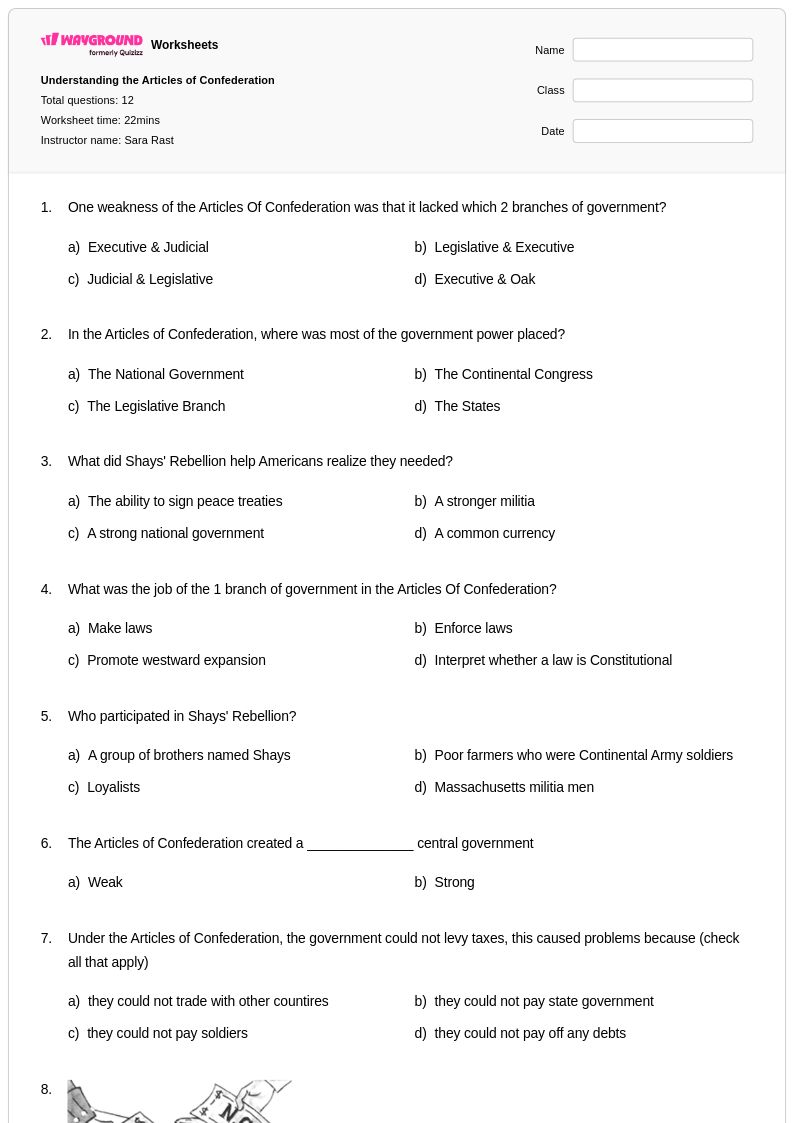
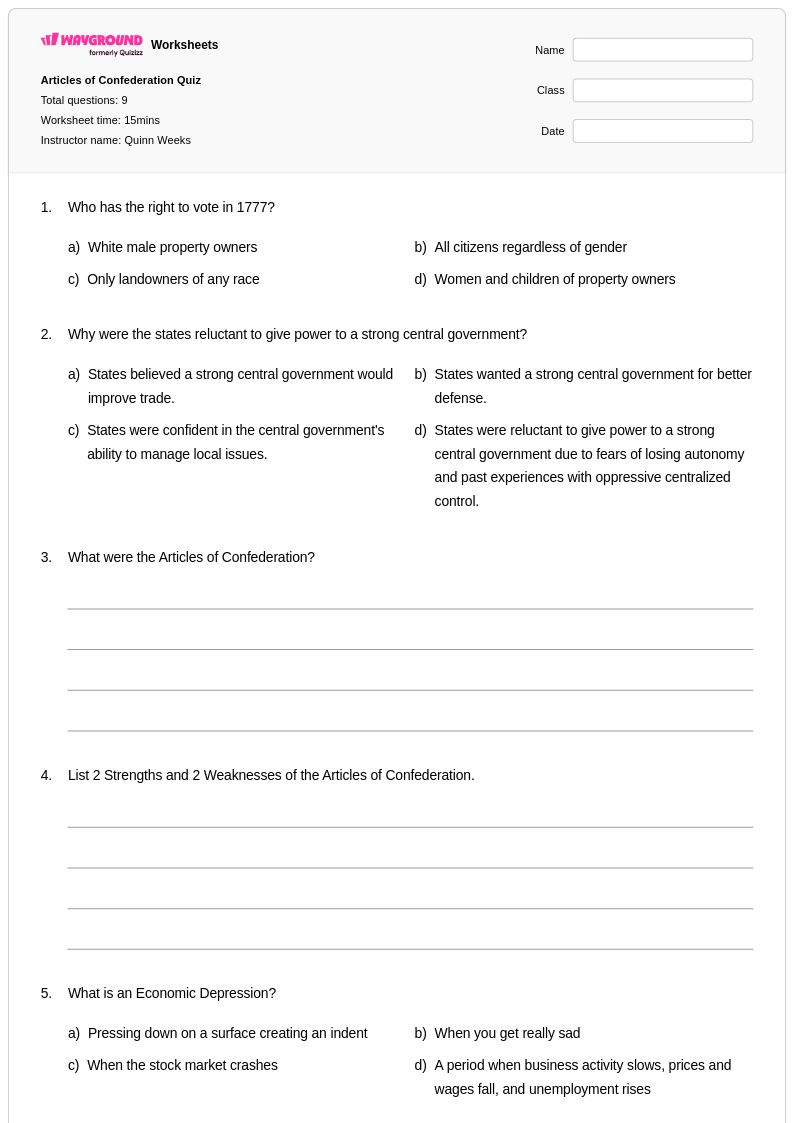
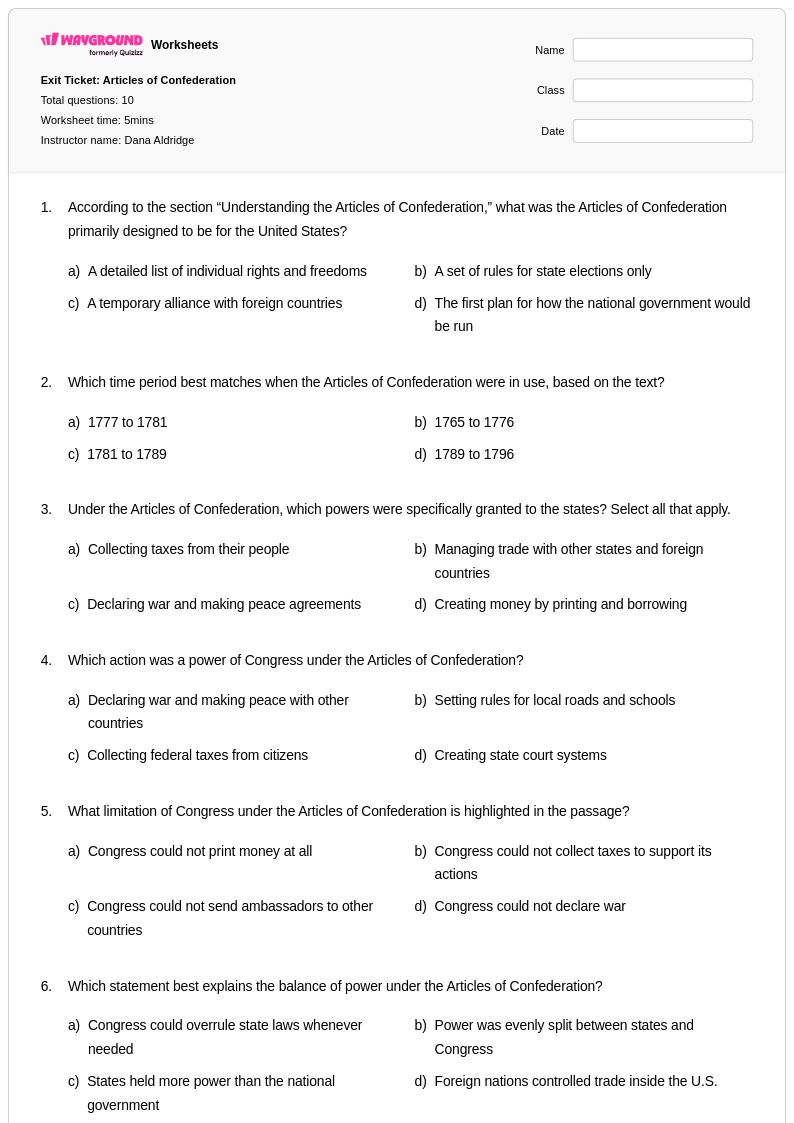
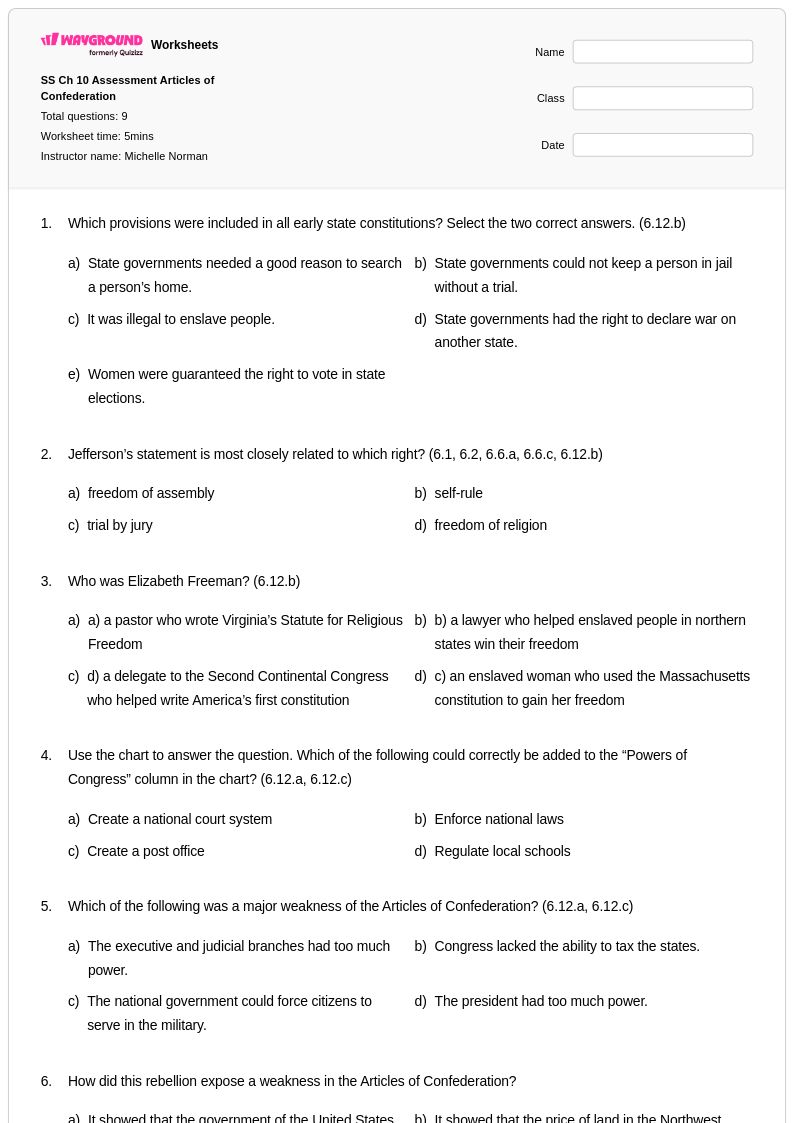
Year 6 Articles of Confederation free worksheets and printables from Wayground help students explore America's first government through engaging practice problems and activities with complete answer keys.
Explore printable Articles of Confederation worksheets for Year 6
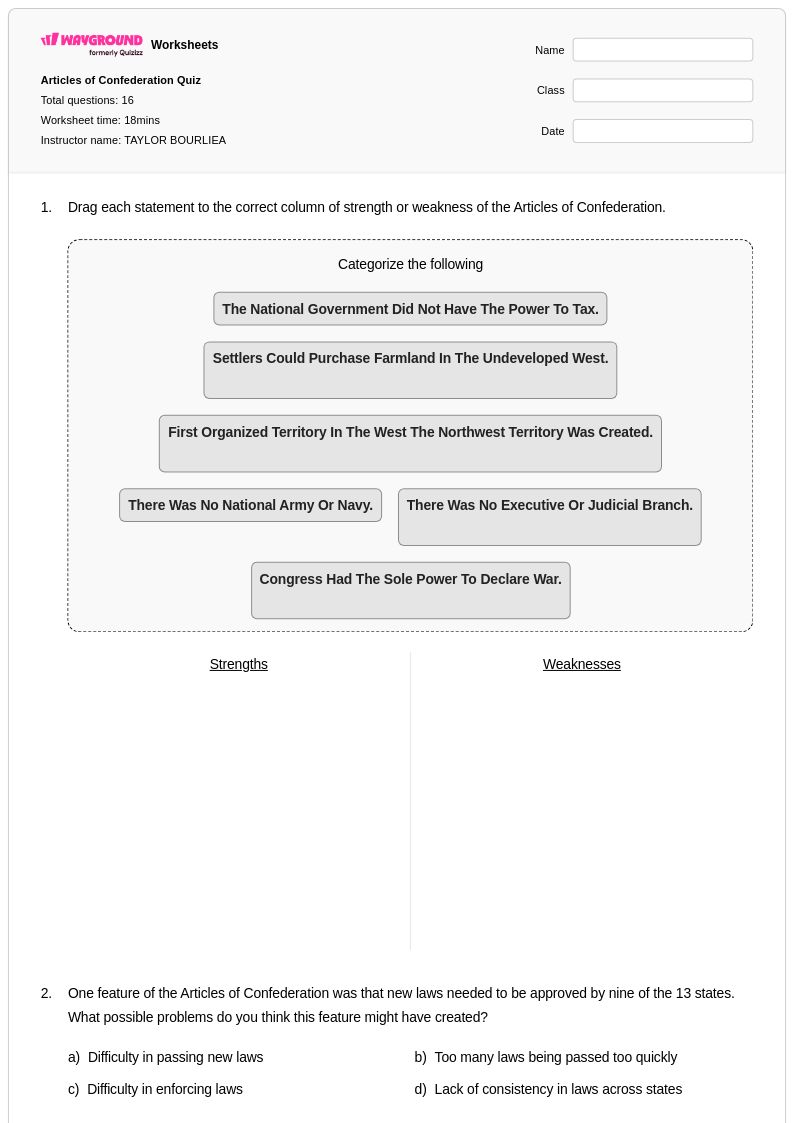
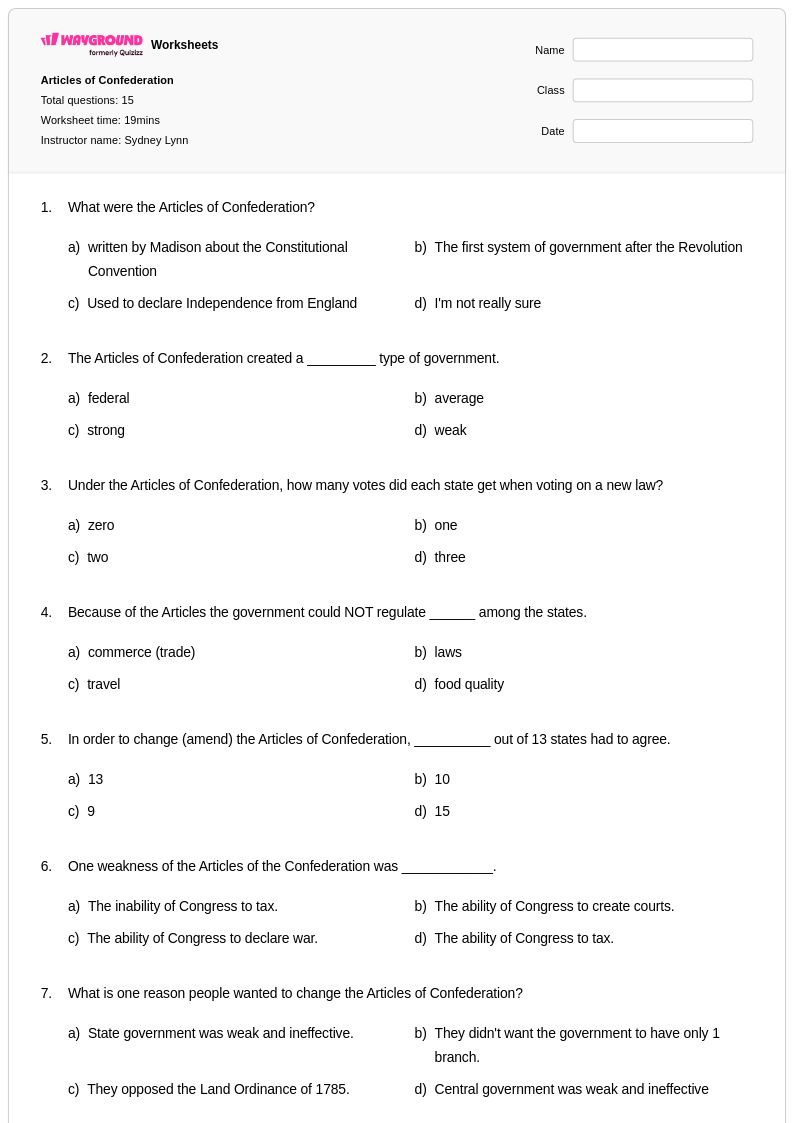
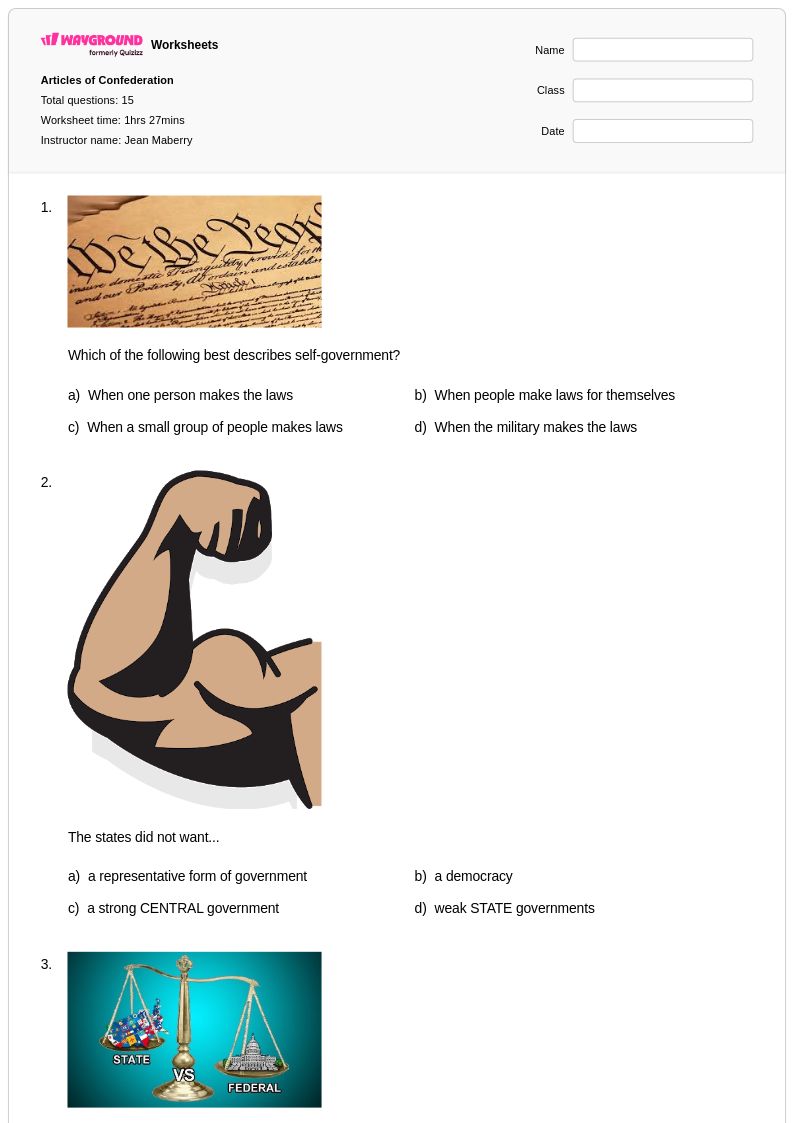
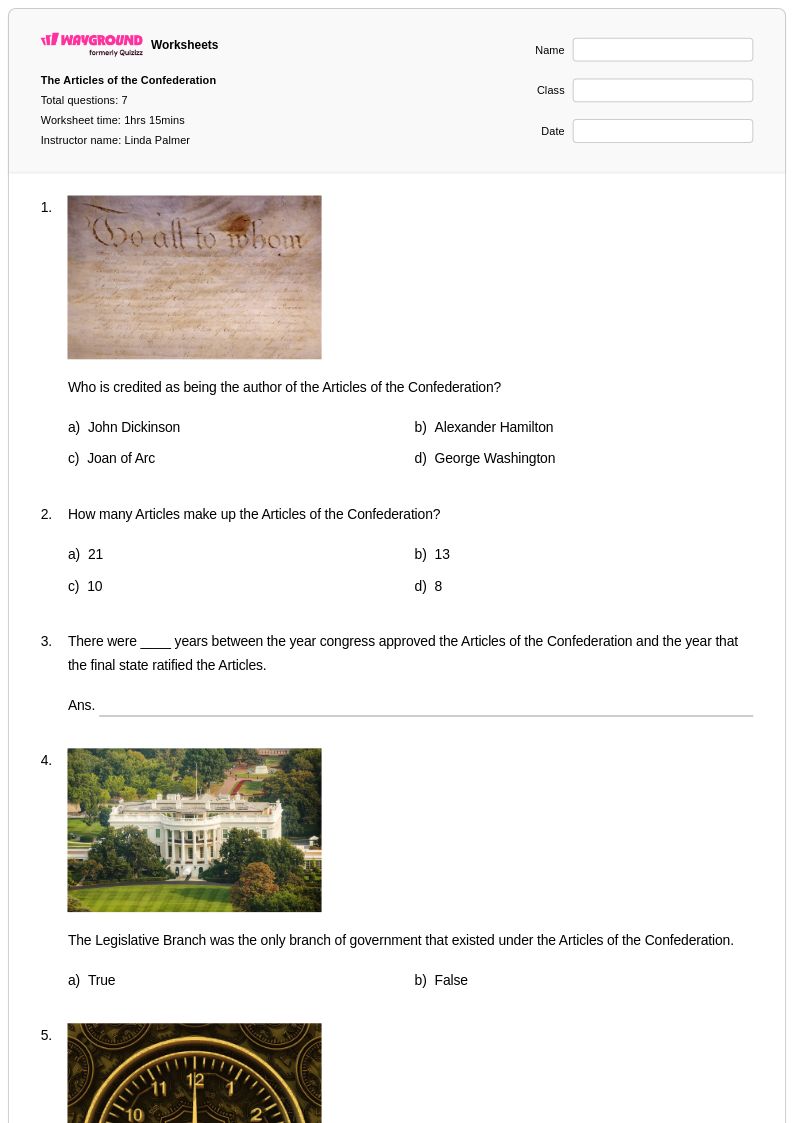
Articles of Confederation worksheets for Year 6 students provide comprehensive practice with America's first governing document and its critical role in early U.S. History. These educational resources help sixth graders understand the structure, powers, and limitations of the Articles while developing essential analytical skills through engaging practice problems that examine why this initial framework ultimately failed. Students work through scenarios involving interstate commerce disputes, taxation challenges, and foreign policy weaknesses that plagued the confederation government from 1781 to 1789. The worksheets include detailed answer keys that support both independent study and classroom instruction, with free printables available in pdf format to accommodate various learning environments and teaching preferences.
Wayground, formerly Quizizz, empowers educators with an extensive collection of teacher-created Articles of Confederation resources that transform complex historical concepts into accessible Year 6 learning experiences. The platform's millions of educational materials feature robust search and filtering capabilities that allow teachers to quickly locate standards-aligned content appropriate for their specific curriculum needs. Advanced differentiation tools enable instructors to customize worksheets for diverse learning levels, while flexible formatting options provide both printable and digital versions to support varied classroom configurations. These comprehensive features streamline lesson planning while offering targeted remediation opportunities for struggling students and enrichment activities for advanced learners, ensuring that all sixth graders can master the foundational concepts surrounding America's first attempt at national governance and its eventual transition to the Constitution.
FAQs
How do I teach the Articles of Confederation effectively?
Effective instruction on the Articles of Confederation should anchor students in the historical context of 1781 to 1789, emphasizing why the founders deliberately limited central authority after their experience under British rule. Start by having students examine specific structural weaknesses such as the lack of federal taxation power, the absence of a national judiciary, and the requirement for unanimous state consent to amend the document. Comparing these limitations directly to the later U.S. Constitution helps students understand the Articles not as a failure but as a necessary first step in American constitutional development.
What are the most common misconceptions students have about the Articles of Confederation?
A frequent misconception is that the Articles of Confederation were simply a failed document with no lasting value, when in fact they established important precedents such as the Northwest Ordinance of 1787 and demonstrated that a republic spanning a large territory was possible. Students also commonly confuse the weaknesses of the confederation system with the intentions of the framers, not recognizing that limiting central power was a deliberate and ideologically motivated choice. Another common error is conflating the Articles era with the Constitutional Convention, blurring the timeline and the distinct political arguments each moment produced.
What exercises help students understand the weaknesses of the Articles of Confederation?
Structured cause-and-effect exercises work well, asking students to trace how specific structural gaps, such as Congress's inability to levy taxes or regulate interstate commerce, led to concrete crises like Shays' Rebellion. Document analysis tasks using excerpts from the Articles itself alongside primary sources from the Constitutional Convention allow students to practice historical thinking while engaging directly with the evidence. Comparative government tasks that place the Articles side-by-side with the Constitution help students articulate precisely what changed and why, reinforcing both content knowledge and analytical writing skills.
How can I use Articles of Confederation worksheets in my classroom?
Articles of Confederation worksheets on Wayground are available as printable PDFs for traditional classroom use and in digital formats for technology-integrated or hybrid learning environments, giving teachers flexibility regardless of their setup. Teachers can also host worksheets as a live or self-paced quiz directly on Wayground, which allows for real-time monitoring of student responses and immediate feedback. Each worksheet includes a complete answer key, making them practical for independent practice, guided instruction, or formative assessment without additional prep time.
How do I differentiate Articles of Confederation instruction for students at different ability levels?
For students who need additional support, focus on scaffolded document analysis with shorter primary source excerpts and guiding questions that break down complex political concepts like state sovereignty and federal authority into manageable steps. Wayground's platform supports individual student accommodations including read aloud functionality, reduced answer choices, and extended time settings, which can be applied to specific students without alerting the rest of the class. Advanced students can be challenged with enrichment tasks that explore the constitutional debates following the Articles, such as analyzing Federalist arguments for a stronger central government.
How do I help students understand why the Articles of Confederation were replaced?
Ground the explanation in specific events rather than abstract arguments: Shays' Rebellion in 1786 is particularly effective because it shows students the tangible consequences of a federal government that could not raise troops or enforce law without state cooperation. Students should also examine the economic instability caused by competing state currencies and interstate trade disputes, which made the limitations of the confederation system concrete and personally relevant to citizens of the time. Framing the Constitutional Convention as a direct response to these documented failures, rather than a planned upgrade, helps students understand the urgency and political tensions that shaped the new document.