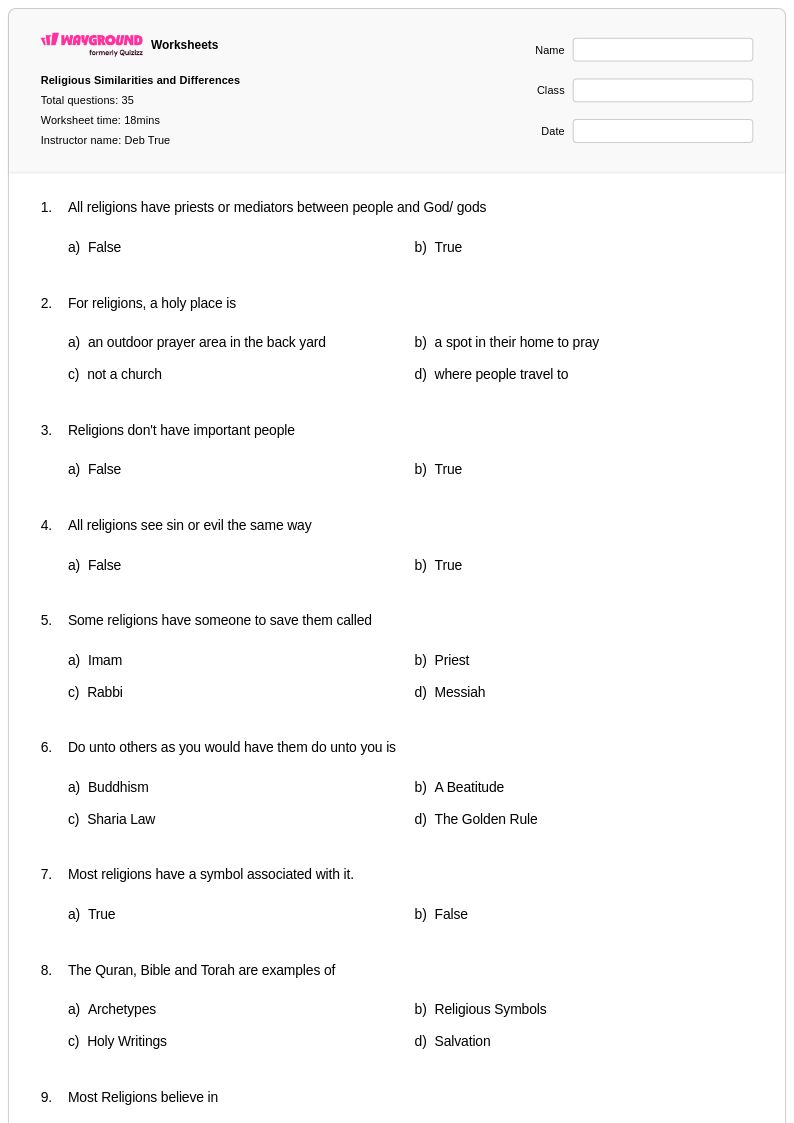
Explore Year 8 Beatitudes worksheets and printables from Wayground that help students understand these foundational teachings through engaging practice problems, free PDF resources, and comprehensive answer keys.
Explore printable Beatitudes worksheets for Year 8
Beatitudes worksheets for Year 8 students provide comprehensive exploration of these fundamental Christian teachings within the broader context of community and cultures studies. These educational resources help eighth-grade learners examine the moral and ethical principles outlined in Jesus's Sermon on the Mount while understanding their influence on various cultural communities throughout history. The worksheets strengthen critical thinking skills as students analyze how the Beatitudes have shaped social movements, community values, and cultural practices across different societies. Through carefully designed practice problems and activities, students develop deeper comprehension of concepts like mercy, peacemaking, and social justice, with comprehensive answer key materials supporting both independent study and classroom discussion. These free printable resources offer varied approaches to understanding how religious teachings intersect with cultural development and community formation.
Wayground, formerly Quizizz, empowers educators with an extensive collection of teacher-created Beatitudes worksheets designed specifically for middle school social studies instruction. Drawing from millions of educational resources, teachers can easily search and filter materials that align with curriculum standards while addressing diverse learning needs in their Year 8 classrooms. The platform's differentiation tools enable seamless customization of content difficulty and format, allowing educators to create targeted interventions for remediation or enrichment activities. Whether accessed as digital assignments or downloaded as PDF printables for traditional classroom use, these resources support flexible lesson planning that accommodates various teaching styles and student preferences. Teachers benefit from the ability to modify existing materials or combine multiple worksheets to create comprehensive units that thoroughly explore how the Beatitudes influence community values and cultural practices, ensuring students receive robust skill practice in analyzing religious and cultural connections.
FAQs
How do I teach the Beatitudes in a social studies context?
Teaching the Beatitudes in social studies means grounding them in their historical and cultural context rather than treating them as purely religious doctrine. Start by situating the Sermon on the Mount within first-century Judea, then guide students to trace how each beatitude has influenced community values, social reform movements, and ethical frameworks across different cultures and time periods. Comparing interpretations across traditions helps students build critical thinking skills while understanding the Beatitudes' broader historical significance.
What activities help students practice interpreting the Beatitudes?
Effective practice activities include paraphrasing each beatitude in modern language, matching beatitudes to historical or contemporary examples of their application, and analyzing how specific social movements have drawn on these teachings. Asking students to compare different cultural interpretations of a single beatitude pushes them beyond surface recall and into genuine ethical analysis. Structured written responses that require students to cite evidence from the text also strengthen both comprehension and argument-building skills.
What misconceptions do students commonly have about the Beatitudes?
A frequent misconception is that the Beatitudes are simple moral rules rather than paradoxical statements that challenge conventional values, such as equating 'blessed are the meek' with passivity rather than a countercultural claim about power and dignity. Students also tend to read the Beatitudes in isolation rather than as a unified ethical vision, which makes it harder to understand their cumulative influence on communities and movements. Addressing these errors early with close reading and discussion activities prevents superficial analysis in later assessments.
How can I use Beatitudes worksheets to assess student understanding?
Beatitudes worksheets are well-suited for formative and summative assessment because they can target distinct skills, from basic identification and recall to higher-order tasks like comparing cultural interpretations or evaluating the Beatitudes' influence on a specific historical period. Including short-answer and analytical prompts alongside multiple-choice questions allows teachers to assess both knowledge and reasoning. Answer keys make it straightforward to provide consistent feedback, especially on complex questions that bridge religious studies and cultural analysis.
How do I use Wayground's Beatitudes worksheets in my classroom?
Wayground's Beatitudes worksheets are available as printable PDFs for traditional classroom use and in digital formats for technology-integrated environments, giving teachers flexibility depending on their setup. Teachers can also host worksheets as a quiz directly on Wayground, which enables interactive student engagement and streamlined response collection. Both formats include complete answer keys, so teachers can use them for independent practice, guided instruction, or assessment without additional preparation.
How do I support students who struggle with the abstract ethical concepts in the Beatitudes?
Students who struggle with abstract ethical content benefit from scaffolded approaches that connect each beatitude to concrete, relatable examples before moving to broader cultural analysis. On Wayground, teachers can apply accommodations such as Read Aloud to support students with reading challenges, reduced answer choices to lower cognitive load on assessment questions, and extended time for students who need more processing time. These settings can be assigned to individual students without disrupting the experience of the rest of the class.