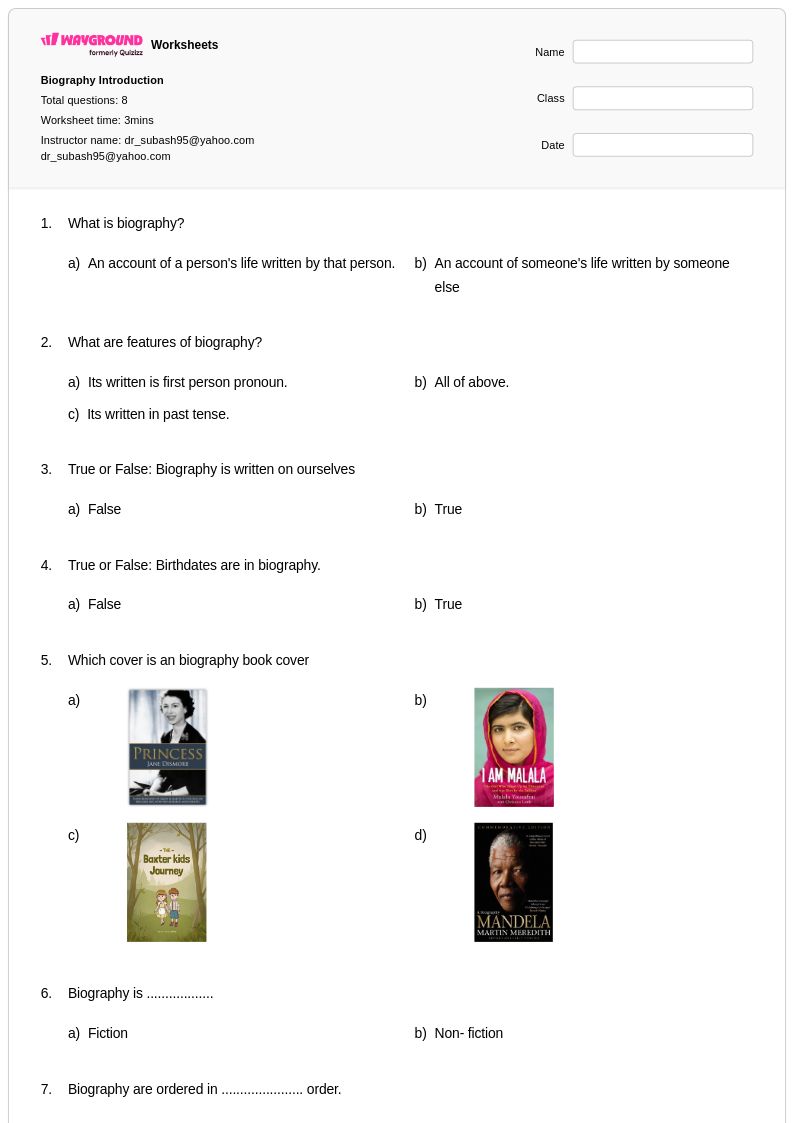
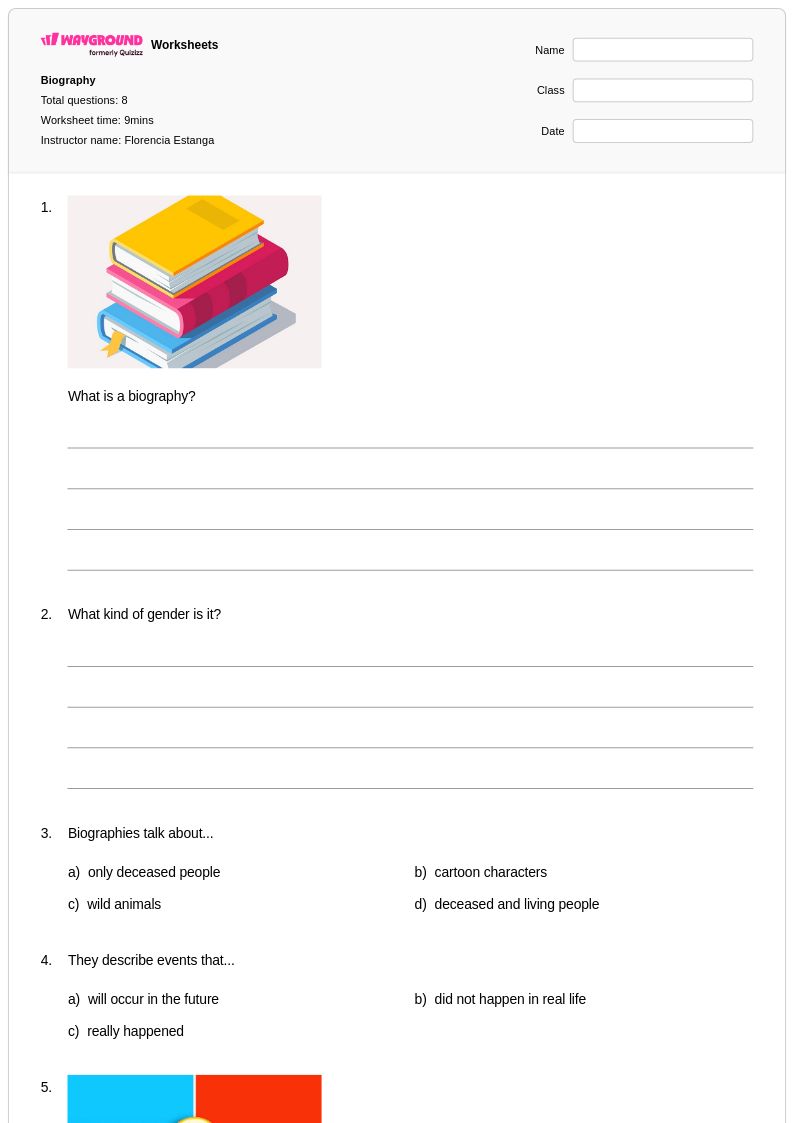
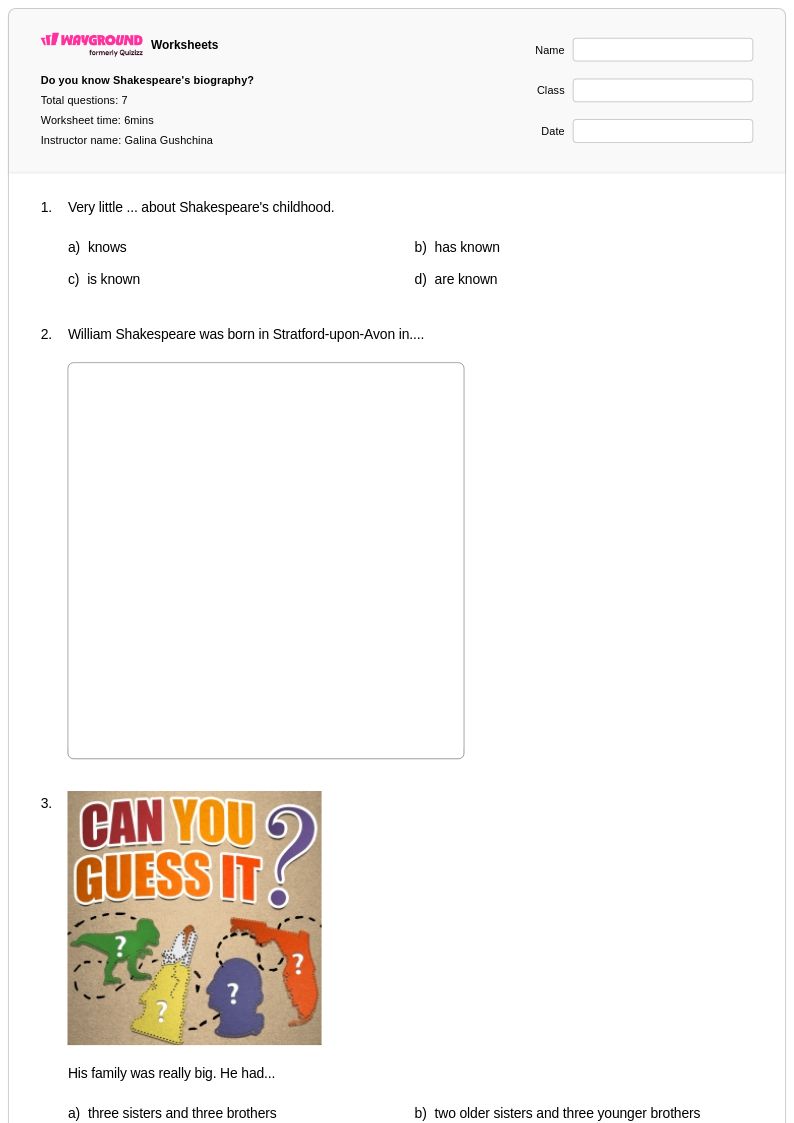
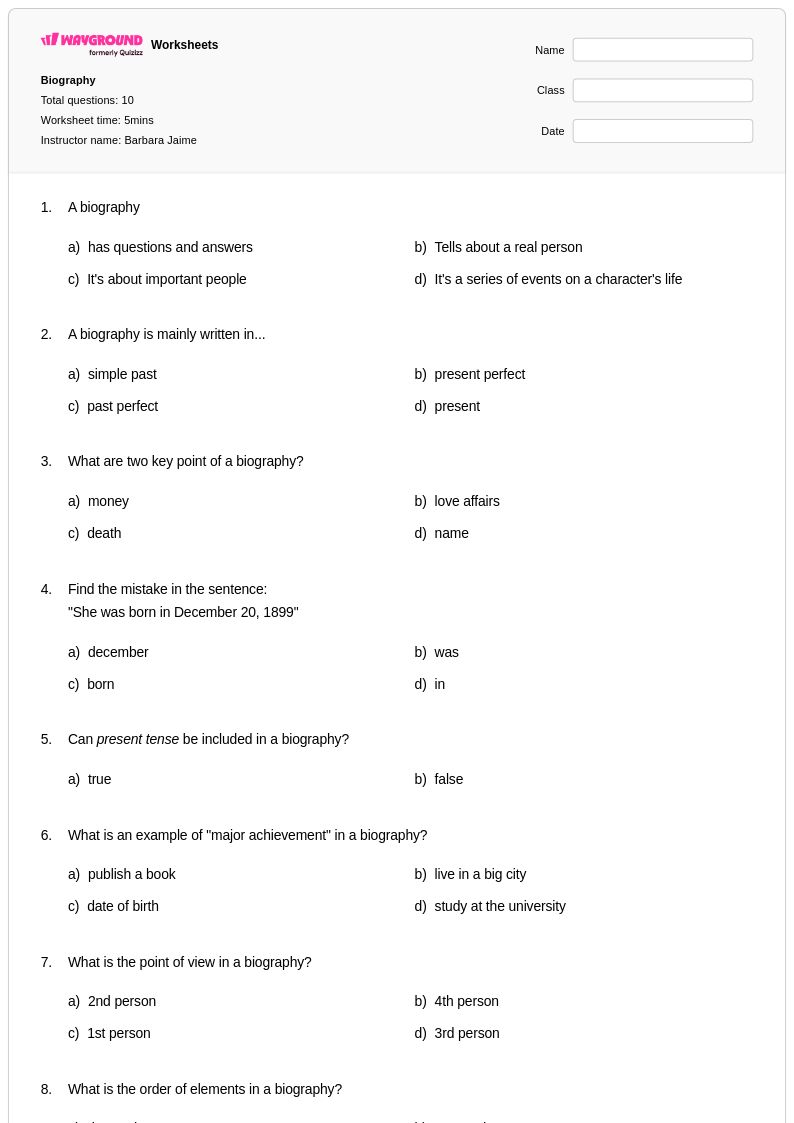
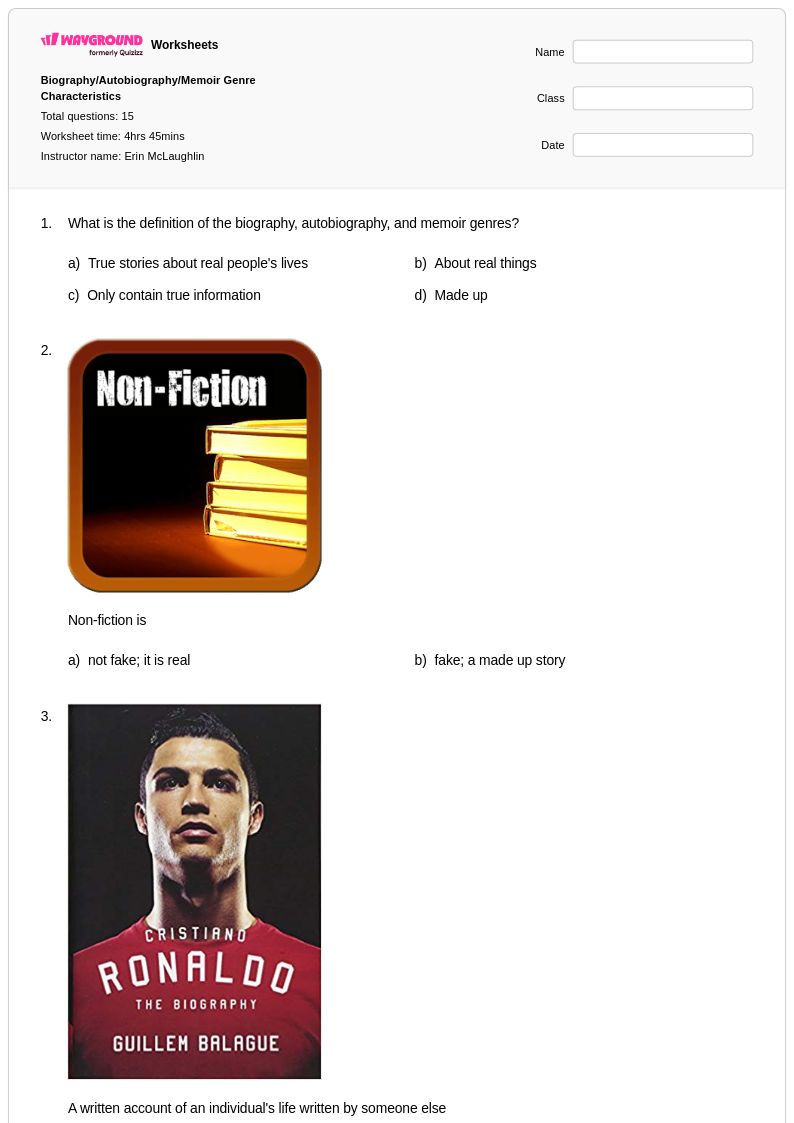
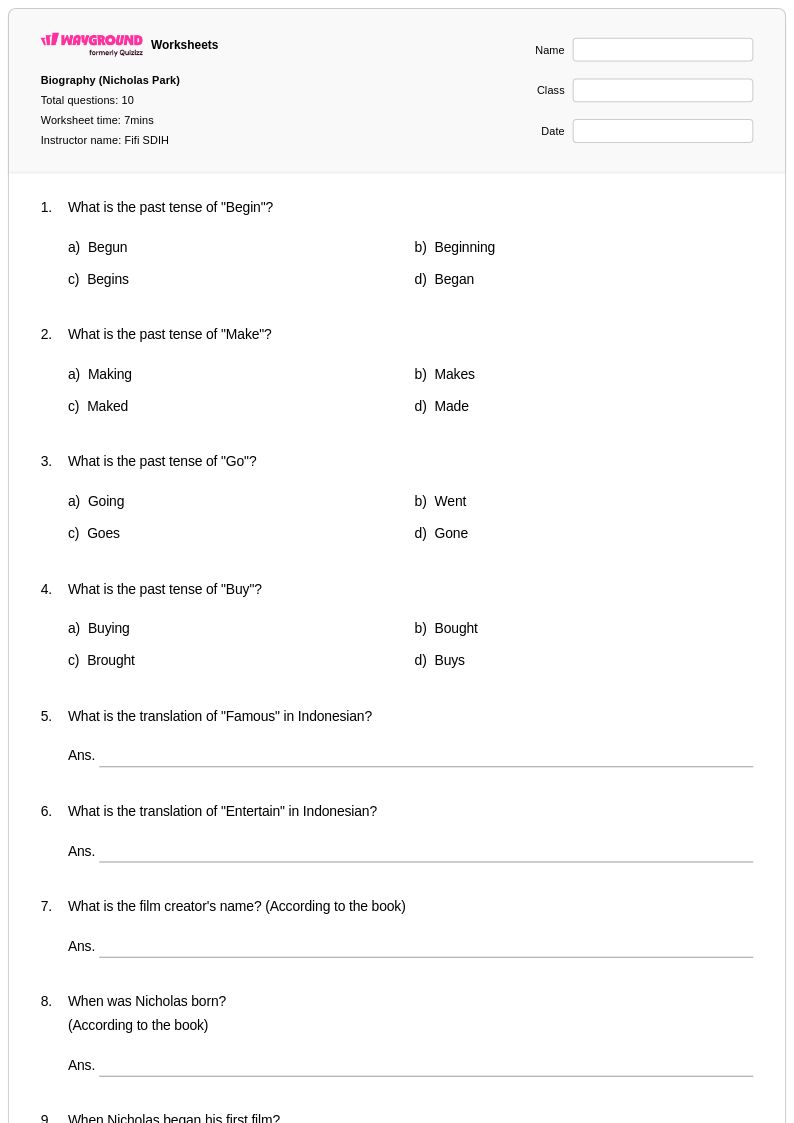
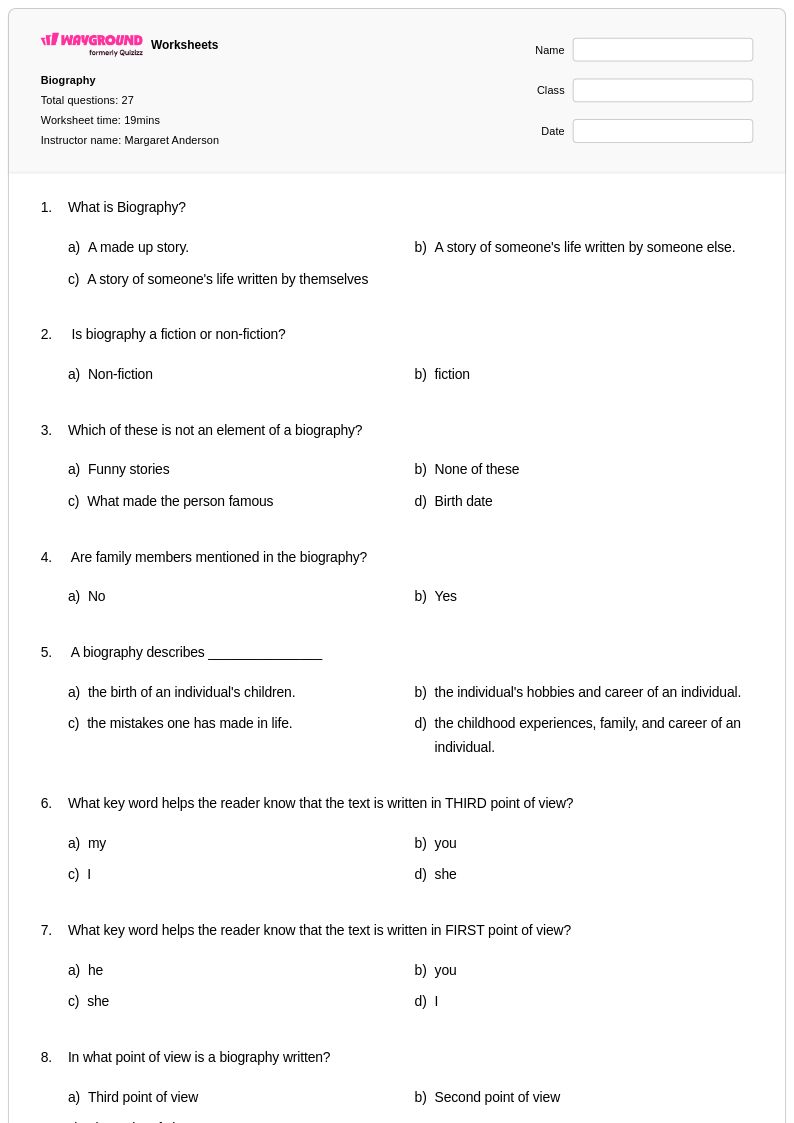
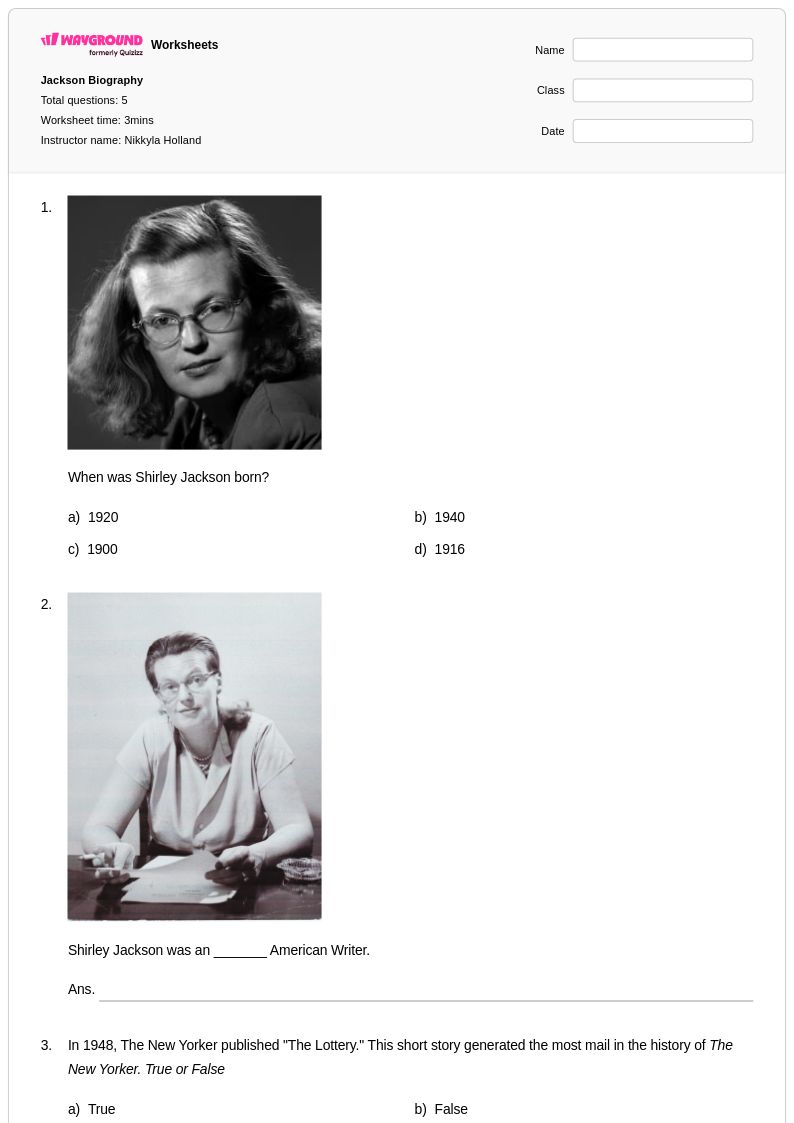
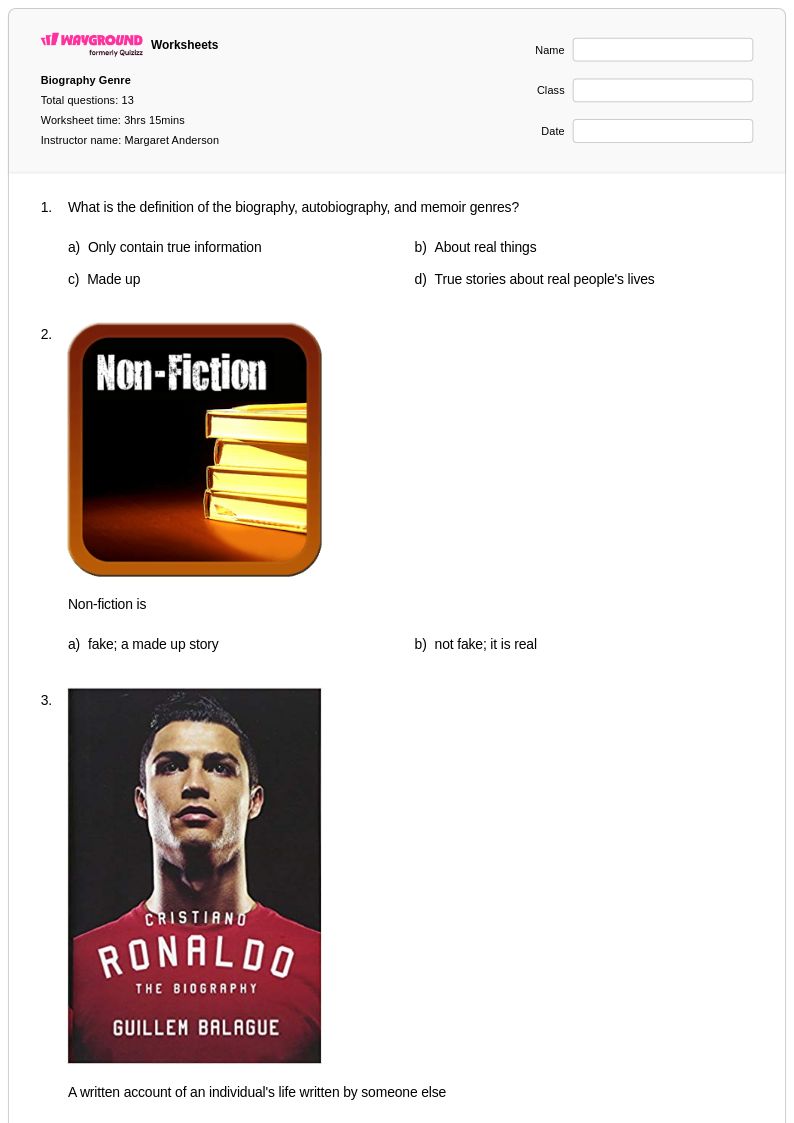
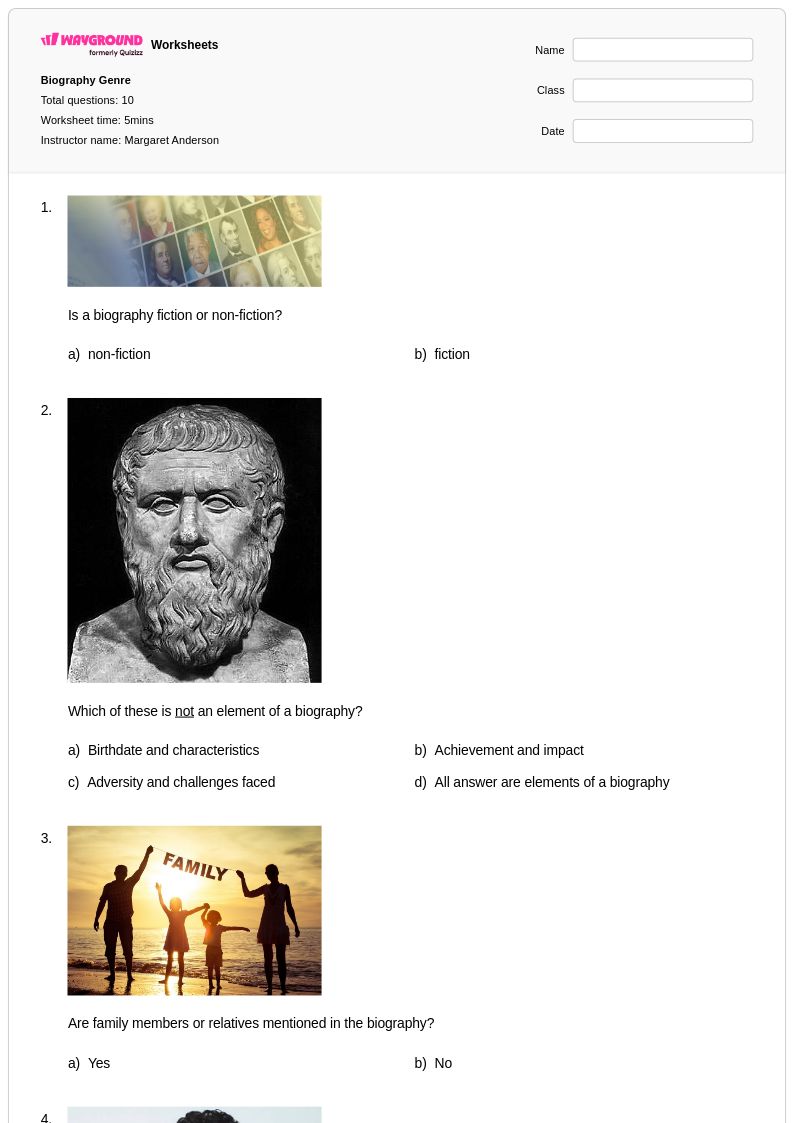
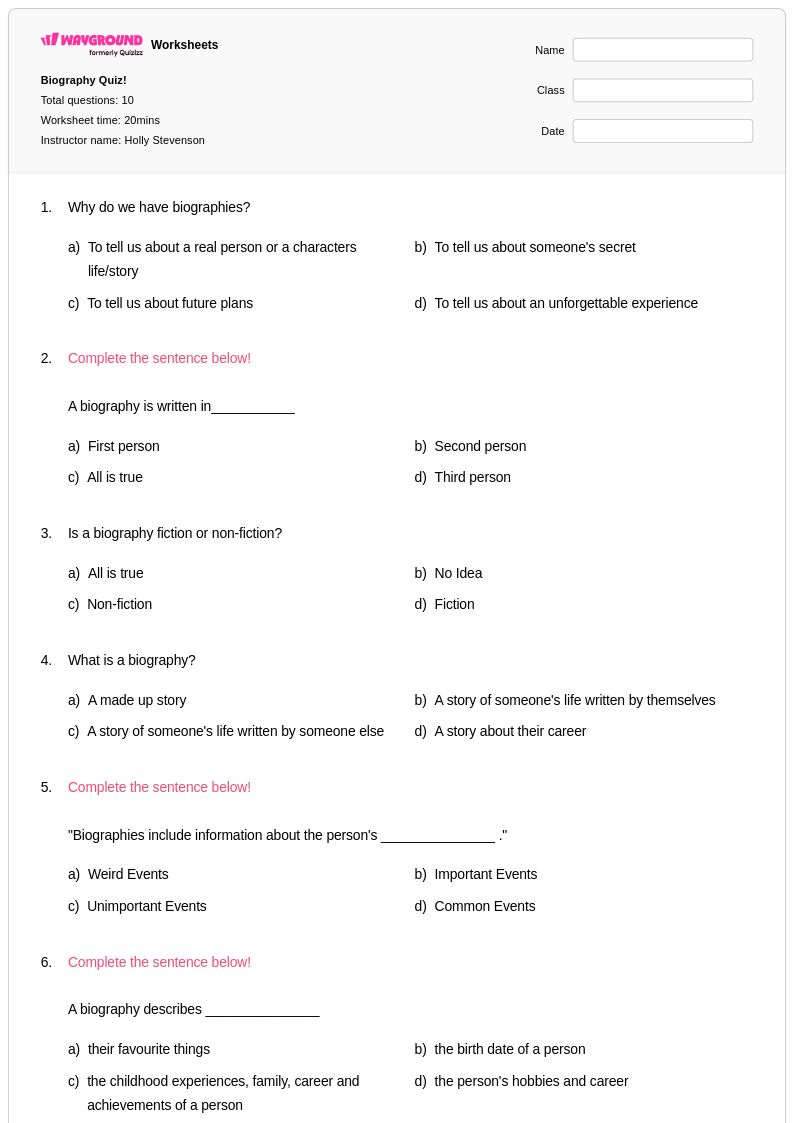
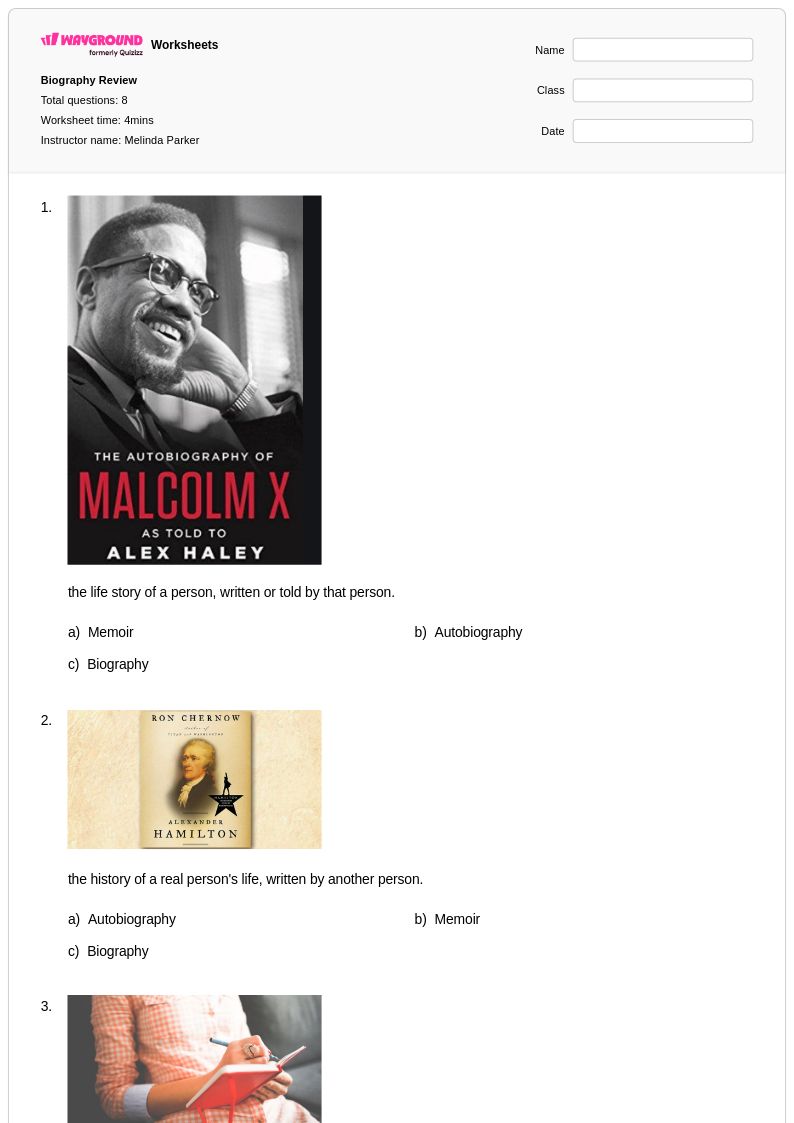
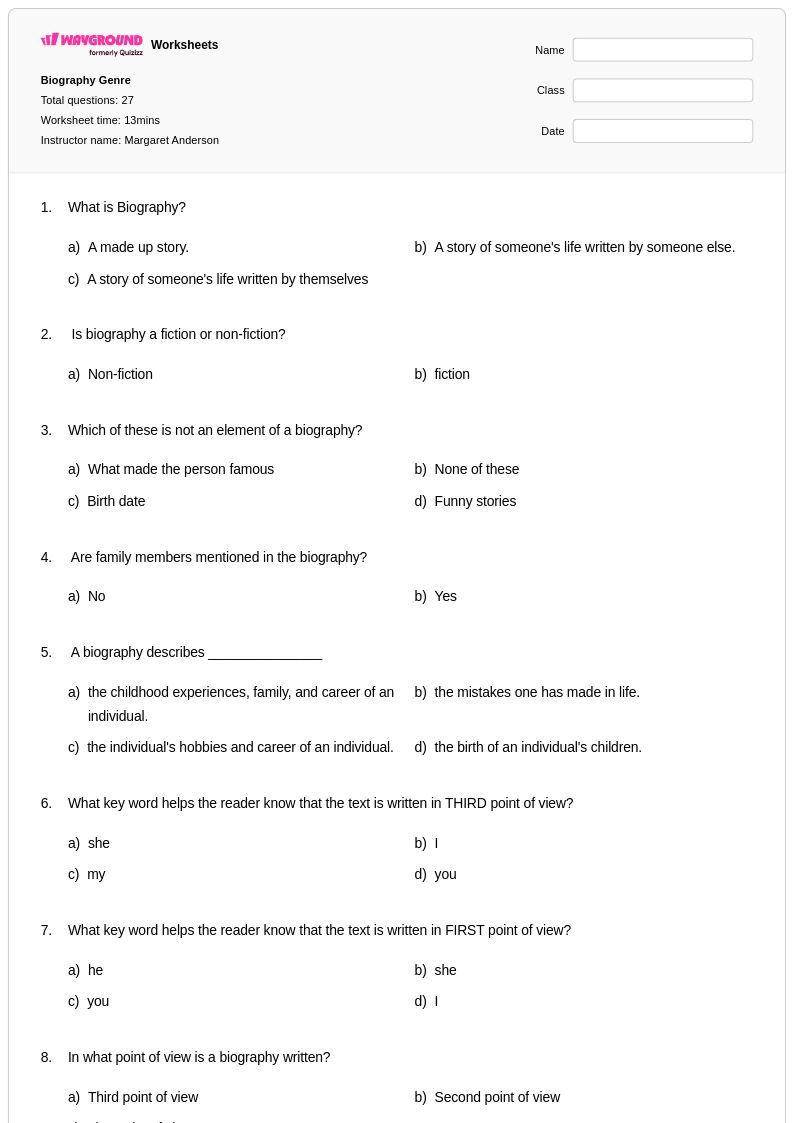
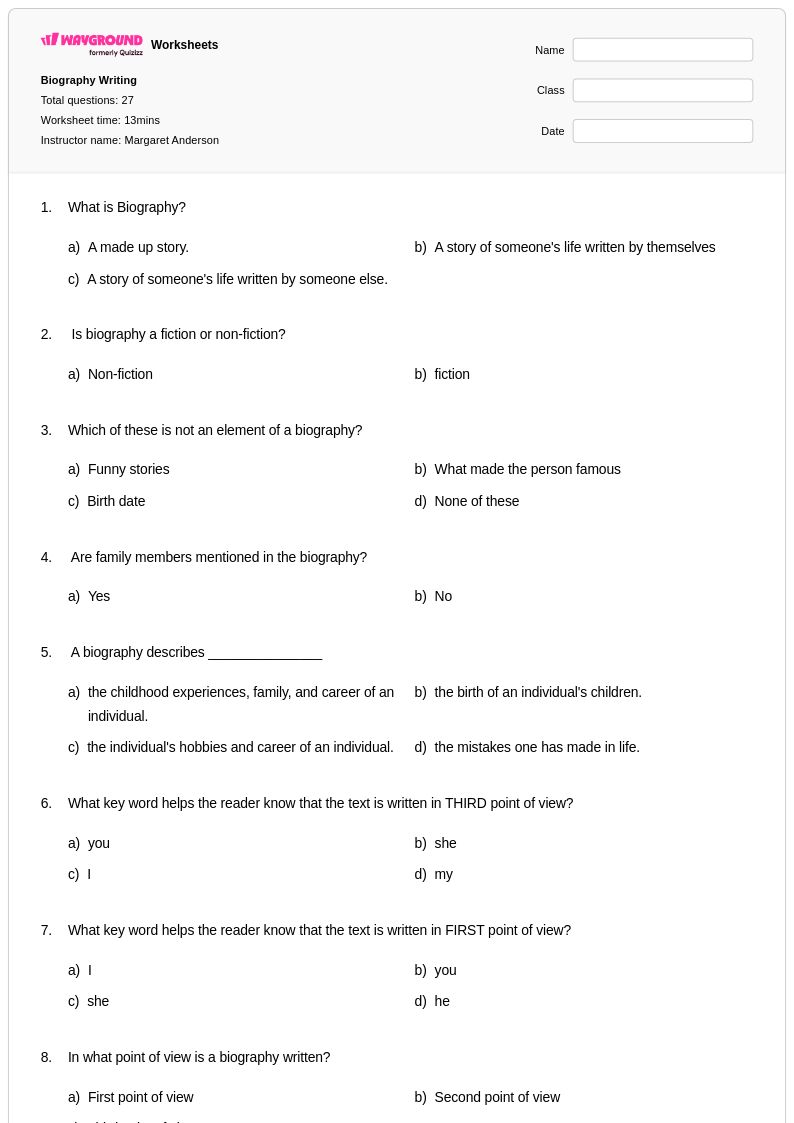
Year 6 biography worksheets and printables help students explore biographical texts through engaging practice problems, featuring free PDF resources with comprehensive answer keys to develop critical reading skills.
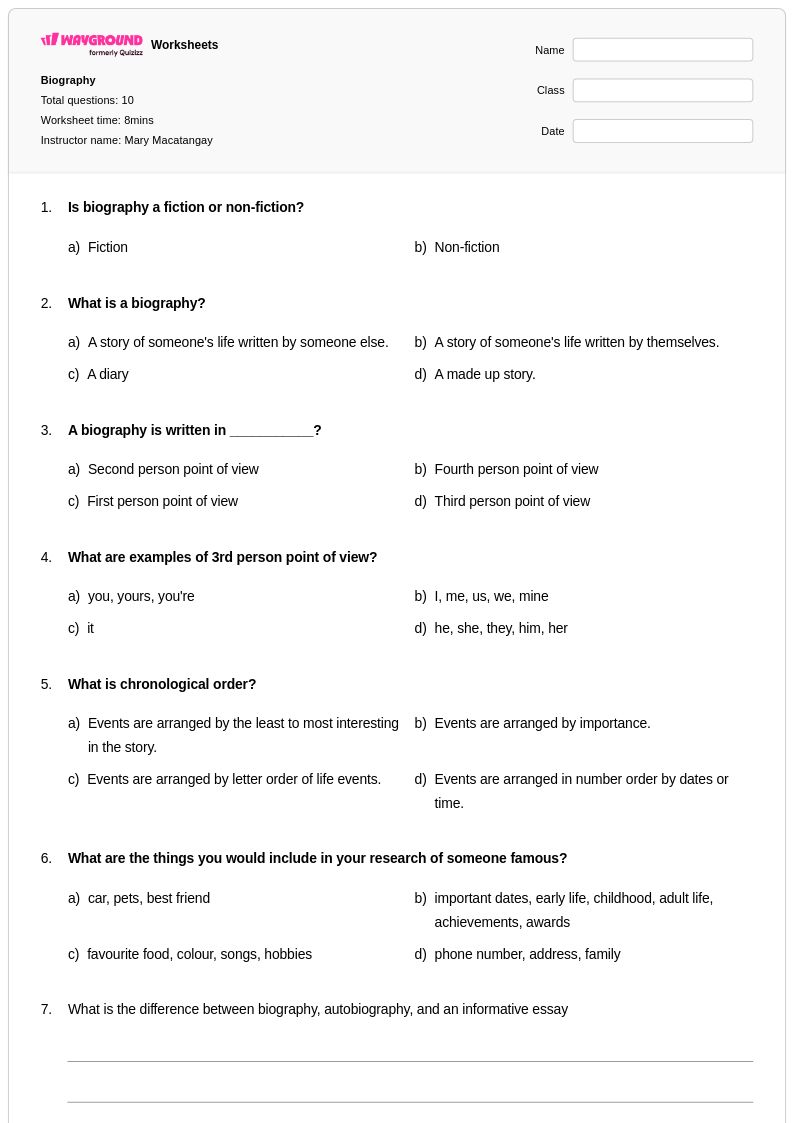
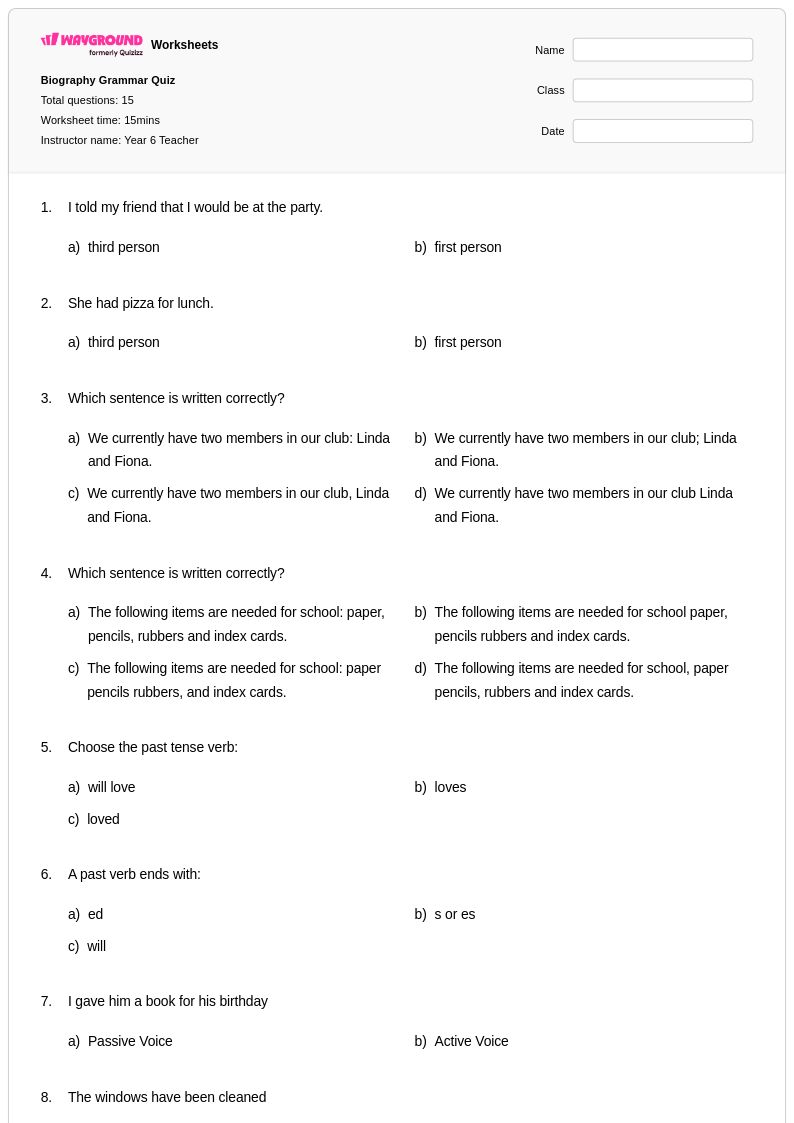
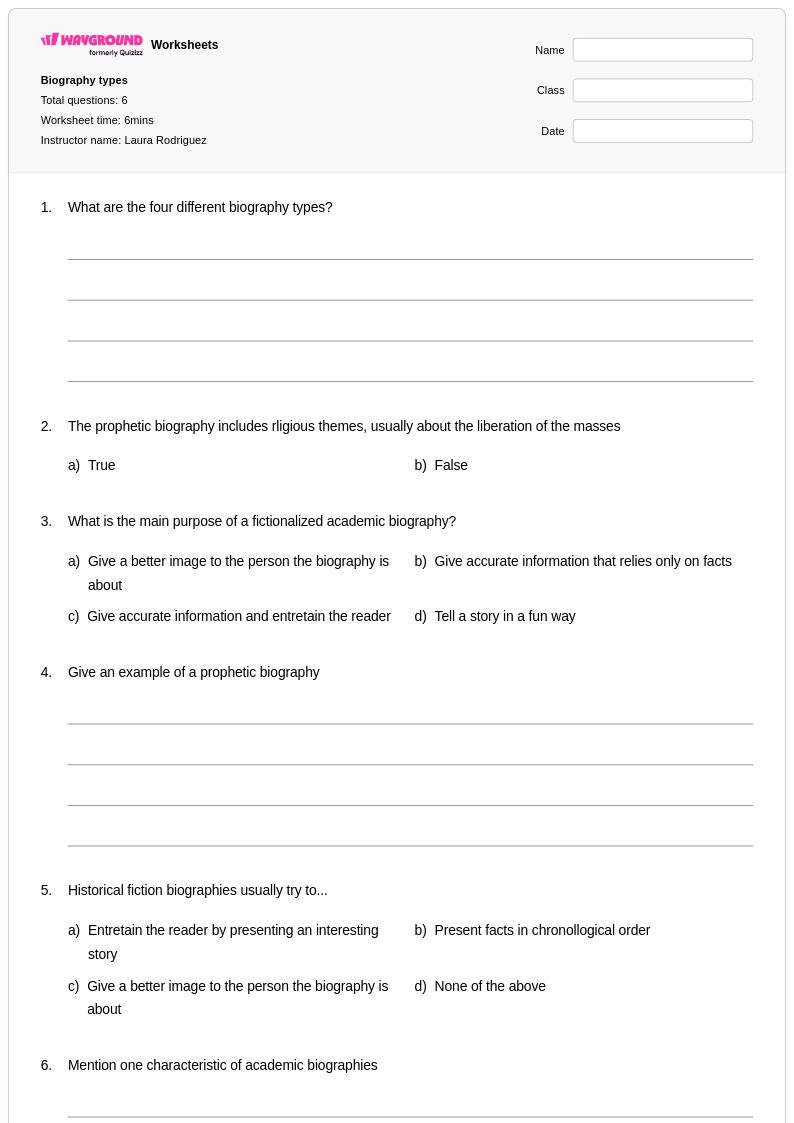
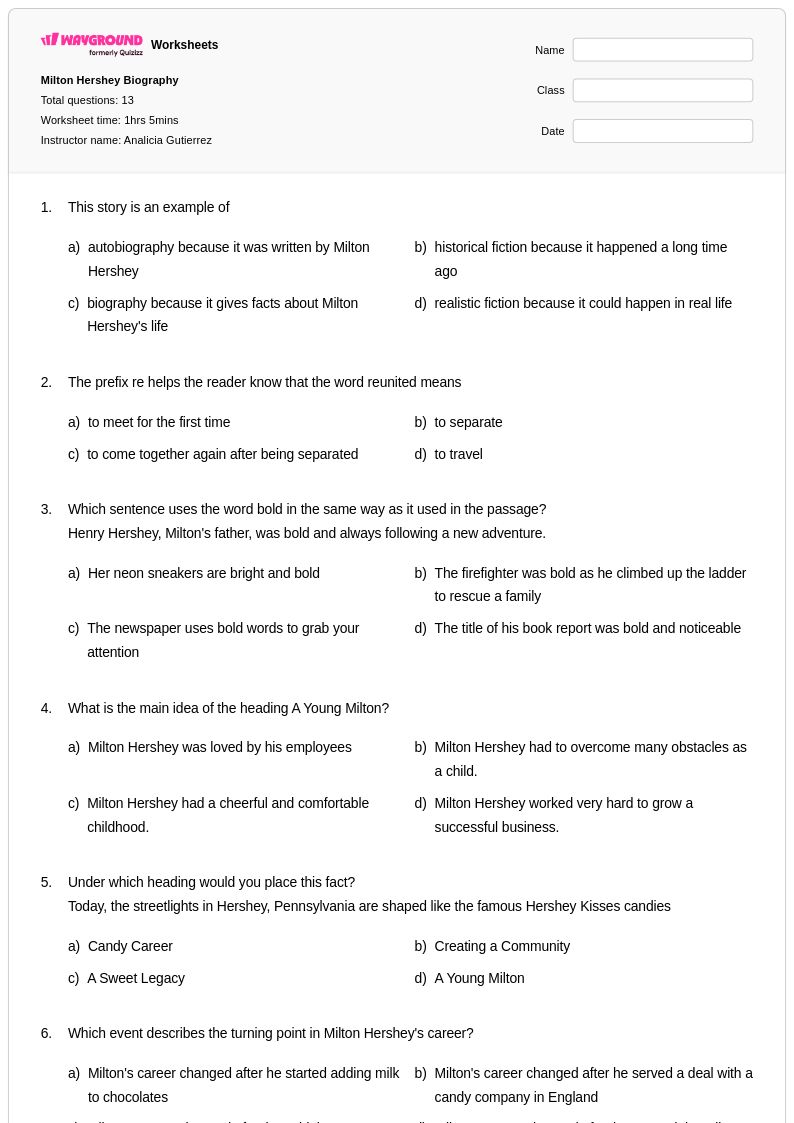
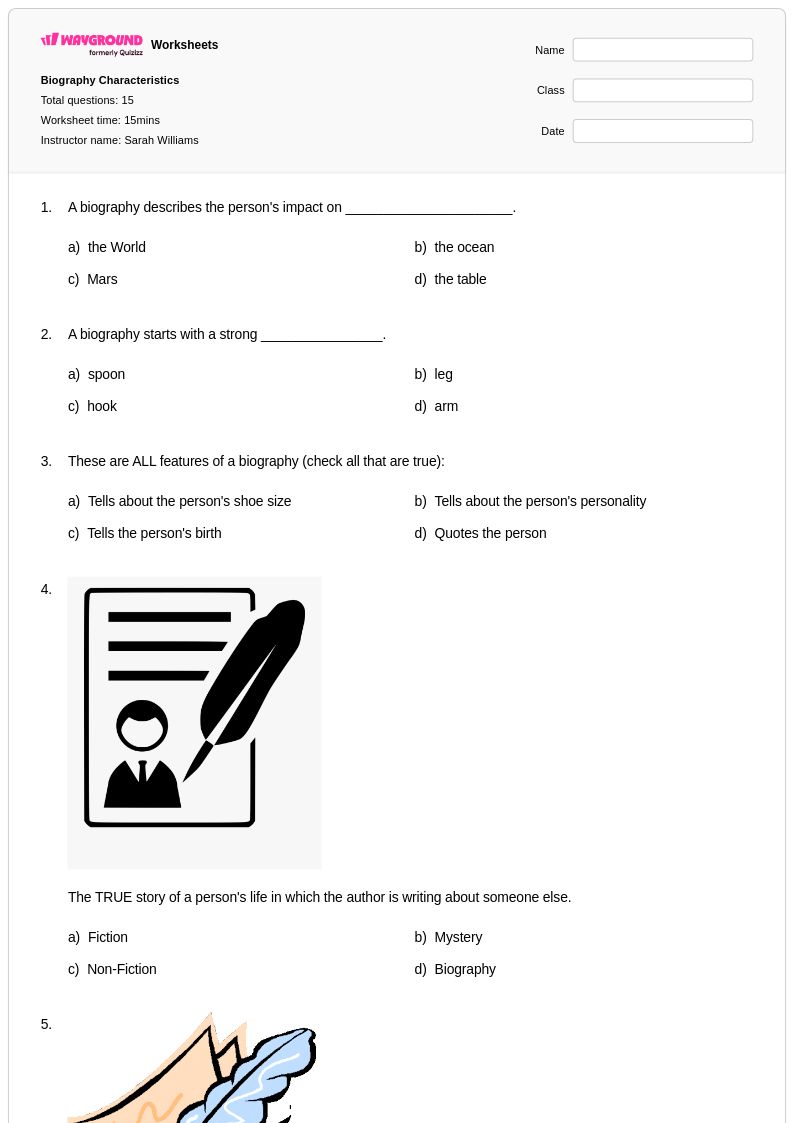
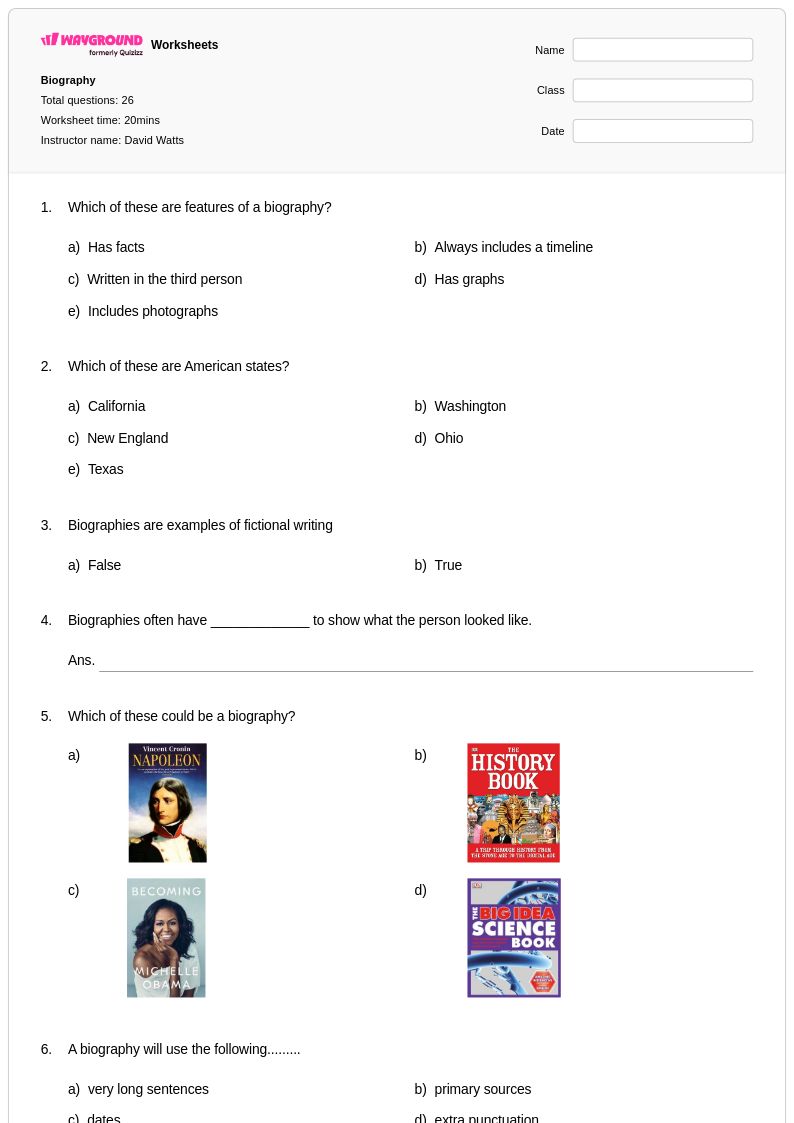
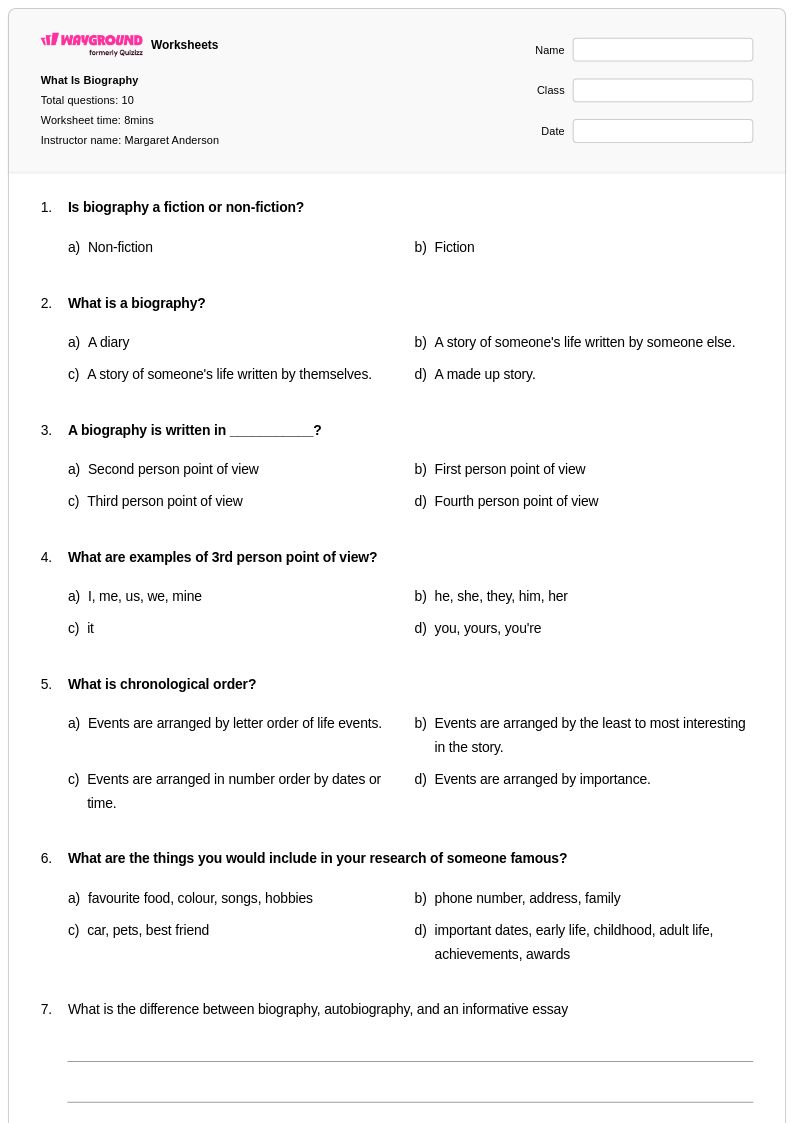
Biography worksheets for Year 6 students available through Wayground (formerly Quizizz) provide comprehensive practice in analyzing this essential non-fiction reading genre. These carefully designed resources help sixth-grade learners develop critical skills in identifying biographical elements such as chronological structure, significant life events, character traits, and the relationship between a subject's experiences and their achievements. Students work through practice problems that require them to distinguish between biographical facts and opinions, analyze how authors present information about real people, and understand the conventions that make biography distinct from other reading genres. Each worksheet collection includes detailed answer keys and is available as free printables in convenient pdf format, enabling teachers to seamlessly integrate biography study into their reading curriculum.
Wayground's extensive library contains millions of teacher-created biography worksheets specifically tailored for Year 6 reading levels, offering educators unprecedented access to high-quality instructional materials. The platform's robust search and filtering capabilities allow teachers to locate resources aligned with specific reading standards and learning objectives, while differentiation tools enable customization for diverse student needs. Whether delivered in printable pdf format for traditional classroom use or accessed digitally for remote learning, these biography worksheets support flexible lesson planning and provide targeted skill practice. Teachers can efficiently identify materials for remediation when students struggle with biographical text structures or select enrichment activities for advanced learners ready to tackle more complex biographical analysis, ensuring every sixth-grade student develops strong comprehension skills within this important reading genre.
FAQs
How do I teach students to analyze a biography?
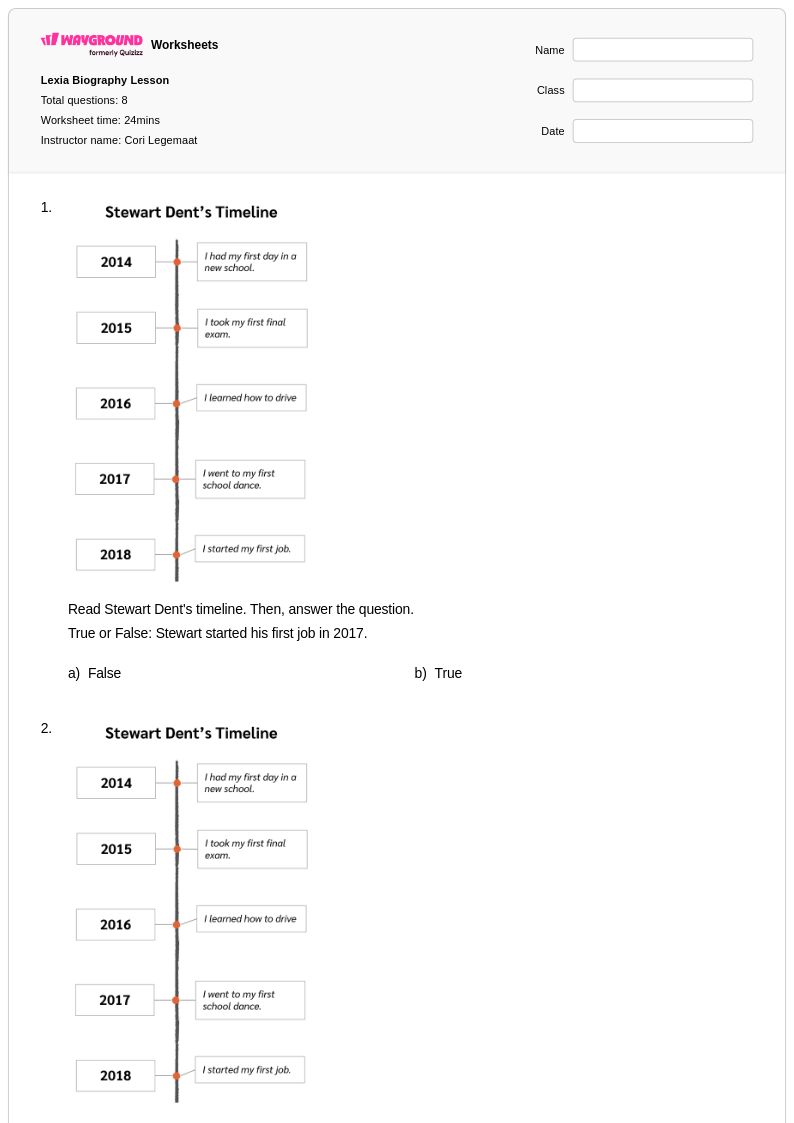
Start by helping students identify the structural elements common to biographical writing: chronological organization, use of primary and secondary sources, and how the author frames the subject's significance. Teach students to distinguish between factual reporting and interpretive commentary, and guide them to examine how the biographer selects which events to include and why. Graphic organizers that map a subject's life timeline alongside historical context can make these abstract concepts concrete and classroom-ready.
What exercises help students practice reading and understanding biographies?
Effective practice exercises include close-reading tasks that ask students to identify how a biographer establishes credibility, comprehension questions tied to specific passages, and comparison activities where students analyze two accounts of the same historical figure. Analytical writing prompts that ask students to evaluate the subject's impact or the author's perspective build higher-order thinking alongside reading fluency. Biography worksheets that combine text excerpts with structured response questions are particularly effective for building both comprehension and critical analysis skills.
What mistakes do students commonly make when reading biographies?
A common misconception is that biographies are purely objective because they are nonfiction. Students often fail to recognize that a biographer makes deliberate choices about which facts to include, how to frame events, and what tone to adopt. Another frequent error is conflating the subject's importance with the quality of the writing, which leads students to accept claims uncritically rather than evaluating the evidence presented. Teaching students to interrogate the author's perspective alongside the content is essential for genuine comprehension of the genre.
How can I differentiate biography worksheets for students reading below grade level?
For students reading below grade level, use shorter biographical excerpts with focused comprehension questions rather than full-length texts, and pre-teach key vocabulary tied to the subject's historical context before assigning independent work. On Wayground, teachers can apply student-level accommodations including Read Aloud, which plays audio of questions and content, and reduced answer choices to lower cognitive load for selected students. These settings can be assigned individually without other students being notified, making differentiation seamless within a mixed-ability classroom.
How do I use Wayground's biography worksheets in my classroom?
Wayground's biography worksheets are available as printable PDFs for traditional classroom use and in digital formats for technology-integrated environments, giving teachers flexibility across in-person, hybrid, and remote settings. Teachers can also host biography worksheets directly as a quiz on Wayground, enabling real-time student responses and instant feedback. Each worksheet includes a detailed answer key, reducing prep time and making it straightforward to review work with the whole class or provide targeted feedback to individual students.
How do I align biography worksheets to reading standards?
Most ELA standards for informational and nonfiction reading require students to analyze text structure, evaluate an author's purpose, assess the use of evidence, and integrate information from multiple sources. Biography worksheets map naturally to these standards because the genre requires students to apply all of these skills simultaneously. When selecting materials, look for worksheets that explicitly target skills like identifying point of view, evaluating source reliability, and analyzing how an author develops a central idea across a biographical text.