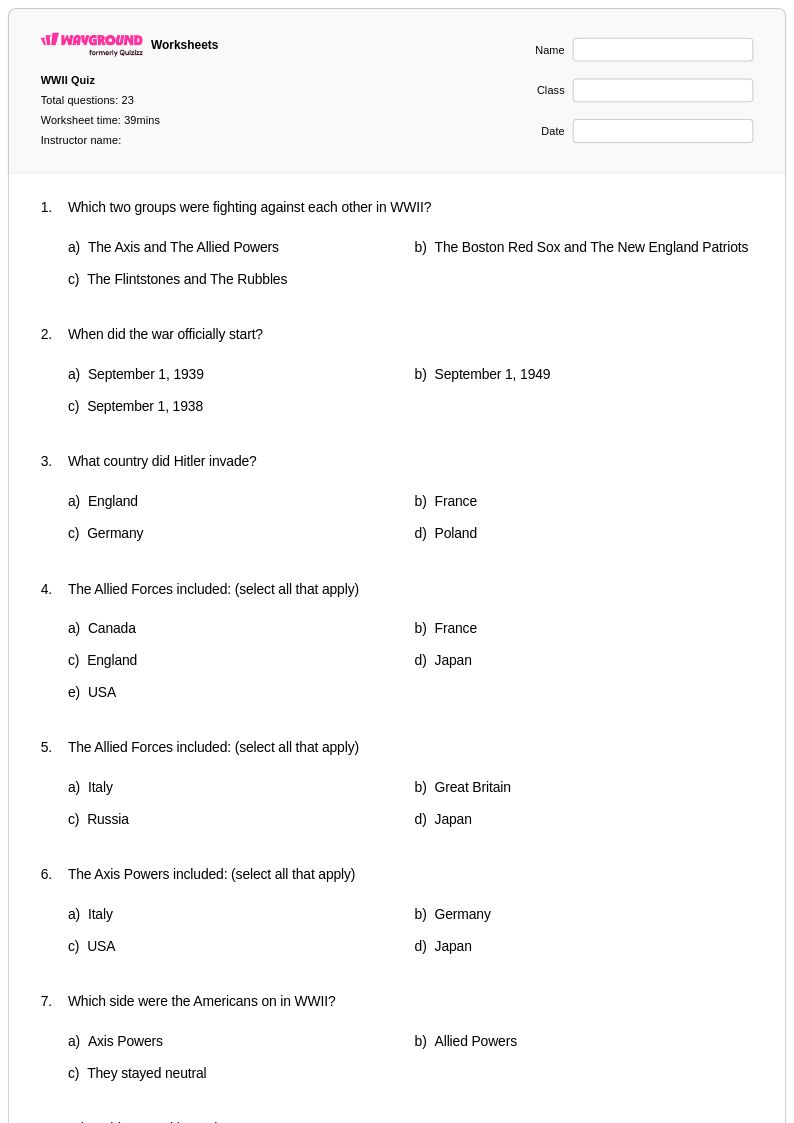
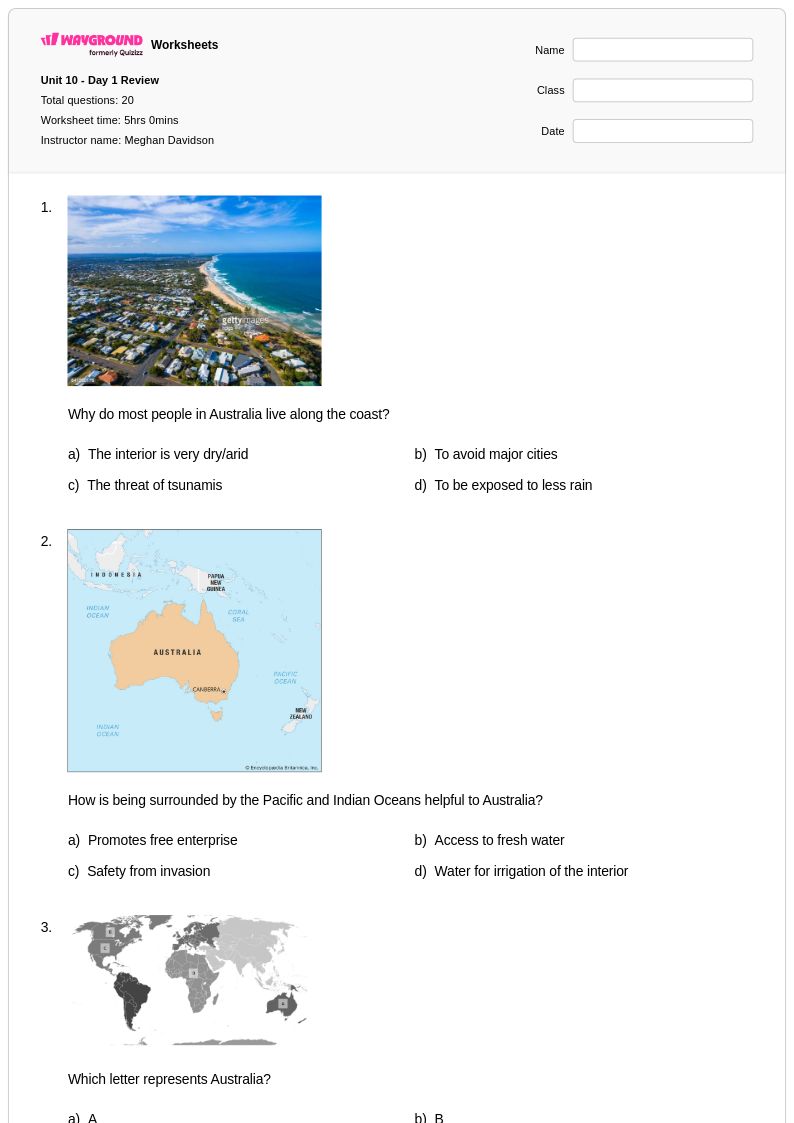
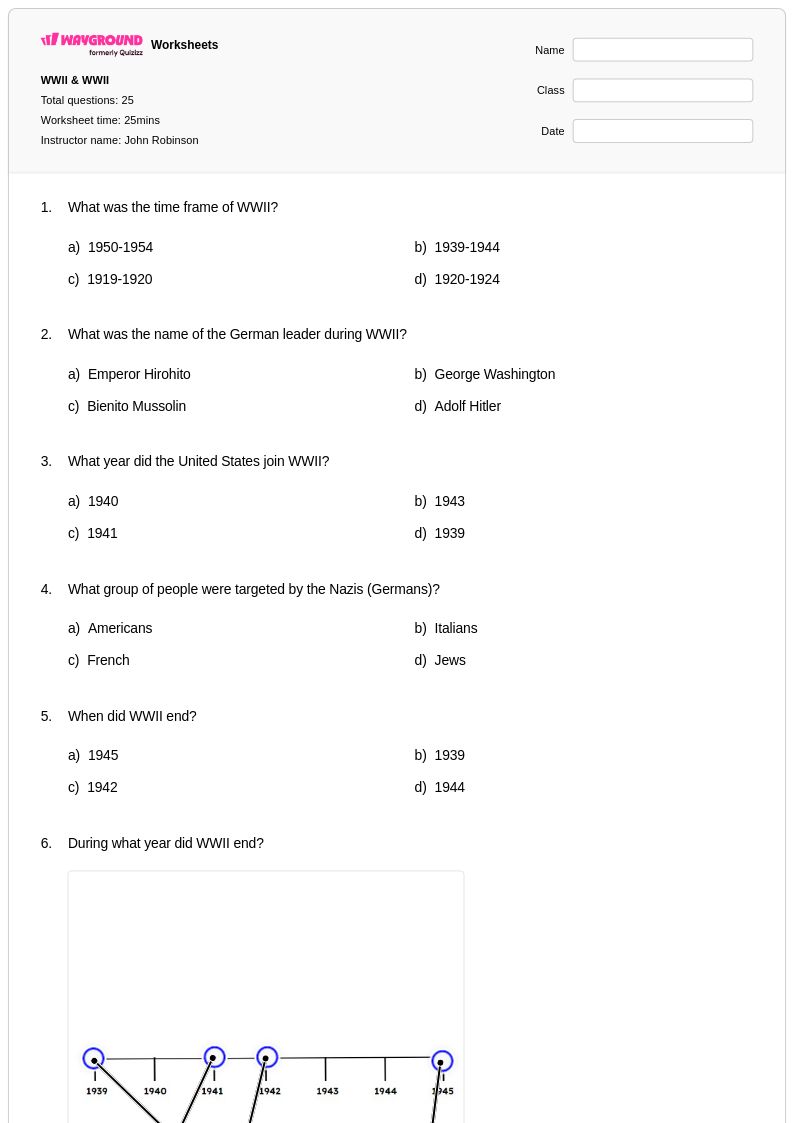
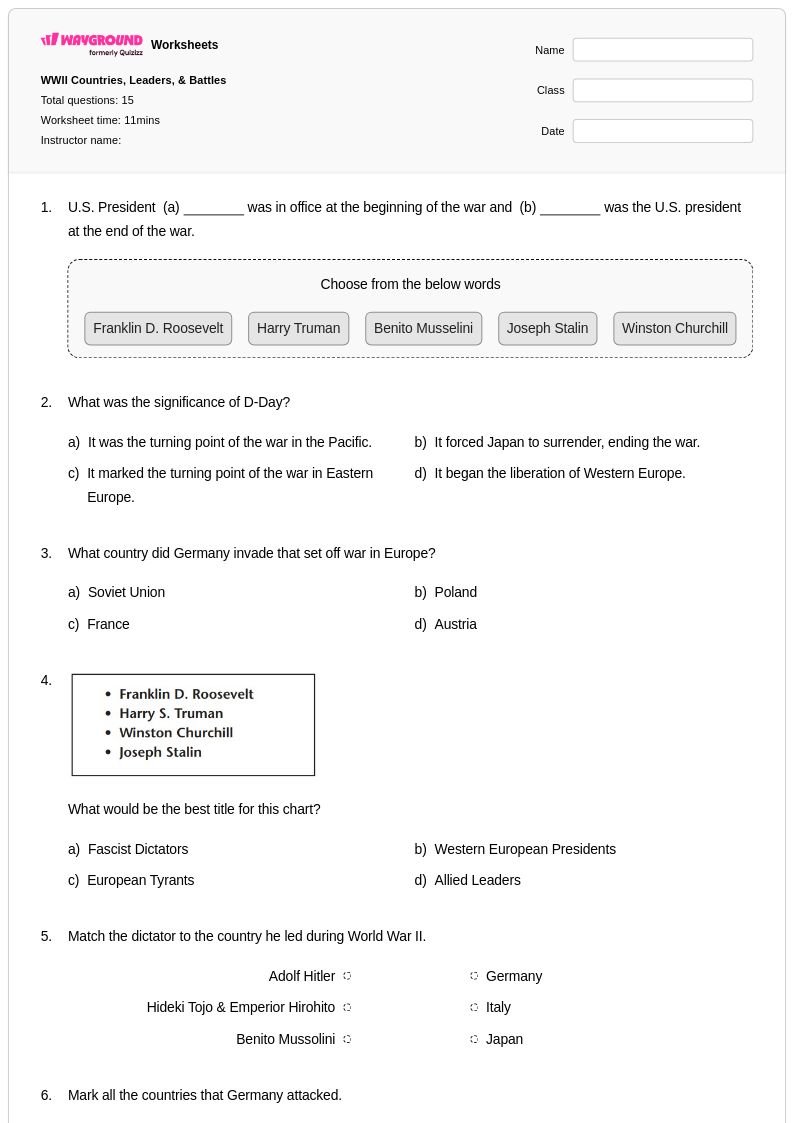
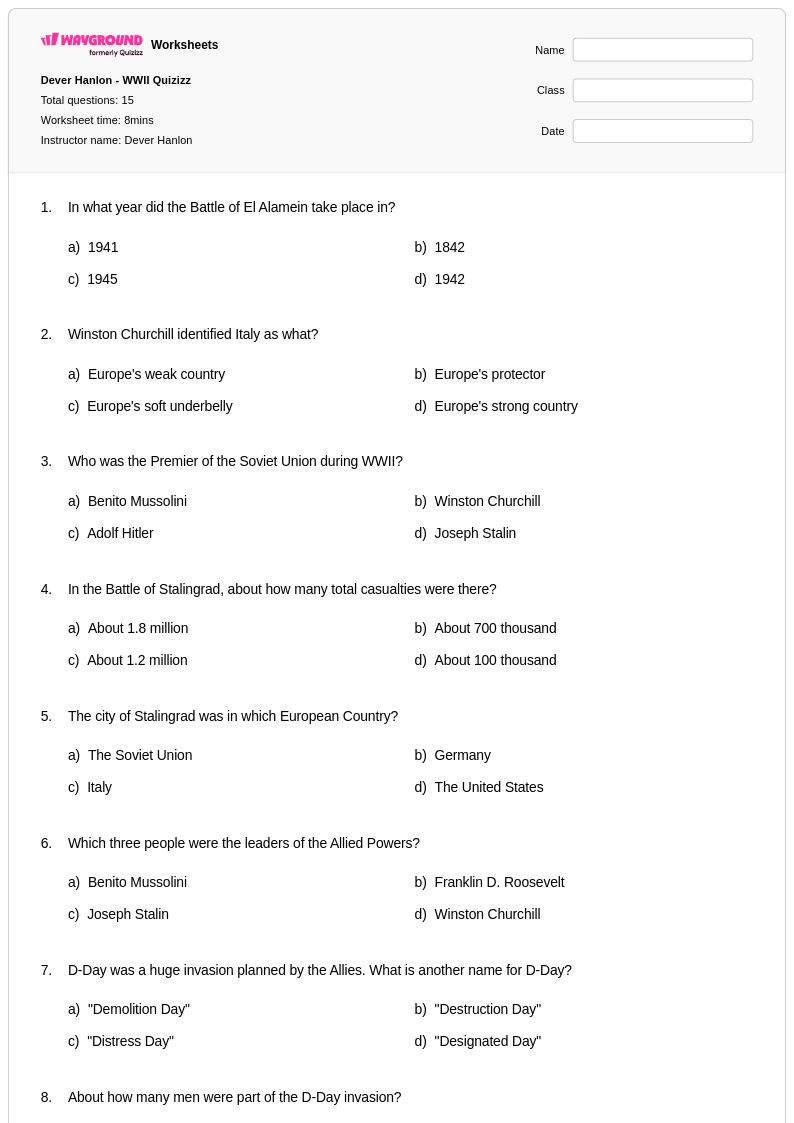
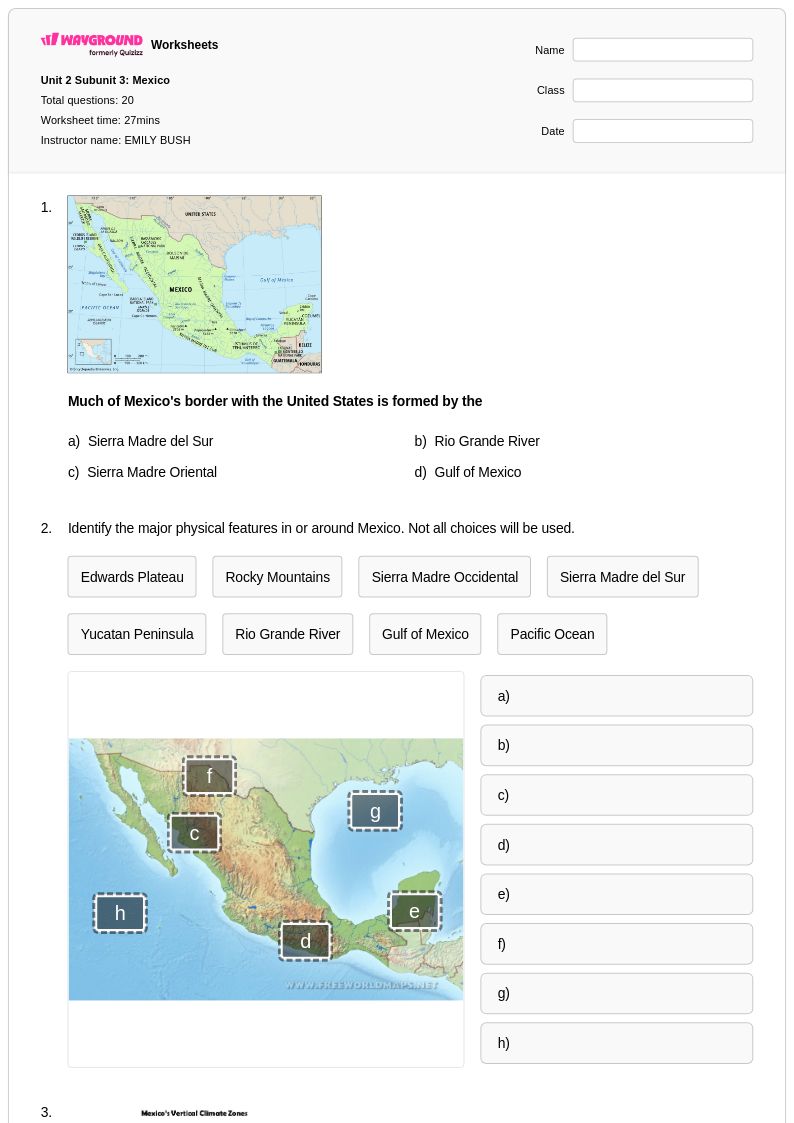
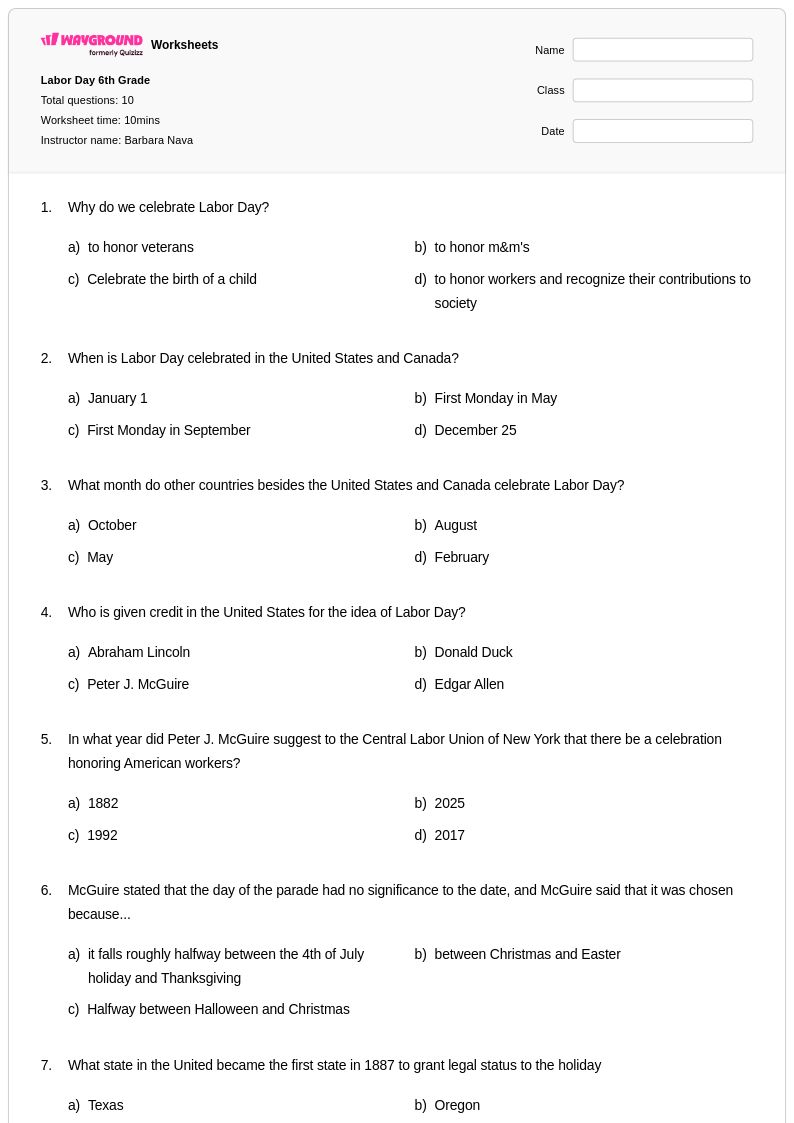
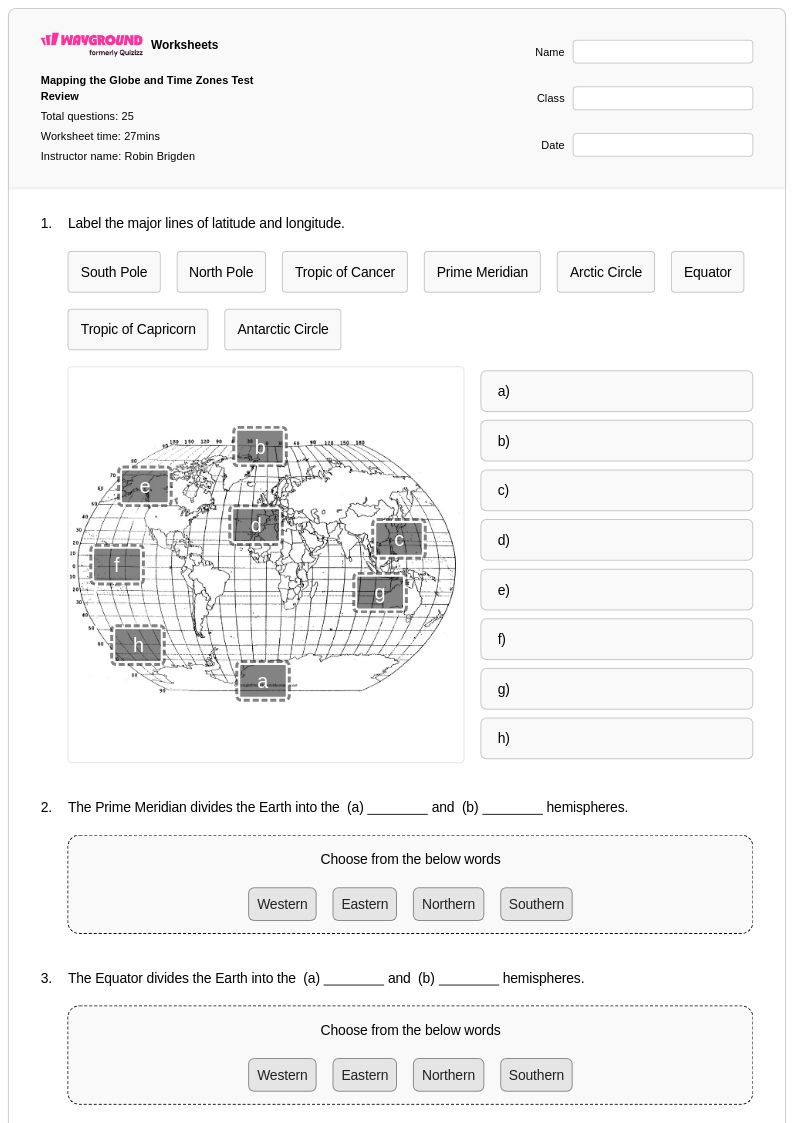
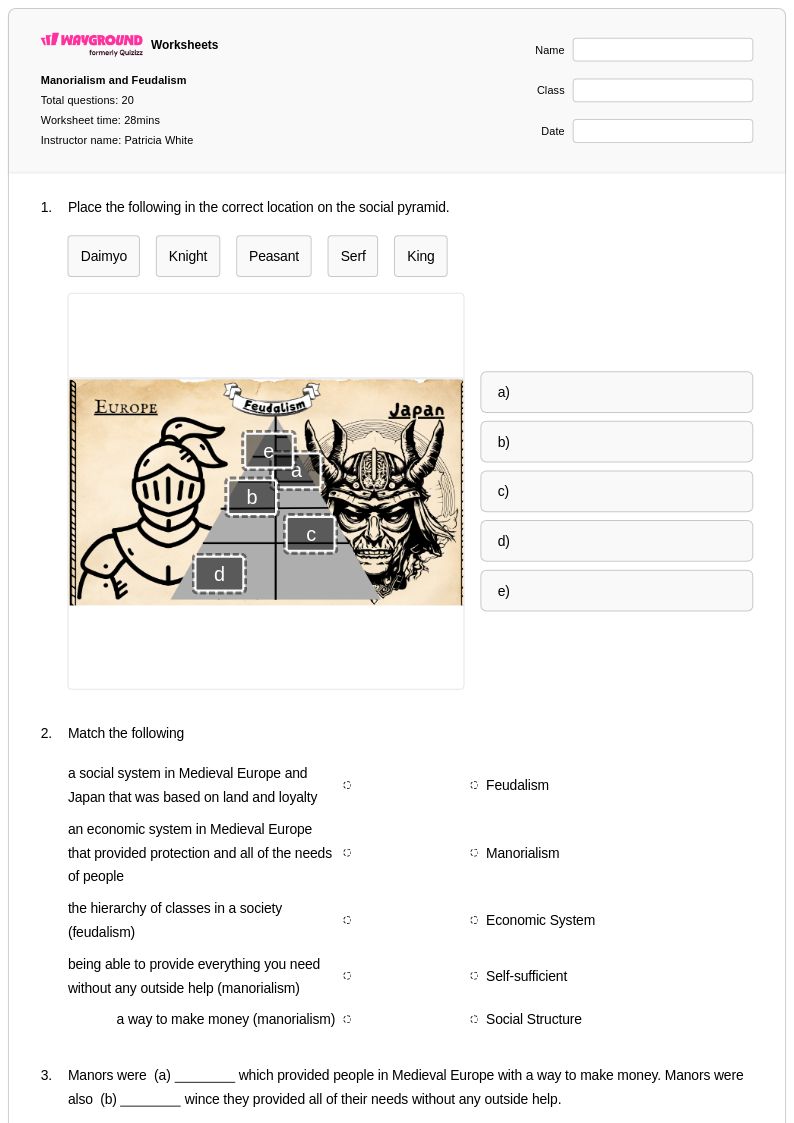
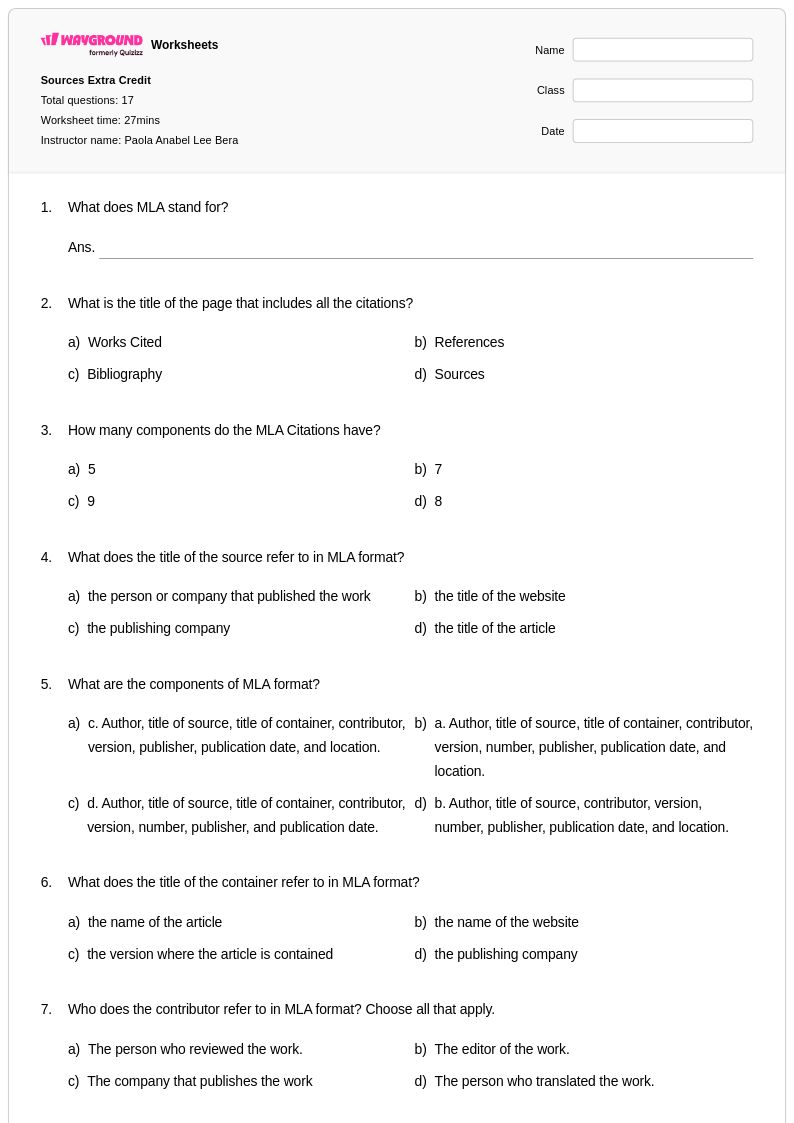
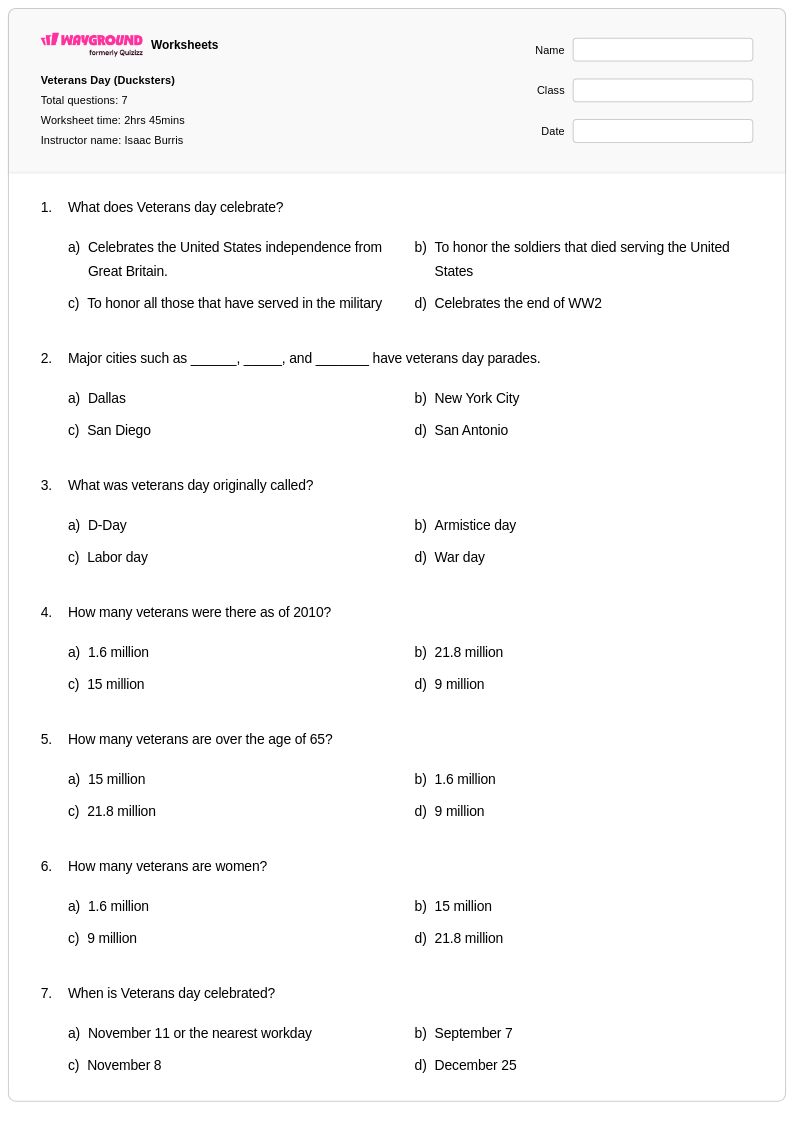
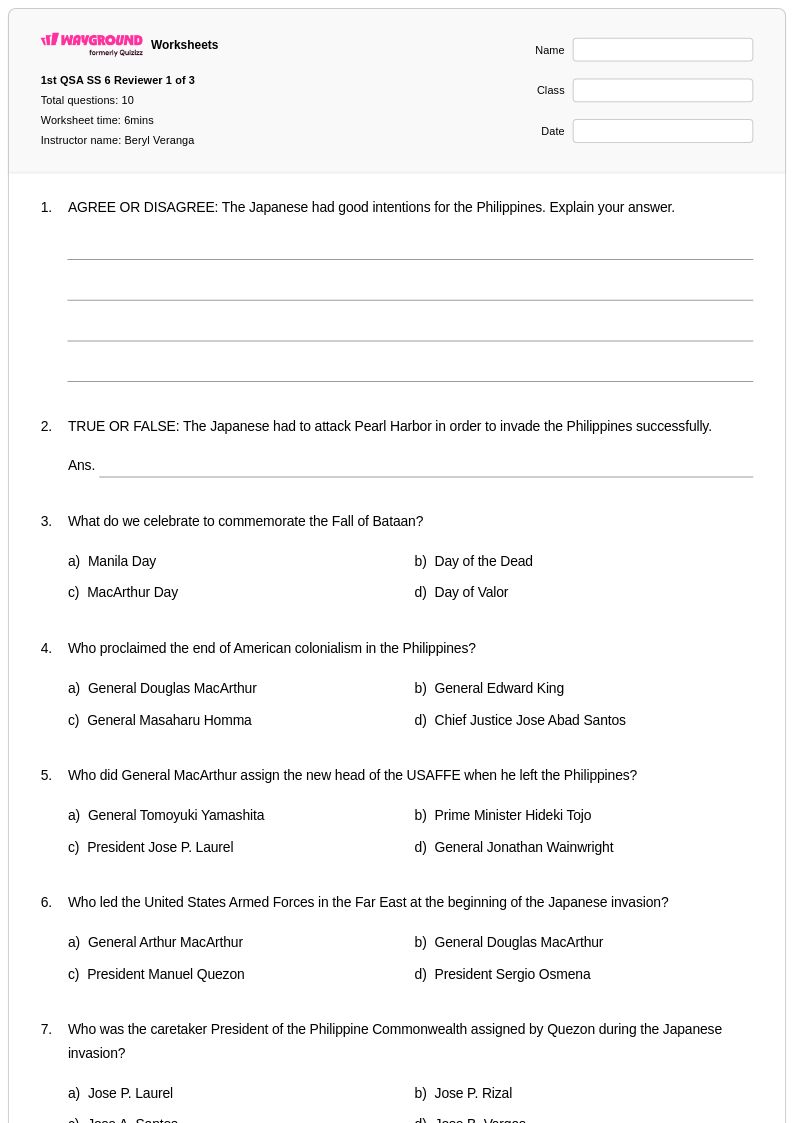
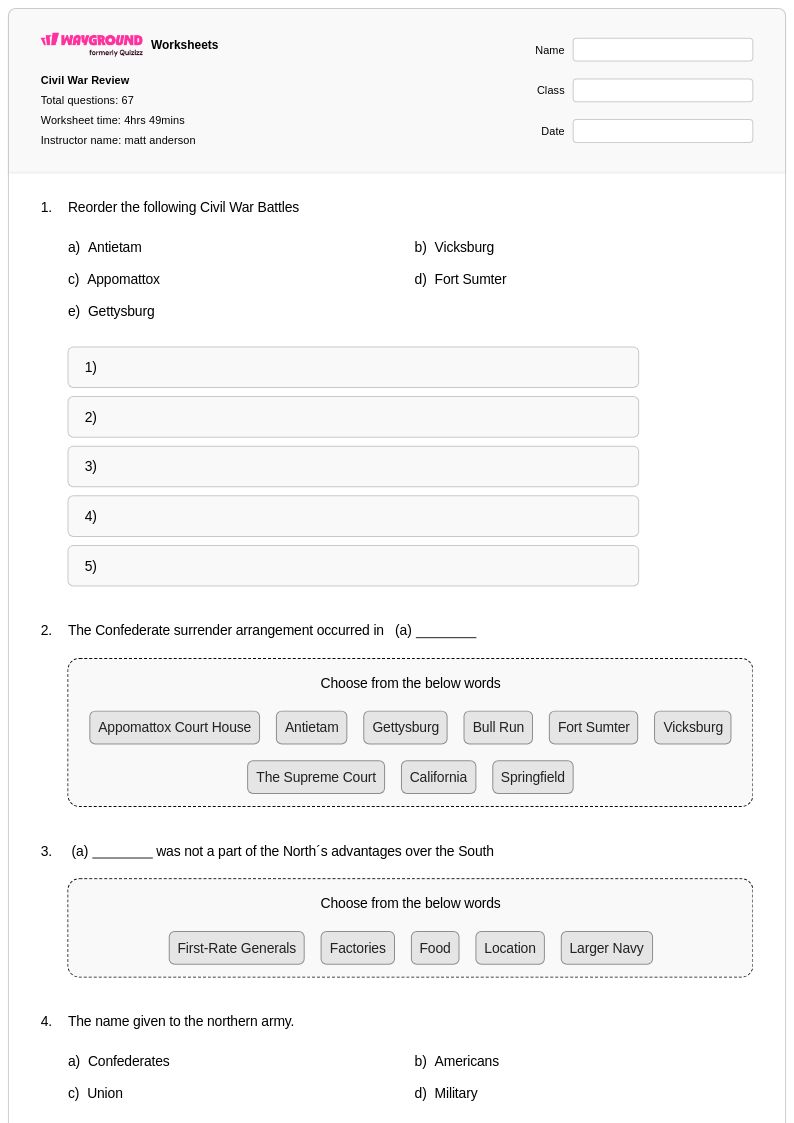
Year 6 D-day worksheets and printables help students explore this pivotal World War 2 invasion through engaging practice problems, free PDF resources, and comprehensive answer keys from Wayground's educational collection.
D-Day worksheets for Year 6 students available through Wayground (formerly Quizizz) provide comprehensive coverage of this pivotal World War 2 operation that changed the course of history. These educational resources help sixth-grade learners understand the strategic planning, execution, and significance of the June 6, 1944 Allied invasion of Normandy, France. Students strengthen critical thinking skills by analyzing primary source documents, examining cause-and-effect relationships, and evaluating the tactical decisions that led to Operation Overlord's success. The collection includes practice problems that challenge students to sequence events, identify key military leaders, and assess the operation's impact on the war's outcome. Each worksheet comes with a detailed answer key to support independent learning and self-assessment, while the free printables in pdf format make these resources accessible for both classroom instruction and homework assignments.
Wayground (formerly Quizizz) empowers educators with millions of teacher-created D-Day worksheet resources that streamline lesson planning and enhance World War 2 instruction for Year 6 students. The platform's robust search and filtering capabilities allow teachers to quickly locate materials aligned with social studies standards, ensuring content meets curriculum requirements while addressing diverse learning needs. Differentiation tools enable instructors to modify worksheets for various skill levels, supporting both remediation for struggling learners and enrichment opportunities for advanced students. Teachers can customize existing materials or create new assessments using the flexible editing features, with all resources available in both printable and digital formats including downloadable pdf versions. This comprehensive approach to worksheet management helps educators efficiently organize D-Day lessons, track student progress through targeted skill practice, and maintain engaging World War 2 units that bring this crucial historical event to life for middle school learners.
FAQs
How do I teach D-Day to middle or high school students?
Teaching D-Day effectively means grounding students in the strategic context before the operational details — start with why the Allies needed a western front, then move into the planning of Operation Overlord, the selection of Normandy, and the deception campaign (Operation Bodyguard). From there, use maps, primary sources, and firsthand accounts to walk students through June 6, 1944 itself. Connecting the human cost to the strategic outcome helps students understand why historians consider it a pivotal turning point in World War 2.
What are common misconceptions students have about D-Day?
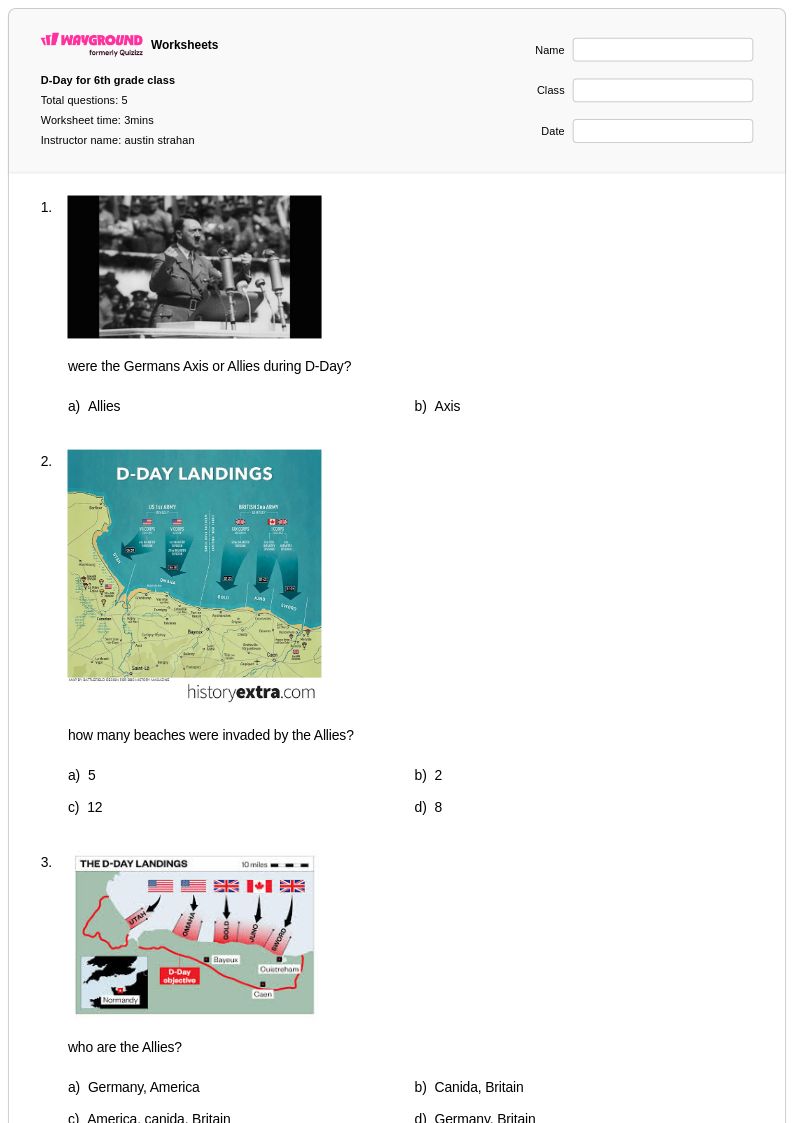
A frequent misconception is that D-Day was a single beach landing rather than a coordinated, multi-front amphibious assault across five beaches — Utah, Omaha, Gold, Juno, and Sword — supported by airborne drops and naval bombardment. Students also often underestimate the role of deception: Operation Bodyguard successfully convinced the Germans that Pas-de-Calais was the real target, which was critical to the landing's success. Another common error is conflating D-Day with the end of the war in Europe; in reality, it took nearly a year of further fighting before Germany surrendered.
What exercises help students analyze the significance of Operation Overlord?
Document analysis activities work particularly well — having students examine Eisenhower's Order of the Day, soldier letters, or casualty reports builds both historical empathy and analytical skills. Map-based exercises that ask students to trace the five landing zones and identify strategic objectives reinforce geographic and operational thinking. Structured written responses comparing the Eastern Front stalemate to the opening of the Western Front help students articulate why Operation Overlord shifted the trajectory of World War 2.
How can I use D-Day worksheets to support different skill levels in my classroom?
D-Day worksheets can be differentiated by adjusting the complexity of the source materials students analyze — struggling readers benefit from adapted text with guided reading questions, while advanced students can engage with unedited primary sources and open-ended analysis prompts. On Wayground, teachers can apply individual accommodations such as Read Aloud, reduced answer choices, and extended time for specific students without disrupting the rest of the class. These settings are saved per student and carry over to future sessions, making it practical to maintain consistent support across a unit.
How do I use D-Day worksheets on Wayground in my classroom?
Wayground's D-Day worksheets are available as printable PDFs for traditional classroom use and in digital formats for technology-integrated or remote learning environments. Teachers can distribute printed copies for in-class work or assign the digital version directly to students, and Wayground also supports hosting the worksheet as a quiz so student responses can be tracked in one place. All worksheets include answer keys, so teachers can use them for guided instruction, independent practice, or assessment with minimal prep time.
How do I connect D-Day to broader World War 2 themes in a social studies unit?
D-Day fits naturally as a capstone or turning-point lesson within a World War 2 unit because it draws together threads of Allied coalition strategy, Nazi occupation, and the human cost of industrial-scale warfare. Teachers can connect it backward to the fall of France in 1940 and forward to the liberation of Paris and the Battle of the Bulge, helping students see Operation Overlord not as an isolated event but as the hinge on which the European theater turned. Primary source analysis and cause-and-effect graphic organizers are especially effective for making these connections explicit.