Year 9 dimensioning worksheets from Wayground help students master geometric measurement and annotation skills through comprehensive printables, practice problems, and answer keys in convenient PDF format.
Explore printable Dimensioning worksheets for Year 9
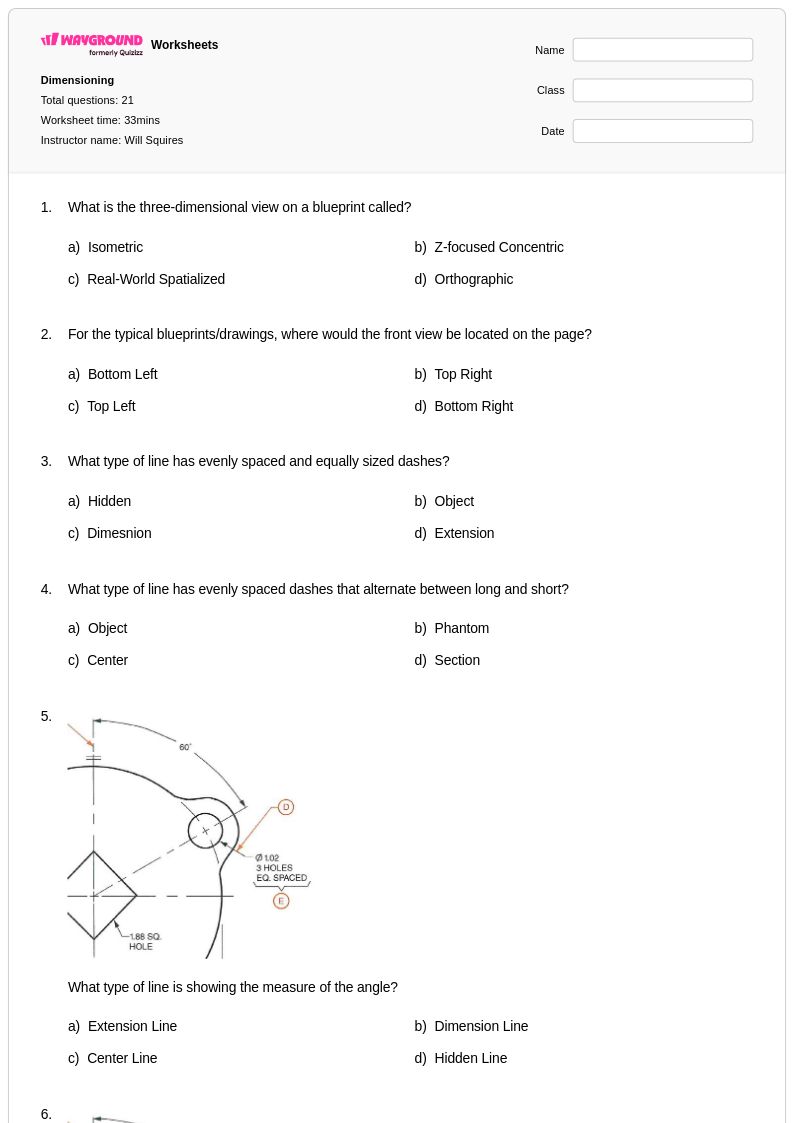
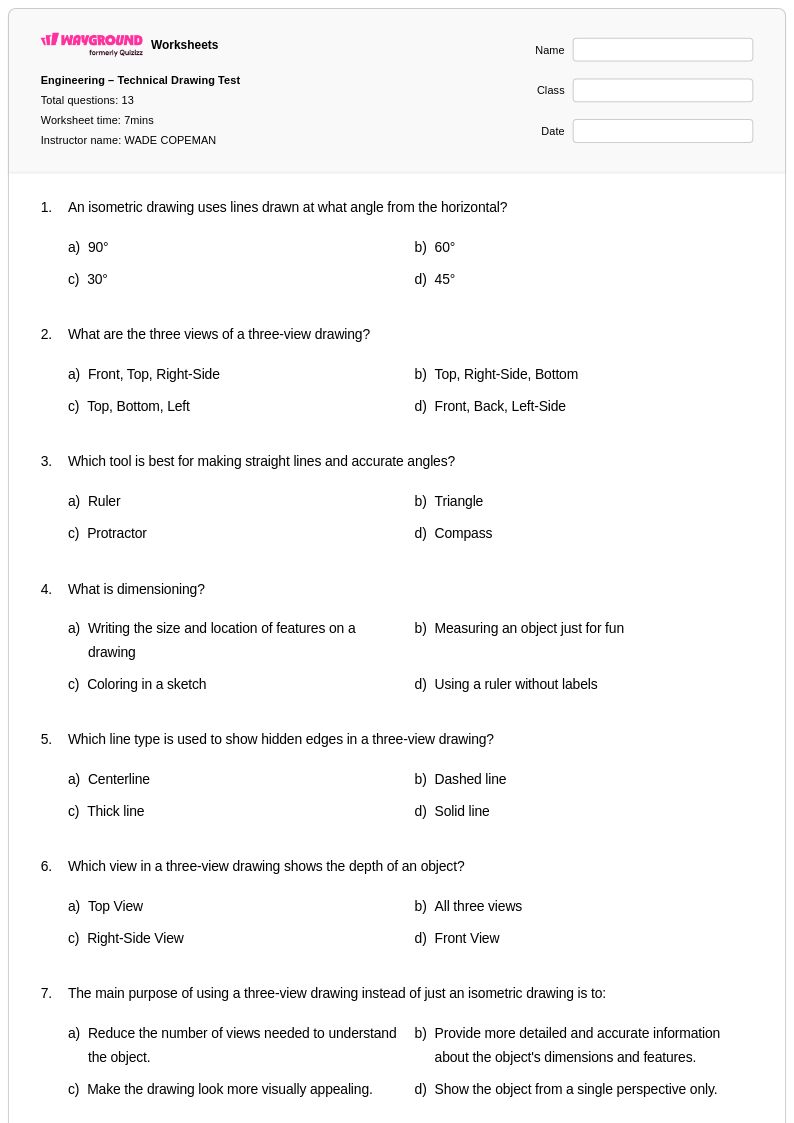
Year 9 dimensioning worksheets available through Wayground (formerly Quizizz) provide comprehensive practice in the fundamental skills of technical drawing and geometric measurement that are essential for advanced geometry studies. These carefully designed resources help students master the precise art of adding measurements, annotations, and specifications to geometric figures, developing their ability to communicate mathematical information clearly and accurately. Students work through practice problems that cover linear dimensioning, angular measurements, coordinate notation, and scale factor applications, building proficiency in reading and creating dimensioned drawings that meet technical standards. Each worksheet includes a detailed answer key that allows for immediate feedback and self-assessment, while the free printable pdf format ensures accessibility for all learning environments.
Wayground (formerly Quizizz) empowers educators with an extensive collection of millions of teacher-created dimensioning resources that streamline lesson planning and provide targeted skill practice for Year 9 geometry students. The platform's robust search and filtering capabilities enable teachers to quickly locate worksheets aligned with specific curriculum standards and learning objectives, while built-in differentiation tools allow for seamless customization based on individual student needs and ability levels. Whether delivered in traditional printable format or through interactive digital assignments, these versatile materials support comprehensive instruction in technical drawing conventions and geometric measurement. Teachers can efficiently implement these resources for initial concept introduction, targeted remediation of specific dimensioning skills, or enrichment activities that challenge advanced learners to apply their understanding in complex geometric contexts.
FAQs
How do I introduce dimensioning to Grade 9 geometry students?
Grade 9 students usually have solid measurement basics but haven't seen formal dimensioning conventions. A good entry point is showing them a simple architectural or engineering sketch and asking what information a builder would need to reproduce it — that surfaces the purpose before you introduce the notation. From there, teach the four core elements (dimension lines, extension lines, leaders, arrowheads) with a labeled reference students can keep, then move into reading practice before production.
What dimensioning skills should Grade 9 students be practicing?
At Grade 9, the focus should be on linear dimensioning, basic angular measurements, and reading scale factors on simple 2D figures. Students should be able to correctly place and label dimensions on polygons and circles (including radius vs. diameter distinctions) and interpret a dimensioned drawing well enough to reproduce the figure. Coordinate notation is a natural extension once those fundamentals are solid.
What errors do Grade 9 students typically make with dimensioning?
The most common issues are crowding dimension lines against the figure, omitting units, and confusing radius with diameter on circular features. A subtler problem at this level is inconsistent scale application — students will correctly identify a scale ratio but then apply it to only some dimensions on the same figure. Catching that inconsistency early matters because it compounds in later technical drawing work.
How do I use these Grade 9 dimensioning worksheets in my class?
You can assign them digitally as a hosted Wayground quiz — useful for immediate feedback during a lesson — or print the PDF for independent or group work. Every worksheet includes a complete answer key, so students can self-check after paper practice. If you go the print route, the Wayground for Teachers app lets you scan submitted work for grading without re-entering everything manually.
Is dimensioning part of the Common Core geometry standards for Grade 9?
Common Core geometry at the high school level emphasizes applying geometric concepts to model real-world situations, and dimensioning is a direct application of that — translating geometric figures into annotated, measurable representations. Grade 9 is typically where students formalize their understanding of scale drawings and proportional relationships, which dimensioning builds on directly. Mastery here sets up later work with geometric modeling and technical drawing conventions in upper-level courses.
How can I support Grade 9 students who struggle with the visual complexity of dimensioned drawings?
Dimensioned drawings can feel visually overwhelming at first — lines, arrows, numbers, and labels all competing for attention. Wayground's worksheet tools let you increase font size and apply wider line spacing to reduce that clutter for students who need it. For students with reading difficulties, the Read Aloud accommodation handles question text. A dyslexia-friendly font option is also available at the worksheet level if that's relevant for specific students.