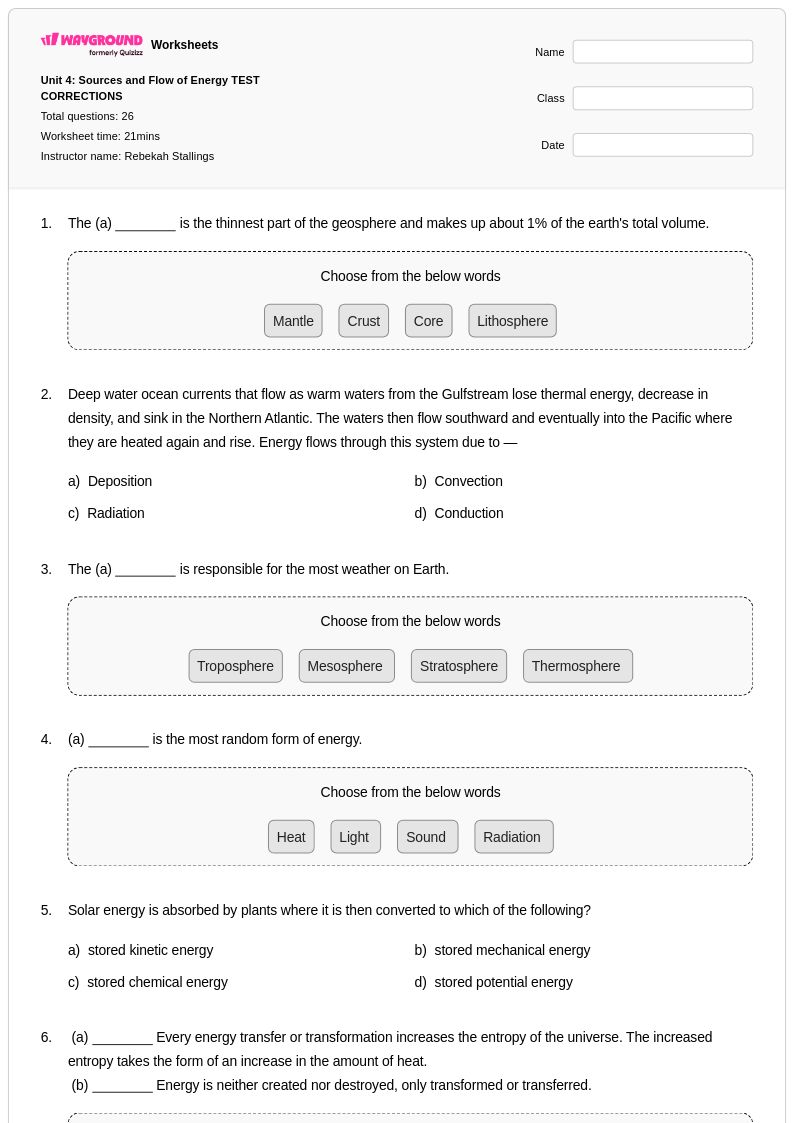
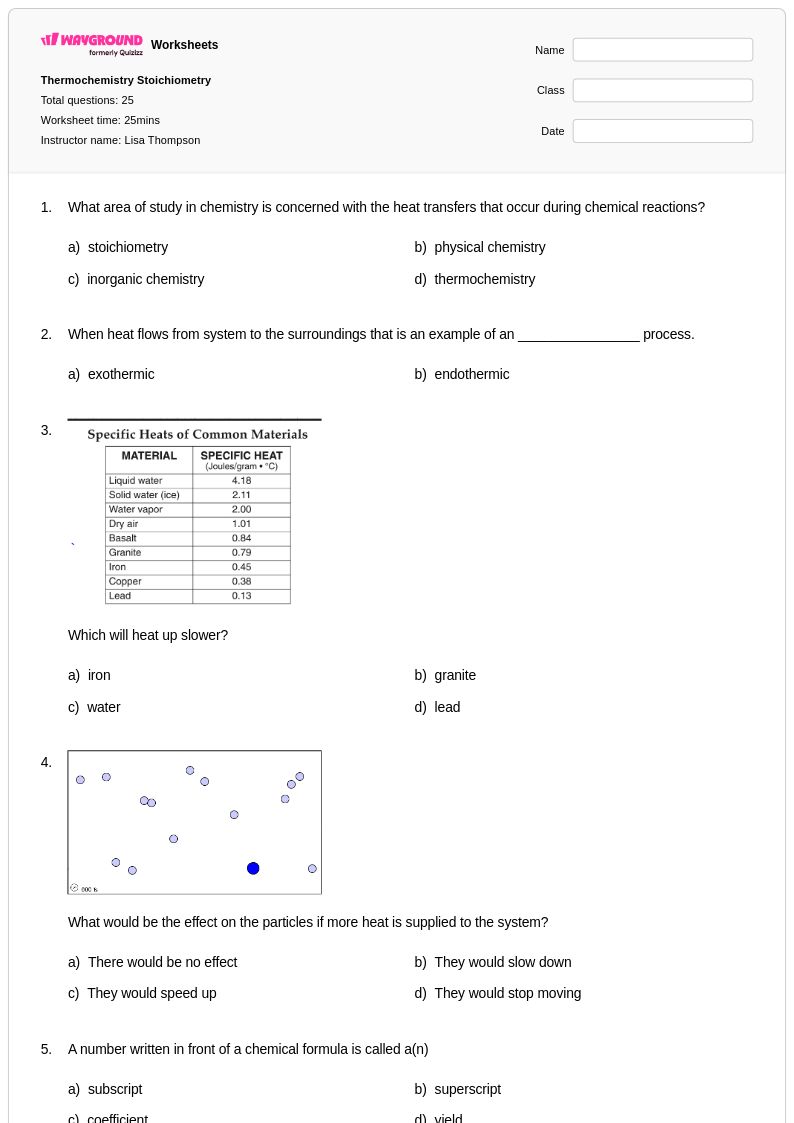
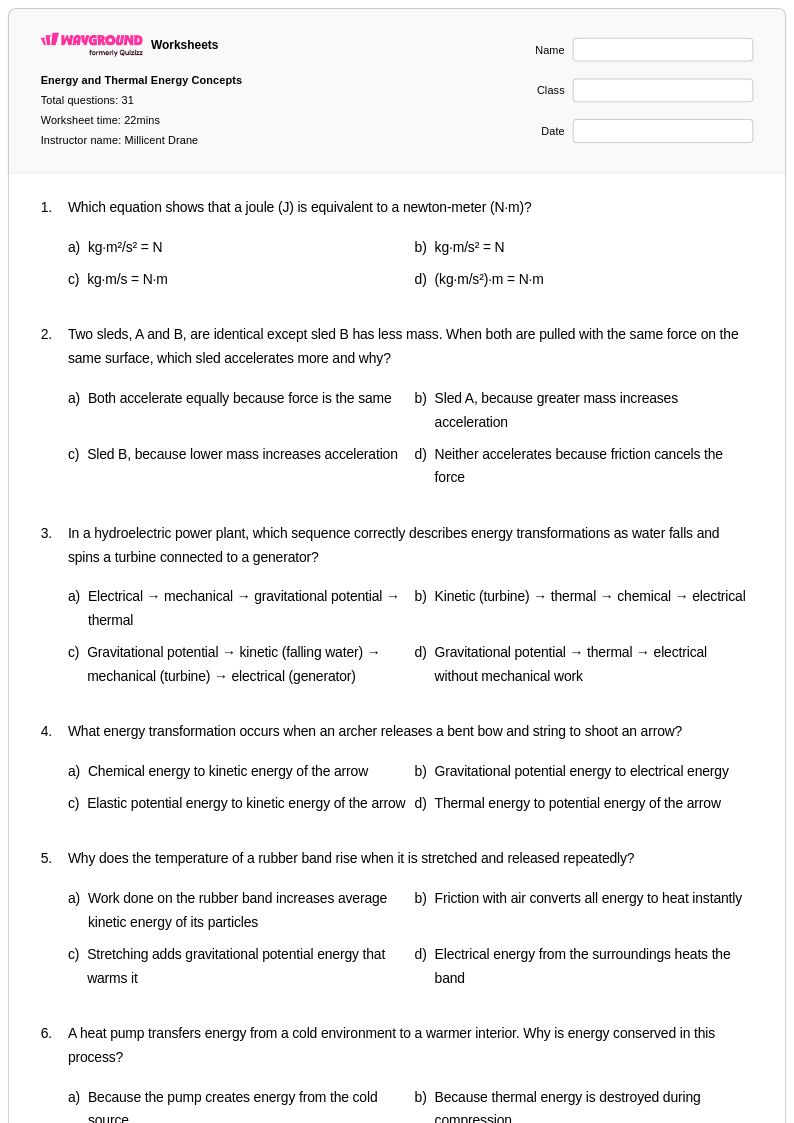
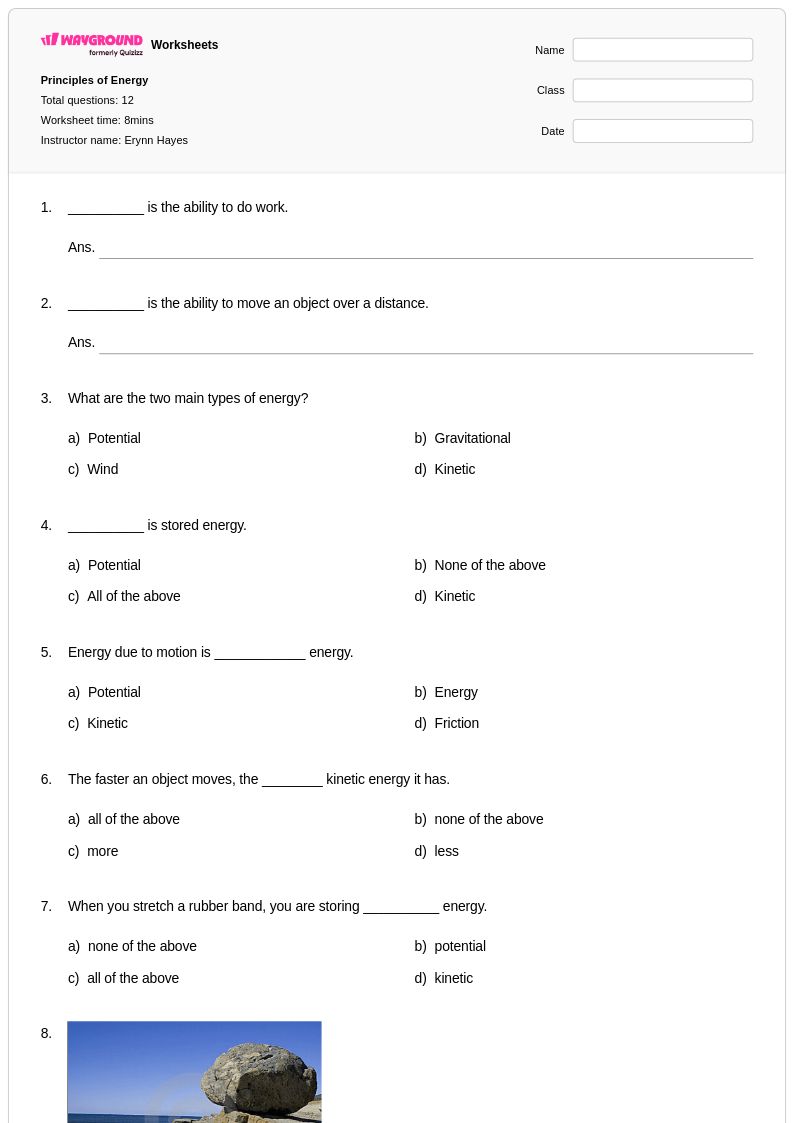
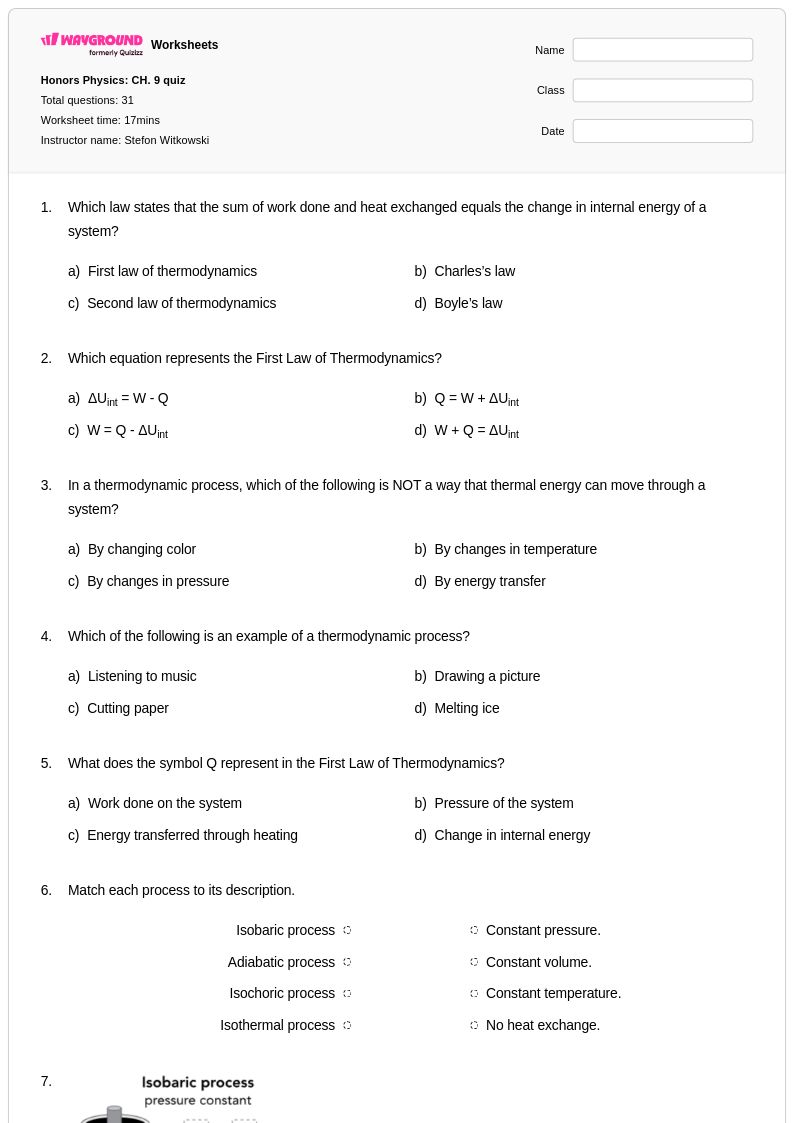
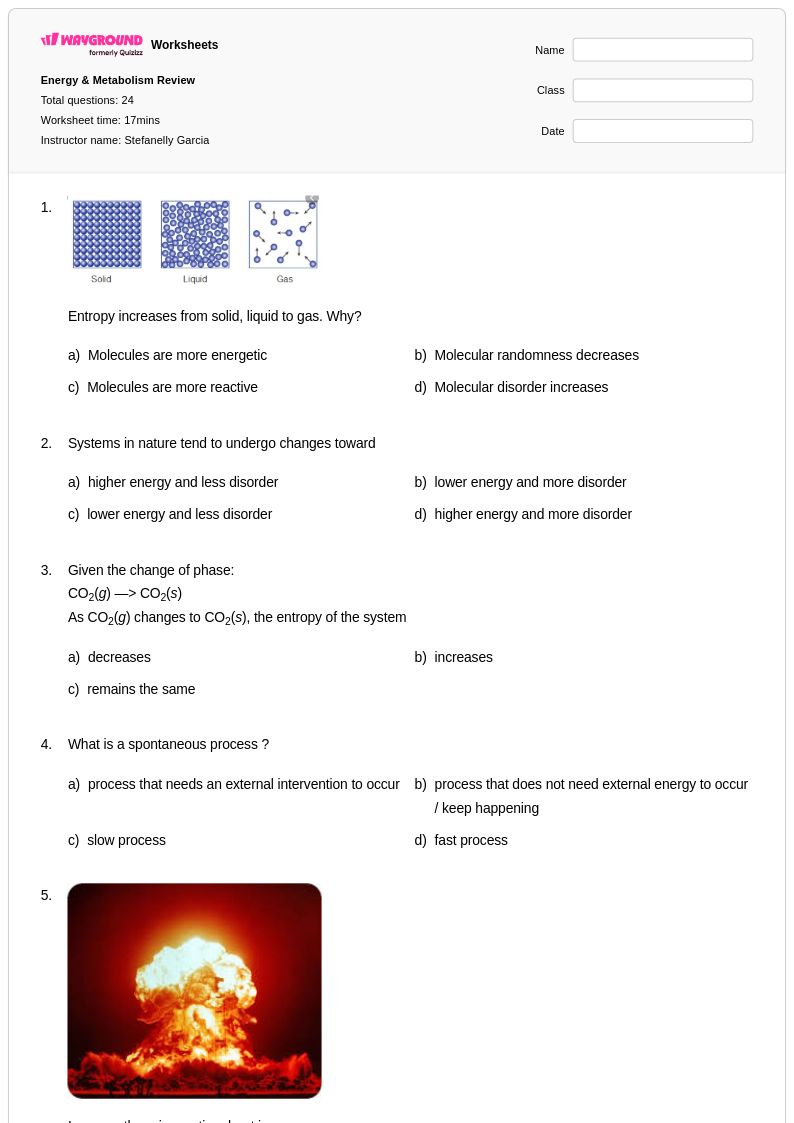
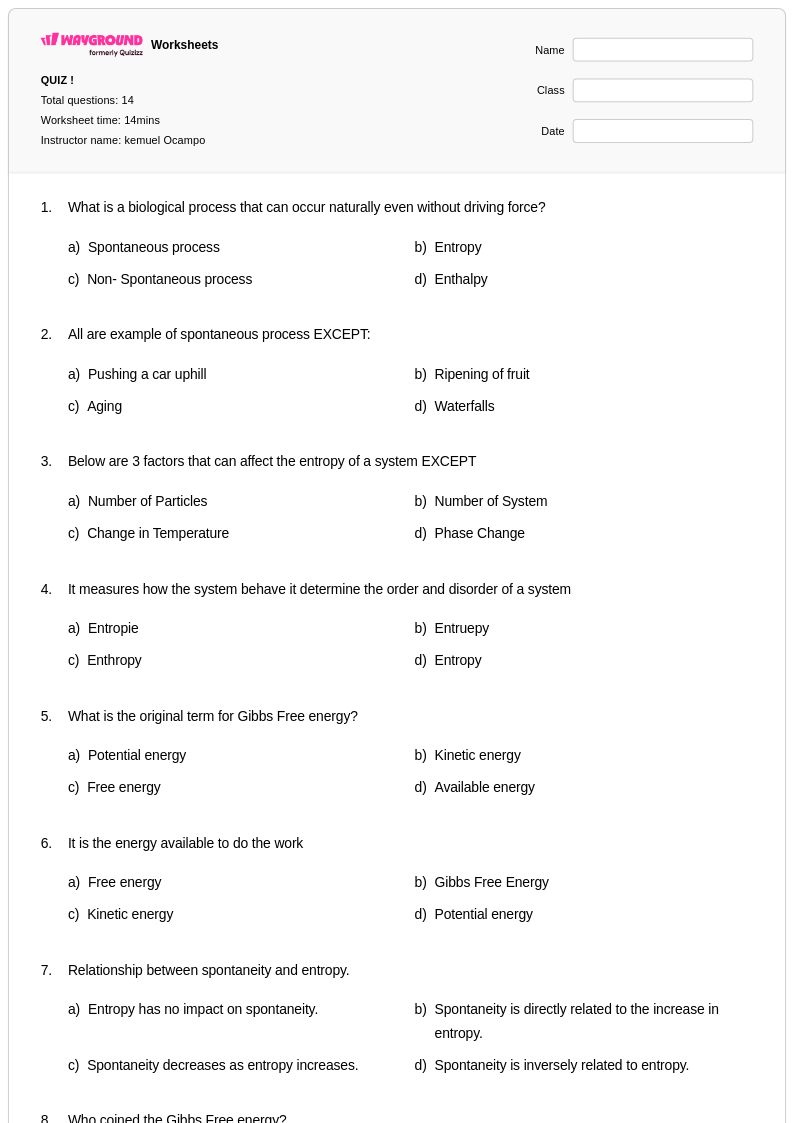
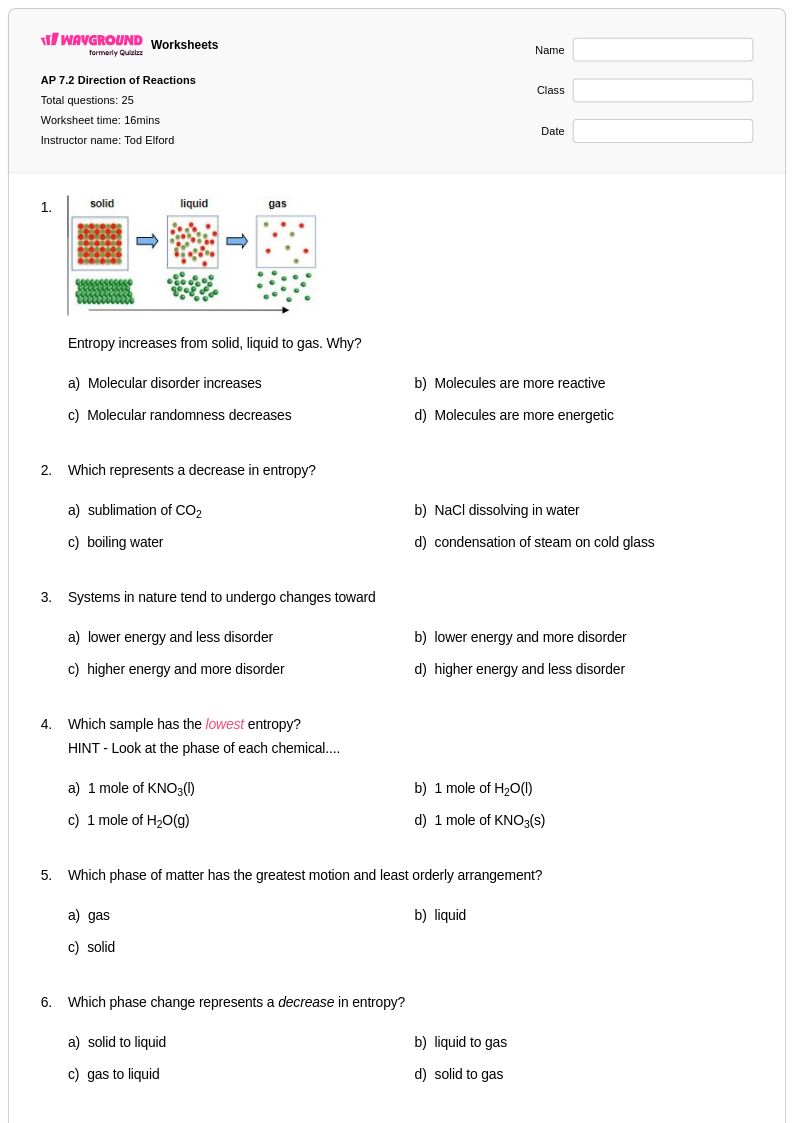
Explore Wayground's comprehensive collection of Year 11 entropy worksheets featuring free printables, practice problems, and detailed answer keys to help students master this fundamental physics concept through engaging PDF exercises.
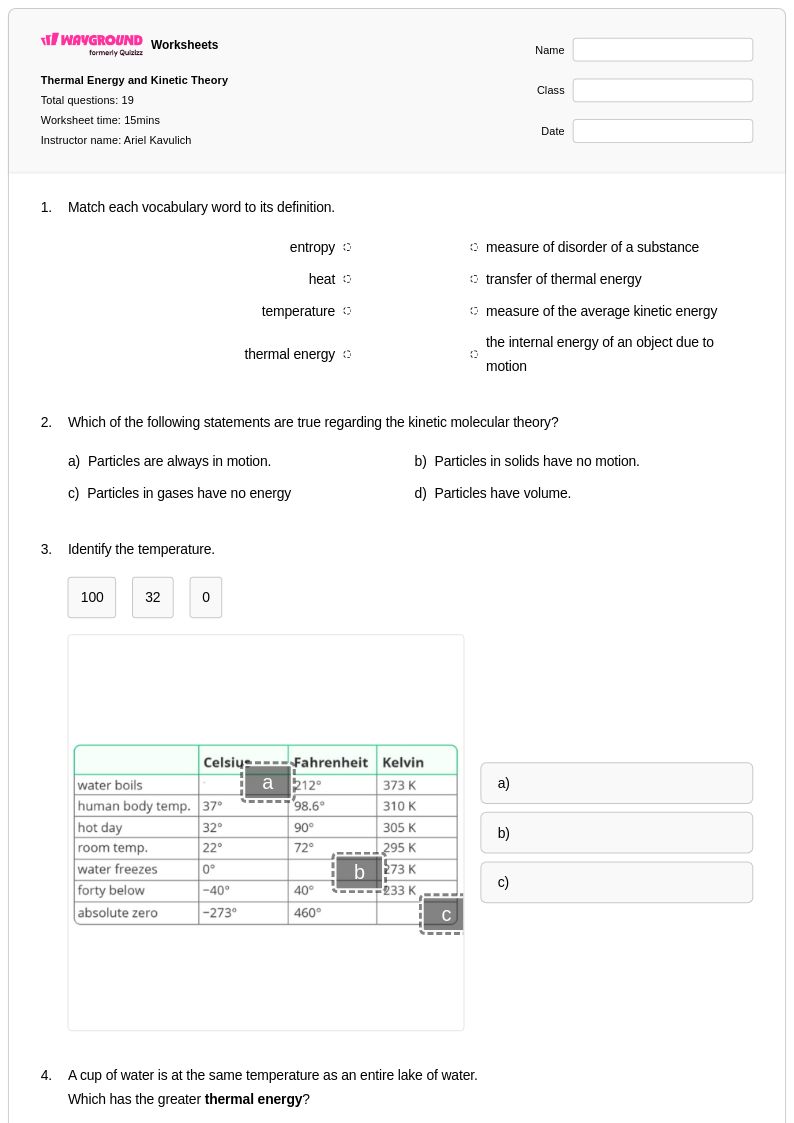
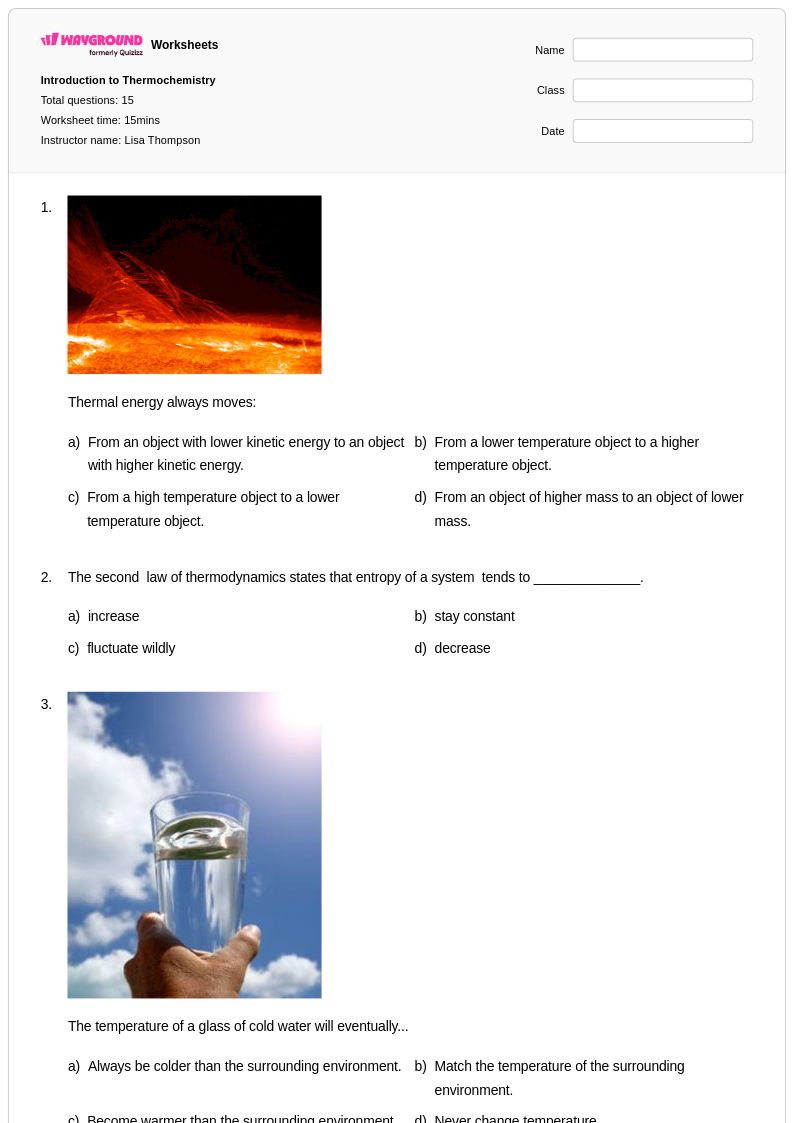
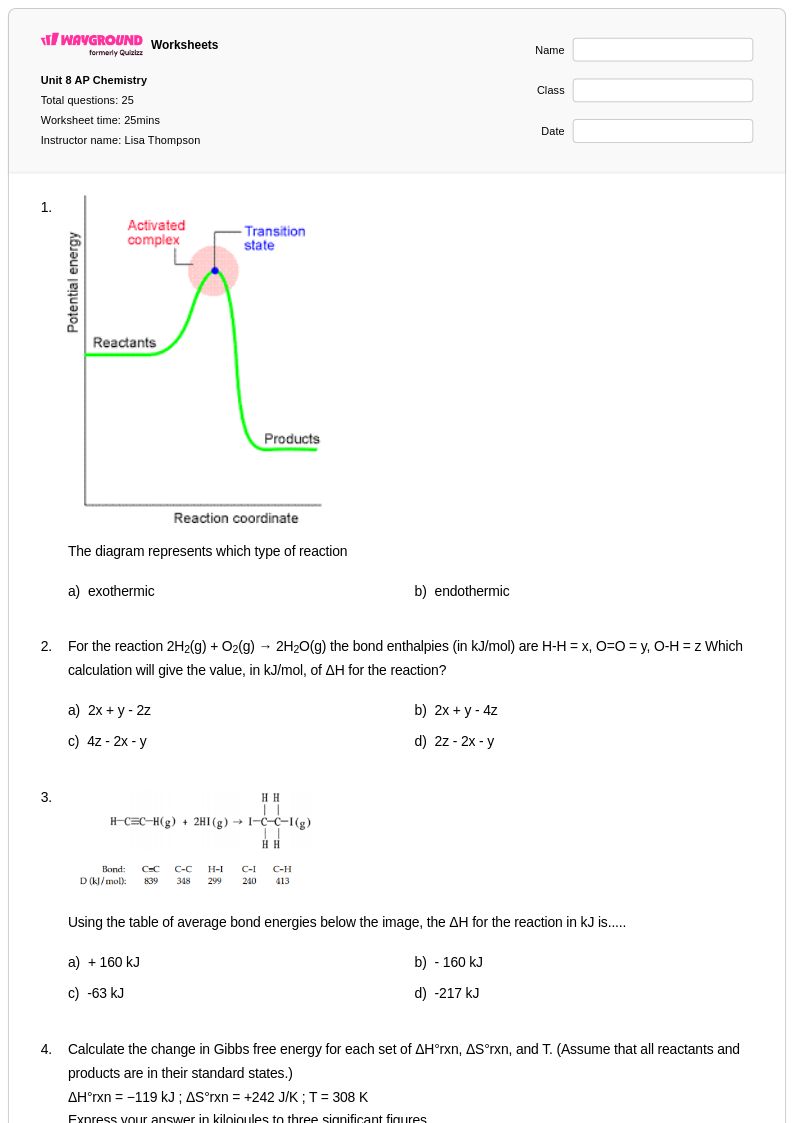
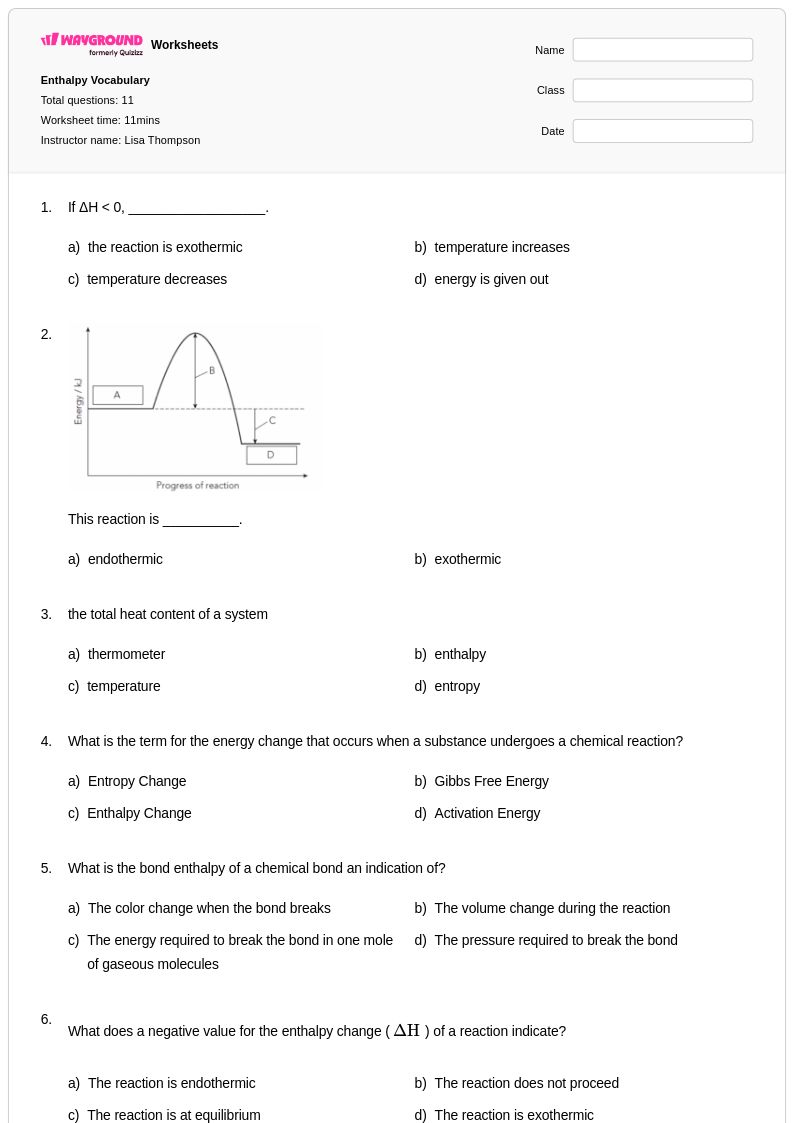
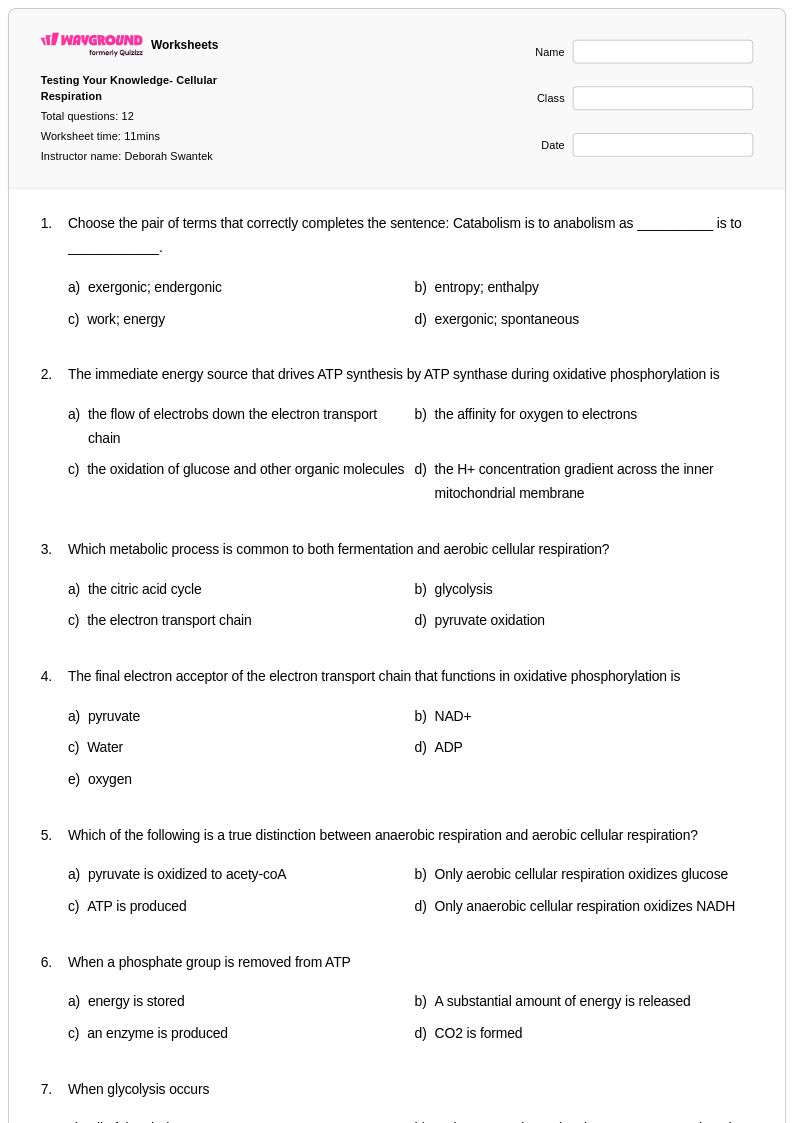
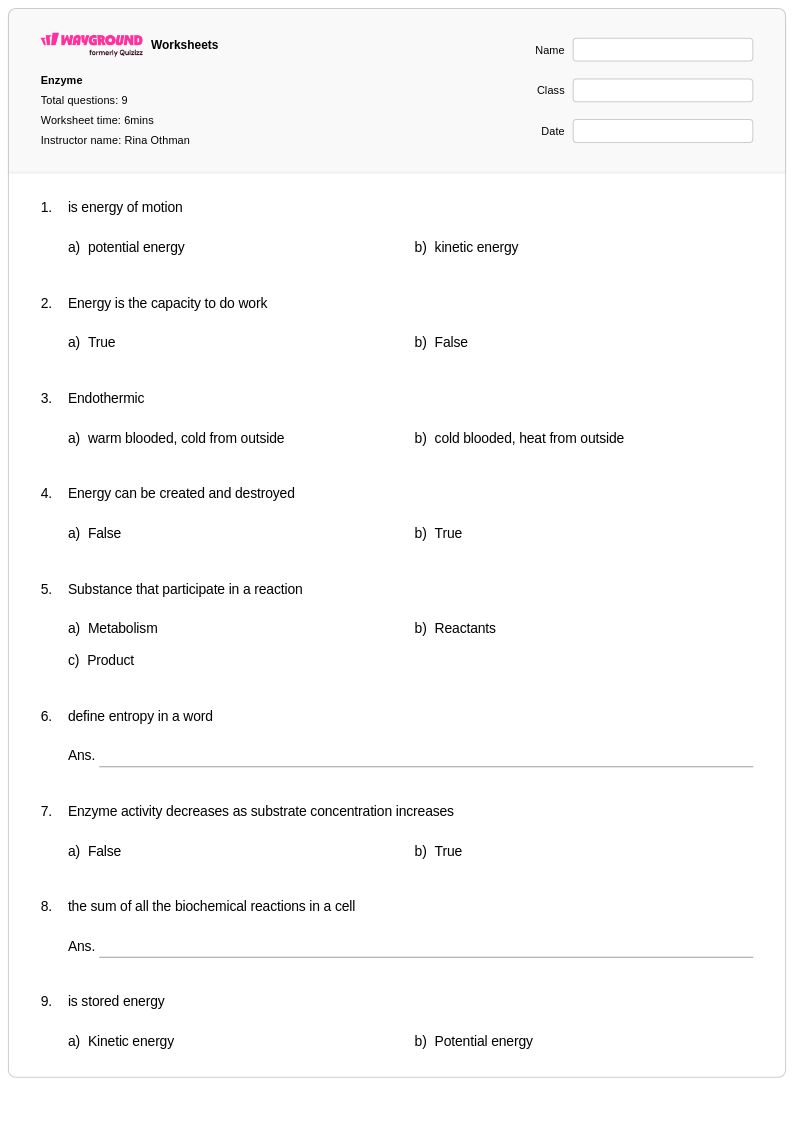
Year 11 entropy worksheets available through Wayground (formerly Quizizz) provide comprehensive coverage of this fundamental thermodynamic concept, helping students master the quantitative and conceptual aspects of disorder in physical systems. These carefully designed practice problems guide students through calculating entropy changes in various processes, interpreting the second law of thermodynamics, and understanding the relationship between entropy, temperature, and energy distribution. The worksheets strengthen critical analytical skills by presenting scenarios involving phase transitions, heat engines, and spontaneous processes, with each printable resource including detailed answer keys that support independent learning and self-assessment. Free pdf downloads ensure accessibility while covering essential topics from basic entropy definitions to advanced applications in chemical and physical systems.
Wayground (formerly Quizizz) empowers educators with millions of teacher-created entropy resources that streamline lesson planning and differentiated instruction for Year 11 physics courses. The platform's robust search and filtering capabilities allow teachers to quickly locate worksheets aligned with specific curriculum standards, whether focusing on statistical mechanics, thermodynamic cycles, or entropy calculations. Digital and printable formats provide maximum flexibility for classroom implementation, while customization tools enable educators to modify existing content or create targeted practice sets for remediation and enrichment. These comprehensive worksheet collections support systematic skill development through varied problem types and difficulty levels, ensuring students build confidence with entropy concepts through structured practice and immediate feedback opportunities.
FAQs
How do I teach entropy to students who struggle with abstract concepts?
Entropy is best introduced through concrete analogies before moving to mathematical formalism. Common approaches include using the "messy room" analogy to illustrate disorder, or demonstrating irreversible processes like ink diffusing in water. Once students grasp the conceptual meaning of disorder and spontaneity, introducing the second law of thermodynamics and entropy calculations becomes significantly more accessible. Grounding abstract ideas in observable, real-world phenomena first reduces cognitive friction and builds lasting understanding.
What types of practice problems help students master entropy calculations?
Effective entropy practice spans several problem types: calculating entropy changes for phase transitions (melting, vaporization), analyzing mixing processes, and determining whether chemical reactions are spontaneous using ΔS values. Students also benefit from problems that connect entropy to the second law of thermodynamics and Gibbs free energy. Varied problem sets that move from single-step calculations to multi-step thermodynamic analyses help students build both procedural fluency and conceptual depth.
What mistakes do students commonly make when working with entropy?
The most common misconception is equating entropy exclusively with "messiness" without understanding its thermodynamic definition as the dispersal of energy across microstates. Students frequently confuse entropy change (ΔS) with absolute entropy, and they often incorrectly assume that all exothermic reactions are spontaneous without accounting for entropy contributions. Another persistent error is misapplying the second law by treating it as applying only to isolated systems rather than understanding that total entropy of the universe must increase in spontaneous processes.
How do I differentiate entropy instruction for students with varying math backgrounds?
For students with limited calculus exposure, focus on qualitative entropy reasoning and algebraic entropy calculations using standard thermodynamic tables. For more advanced learners, introduce statistical mechanics interpretations using Boltzmann's equation (S = k ln W) and entropy calculations from first principles. Wayground's entropy worksheets are available in difficulty levels that allow teachers to assign content appropriate to each student's mathematical background, and individual accommodations such as reduced answer choices or read-aloud support can be applied per student without disrupting the rest of the class.
How can I use Wayground's entropy worksheets in my classroom?
Wayground's entropy worksheets are available as free printable PDFs for traditional classroom use and in digital formats for technology-integrated environments, making them suitable for in-class instruction, homework, or targeted remediation. Teachers can also host worksheets as a quiz directly on Wayground, giving students an interactive experience while automatically collecting response data. All worksheets include answer keys, so teachers can use them for independent practice, formative checks, or self-paced review without additional preparation.
How does entropy relate to spontaneity, and how do I help students connect these ideas?
Spontaneity in thermodynamics is determined by Gibbs free energy (ΔG = ΔH - TΔS), which means entropy is one of two driving forces for whether a process occurs without external input. A common instructional strategy is to present students with four scenario types: reactions that are enthalpy-driven, entropy-driven, both, or neither, and have them predict spontaneity under different temperature conditions. This matrix-based approach makes the relationship between entropy, enthalpy, and spontaneity explicit and reduces rote memorization in favor of logical reasoning.