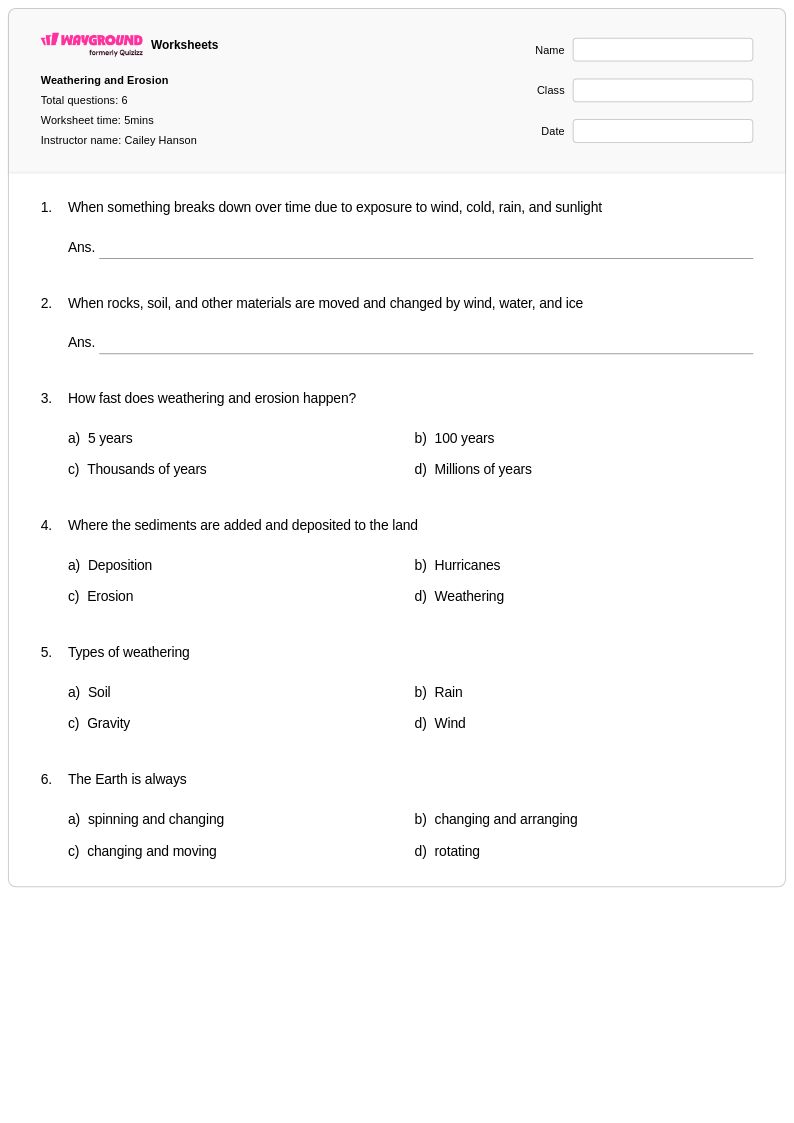
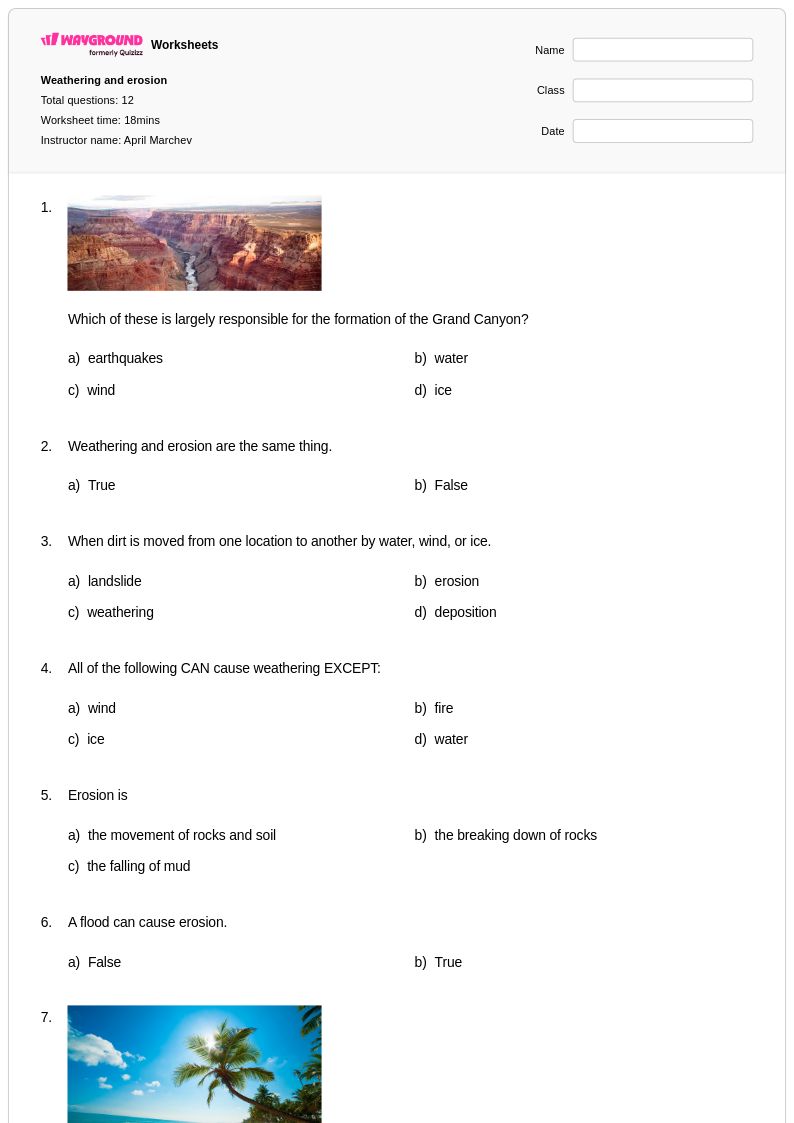
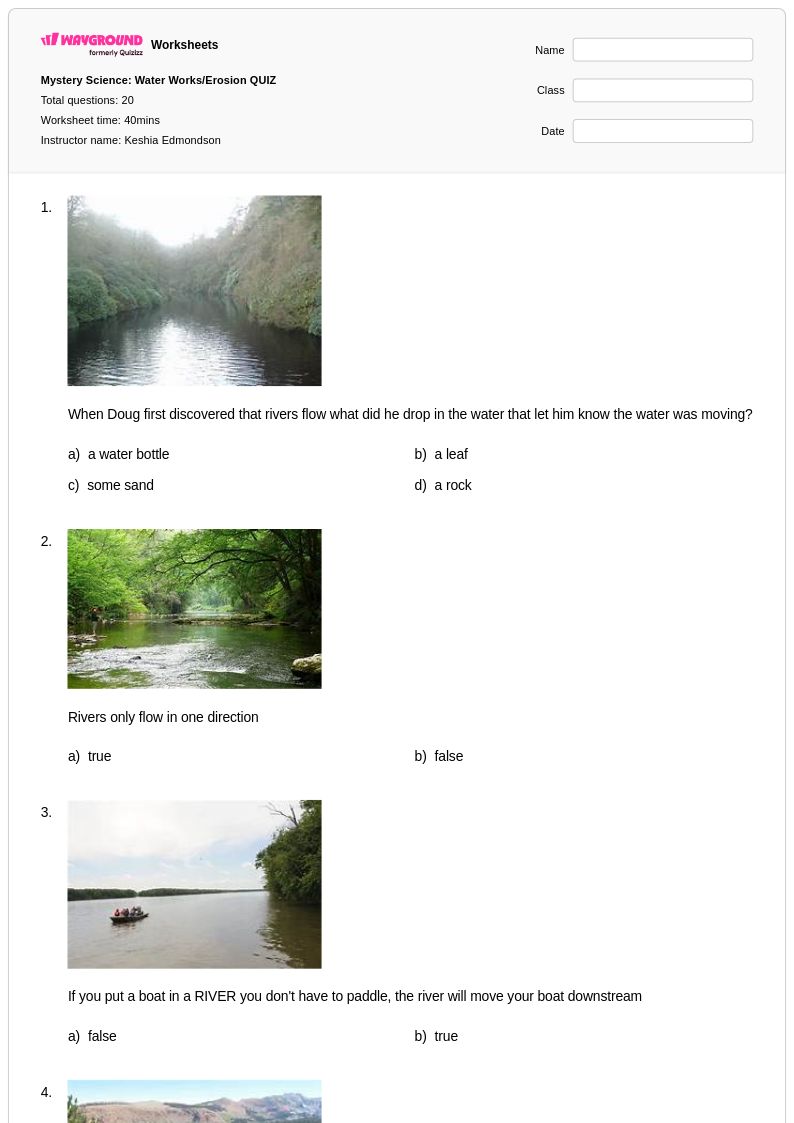
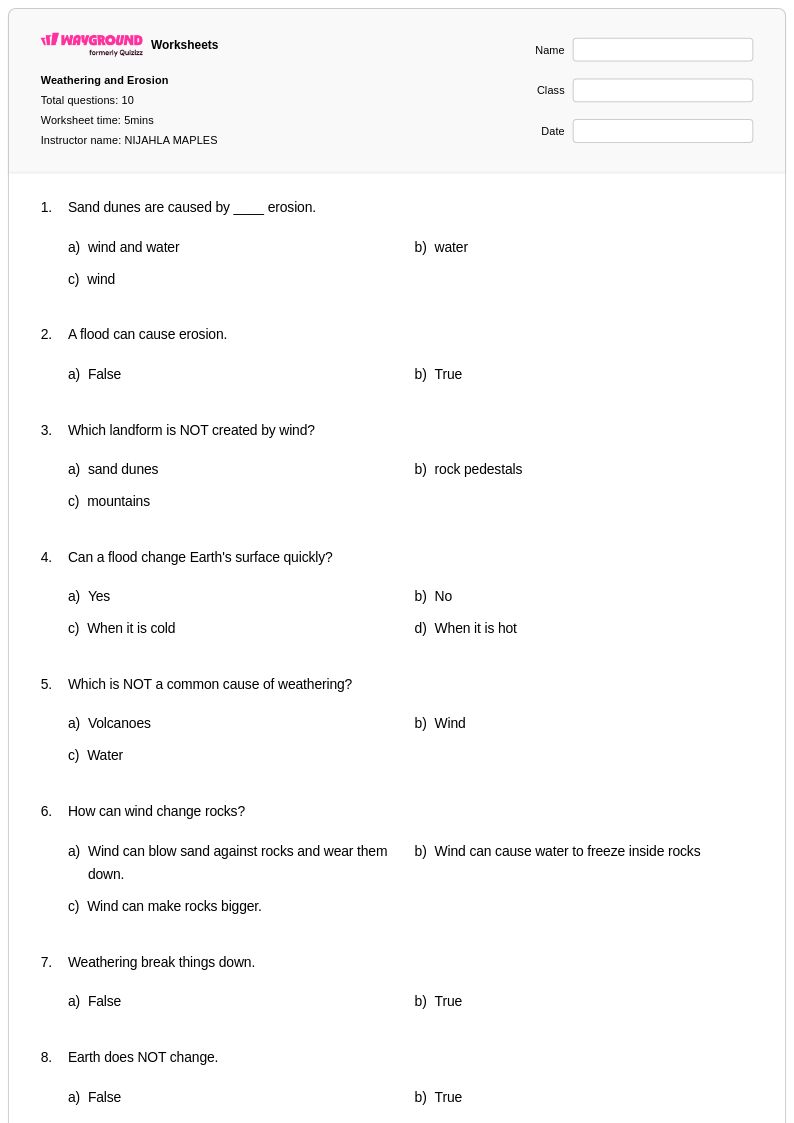
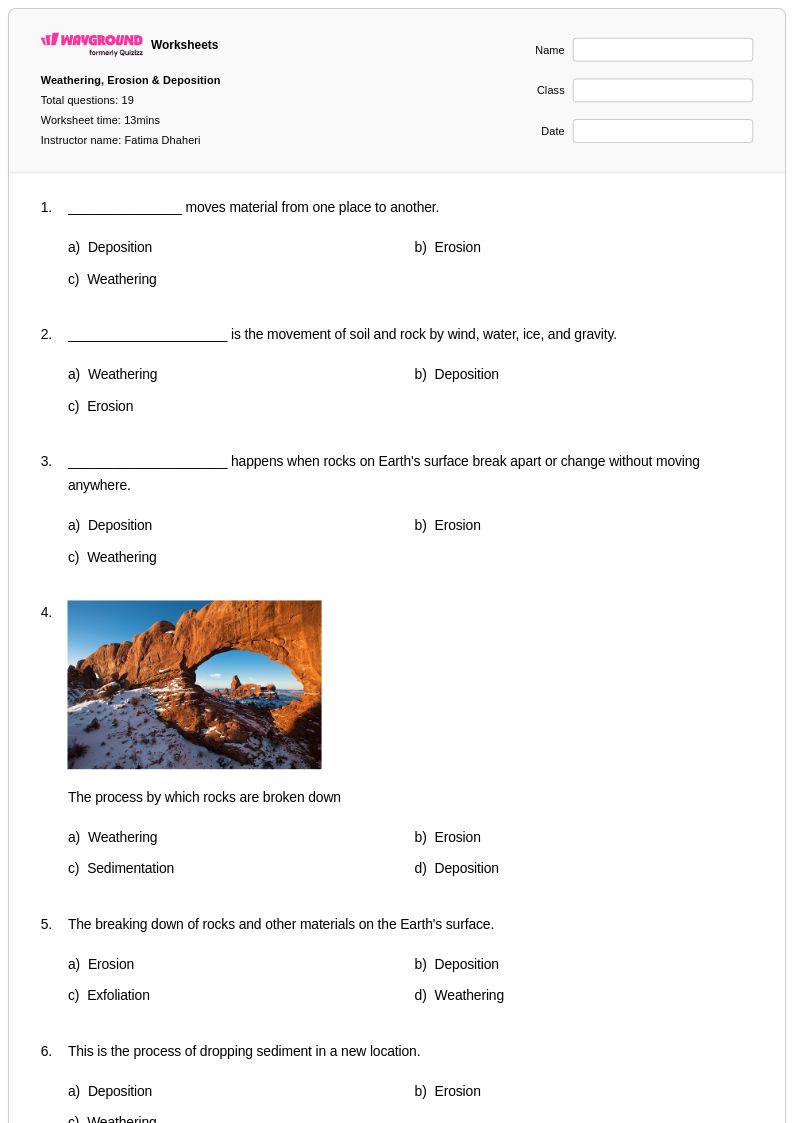
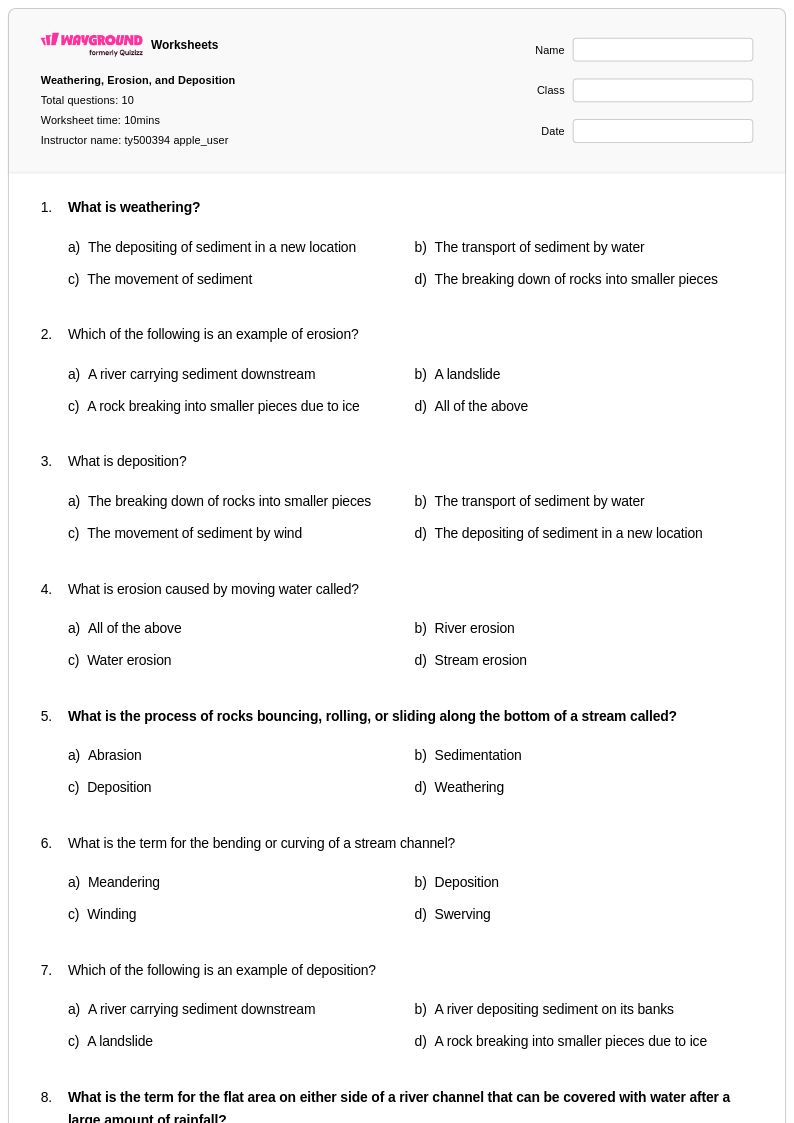
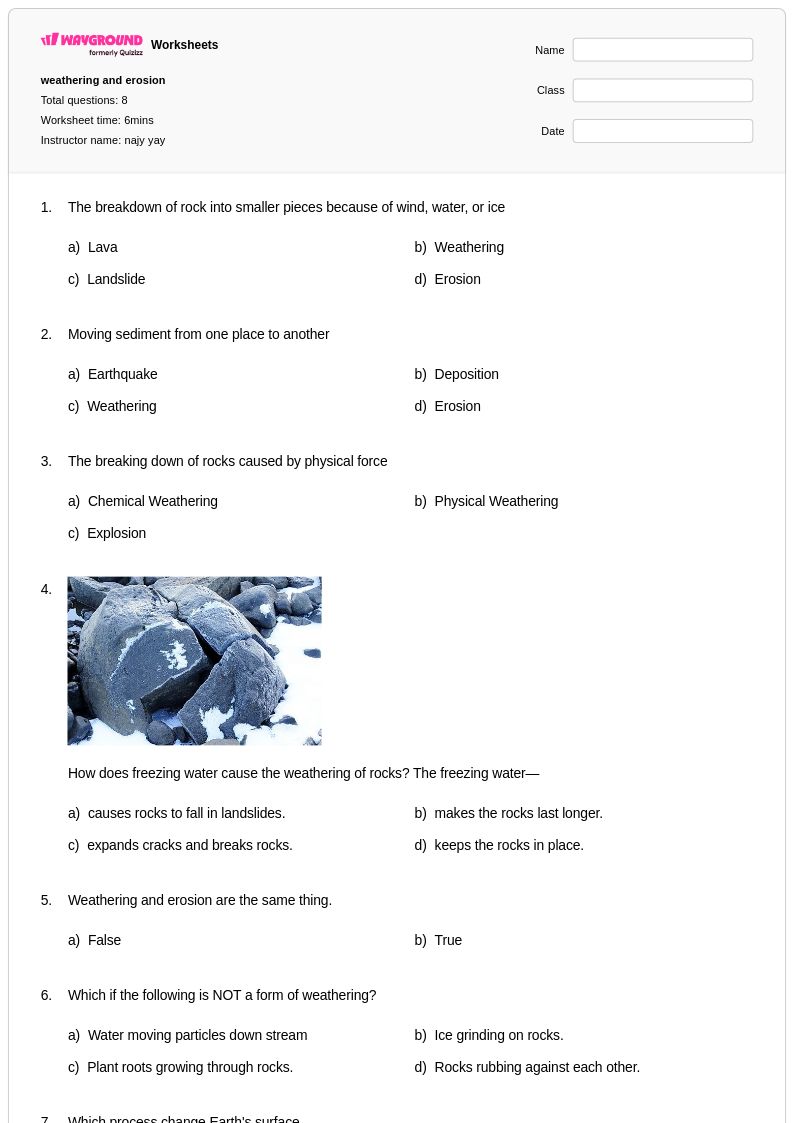
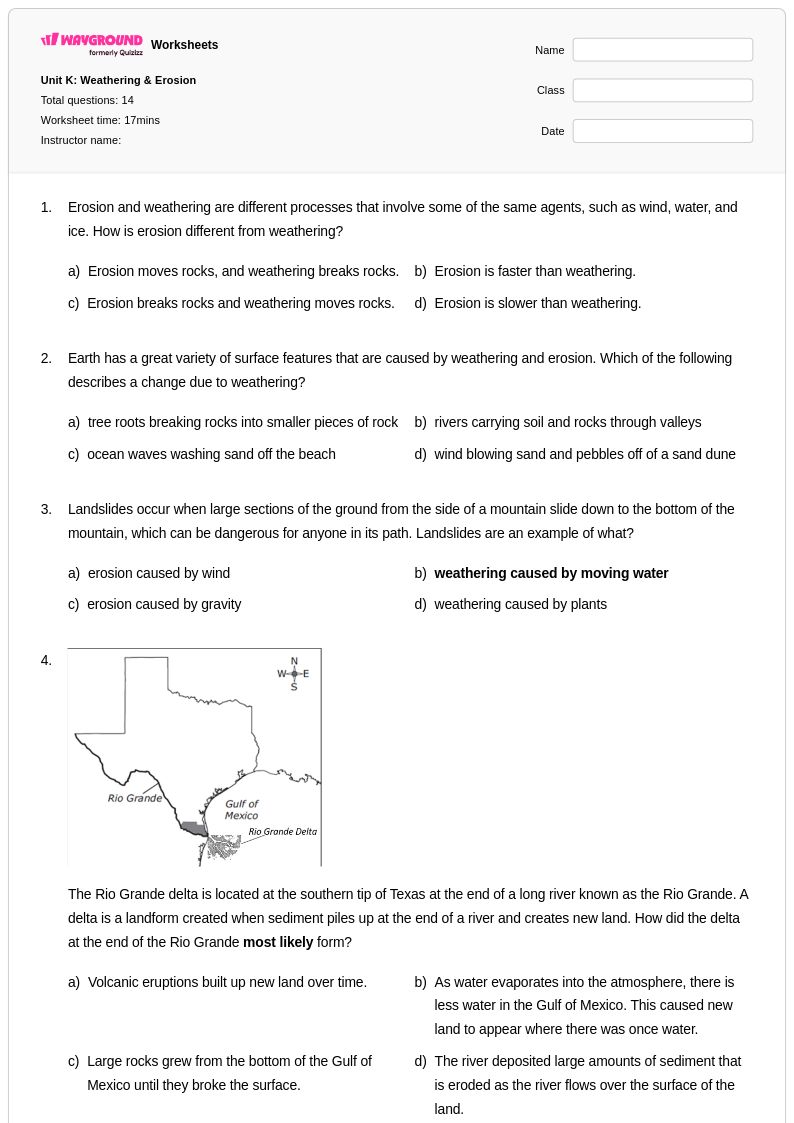
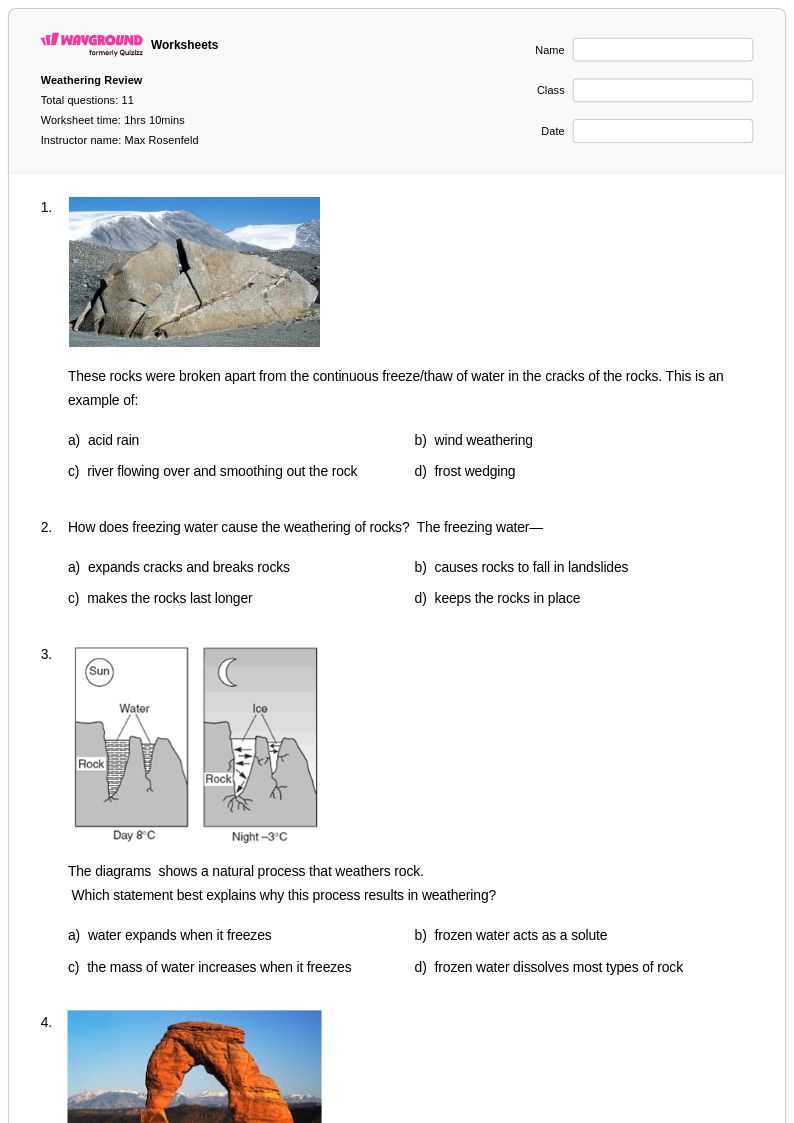
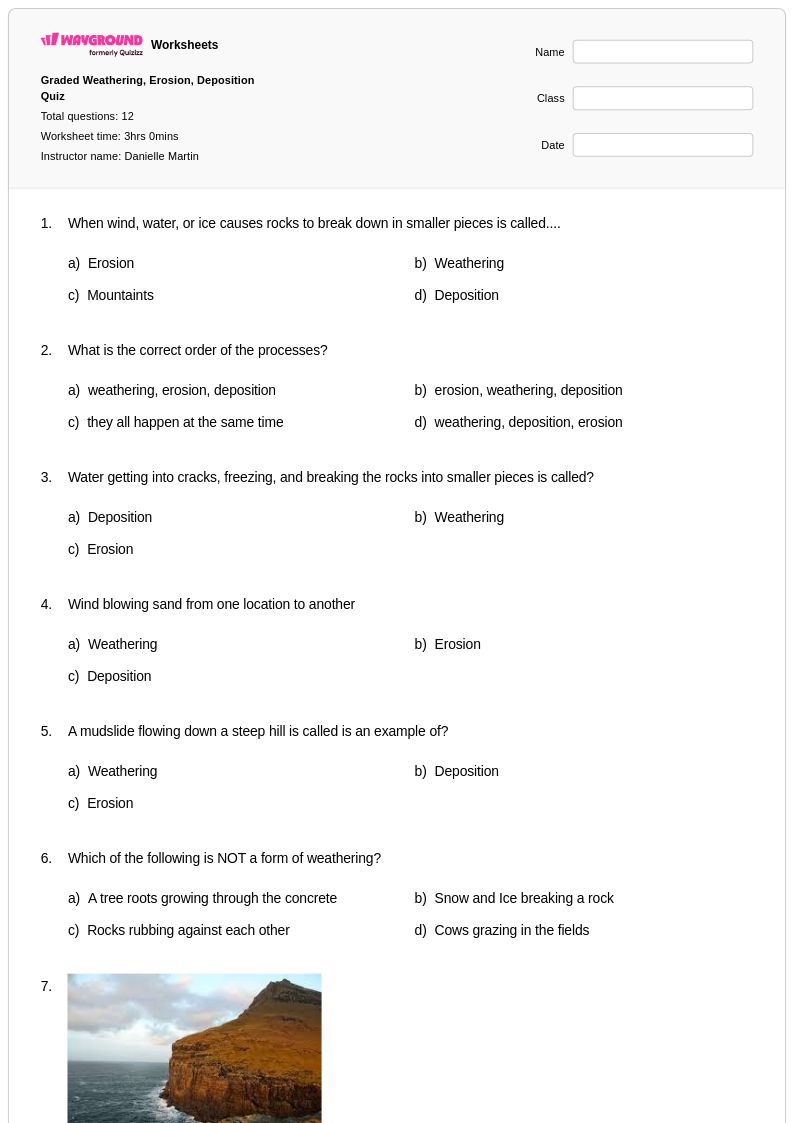
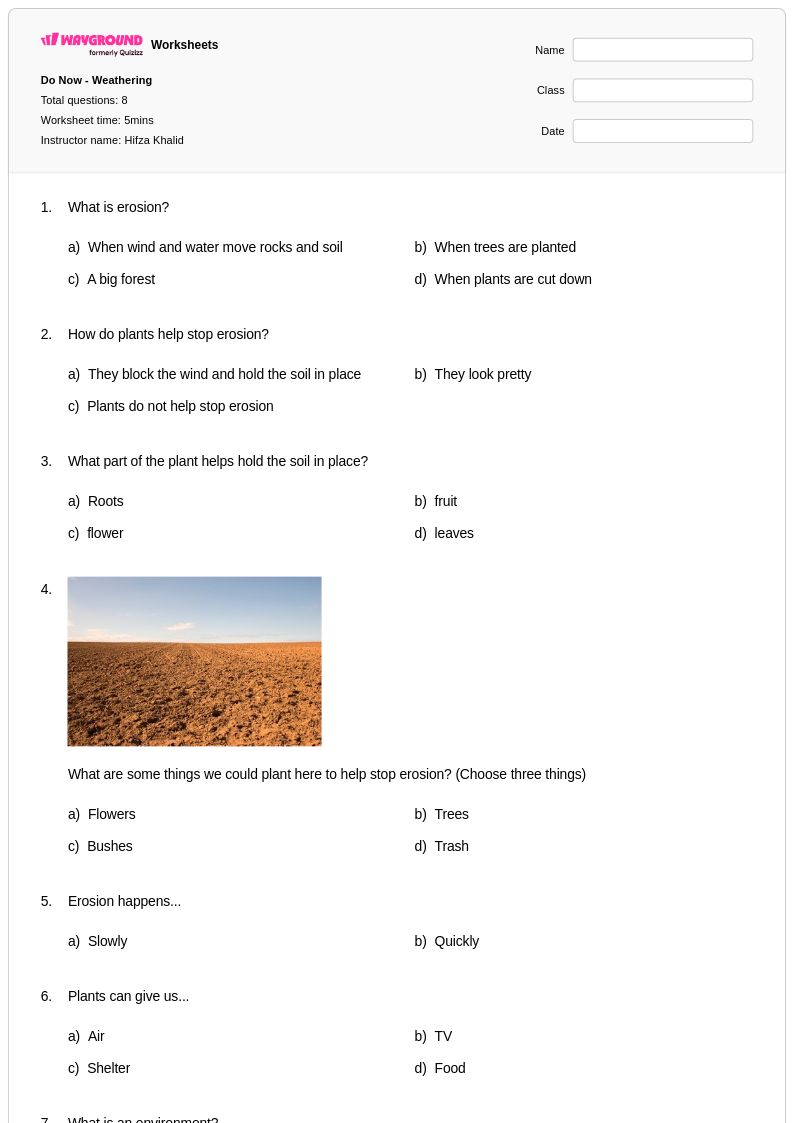
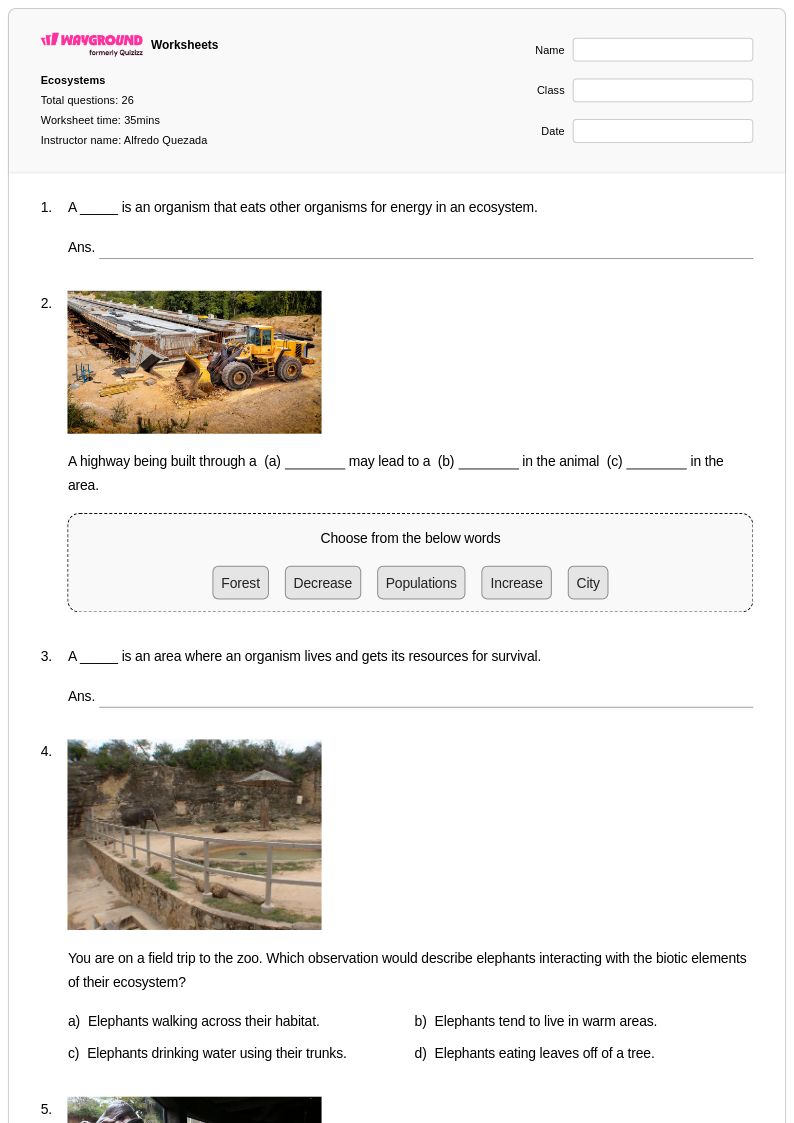
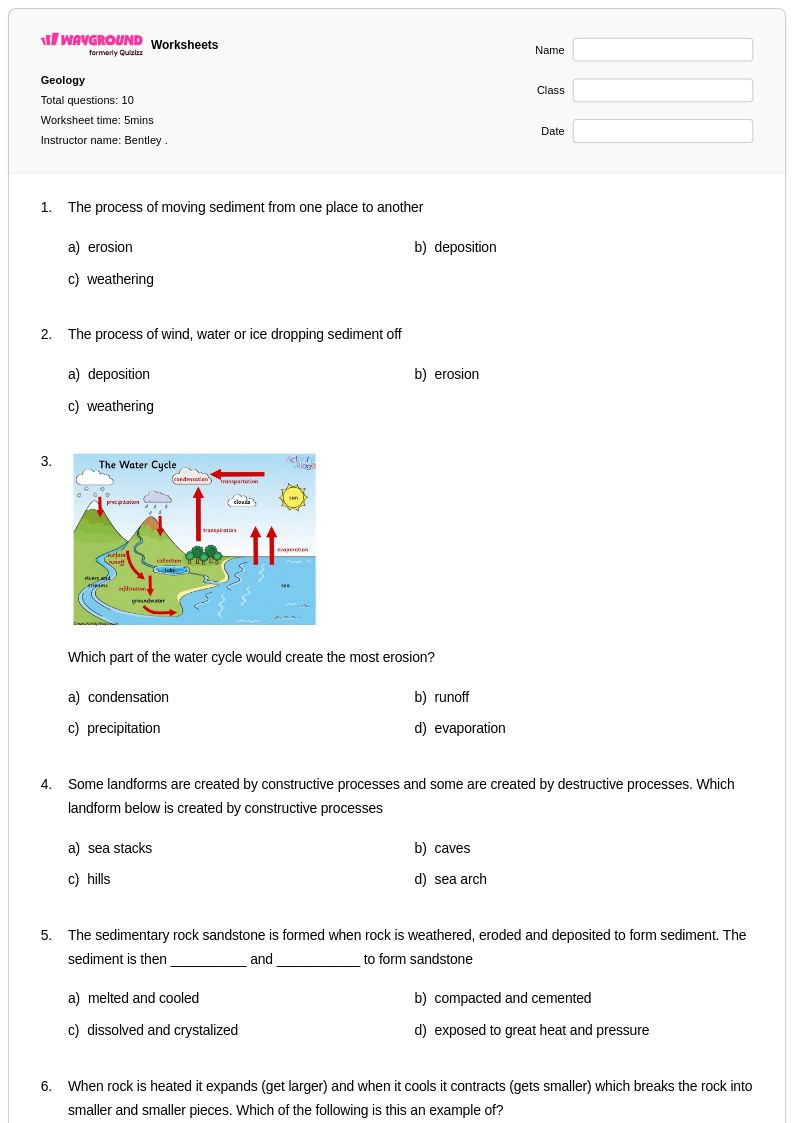
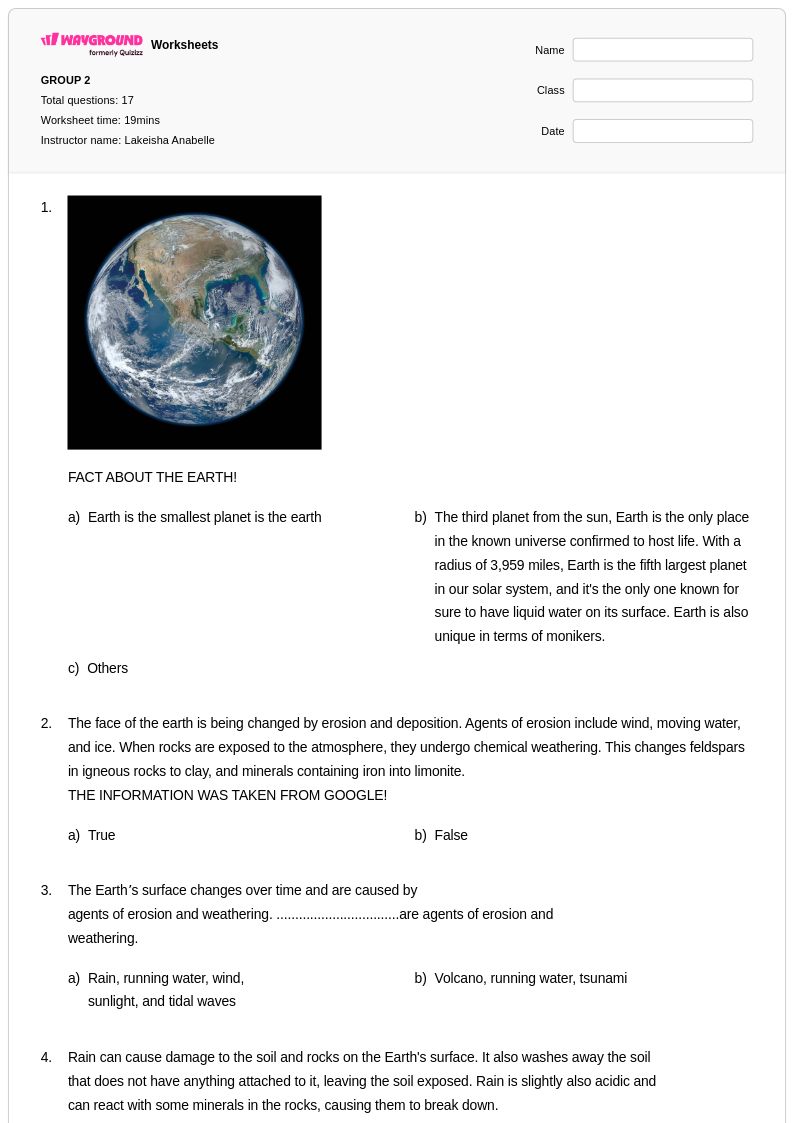
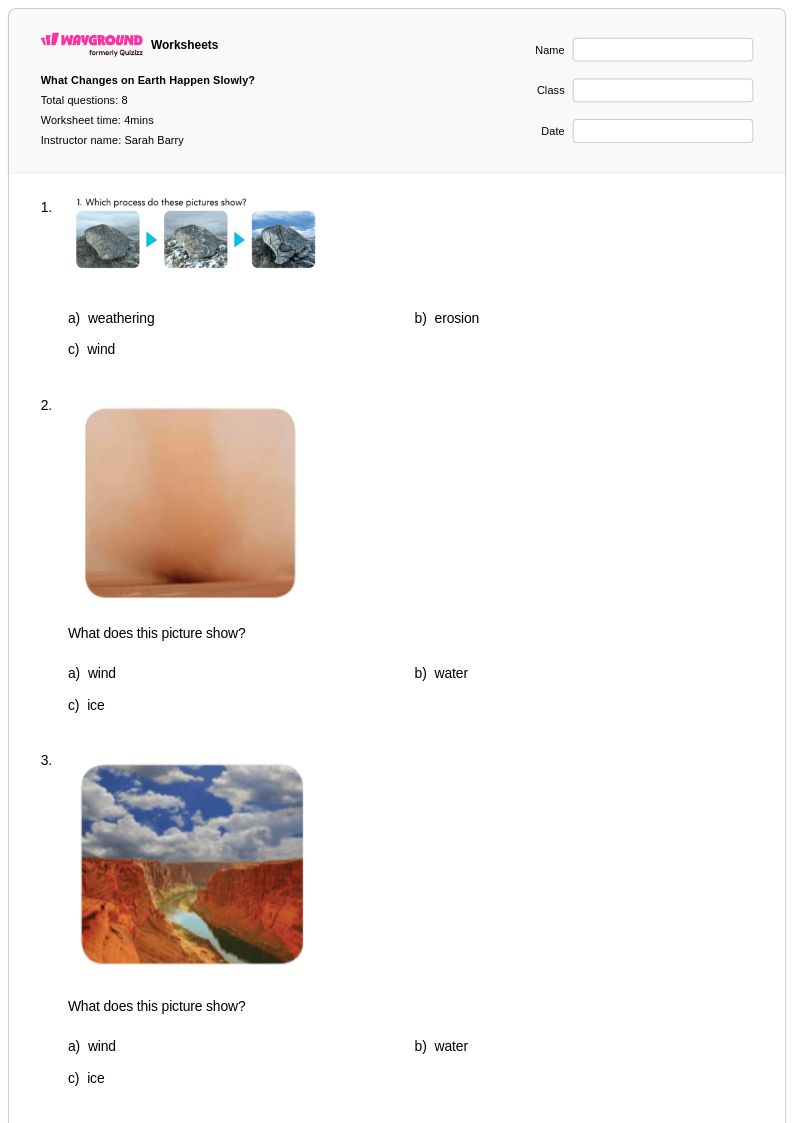
Explore Wayground's free Year 1 erosion worksheets and printables that help young students understand how wind, water, and ice change Earth's surface through engaging practice problems and answer keys.
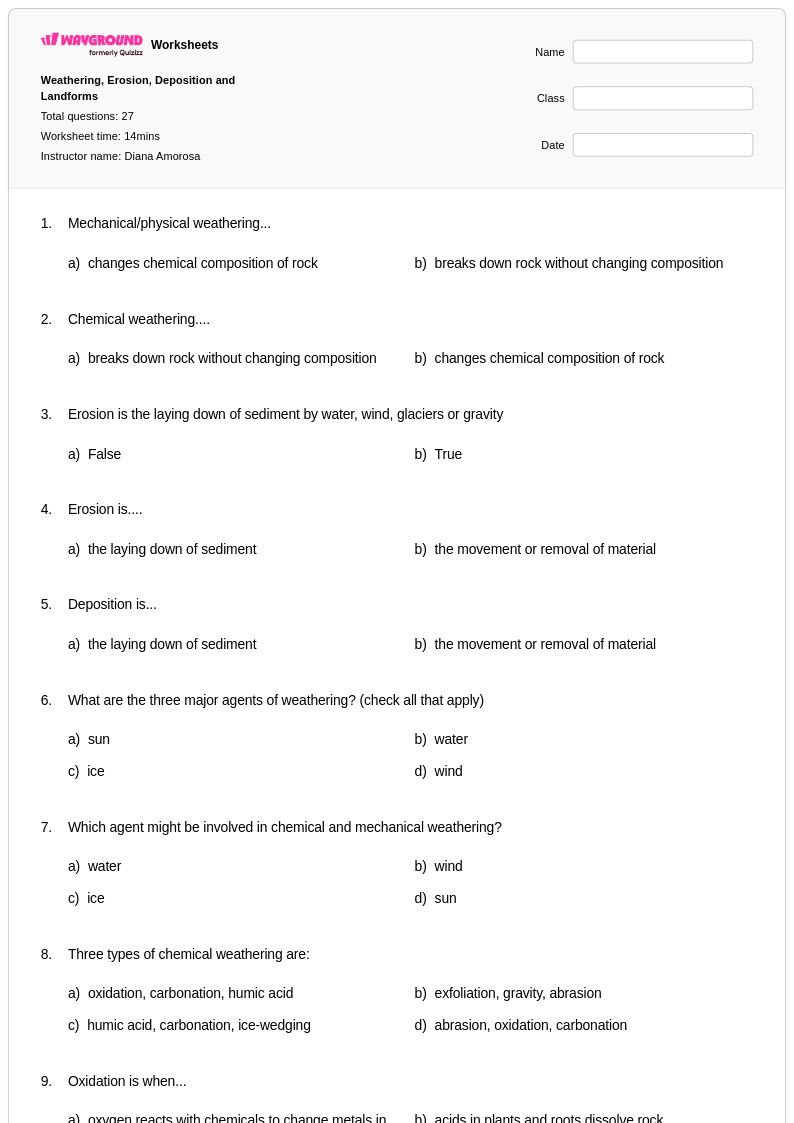
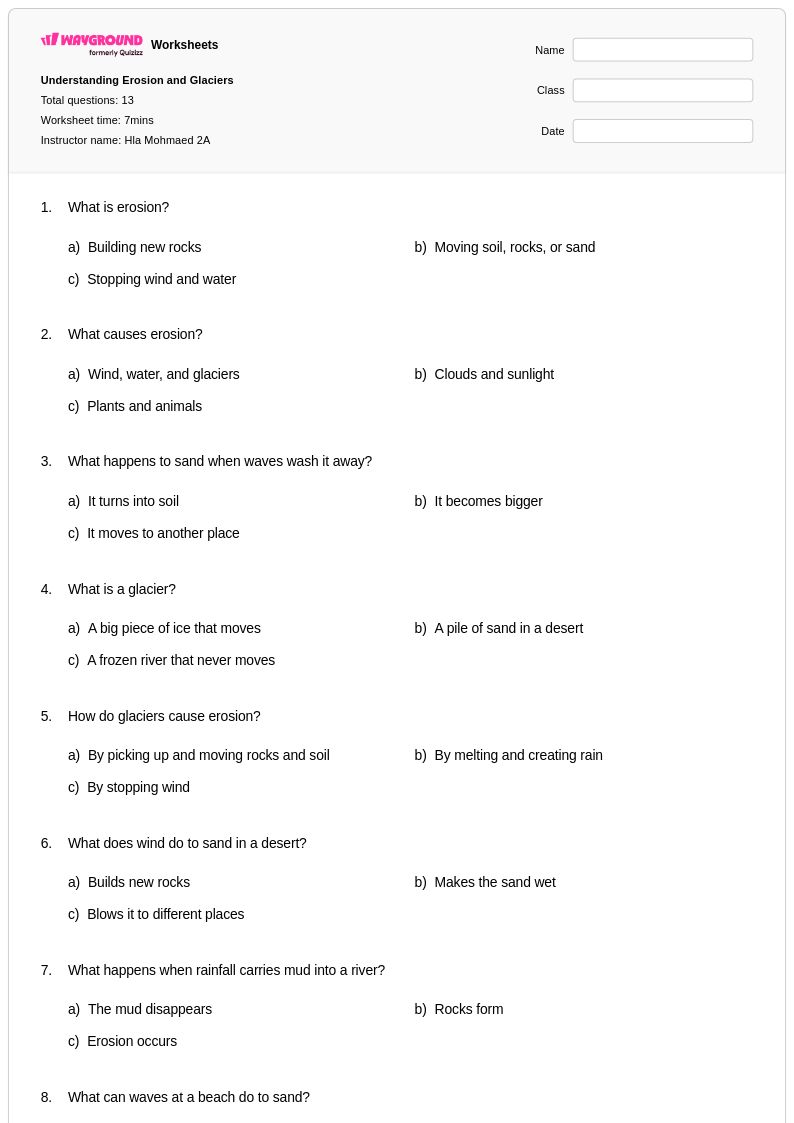
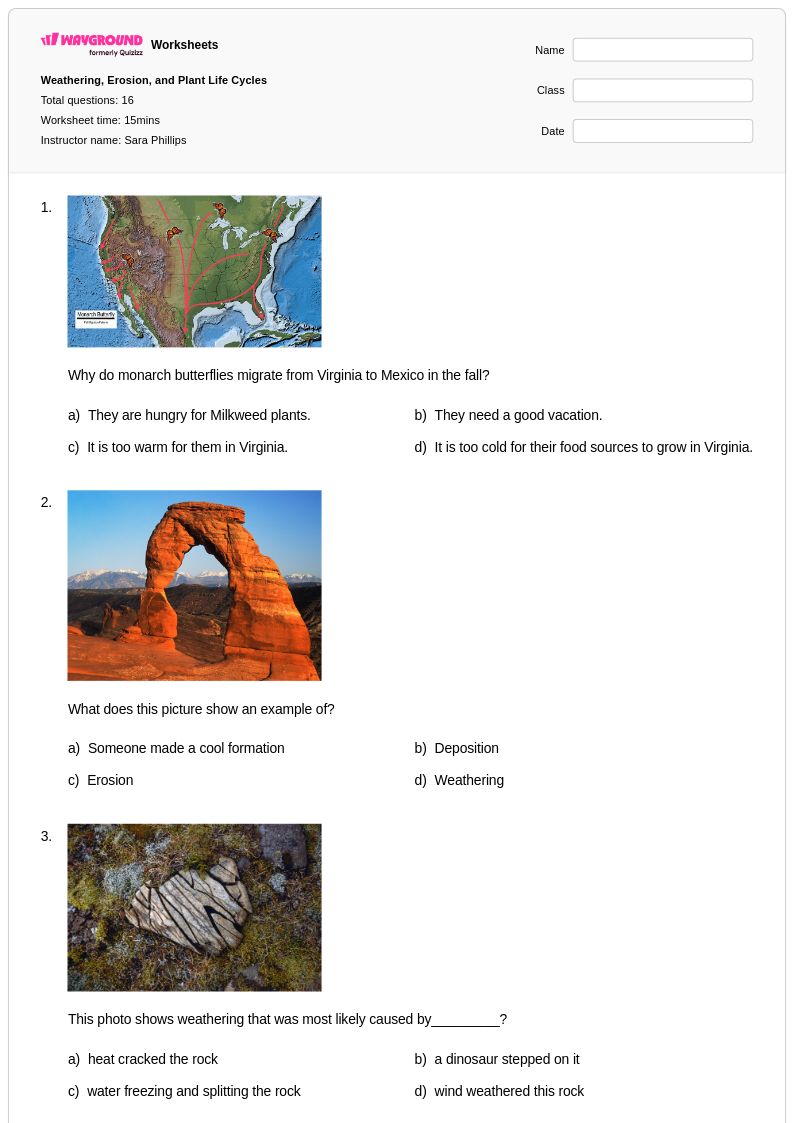
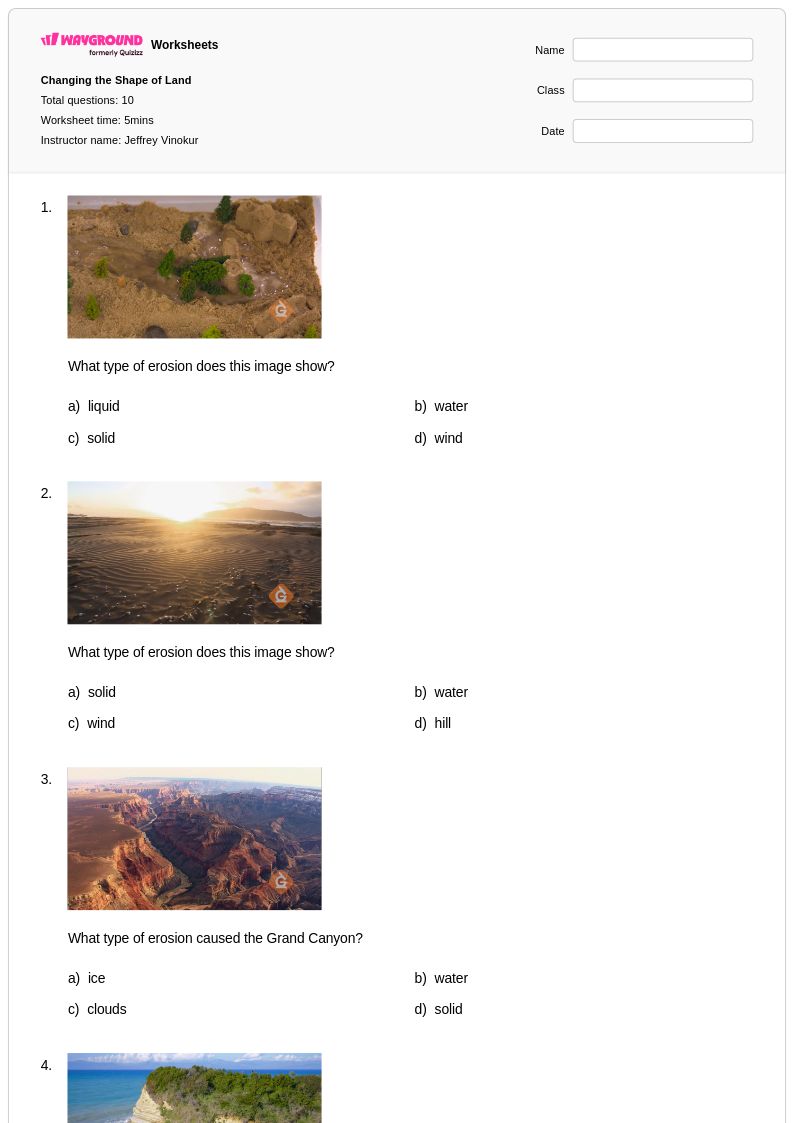
Year 1 erosion worksheets available through Wayground (formerly Quizizz) introduce young learners to the fundamental concept of how Earth's surface changes over time through natural forces. These carefully designed educational resources help first-grade students understand erosion through age-appropriate activities that demonstrate how wind, water, and ice can move soil, rocks, and sand from one place to another. The worksheets strengthen essential scientific observation skills and critical thinking abilities as students examine real-world examples of erosion in their environment. Each printable resource includes comprehensive practice problems that encourage students to identify erosion patterns, compare before-and-after scenarios, and connect cause-and-effect relationships in nature. Teachers can access complete answer keys and free pdf downloads that support both classroom instruction and independent learning, making these materials invaluable for building foundational earth science knowledge.
Wayground (formerly Quizizz) empowers educators with an extensive collection of millions of teacher-created erosion worksheets specifically tailored for Year 1 learners. The platform's advanced search and filtering capabilities allow teachers to quickly locate resources that align with specific learning standards and curriculum requirements for earth and space science instruction. Differentiation tools enable seamless customization of worksheet content to meet diverse student needs, from remediation support for struggling learners to enrichment activities for advanced students. These erosion-focused materials are available in both printable and digital formats, including downloadable pdfs that facilitate flexible lesson planning and implementation across various learning environments. The comprehensive worksheet collection supports systematic skill practice while providing teachers with reliable resources for formative assessment, concept reinforcement, and engaging hands-on learning experiences that make complex geological processes accessible to young scientists.
FAQs
How do I teach erosion to middle school students?
Start by grounding students in the difference between weathering and erosion, since conflating the two is one of the most common early misconceptions. From there, connect erosion to its agents — water, wind, ice, and gravity — using real-world landform examples like river deltas, sand dunes, and glacial valleys. Hands-on simulations, such as pouring water over a soil tray to model runoff erosion, help students visualize sediment transport and deposition as a connected sequence rather than isolated events.
What exercises help students practice identifying types of erosion?
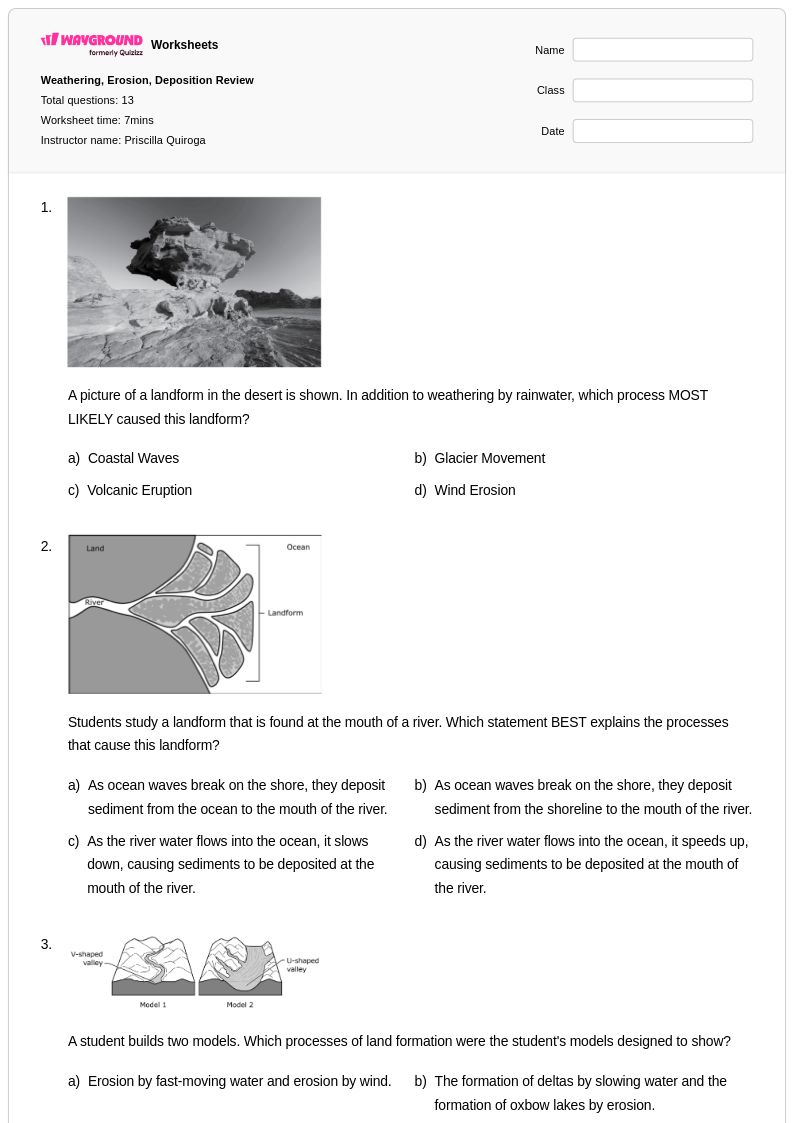
Effective practice tasks ask students to analyze landform images or data and attribute the erosion type responsible, rather than simply matching vocabulary terms to definitions. Problem sets that present scenarios — such as a coastal cliff retreating or a river bend widening — and require students to predict future landscape changes build the analytical reasoning that erosion instruction aims to develop. Practice problems that connect erosion type to its agent (e.g., glacial erosion carving U-shaped valleys vs. water erosion forming V-shaped valleys) reinforce conceptual distinctions through applied comparison.
What are common misconceptions students have about erosion?
The most persistent misconception is that weathering and erosion are the same process. Students often use the terms interchangeably, not recognizing that weathering breaks material down in place while erosion involves the movement of that material. A second common error is assuming erosion is always slow and gradual — students are often surprised to learn that flash floods, landslides, and wave action can reshape landforms rapidly. A third misconception is underestimating human impact; students frequently overlook how deforestation, agriculture, and construction significantly accelerate natural erosion rates.
How do I explain the relationship between erosion and deposition to students?
Erosion and deposition are two halves of the same process: eroded material is transported by an agent and then deposited when that agent loses energy. A useful classroom framing is to follow a single sediment particle — picked up by a river during heavy rain, carried downstream, and eventually deposited as a delta where the river slows. This narrative approach helps students see erosion not as a standalone event but as part of a continuous cycle that reshapes Earth's surface over time.
How can I use erosion worksheets to support students at different skill levels?
Erosion worksheets can be differentiated by adjusting the complexity of the task — lower-level tasks might ask students to label erosion agents on a diagram, while higher-level tasks require interpreting erosion data or evaluating prevention strategies. On Wayground, teachers can apply individual student accommodations such as reduced answer choices to lower cognitive load for students who need additional support, or enable Read Aloud for students who benefit from audio delivery of questions. These settings can be configured per student and reused across sessions, making it practical to maintain differentiated instruction without rebuilding materials each time.
How do I use Wayground's erosion worksheets in my classroom?
Wayground's erosion worksheets are available as free printable PDFs for traditional classroom use and in digital formats for technology-integrated environments, giving teachers flexibility in how they assign and collect student work. Digital versions can be hosted as a quiz directly on Wayground, allowing teachers to track student responses and review results in one place. The worksheets include detailed answer keys, which makes them practical for independent practice, homework assignments, or review sessions where students self-check their work.