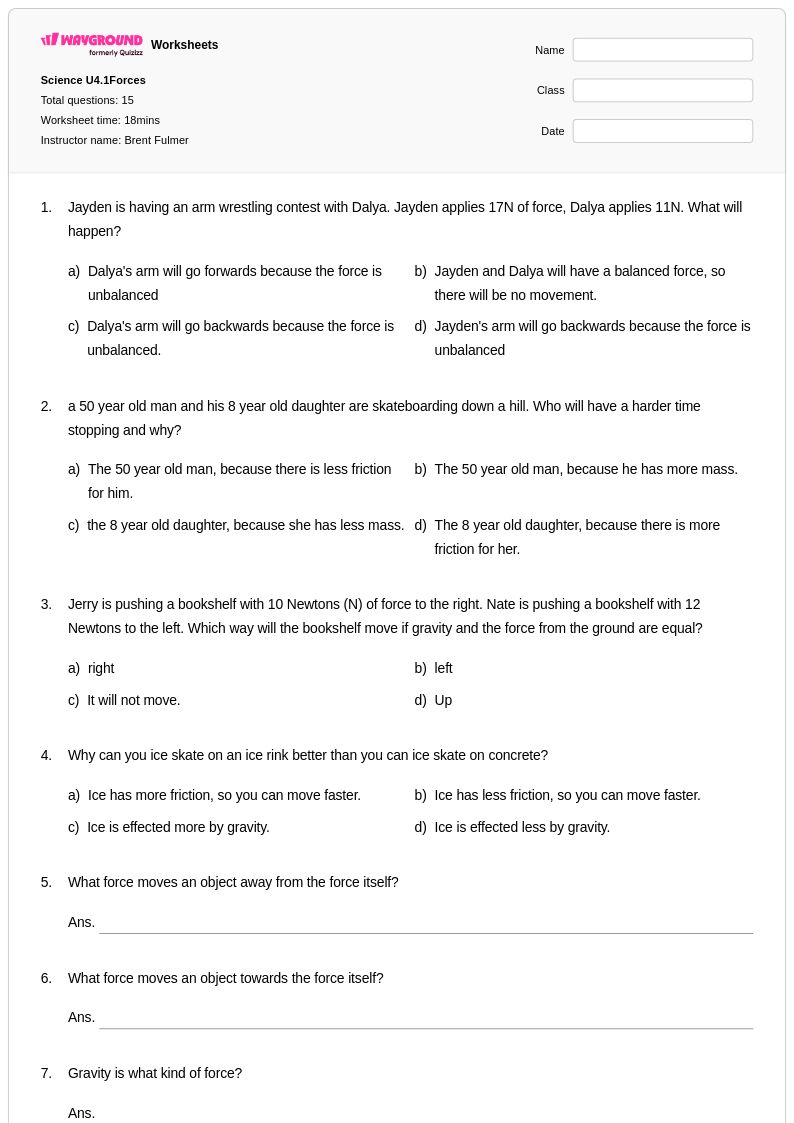
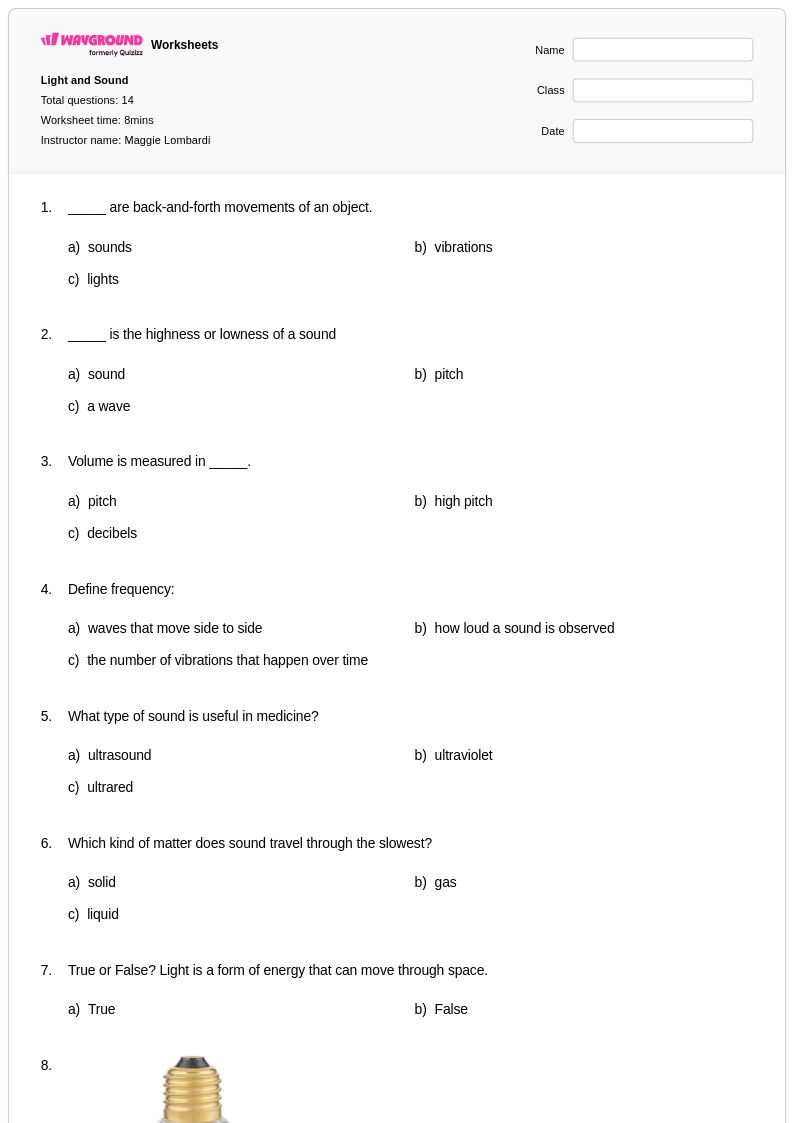
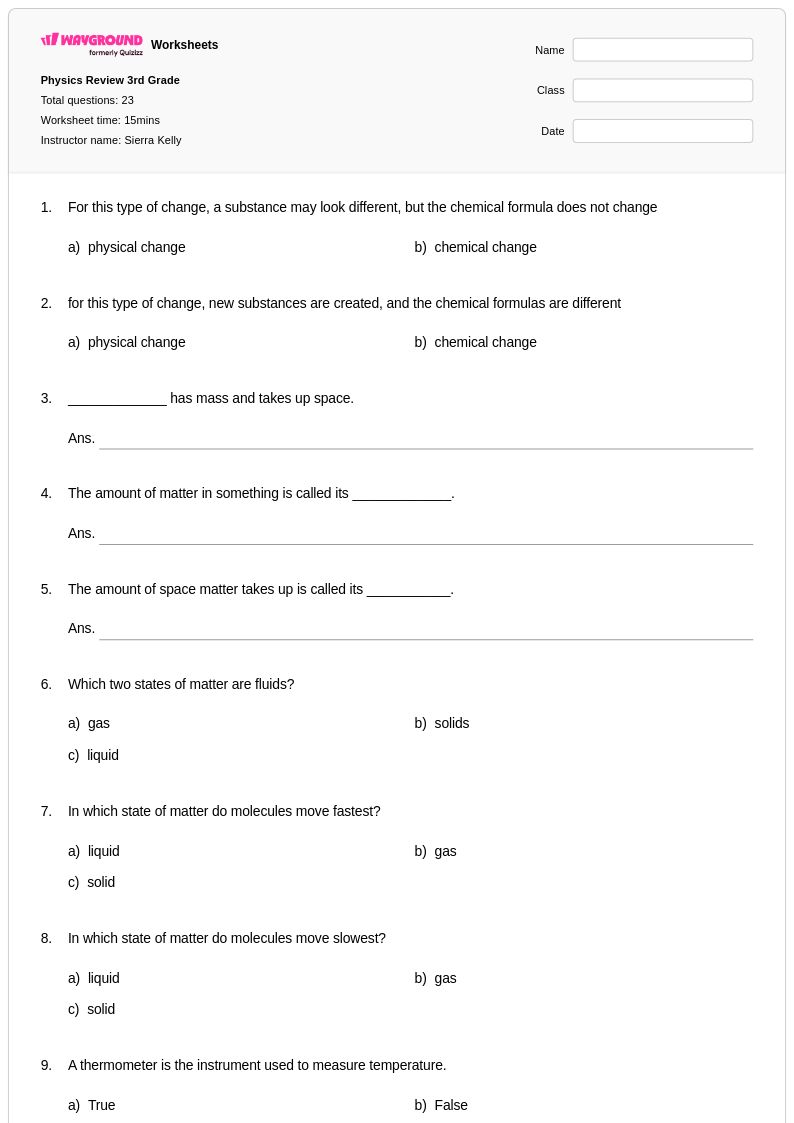
Year 5 Physics worksheets from Wayground help students explore fundamental concepts through engaging printables, practice problems, and comprehensive answer keys that make learning physical science accessible and fun.
Year 5 physics worksheets available through Wayground (formerly Quizizz) provide essential foundations in physical science concepts that introduce young learners to the fundamental principles governing motion, energy, and matter. These comprehensive resources strengthen critical thinking skills as students explore topics such as simple machines, forces and motion, sound and light waves, magnetism, and basic electrical circuits through hands-on practice problems and engaging activities. Each worksheet collection includes detailed answer keys and is available as free printables in convenient pdf format, allowing educators to seamlessly integrate physics concepts into their science curriculum while building students' analytical reasoning and scientific inquiry abilities.
Wayground (formerly Quizizz) empowers teachers with millions of teacher-created physics resources specifically designed for fifth-grade learners, featuring robust search and filtering capabilities that enable quick identification of materials aligned with state and national science standards. The platform's differentiation tools and flexible customization options allow educators to modify worksheets for diverse learning needs, supporting both remediation for struggling students and enrichment opportunities for advanced learners. Available in both printable and digital formats including downloadable pdfs, these physics worksheet collections streamline lesson planning while providing structured skill practice that reinforces classroom instruction and helps students develop confidence in scientific problem-solving and conceptual understanding.
FAQs
How do I teach physics concepts like Newton's Laws and energy to high school students?
Effective physics instruction builds from concrete physical experiences to abstract mathematical modeling. Start with free body diagrams and qualitative predictions before introducing equations, then use worked examples that connect the math to observable phenomena. Sequencing topics so that kinematics and Newton's Laws precede energy and momentum helps students build a coherent conceptual framework rather than treating each unit as isolated formulas.
What types of practice problems help students get better at physics problem solving?
Physics problem solving improves when students practice multiple representation types: verbal descriptions, equations, graphs, and diagrams for the same scenario. Worksheet exercises that require students to draw free body diagrams, interpret kinematic graphs, and set up equations from written prompts reinforce the translation skills that are central to physics reasoning. Varying problem contexts across mechanics, waves, electricity, and thermodynamics also prevents students from pattern-matching surface features rather than understanding the underlying principles.
What mistakes do students commonly make in physics, especially with kinematics and forces?
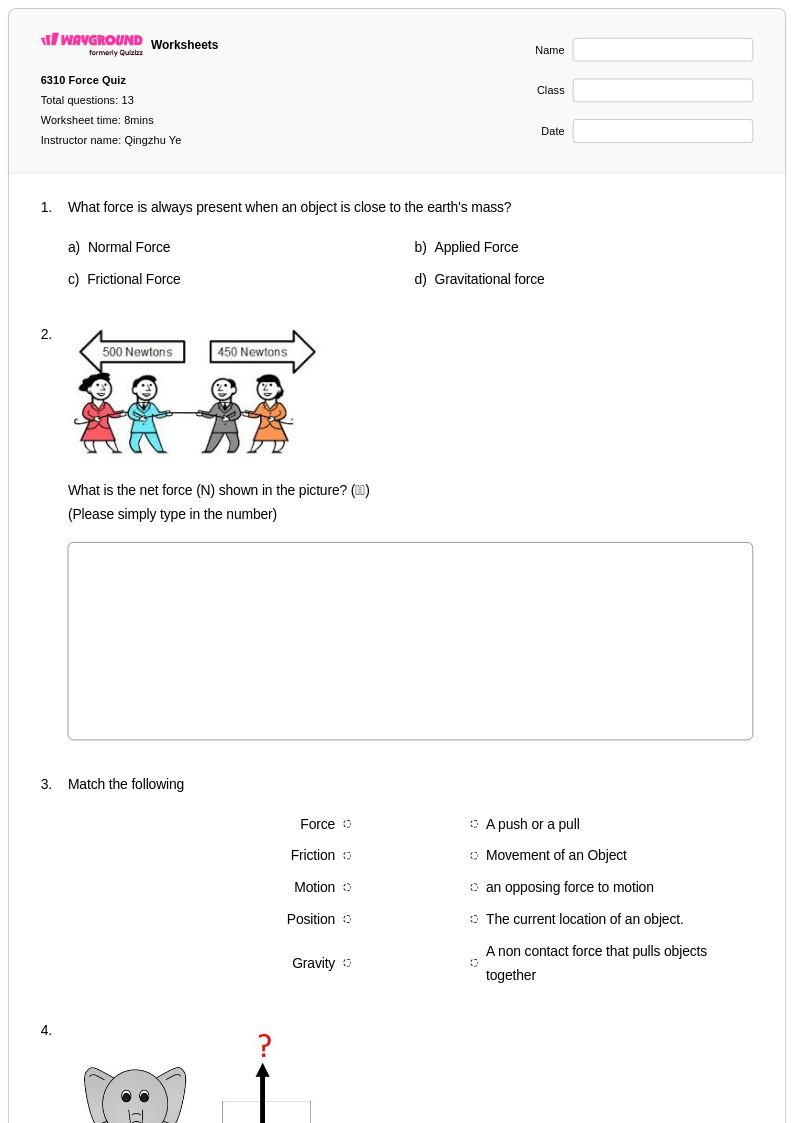
One of the most persistent errors in kinematics is confusing velocity with acceleration — students frequently assume that if an object is moving, it must be accelerating, or that a stationary object cannot be experiencing a net force. In force problems, students routinely omit forces, double-count them, or fail to identify the correct system boundary when drawing free body diagrams. Targeted practice on these specific scenarios, particularly problems designed to surface and correct these misconceptions, is more effective than additional repetition of standard problem sets.
How do I help struggling physics students who can't keep up with the math?
Students who struggle with the mathematical demands of physics often need explicit scaffolding that separates conceptual reasoning from calculation. Start by confirming that the student can correctly identify what is given, what is unknown, and which principle applies before any numbers are introduced. Worksheets that use guided problem-solving templates or stepwise prompts can reduce cognitive overload, and on Wayground, teachers can enable the Read Aloud accommodation so that question text is read to students who find dense written problem stems difficult to parse independently.
What common misconceptions do students have about electricity and circuits?
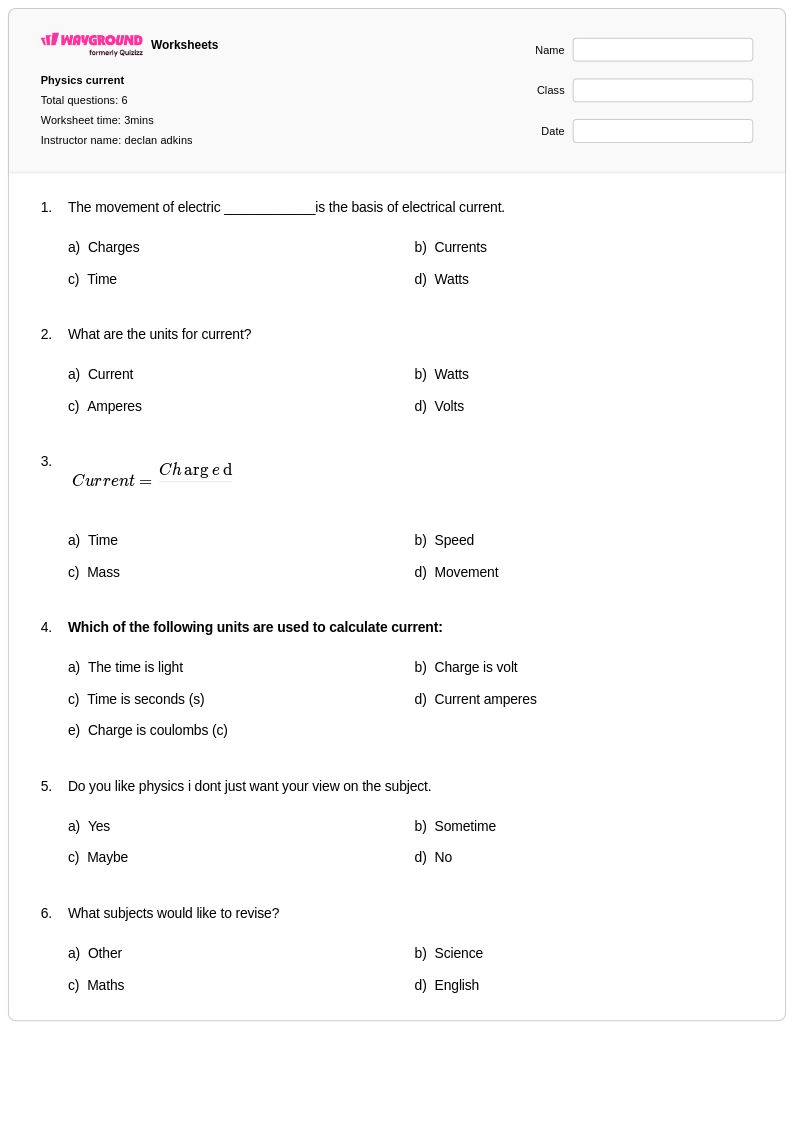
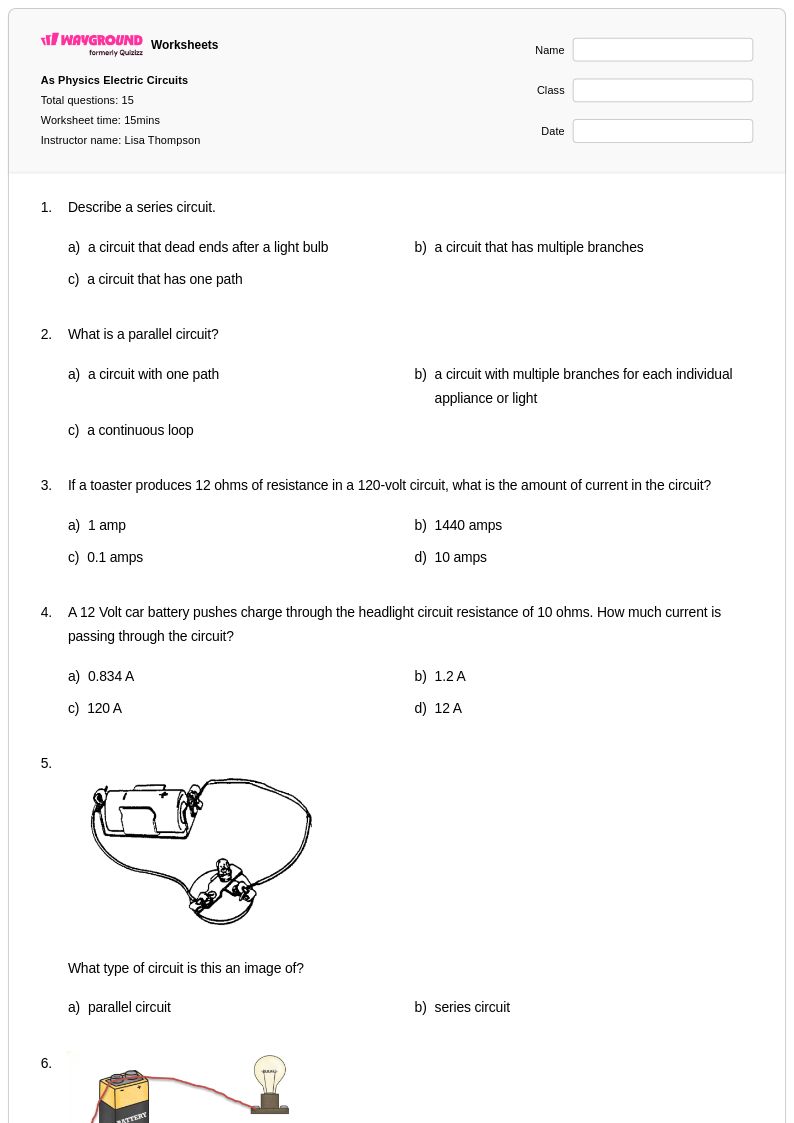
A widely documented misconception is that current is 'used up' as it flows through a circuit, leading students to predict that components farther from the battery receive less current. Students also frequently confuse voltage and current, treating them as interchangeable rather than understanding voltage as the driving potential and current as the resulting flow. Worksheet problems that require students to calculate and compare values at multiple points in series and parallel circuits are particularly effective at exposing and correcting these errors.
How do I use Wayground's physics worksheets in my classroom?
Wayground's physics worksheets are available as printable PDFs for traditional classroom use and in digital formats for technology-integrated environments, giving teachers flexibility to deploy them as homework, in-class practice, or review. Teachers can also host any worksheet as a live or asynchronous quiz directly on Wayground, enabling automatic grading and immediate feedback. For classrooms with diverse learners, Wayground supports per-student accommodations such as extended time, read aloud, and reduced answer choices, all configurable without notifying other students.
How do I assess student understanding across different physics topics without creating materials from scratch?
Wayground provides teacher-created physics resources spanning topics from basic kinematics and Newton's Laws through quantum mechanics and thermodynamics, with answer keys included so teachers can use them for formative checks, quizzes, or end-of-unit assessments without additional preparation. The platform's search and filtering tools allow teachers to locate materials aligned to specific curriculum standards quickly, making it practical to pull targeted assessment problems for a single topic rather than assigning a broad review. This makes it easier to diagnose exactly where a student's understanding breaks down across a wide physics curriculum.