Free Printable Population Studies Worksheets for Year 10
Enhance Year 10 students' understanding of population studies with Wayground's comprehensive collection of free worksheets, printables, and practice problems featuring detailed answer keys to master demographic analysis and geographic population patterns.
Explore printable Population Studies worksheets for Year 10
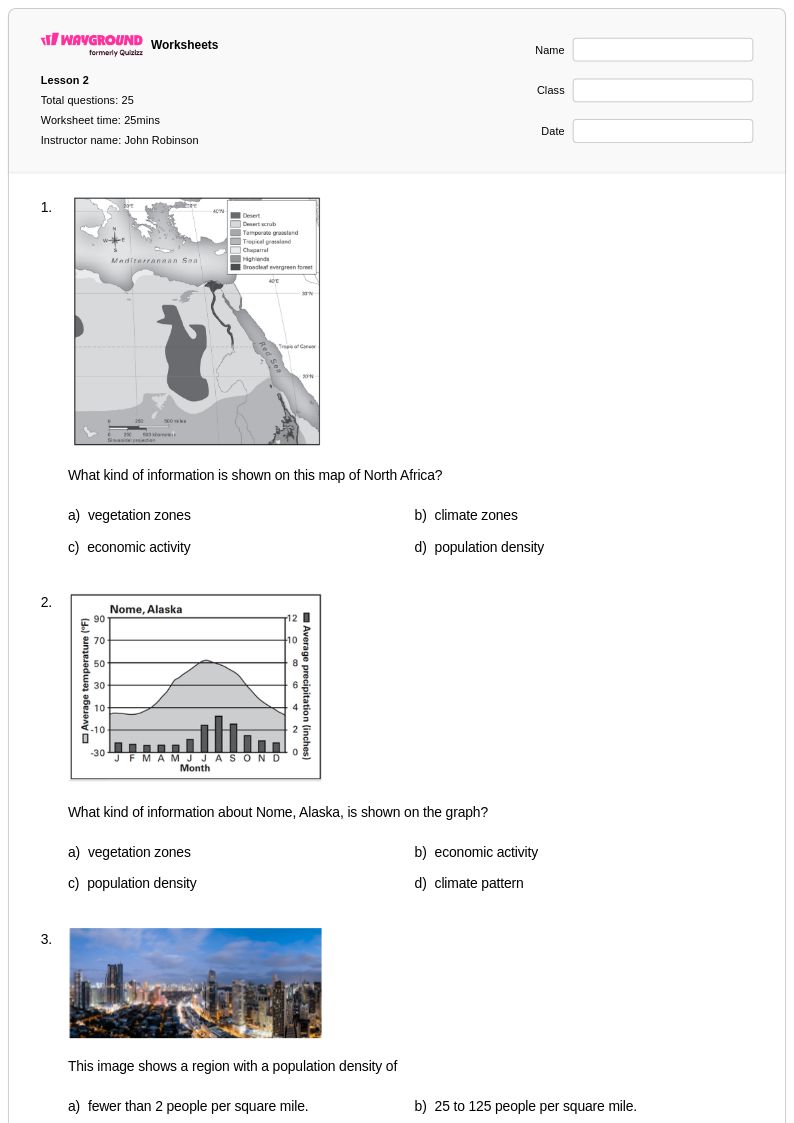
Population Studies worksheets for Year 10 students available through Wayground (formerly Quizizz) provide comprehensive practice in analyzing demographic patterns, population distribution, and human migration trends across global regions. These expertly designed resources strengthen critical skills including interpreting population pyramids, calculating demographic indicators such as birth and death rates, examining urbanization patterns, and evaluating the relationship between population dynamics and economic development. Students engage with real-world data through practice problems that explore topics like demographic transition models, carrying capacity, and population policies, while teachers benefit from complete answer keys and free printable pdf formats that facilitate both classroom instruction and independent study sessions.
Wayground (formerly Quizizz) supports educators with an extensive collection of millions of teacher-created Population Studies resources that can be easily located through robust search and filtering capabilities aligned with curriculum standards. Teachers can differentiate instruction by selecting worksheets that match varying skill levels within their Year 10 classrooms, while flexible customization tools allow for modifications to address specific learning objectives or regional case studies. These resources are available in both printable and digital formats, including downloadable pdf versions, making them ideal for lesson planning, targeted remediation for students struggling with demographic concepts, enrichment activities for advanced learners, and consistent skill practice that reinforces understanding of population geography principles throughout the academic year.
FAQs
How do I teach population studies in a geography class?
Effective population studies instruction begins with grounding students in core demographic indicators such as birth rates, death rates, and population density before introducing more complex concepts like the demographic transition model and migration push-pull factors. Teachers should connect abstract data to real-world examples by having students analyze current census data, population pyramids, and regional case studies. Pairing direct instruction with data interpretation tasks helps students build the analytical literacy needed to understand how population dynamics shape economic and social conditions globally.
What are good practice exercises for teaching population pyramids?
Population pyramid exercises should progress from reading and labeling pre-made pyramids to comparing pyramids across different countries and time periods. Students benefit from identifying structural patterns, such as wide bases indicating high birth rates or narrowing mid-sections indicating aging populations, and explaining what those patterns reveal about a country's development stage. Practice problems that ask students to calculate dependency ratios or predict future population trends from pyramid data build higher-order analytical skills alongside basic interpretation.
What mistakes do students commonly make when analyzing demographic data?
One of the most common errors is conflating population density with population size, leading students to misinterpret why densely populated areas are not necessarily the most populous countries overall. Students also frequently confuse emigration and immigration directions, especially when analyzing net migration rates. A third widespread misconception is assuming that high birth rates always indicate population growth, without accounting for corresponding death rates or age structure. Targeted practice problems that explicitly address these error patterns help students self-correct before assessments.
How do I help students understand the relationship between population and economic development?
Teachers can scaffold this concept by first establishing the demographic transition model as a framework, then having students examine real country data to identify which stage each nation occupies. Analytical tasks that compare GDP per capita, literacy rates, and life expectancy alongside population growth rates help students recognize patterns rather than memorize isolated facts. Case study comparisons between countries at different development stages are particularly effective at making this relationship concrete and transferable.
How do I use Wayground's population studies worksheets in my classroom?
Wayground's population studies worksheets are available as printable PDFs for traditional classroom use and in digital formats for technology-integrated environments, making them flexible for in-class activities, homework assignments, and assessments. Teachers can also host the worksheets as a quiz directly on Wayground, enabling real-time student response tracking. All worksheets include complete answer keys, supporting both independent student practice and teacher-led review. For classrooms with diverse learners, Wayground's built-in accommodation settings allow teachers to enable features such as extended time, read aloud, or reduced answer choices for individual students without disrupting the rest of the class.
How can I differentiate population studies instruction for students with varying ability levels?
For students who need additional support, scaffolding demographic data tasks with partially completed tables, glossaries of key terms, and guided question sequences reduces cognitive overload while maintaining rigor. Advanced students can be challenged with open-ended analytical tasks such as forecasting demographic shifts or evaluating population policy effectiveness using real data. On Wayground, teachers can apply individual accommodations including extended time, read aloud support, and reduced answer choices to specific students, allowing differentiated access to the same core content without requiring entirely separate materials.