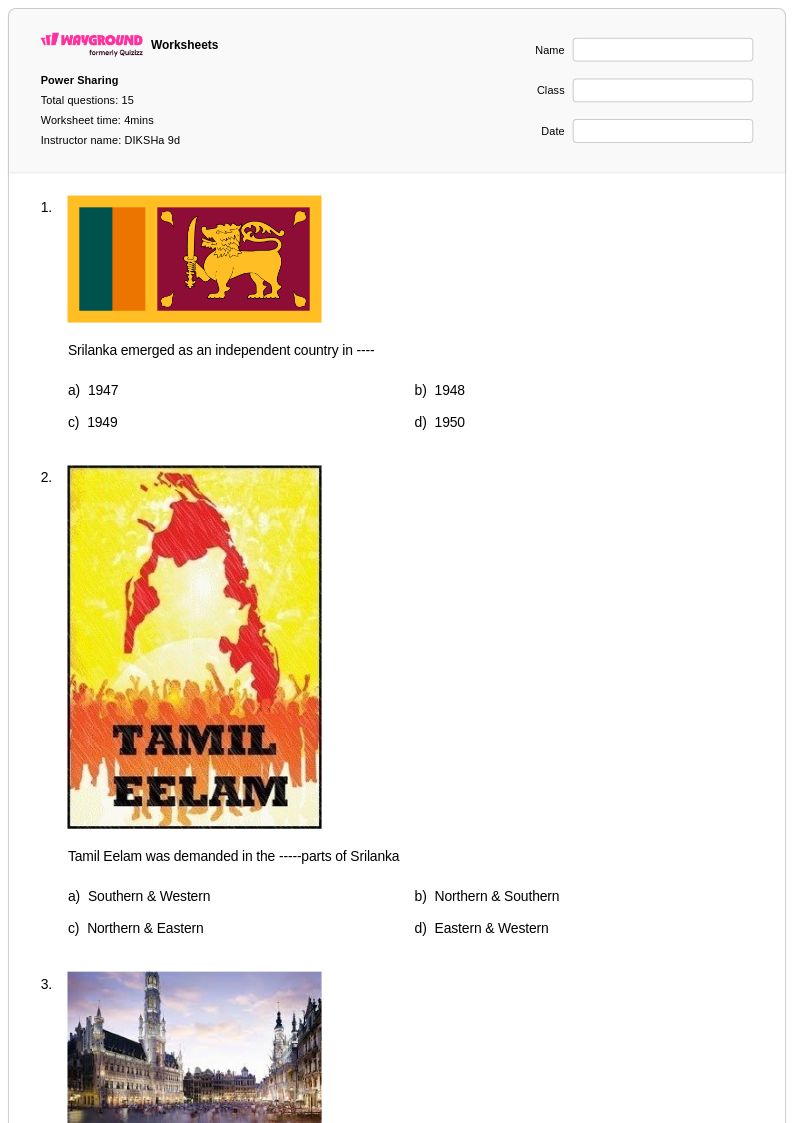
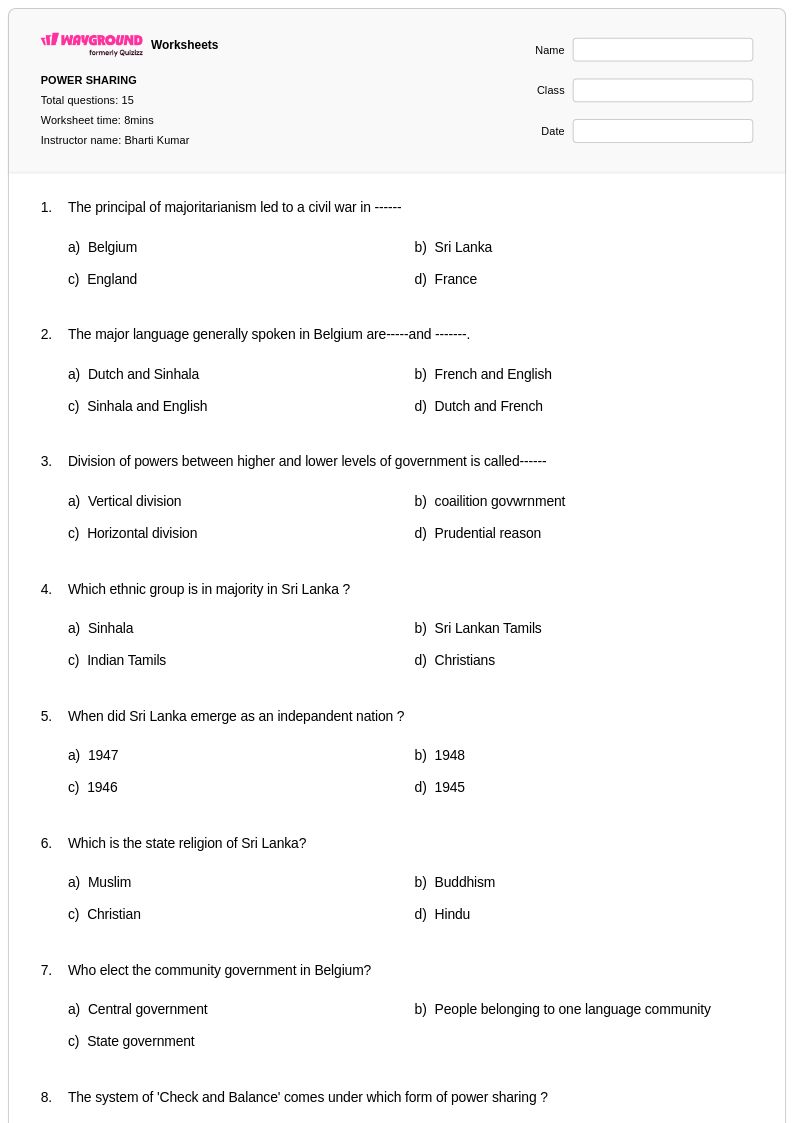
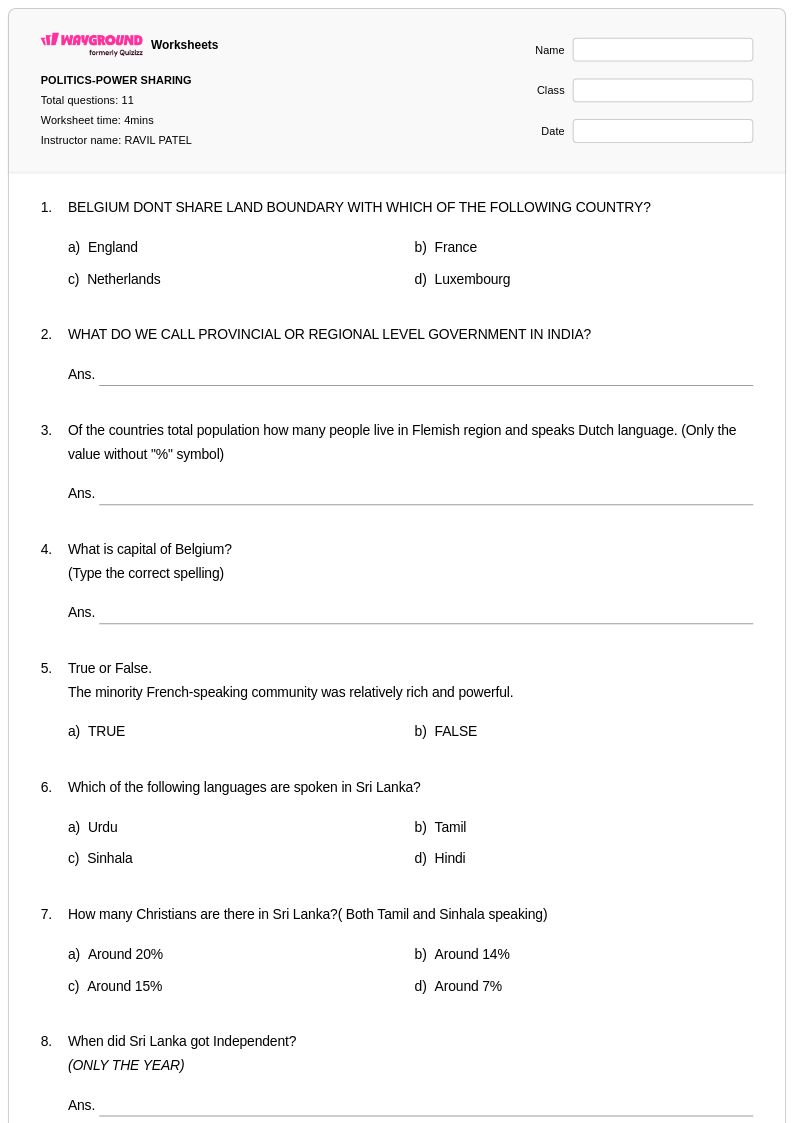
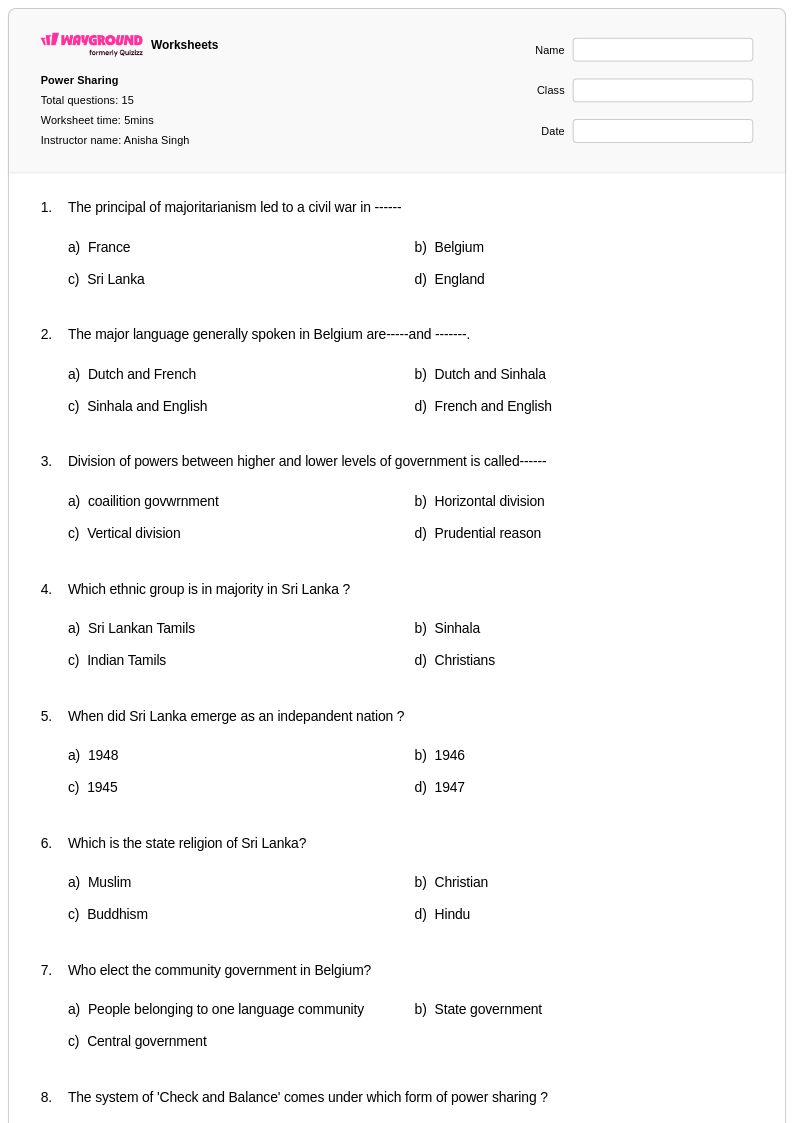
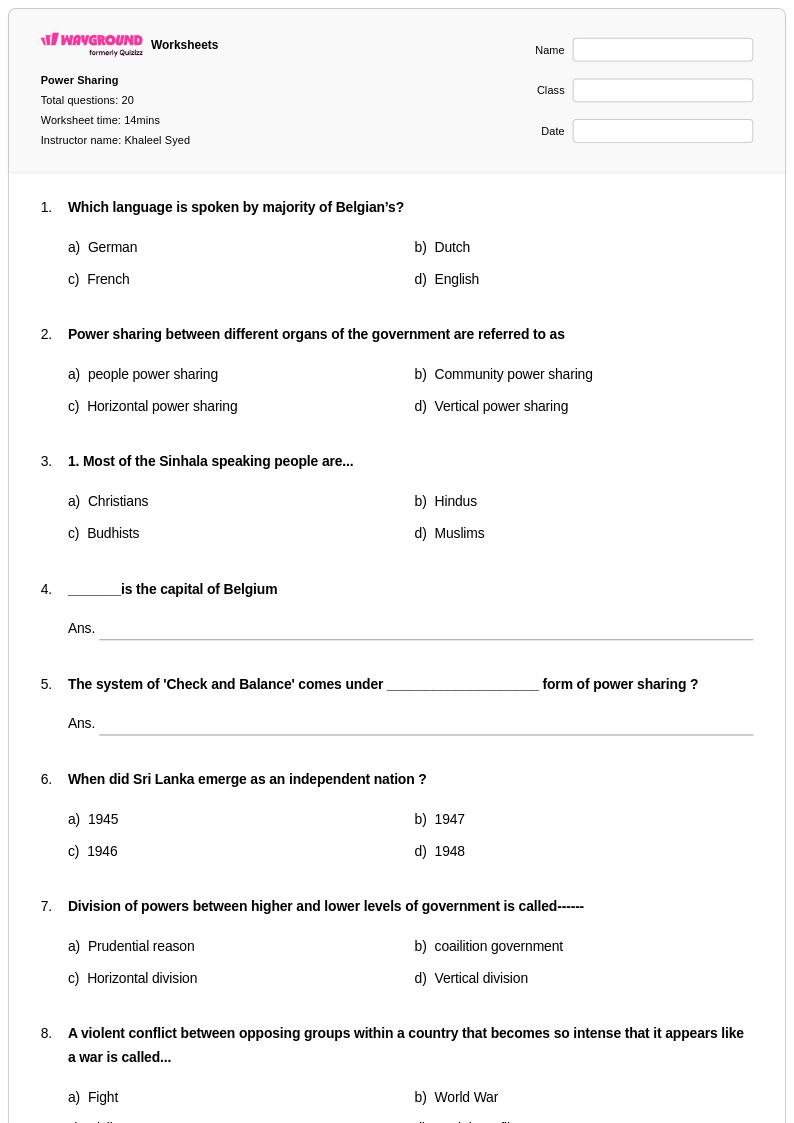
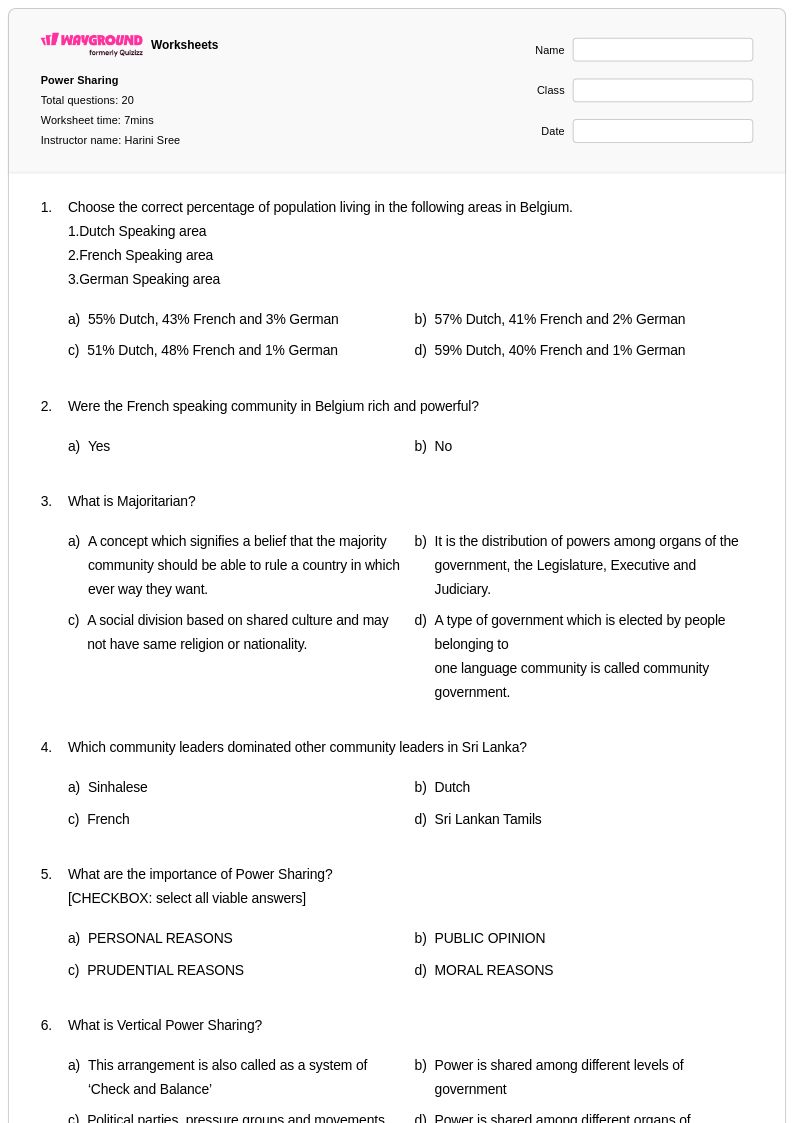
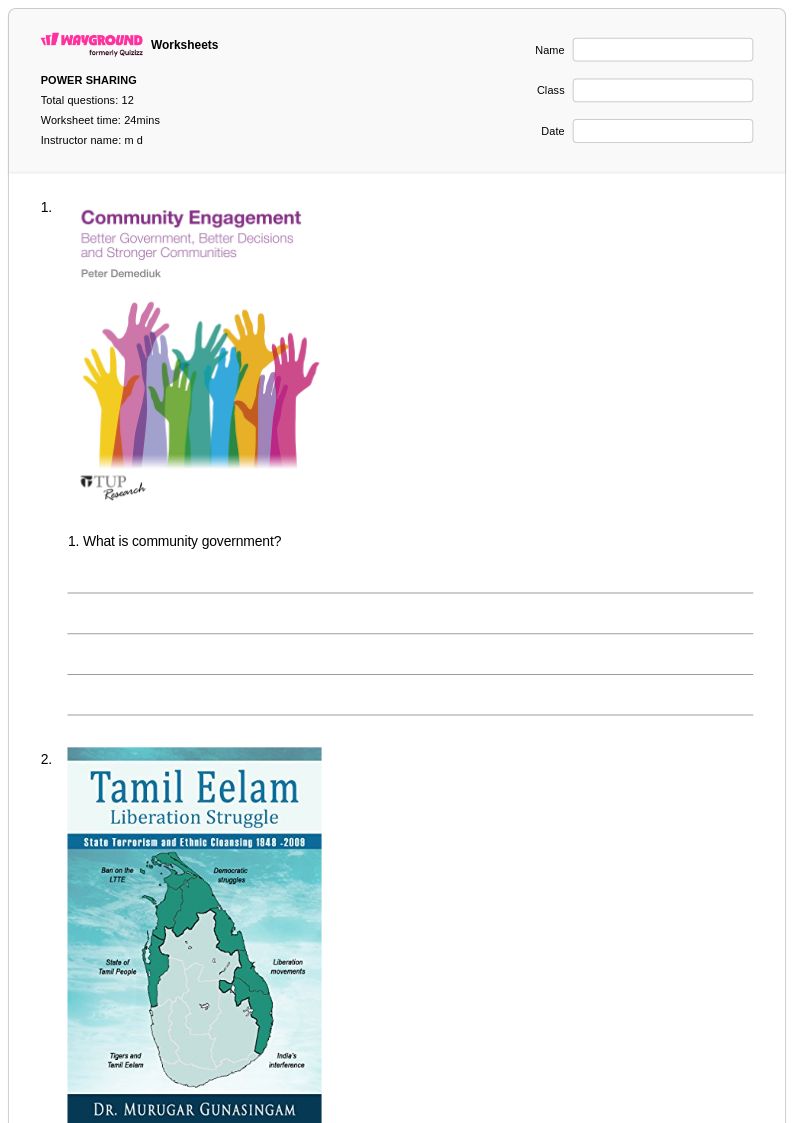
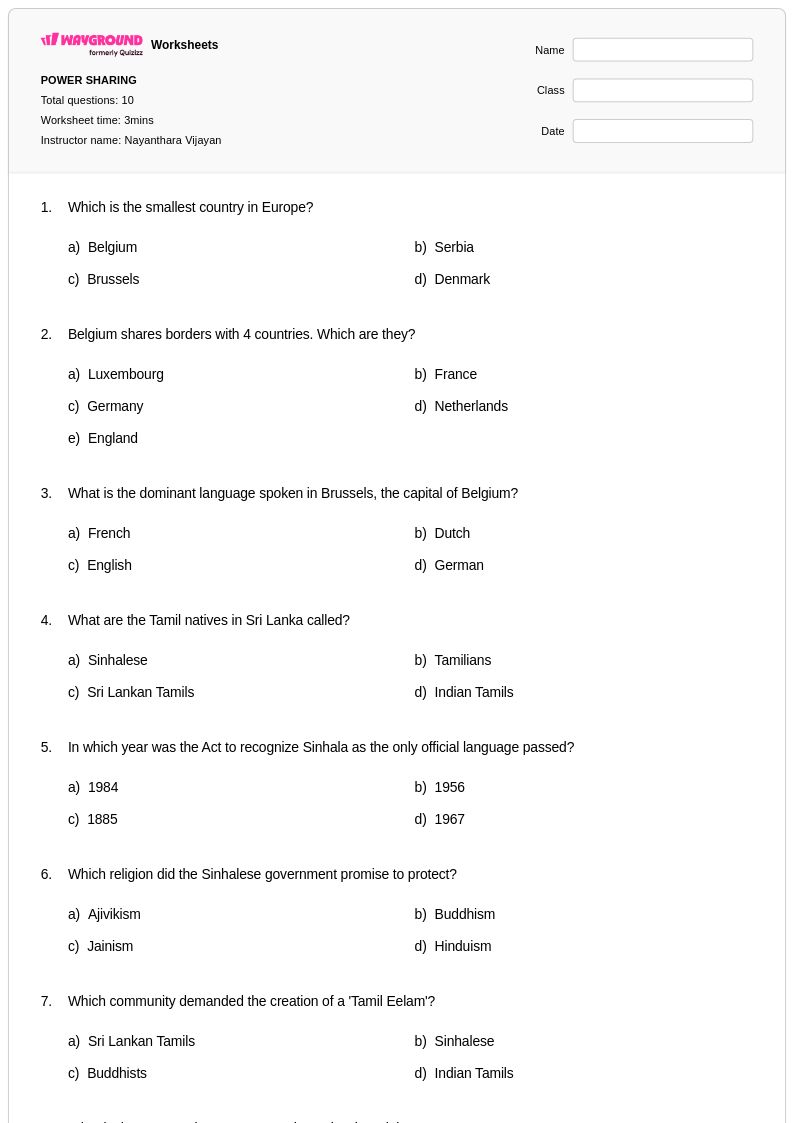
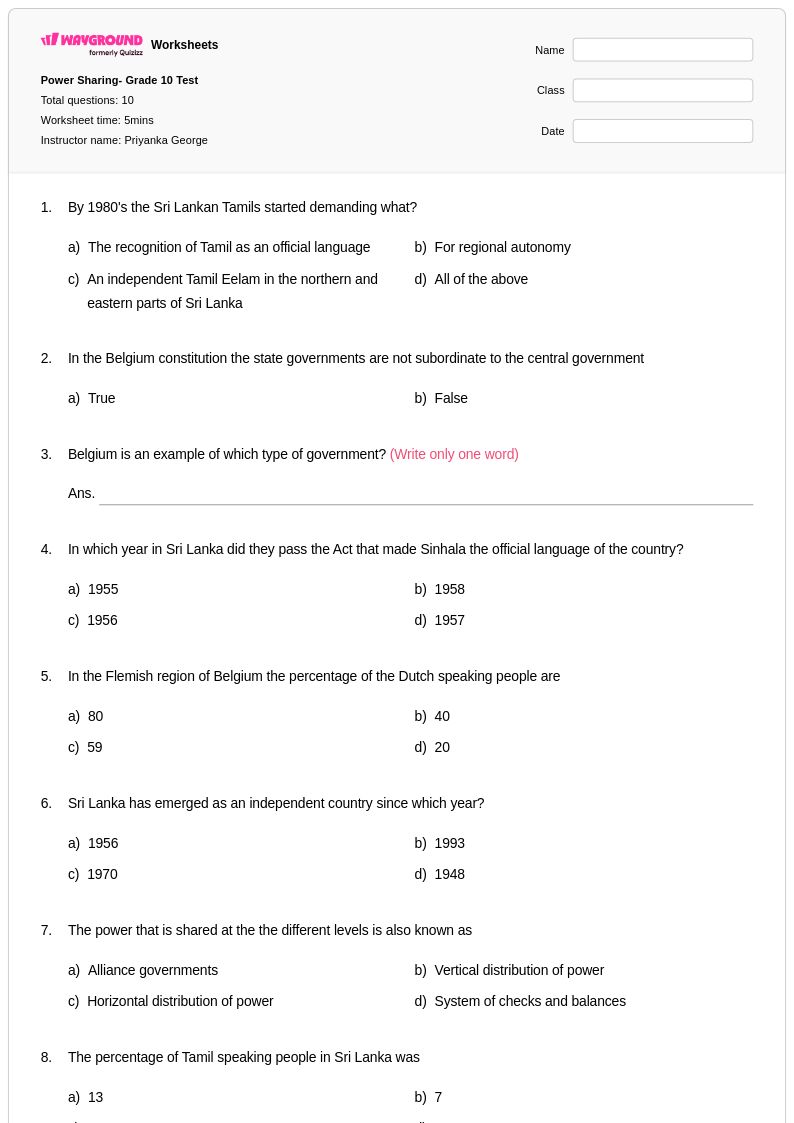
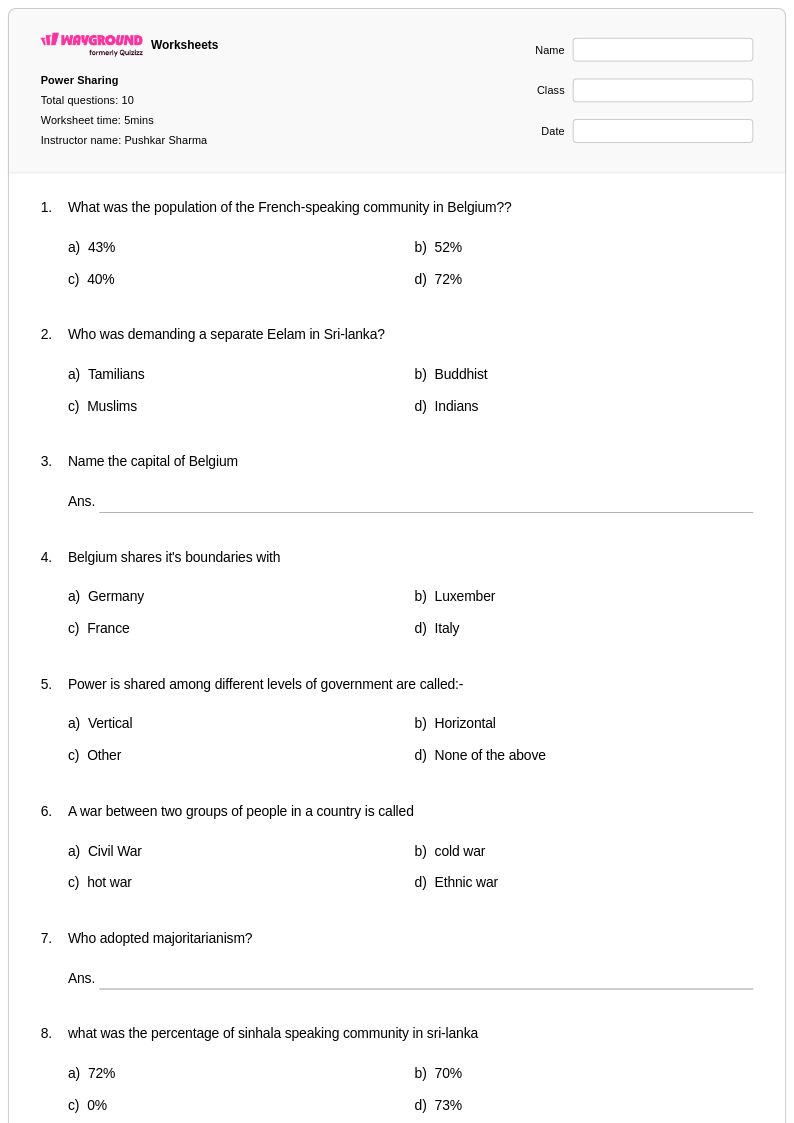
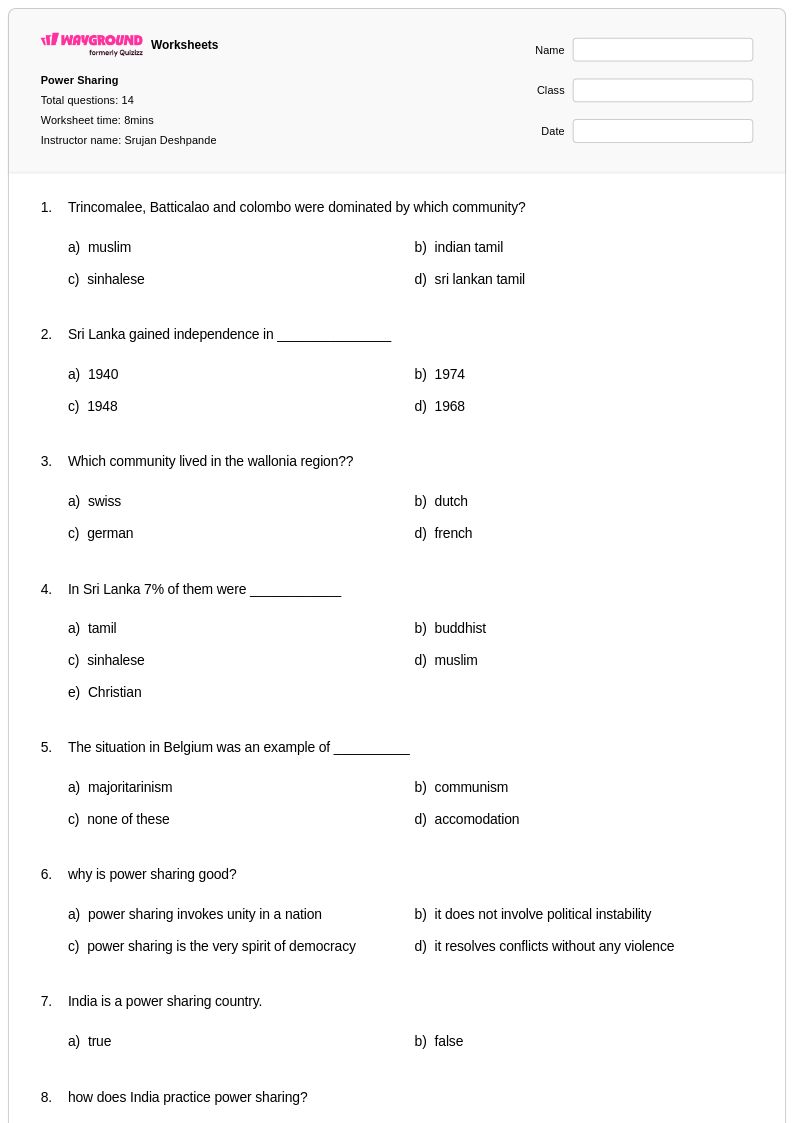
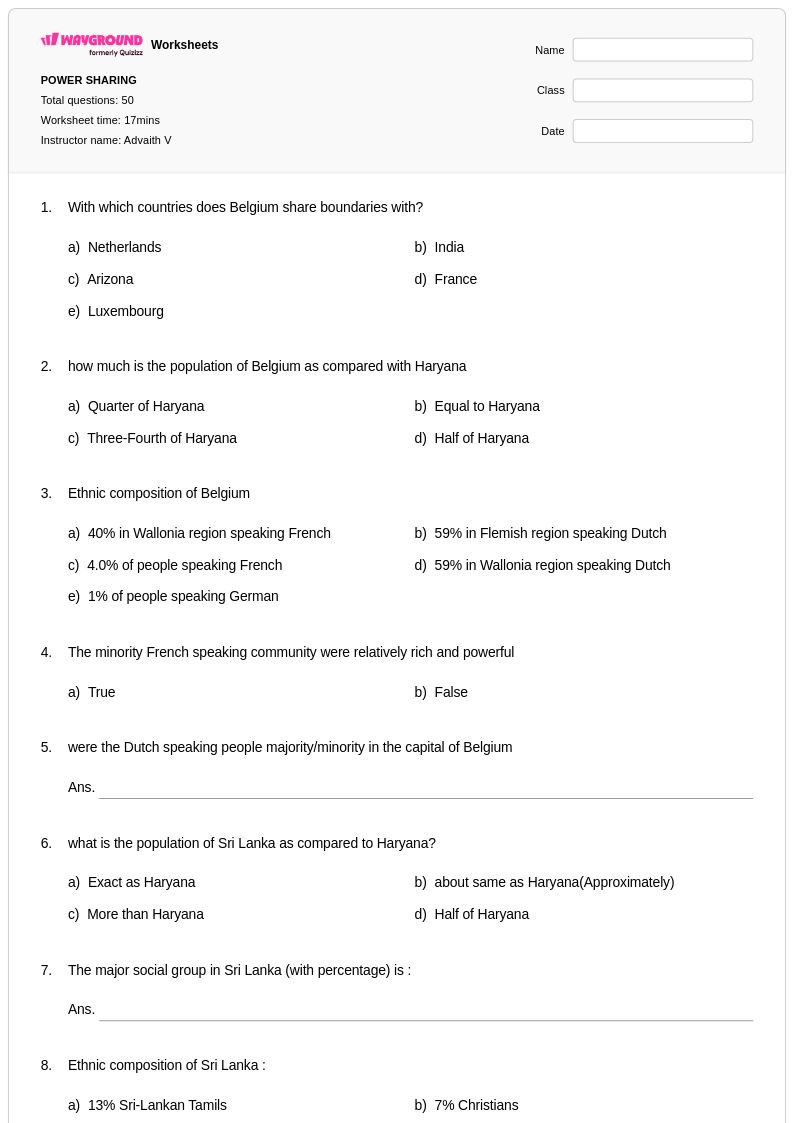
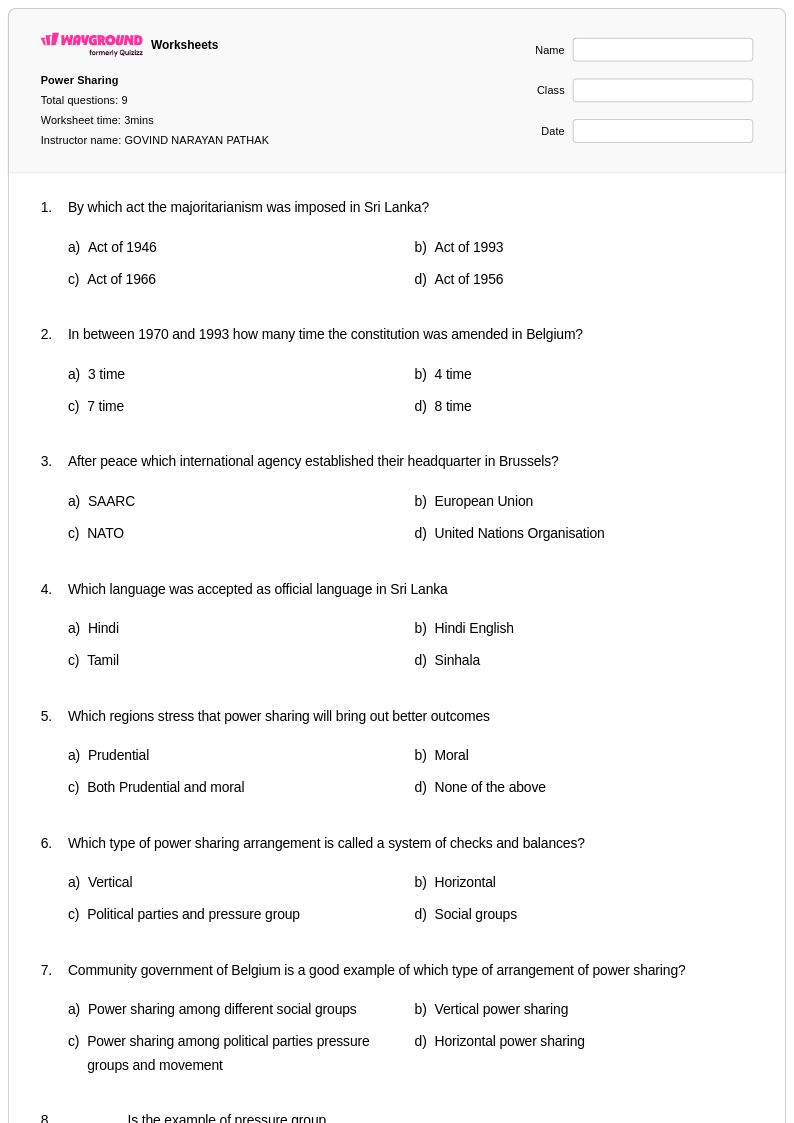
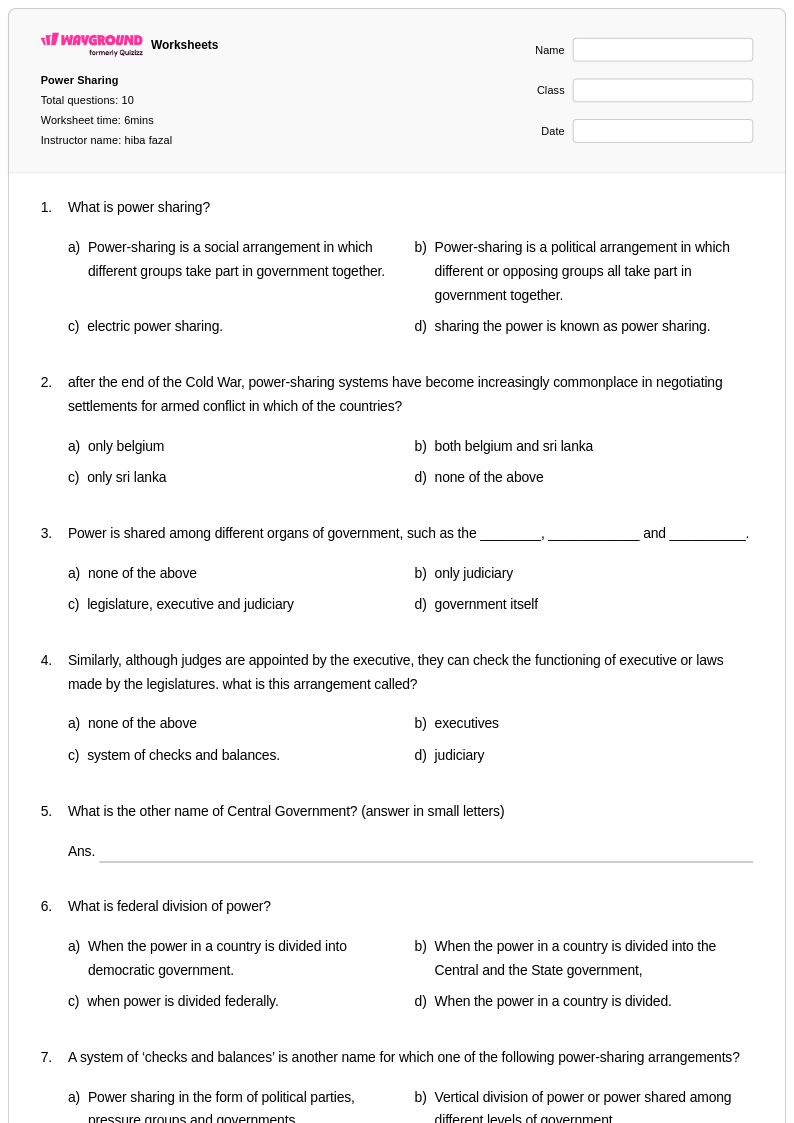
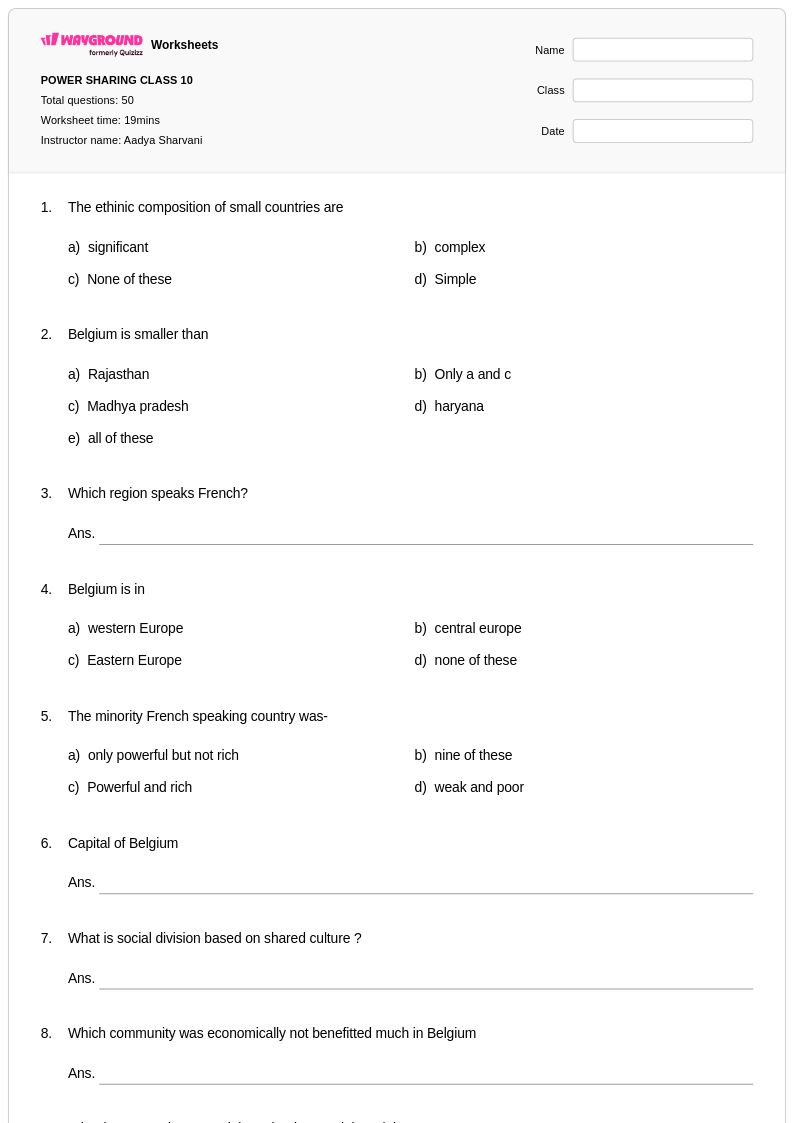
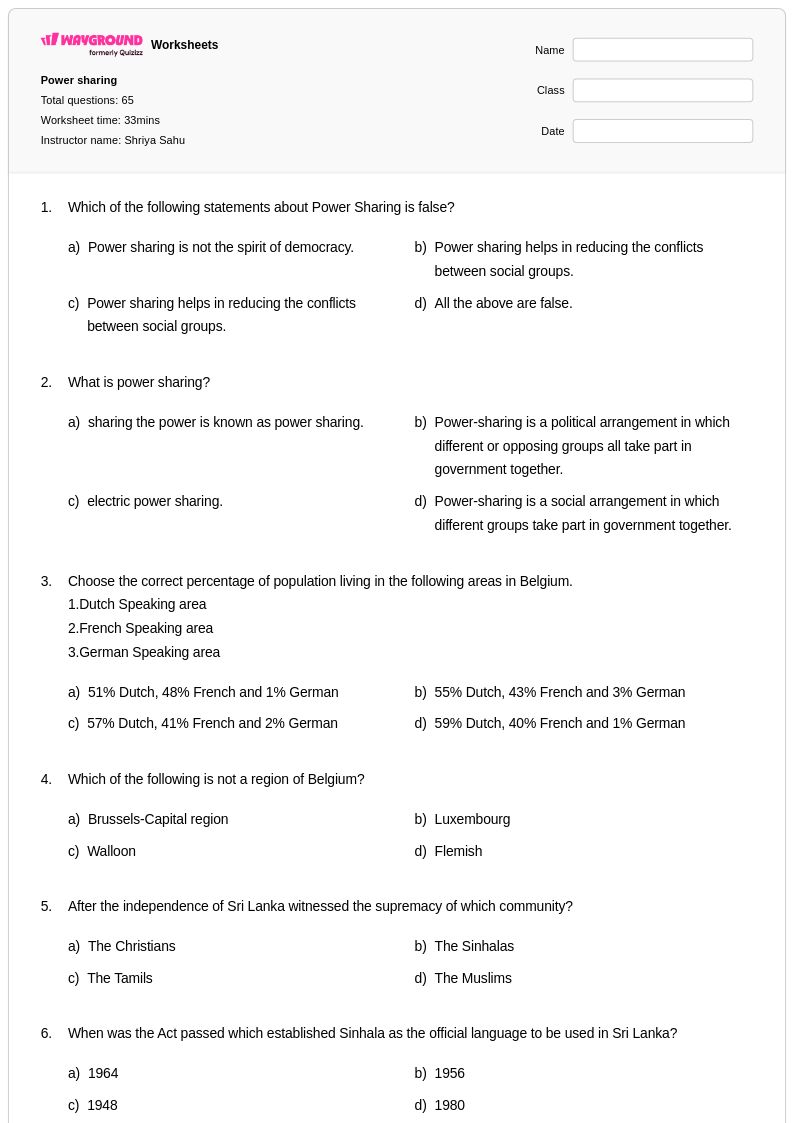
Explore Wayground's free power sharing worksheets and printables that help students understand how governmental authority is distributed and balanced across different institutions, featuring practice problems and comprehensive answer keys for effective civics learning.
Power sharing worksheets available through Wayground (formerly Quizizz) provide comprehensive educational resources designed to help students understand the fundamental principles of how governmental authority is distributed and exercised in democratic systems. These carefully crafted materials strengthen critical thinking skills by guiding students through complex concepts such as federalism, separation of powers, checks and balances, and the division of responsibilities between different levels of government. Students engage with practice problems that examine real-world examples of power sharing arrangements, from local municipal structures to international governance models, while developing analytical abilities through structured exercises that include detailed answer keys for immediate feedback and self-assessment. The collection features free printables in convenient pdf format that make these essential civics concepts accessible for classroom instruction, homework assignments, and independent study.
Wayground (formerly Quizizz) supports educators with an extensive library of millions of teacher-created power sharing resources that can be easily discovered through robust search and filtering capabilities designed specifically for busy classroom professionals. The platform's standards alignment features ensure that worksheet collections meet curriculum requirements while offering differentiation tools that allow teachers to customize content for diverse learning needs and ability levels. These versatile materials are available in both printable and digital formats, including downloadable pdf versions, making them ideal for traditional classroom settings, remote learning environments, or hybrid instructional models. Teachers can efficiently plan comprehensive lessons, provide targeted remediation for struggling students, offer enrichment opportunities for advanced learners, and create focused skill practice sessions that reinforce understanding of how democratic institutions share power to maintain governmental balance and protect citizen rights.
FAQs
How do I teach power sharing in government to my students?
Teaching power sharing effectively starts with grounding students in the core structures: federalism, separation of powers, and checks and balances. Use concrete examples such as how a bill becomes a law or how federal and state governments divide responsibilities to make abstract distribution of authority tangible. From there, move students toward comparing different governmental models, including local, national, and international structures, so they can analyze why distributed authority is essential to democratic governance.
What exercises help students practice power sharing concepts?
Practice exercises that ask students to classify governmental powers as federal, state, or concurrent reinforce the structural logic of federalism. Scenario-based problems, where students must determine which branch or level of government has authority in a given situation, build analytical and application skills. Structured practice with real-world examples, such as examining municipal governance or international agreements, helps students move beyond memorization toward genuine conceptual understanding.
What common mistakes do students make when learning about power sharing?
A frequent misconception is conflating separation of powers with checks and balances, treating them as the same concept rather than distinct but related mechanisms. Students also tend to oversimplify federalism by assuming federal law always supersedes state law in every context, which ignores areas of concurrent or reserved state authority. Another common error is viewing power sharing as a static structure rather than a dynamic system subject to legal interpretation and political change over time.
How can I use power sharing worksheets to support different learners in my civics class?
Power sharing worksheets on Wayground are available as both printable PDFs and in digital formats, making them flexible for in-person, remote, and hybrid classrooms. When hosting worksheets digitally on Wayground, teachers can apply student-level accommodations such as read aloud for struggling readers, reduced answer choices to lower cognitive load, and extended time for students who need it. These settings can be assigned to individual students without notifying the rest of the class, allowing differentiated support to run seamlessly alongside standard instruction.
How does power sharing relate to checks and balances, and how do I explain the difference to students?
Power sharing is the broader principle that governmental authority should be distributed across multiple institutions rather than concentrated in one, while checks and balances is the specific mechanism by which each branch of government can limit or oversee the others. A useful classroom distinction is to frame power sharing as the 'what' and checks and balances as the 'how.' Helping students trace specific constitutional provisions, such as the presidential veto or Senate confirmation of appointments, to their function within the checks and balances system makes the relationship concrete and testable.
Can I use power sharing worksheets for both homework and in-class assessment?
Yes, power sharing worksheets are well-suited to both contexts because they cover a range of task types, from structured practice problems to analytical questions about real-world governance examples. For homework, printable PDF versions allow independent work without requiring device access. For in-class use, digital formats on Wayground enable teachers to host worksheets as quizzes with immediate feedback, and all worksheets include comprehensive answer keys to support efficient review and self-assessment.