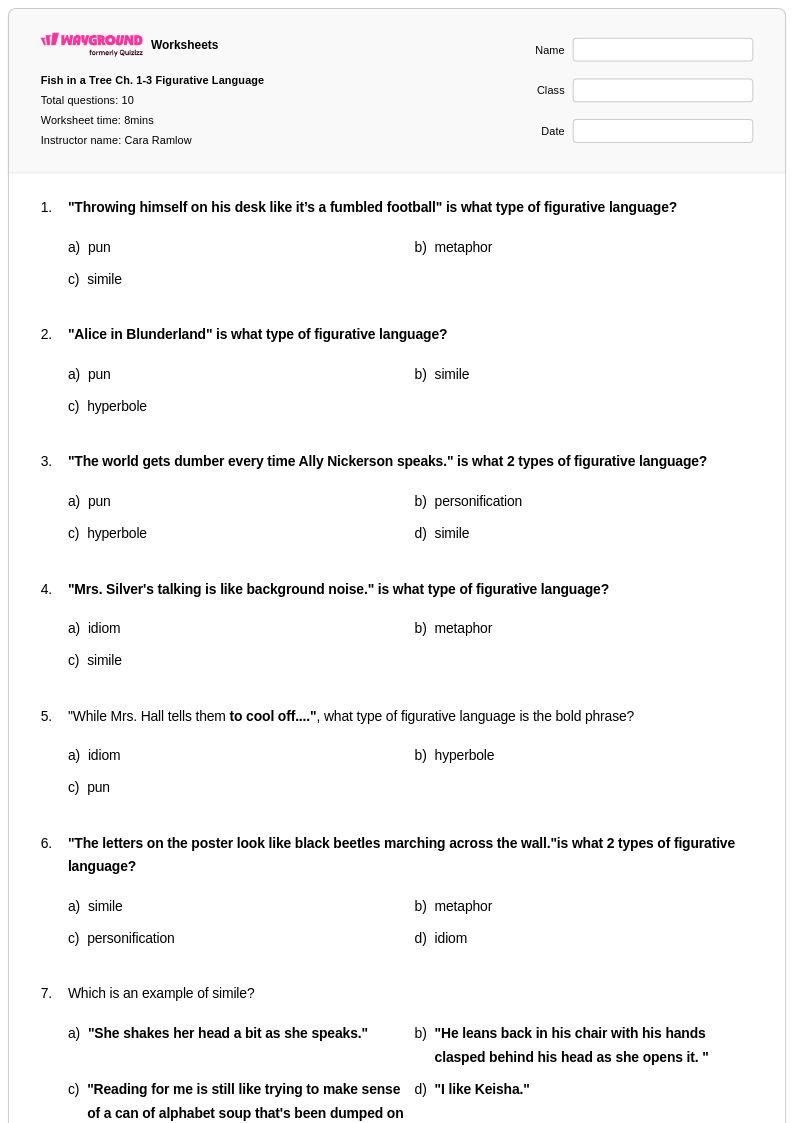
Enhance Year 7 students' understanding of puns with Wayground's comprehensive collection of free worksheets, printables, and practice problems that develop wordplay skills through engaging exercises and detailed answer keys.
Pun worksheets for Year 7 students available through Wayground (formerly Quizizz) provide comprehensive practice in understanding and creating this sophisticated form of wordplay that relies on multiple meanings of words or similar-sounding words for humorous or rhetorical effect. These educational resources strengthen students' analytical reading skills, vocabulary development, and creative writing abilities by challenging them to recognize the dual meanings that make puns effective literary devices. The practice problems guide seventh graders through identifying puns in literature and everyday language, analyzing how authors use wordplay to create humor or emphasize themes, and crafting their own puns using homophones, homonyms, and words with multiple definitions. Each worksheet includes detailed answer keys that explain the linguistic mechanisms behind different types of puns, while the free printables offer structured exercises ranging from basic identification to complex creative applications that develop critical thinking about language manipulation.
Wayground (formerly Quizizz) supports English teachers with an extensive collection of pun worksheets drawn from millions of teacher-created resources that address varying skill levels and learning objectives for Year 7 students. The platform's robust search and filtering capabilities enable educators to quickly locate materials that align with specific curriculum standards for figurative language instruction, while differentiation tools allow teachers to modify content complexity for diverse learners within the same classroom. These customizable resources are available in both printable PDF formats for traditional classroom use and digital formats for interactive online learning, providing flexibility for lesson planning, targeted remediation for students struggling with wordplay concepts, and enrichment activities for advanced learners ready to explore sophisticated literary techniques. Teachers can seamlessly integrate these worksheets into broader figurative language units, using them for skill practice, assessment preparation, and creative writing workshops that build students' appreciation for the nuanced ways authors manipulate language for artistic effect.
FAQs
How do I teach puns to students who struggle with wordplay?
Start by grounding the lesson in concrete examples students already know, such as jokes from popular media or everyday conversation, before introducing the term 'pun' formally. Explicitly teach that puns rely on either multiple meanings of a single word (homonymy) or words that sound alike but mean different things (homophones). Once students can identify the two meanings at play, they are better equipped to recognize and create puns independently.
What exercises help students practice identifying puns?
Effective practice exercises ask students to read a sentence containing a pun and then write out both meanings the pun is playing on, which forces them to articulate the wordplay rather than just recognize it. Matching activities that pair a pun with its double meaning, and fill-in-the-blank exercises where students complete a pun using context clues, are also strong practice formats. Moving from identification to creation, such as asking students to write their own puns on a given topic, deepens understanding significantly.
What mistakes do students commonly make when learning about puns?
The most common error is confusing puns with other forms of figurative language, particularly idioms and similes, because students focus on the humorous effect rather than the specific mechanism of double meaning or sound similarity. Students also frequently identify a word as a pun simply because it sounds funny rather than demonstrating that it carries two distinct meanings simultaneously. Requiring students to explicitly name both meanings in their answers is the most effective way to address this misconception.
How do pun worksheets connect to broader figurative language instruction?
Puns are a gateway into the larger study of figurative language because they make abstract concepts like connotation, phonetics, and word relationships immediately tangible and often amusing for students. Teaching puns alongside idioms, metaphors, and similes helps students understand that language routinely operates on more than one level at once. This builds the interpretive skills students need for literary analysis, particularly when reading authors who use wordplay deliberately, such as Shakespeare.
How do I use Wayground's pun worksheets in my classroom?
Wayground's pun worksheets are available as printable PDFs for traditional classroom use and in digital formats for technology-integrated environments, so they work equally well as independent practice, partner activities, or homework assignments. You can also host the worksheets as a live quiz on Wayground, which allows you to review answers with the whole class in real time. Each worksheet includes a complete answer key, making them practical for self-paced learning or teacher-led correction.
How can I differentiate pun instruction for students at different skill levels?
For students who are still developing phonemic awareness or vocabulary, reduce cognitive load by providing a word bank of possible pun answers or limiting the number of answer choices displayed, which is a built-in accommodation available on Wayground. Advanced students benefit from tasks that move beyond identification into original creation, such as writing pun-based headlines or composing a short humorous paragraph that incorporates multiple puns. Wayground also supports read-aloud settings, which is particularly useful for pun instruction since hearing a word spoken aloud often makes the sound-based dimension of a pun much clearer.