Free Printable Reflection and Refraction Worksheets for Year 6
Master Year 6 reflection and refraction concepts with Wayground's comprehensive collection of free physics worksheets, featuring engaging practice problems, printable PDFs, and detailed answer keys to strengthen students' understanding of light behavior.
Explore printable Reflection and Refraction worksheets for Year 6
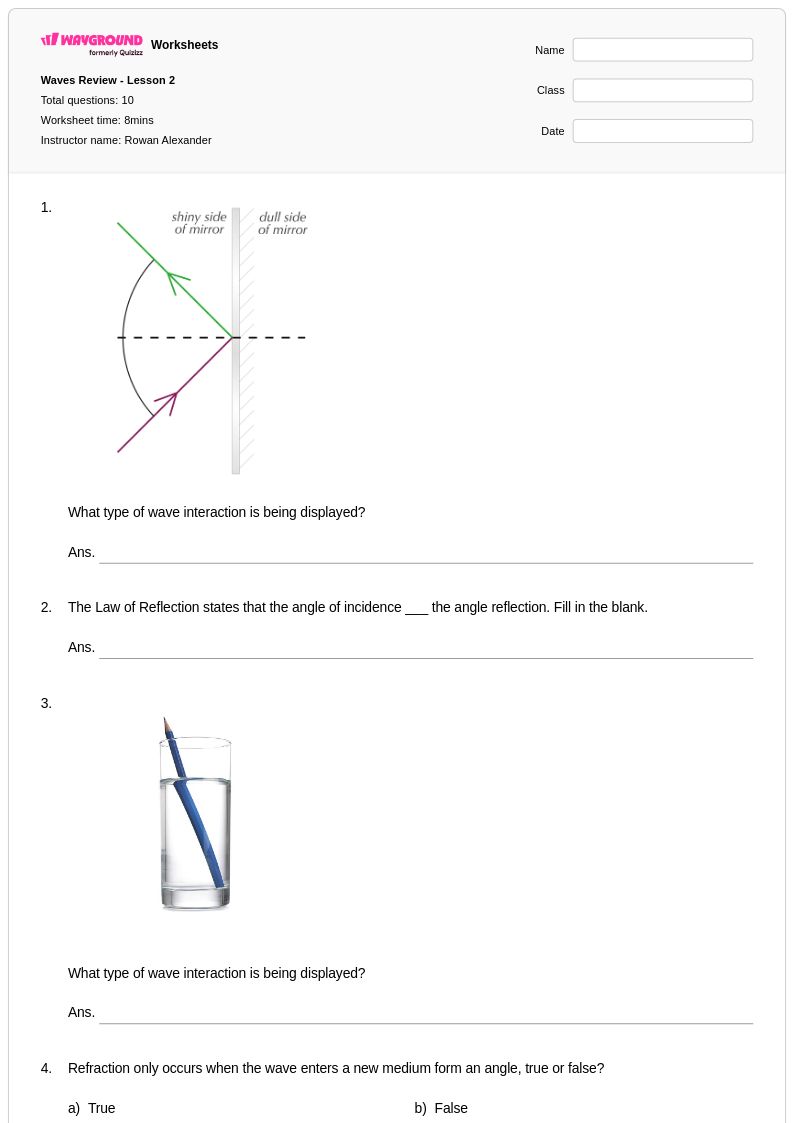
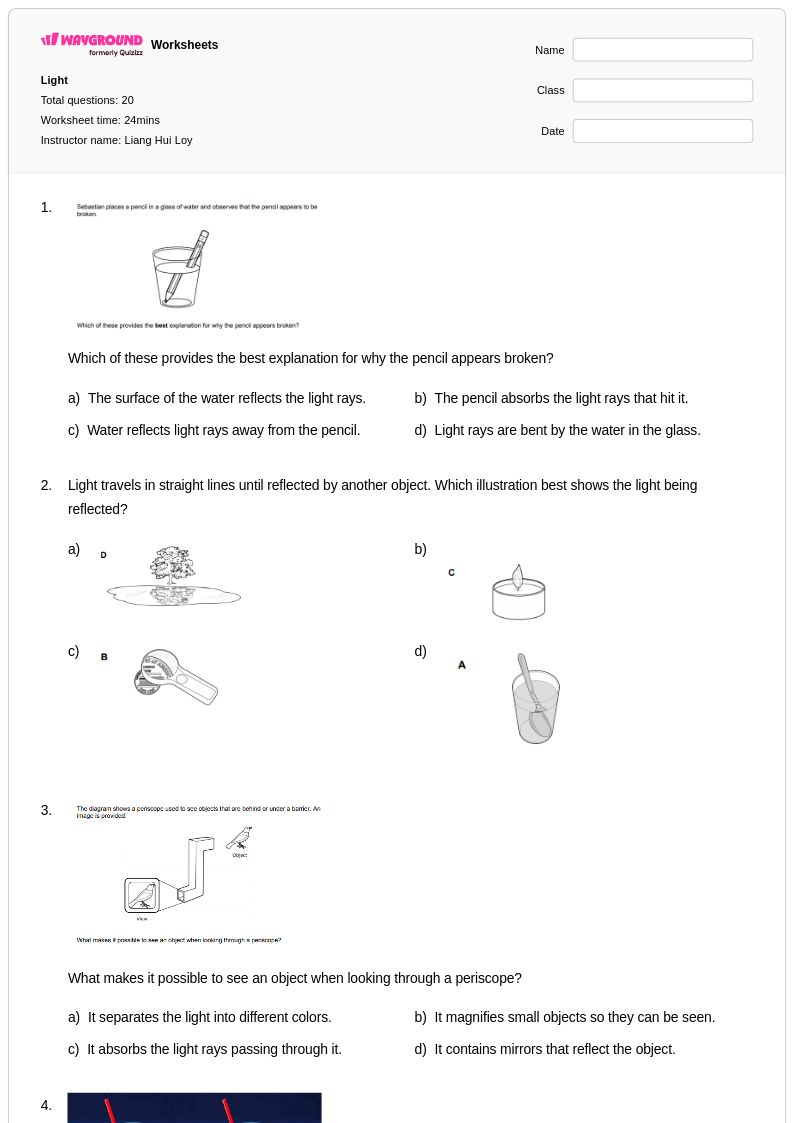
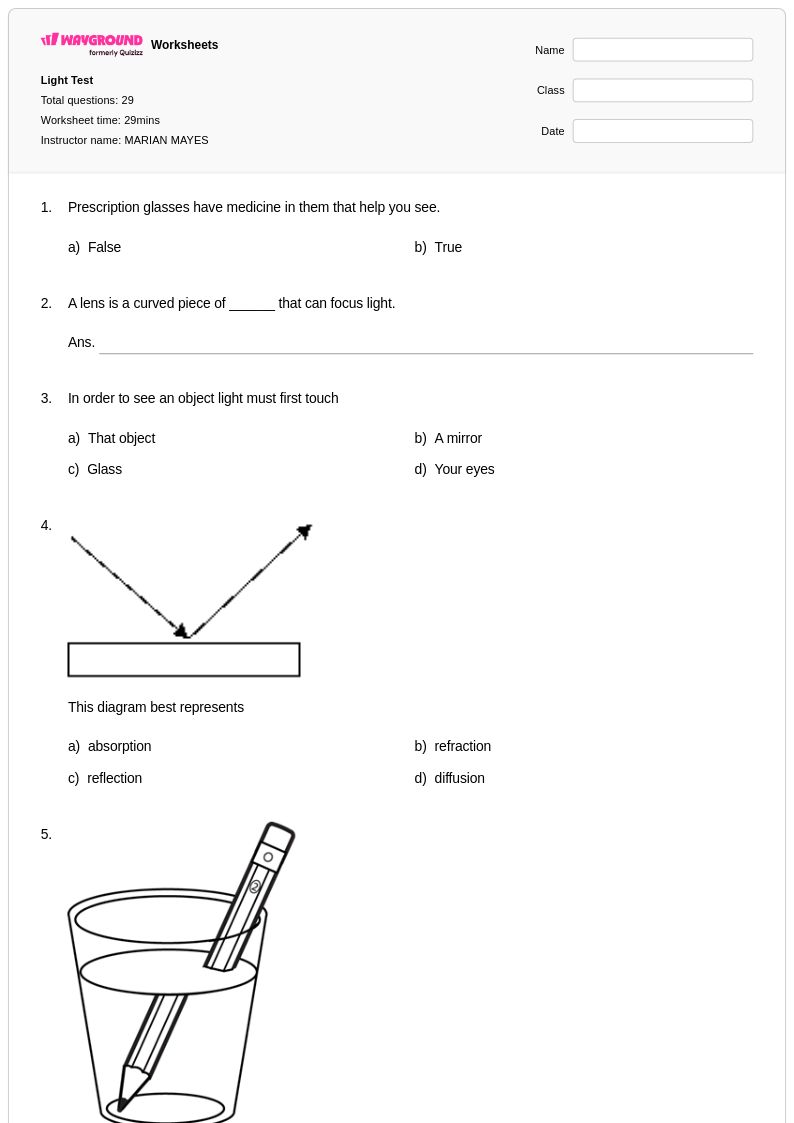
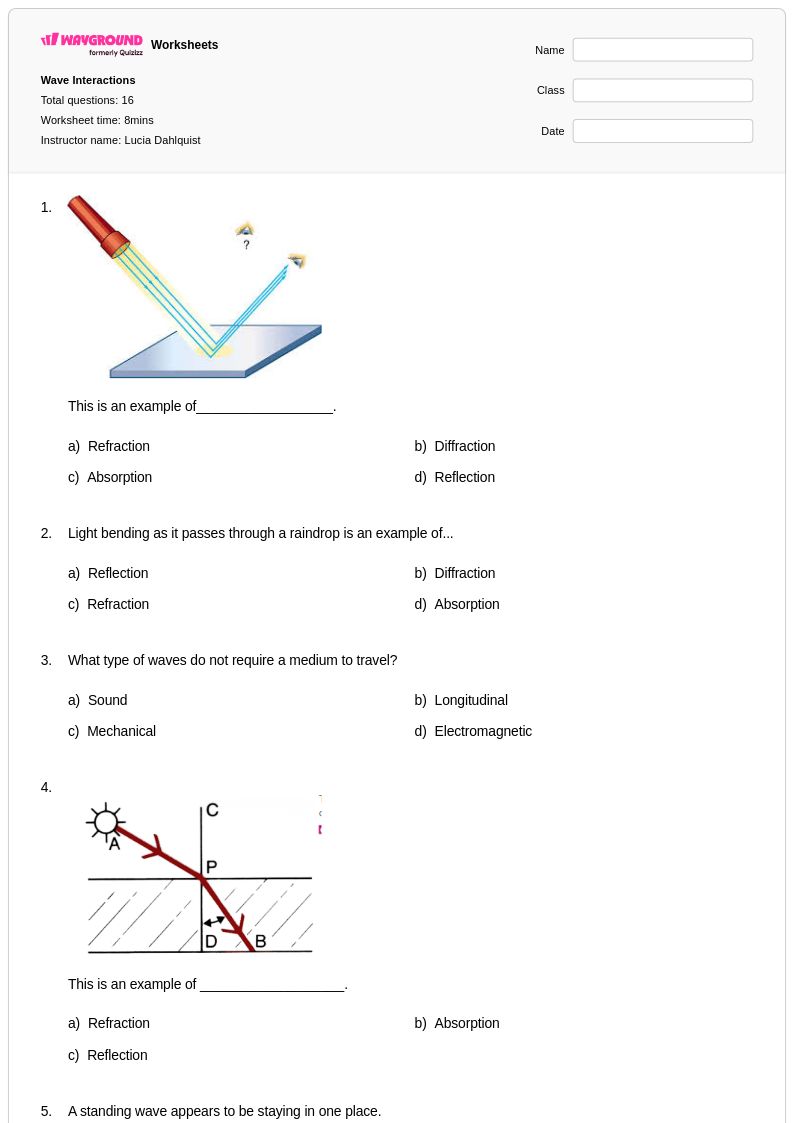
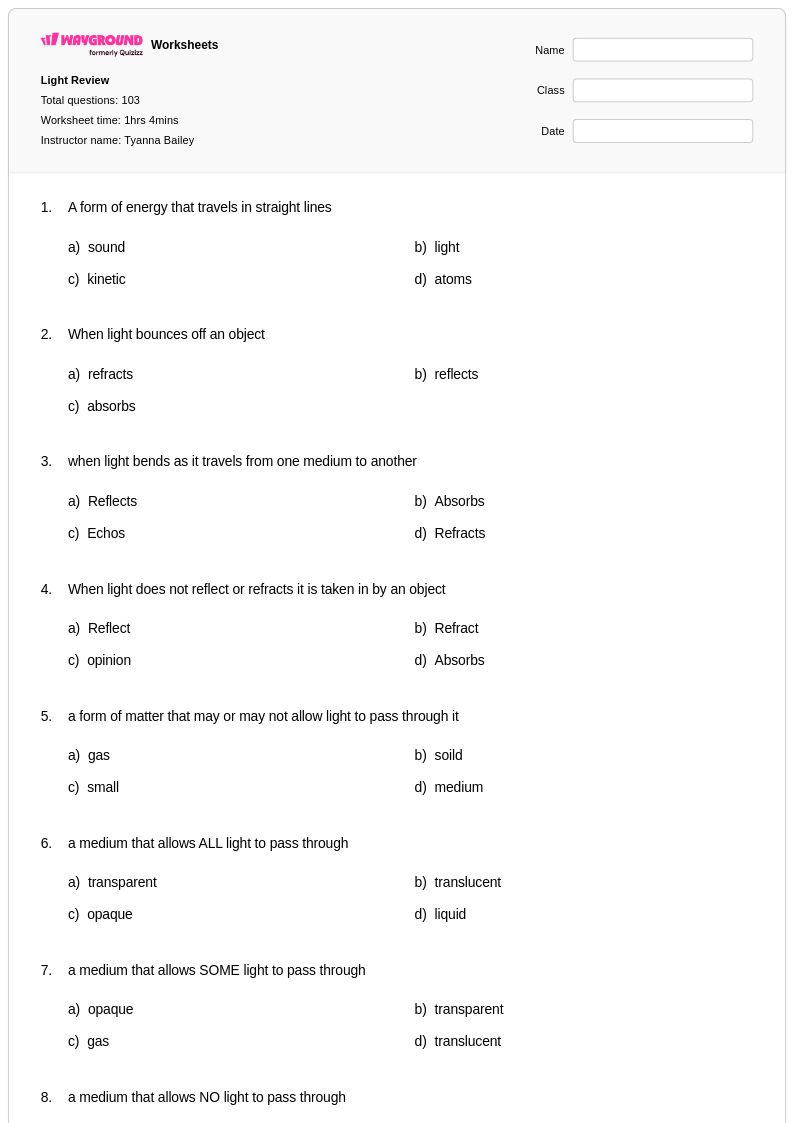
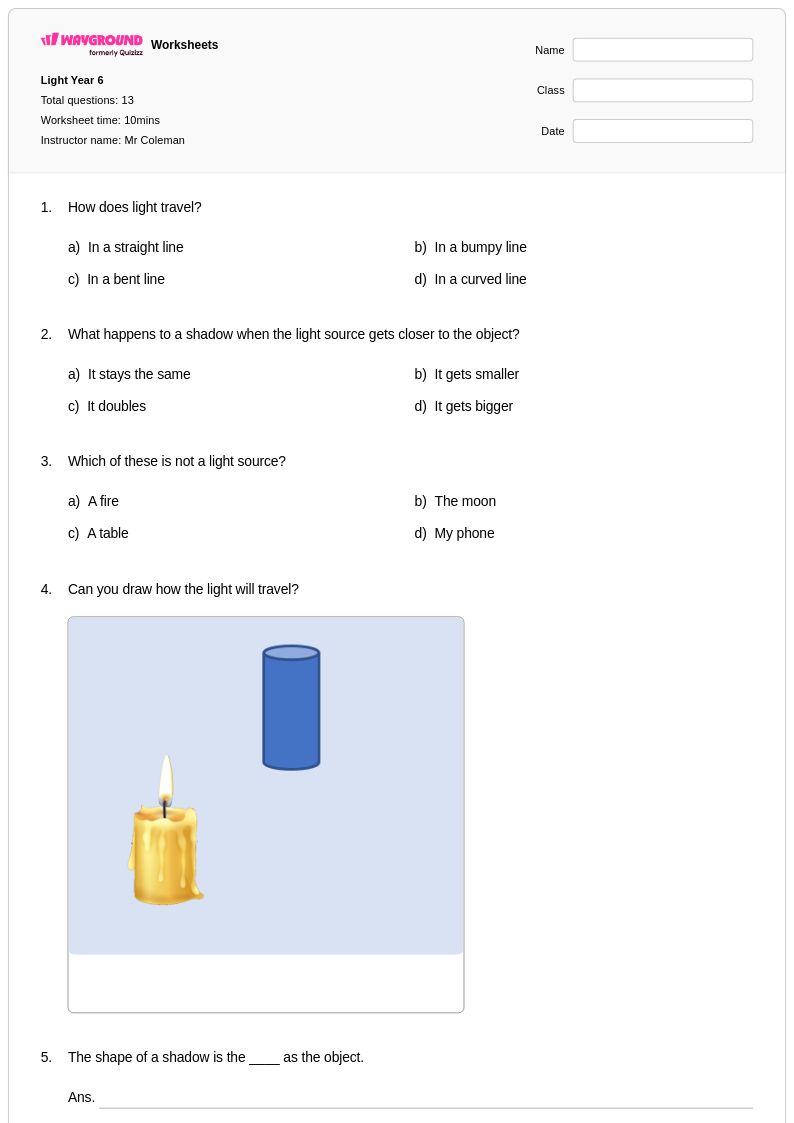
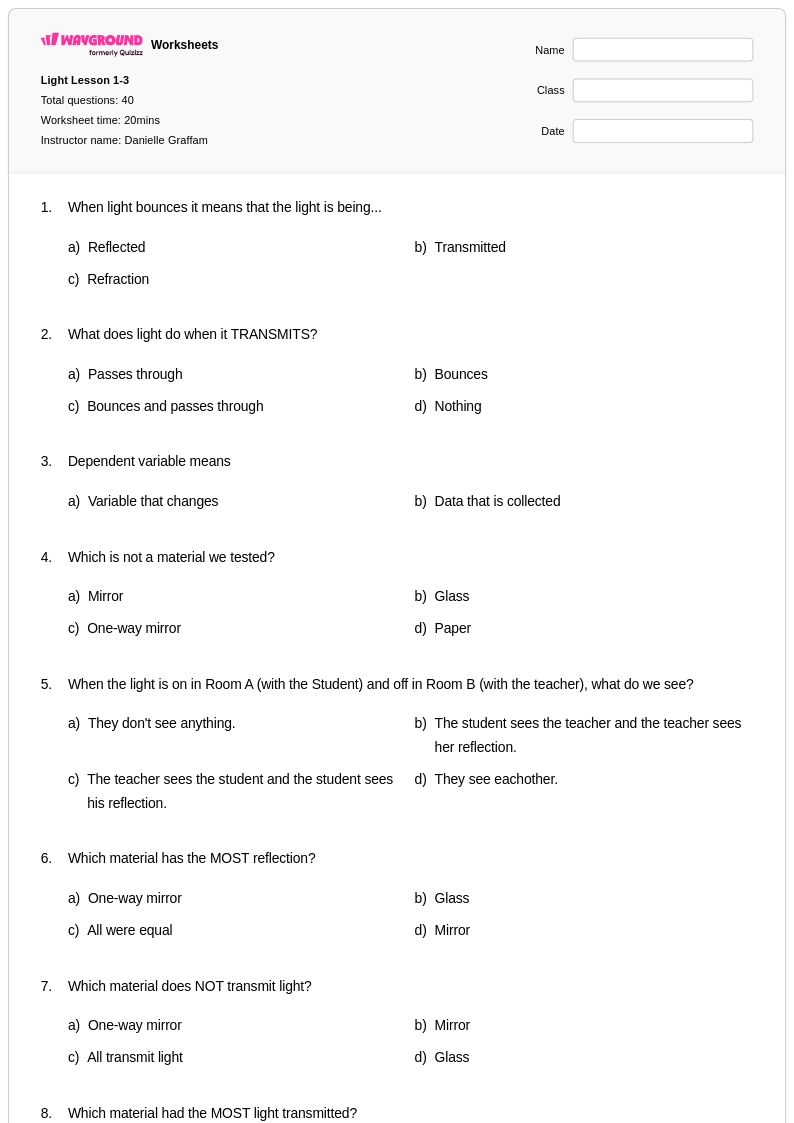
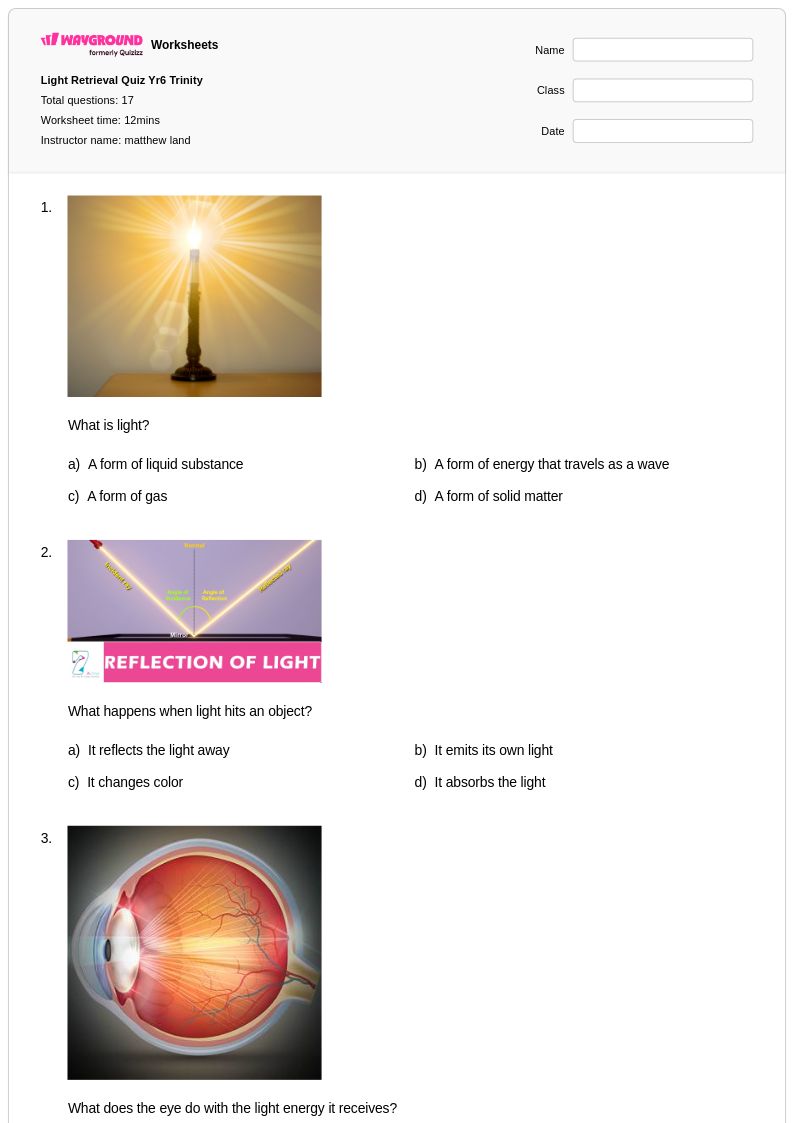
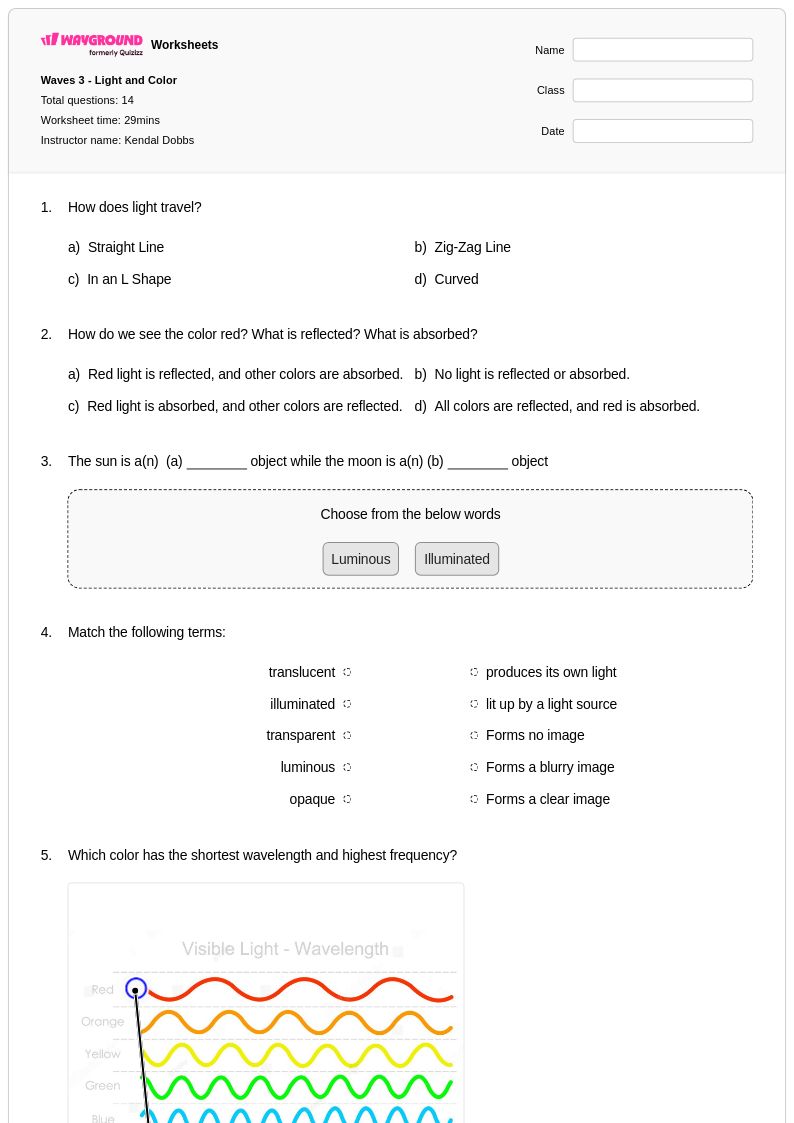
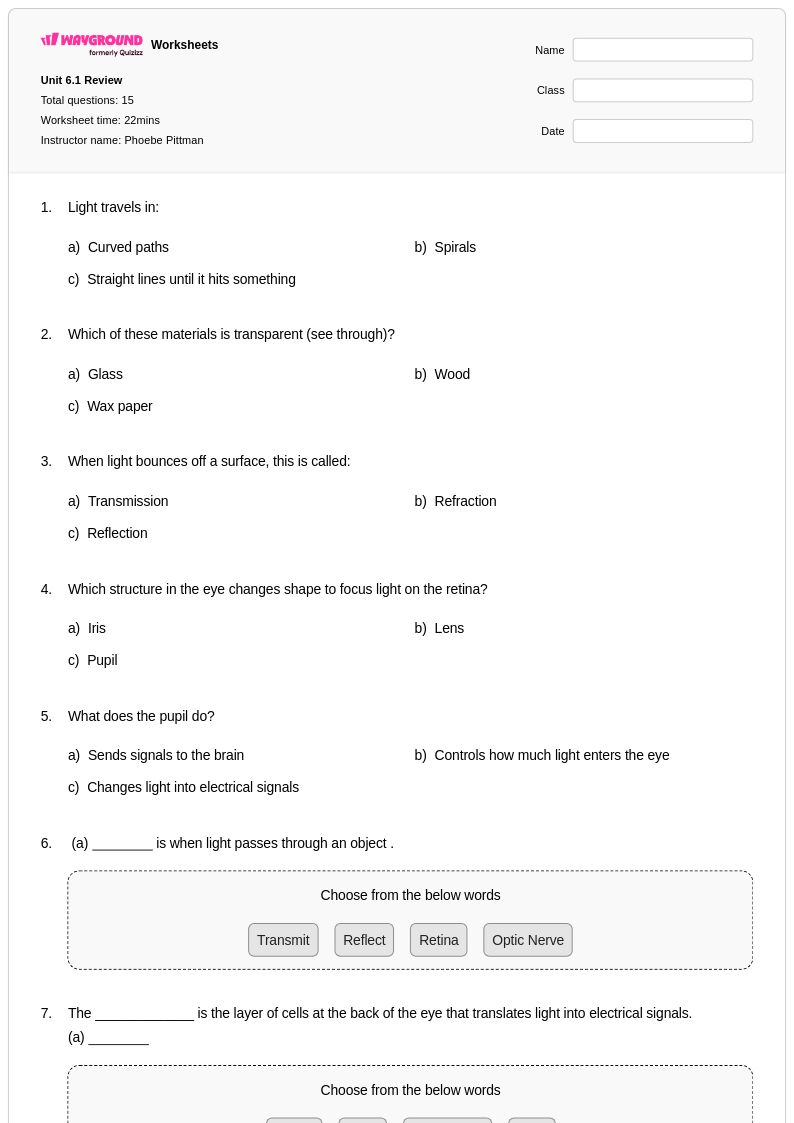
Reflection and refraction worksheets for Year 6 students available through Wayground provide comprehensive practice opportunities for mastering fundamental light behavior concepts in physics. These expertly designed worksheets guide sixth-grade learners through essential skills including identifying how light bounces off surfaces during reflection, understanding how light bends when passing through different materials during refraction, and applying the basic laws governing both phenomena. Students work through carefully scaffolded practice problems that build conceptual understanding while developing scientific reasoning abilities, with each worksheet offering complete answer keys and detailed explanations to support independent learning. The collection includes free printable resources in convenient PDF format, allowing educators to seamlessly integrate hands-on light experiments with theoretical understanding through engaging visual diagrams and real-world applications.
Wayground's extensive library of teacher-created reflection and refraction worksheets empowers educators with millions of high-quality resources specifically aligned to Year 6 physics standards and learning objectives. The platform's robust search and filtering capabilities enable teachers to quickly locate materials that match their specific curriculum needs, whether focusing on plane mirrors, concave and convex lenses, or practical applications like periscopes and eyeglasses. Advanced differentiation tools allow instructors to customize worksheet difficulty levels and modify content to accommodate diverse learning styles, while the availability of both digital and printable PDF formats provides maximum classroom flexibility. These comprehensive resources streamline lesson planning while offering targeted materials for remediation, enrichment activities, and systematic skill practice, ensuring that every student develops a solid foundation in understanding how light interacts with different surfaces and materials.
FAQs
How do I teach reflection and refraction to physics students?
Start by building students' conceptual understanding of how light behaves at media boundaries before introducing mathematical relationships. Use ray diagrams to show angles of incidence and reflection, then extend to refraction by demonstrating how light bends when passing between materials with different optical densities. Once students can visualize the behavior, introduce Snell's law for quantitative problem-solving. Real-world examples like fiber optics, prisms, and eyeglass lenses help students connect abstract optical principles to familiar applications.
What practice problems help students master Snell's law and refraction angles?
Effective practice problems progress from straightforward angle calculations using Snell's law to multi-step scenarios involving critical angles and total internal reflection. Students benefit from problems that require them to identify the incident ray, determine the index of refraction for each medium, and solve for the unknown angle. Including real-world contexts such as light passing through glass, water, or fiber optic cables reinforces why the mathematics matters and helps students apply the formula correctly across varied situations.
What mistakes do students commonly make when working with reflection and refraction?
One of the most frequent errors is measuring angles from the surface rather than from the normal, which produces incorrect angle values for both reflection and refraction calculations. Students also commonly confuse the indices of refraction for the two media when applying Snell's law, flipping n1 and n2 and arriving at the wrong refraction angle. A subtler misconception is the belief that light always bends toward the normal when crossing a boundary, when in fact the direction depends on whether light is moving into a denser or less dense medium.
How do I differentiate reflection and refraction instruction for students at different skill levels?
For students who are still building foundational understanding, focus on conceptual ray diagrams and the law of reflection before introducing Snell's law. Advanced learners can be challenged with total internal reflection problems, critical angle derivations, and multi-boundary scenarios like light passing through a glass slab. On Wayground, teachers can apply accommodations such as reduced answer choices to lower cognitive load for struggling students, or enable Read Aloud support for students who benefit from audio delivery of problem text, while other students work through standard problem sets simultaneously.
How can I use Wayground's reflection and refraction worksheets in my classroom?
Wayground's reflection and refraction worksheets are available as printable PDFs for traditional classroom use and in digital formats for technology-integrated learning environments, making them adaptable for in-class practice, homework, or lab follow-up. Teachers can also host worksheets directly as a quiz on Wayground for interactive digital delivery. All worksheets include complete answer keys, enabling immediate feedback and supporting self-assessment. The collection spans graduated difficulty levels, so the same platform can serve both students who need remediation on basic angle relationships and those ready for advanced total internal reflection problems.
How do reflection and refraction fit into a broader physics or waves unit?
Reflection and refraction are core principles within geometric optics and wave physics, typically introduced after students have a working understanding of wave behavior, speed, and frequency. These concepts connect directly to topics like lenses, mirrors, diffraction, and the electromagnetic spectrum, making them a foundational bridge unit. Teaching reflection and refraction with an emphasis on Snell's law and ray diagrams prepares students for more complex optics topics including image formation and optical instruments.