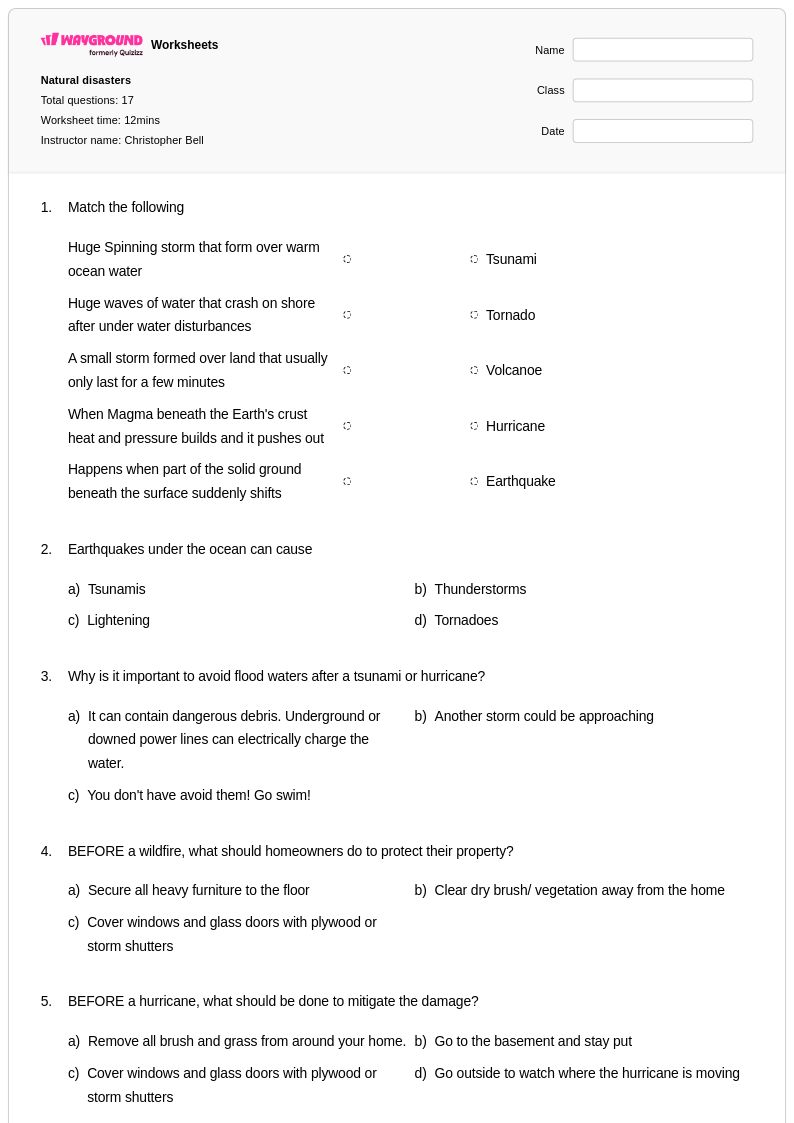
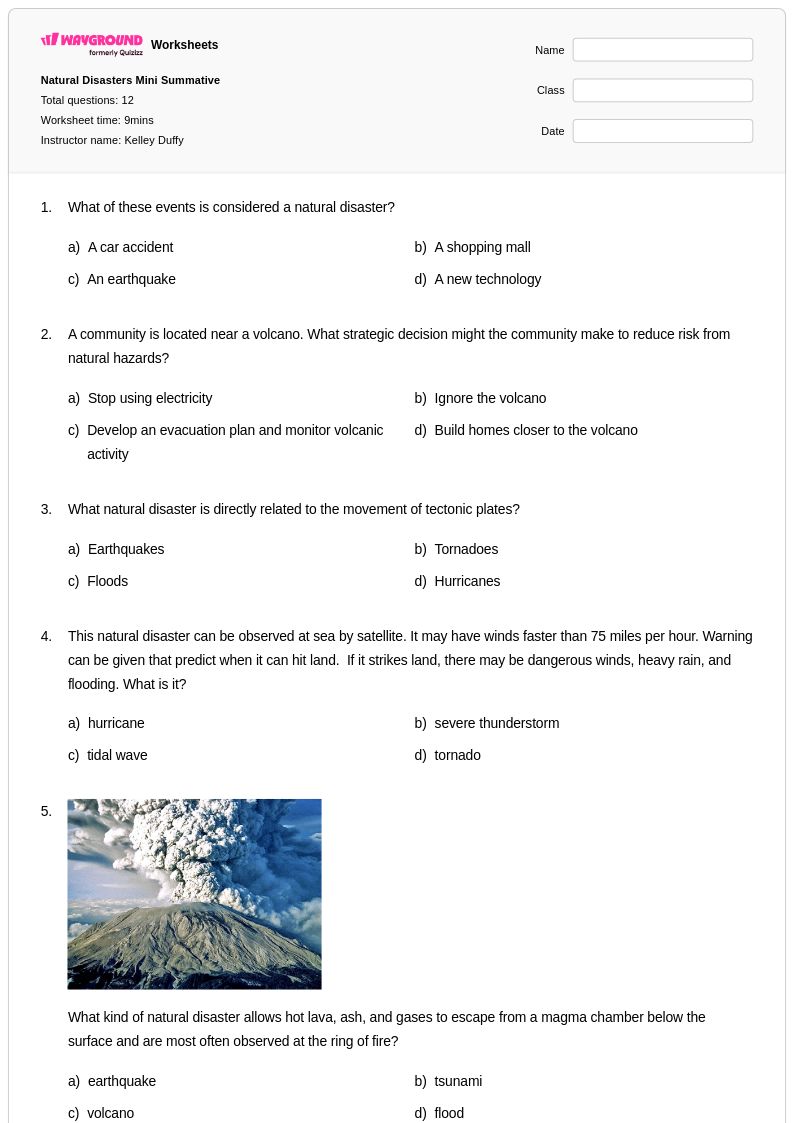
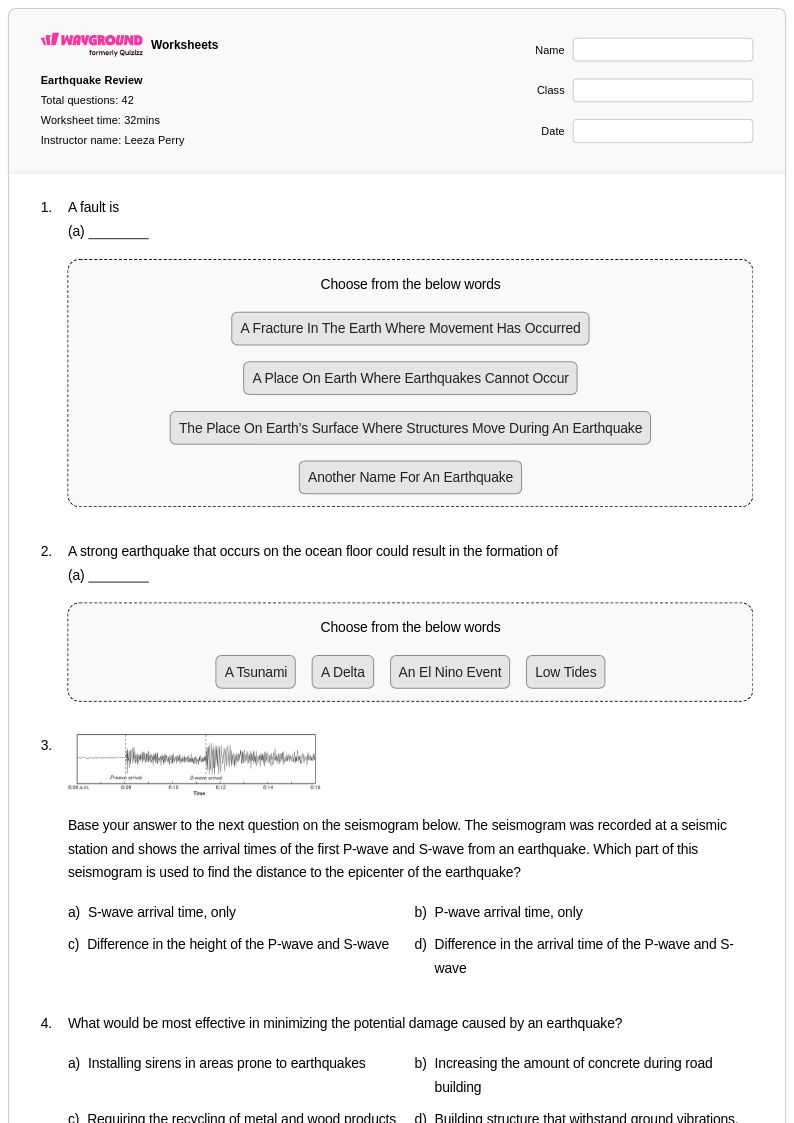
Year 9 tsunami worksheets and printables from Wayground help students explore seismic sea waves, their causes, and devastating impacts through engaging practice problems and comprehensive answer keys.
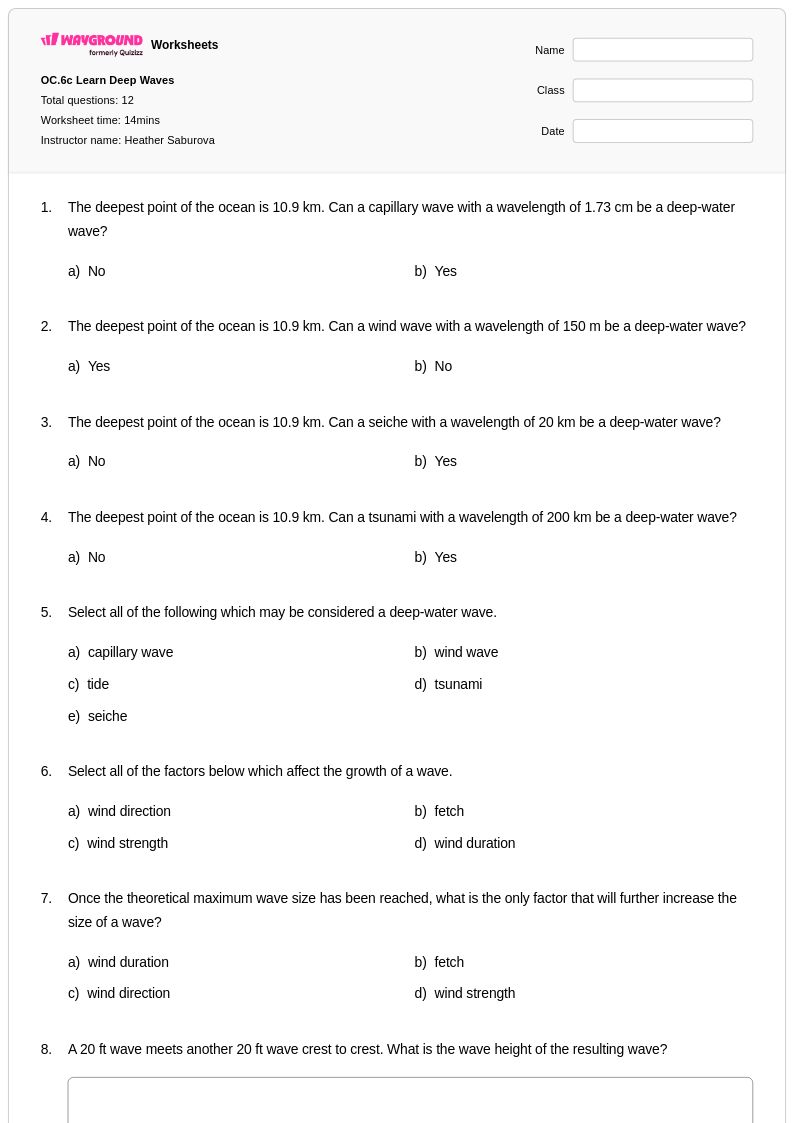
Tsunami worksheets for Year 9 students available through Wayground (formerly Quizizz) provide comprehensive practice materials that explore one of Earth's most powerful and devastating natural phenomena. These expertly designed worksheets strengthen critical thinking skills as students investigate the geological processes that generate tsunamis, including underwater earthquakes, volcanic eruptions, and submarine landslides. Through detailed practice problems, students analyze wave propagation patterns, calculate tsunami speeds across ocean basins, and examine the relationship between water depth and wave behavior. Each worksheet includes a complete answer key to support independent learning, and the free printable pdf format ensures accessibility for both classroom instruction and homework assignments. Students develop scientific literacy by interpreting real-world tsunami data, evaluating coastal vulnerability assessments, and understanding the sophisticated early warning systems that protect millions of people worldwide.
Wayground (formerly Quizizz) empowers educators with an extensive collection of teacher-created tsunami resources drawn from millions of high-quality materials specifically aligned to Year 9 Earth and Space Science standards. The platform's advanced search and filtering capabilities enable teachers to quickly locate worksheets that match their specific instructional needs, whether focusing on tsunami formation mechanisms, wave characteristics, or disaster preparedness strategies. Flexible customization tools allow educators to modify existing materials or create differentiated versions that accommodate diverse learning levels within their classrooms. These versatile resources are available in both printable and digital formats, including downloadable pdf versions that facilitate seamless integration into lesson planning, targeted remediation for struggling students, and enrichment opportunities for advanced learners. The comprehensive worksheet collection supports systematic skill practice that builds students' understanding of tsunami science while developing their ability to analyze complex geophysical processes and evaluate natural hazard mitigation strategies.
FAQs
How do I teach students about tsunamis in a science class?
Effective tsunami instruction begins with the mechanics of wave generation, helping students trace the chain of events from an underwater seismic event to coastal inundation. Teachers should connect tsunami formation to prior knowledge of plate tectonics and ocean dynamics, then layer in real-world case studies such as the 2004 Indian Ocean tsunami to make the science concrete. Incorporating data interpretation activities, such as reading seismograph outputs or wave propagation maps, builds analytical skills alongside content knowledge.
What exercises help students practice understanding tsunami causes and effects?
Practice activities that ask students to sequence tsunami formation, from an underwater earthquake or landslide to wave travel and coastal impact, reinforce cause-and-effect reasoning specific to this topic. Exercises involving wave speed calculations across ocean basins, analysis of tsunami detection buoy data, and evaluation of early warning system timelines give students hands-on engagement with the science. Comparing the impacts of tsunamis at different coastal elevations and distances also deepens understanding of why geography matters in natural hazard preparedness.
What misconceptions do students commonly have about tsunamis?
One of the most persistent misconceptions is that tsunamis are single, enormous waves similar to surfing swells, when in reality they are a series of long-wavelength waves that can arrive over several hours. Students also frequently confuse tsunami magnitude with earthquake magnitude, not realizing that fault orientation and seafloor displacement matter more than earthquake strength alone. Another common error is assuming that deep open-ocean water is dangerous during a tsunami, when in fact the waves are barely detectable at sea and only become destructive as they approach shallow coastal areas.
How can I use tsunami worksheets to support different skill levels in my classroom?
Tsunami worksheets can be differentiated by adjusting the complexity of the task, offering foundational cause-and-effect questions for students still building content knowledge while providing wave physics calculations or critical analysis of real tsunami events for advanced learners. On Wayground, teachers can customize worksheet difficulty and content focus to match diverse learning needs within the same class. For students who need additional support, Wayground also offers accommodations such as read-aloud, extended time, and reduced answer choices, which can be assigned individually without disrupting the rest of the class.
How do I use Wayground's tsunami worksheets in my classroom?
Wayground's tsunami worksheets are available as free printable PDFs for traditional classroom use and in interactive digital formats for technology-integrated learning environments, giving teachers flexibility regardless of their setup. Teachers can also host the material as a live quiz on Wayground, making it easy to track student responses in real time. Each worksheet includes a complete answer key, so grading and feedback can be handled quickly after instruction.
What safety and preparedness concepts should tsunami worksheets cover?
Tsunami worksheets should address how early warning systems work, including the role of deep-ocean assessment and reporting of tsunamis (DART) buoys and seismic monitoring networks, so students understand how communities receive alerts. Students should also explore evacuation planning, the significance of natural warning signs such as sudden sea withdrawal, and why coastal populations are most at risk. Connecting scientific understanding to real preparedness actions helps students see the practical value of Earth science knowledge.