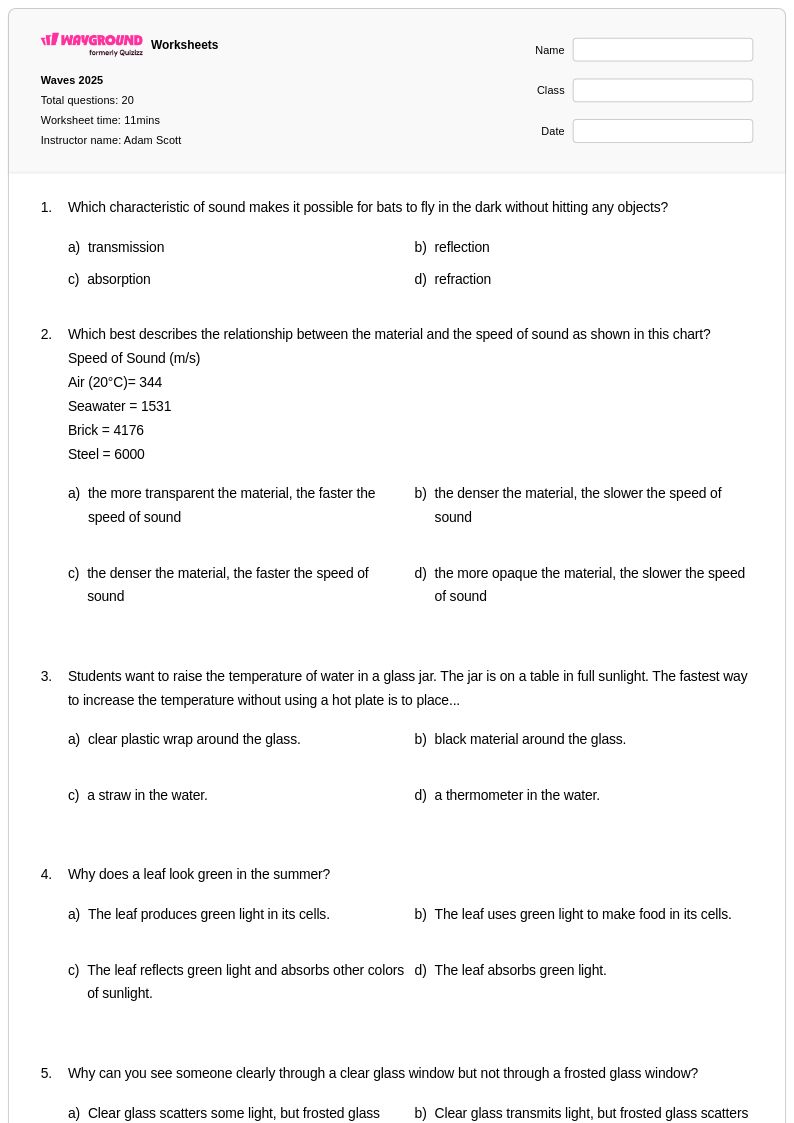
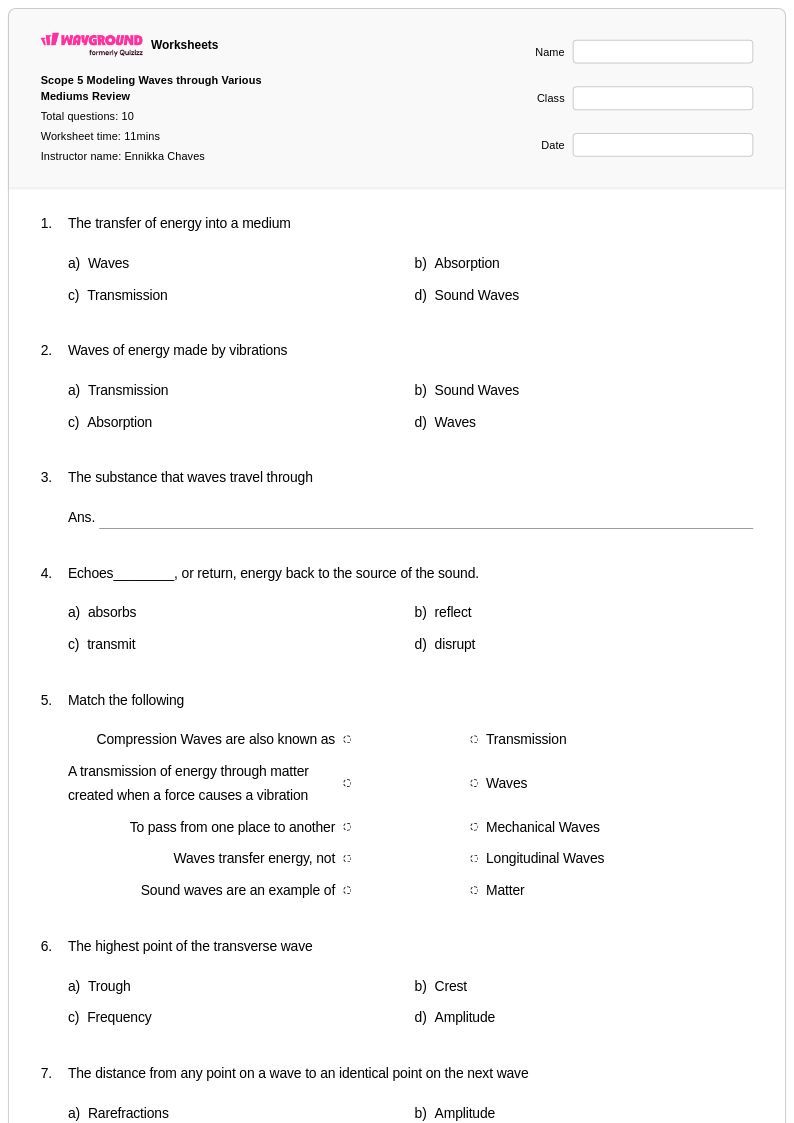
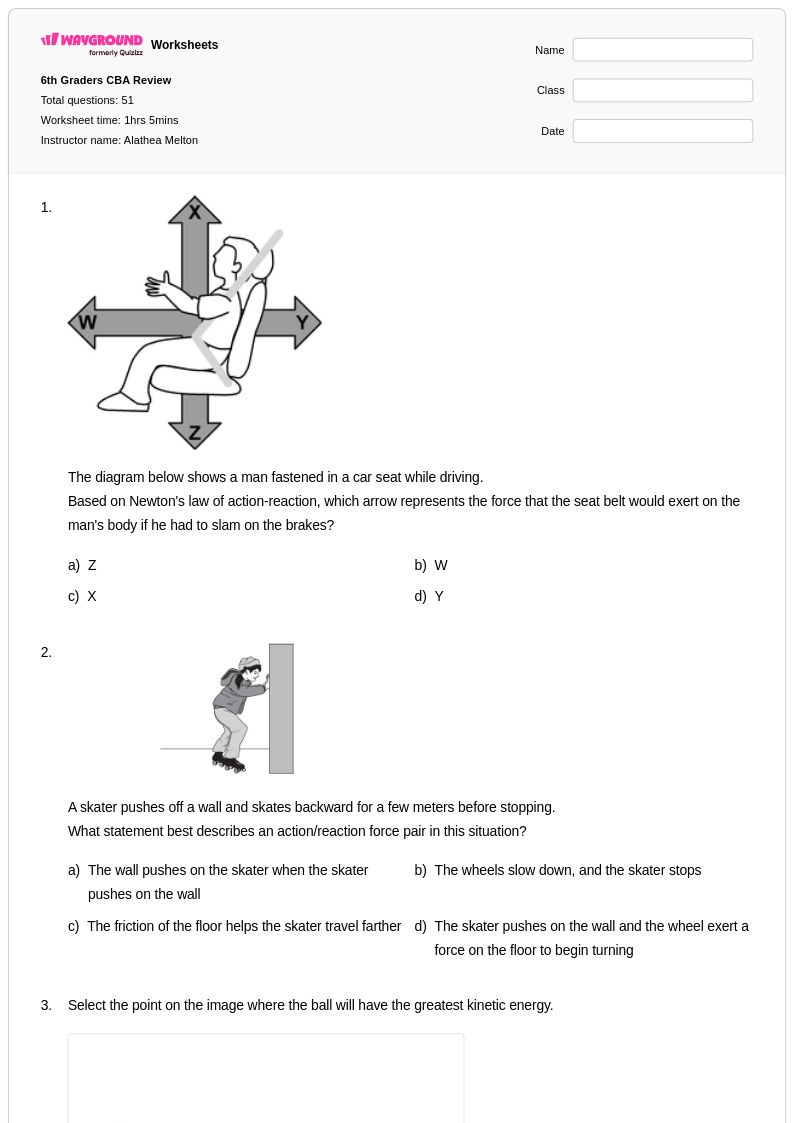
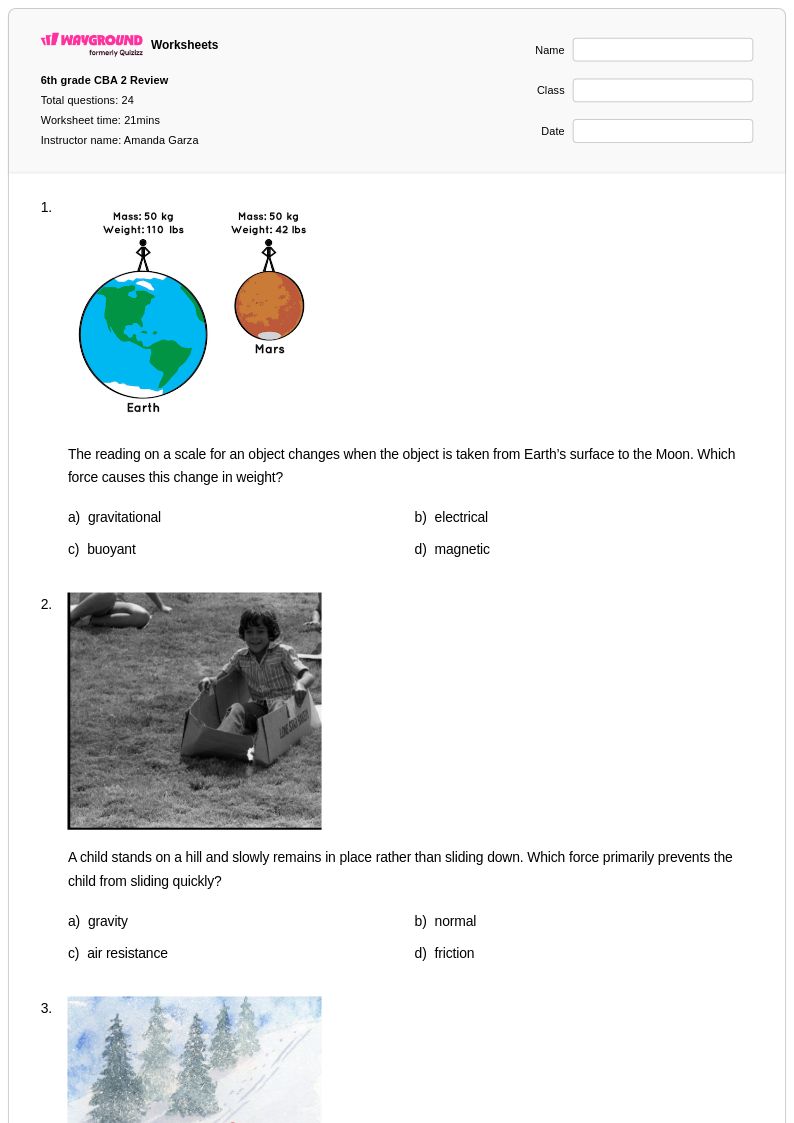
Enhance Year 6 students' understanding of wave action with Wayground's comprehensive collection of free worksheets, printable PDFs, and practice problems that explore wave properties, motion, and behavior through engaging exercises with complete answer keys.
Explore printable Wave Action worksheets for Year 6
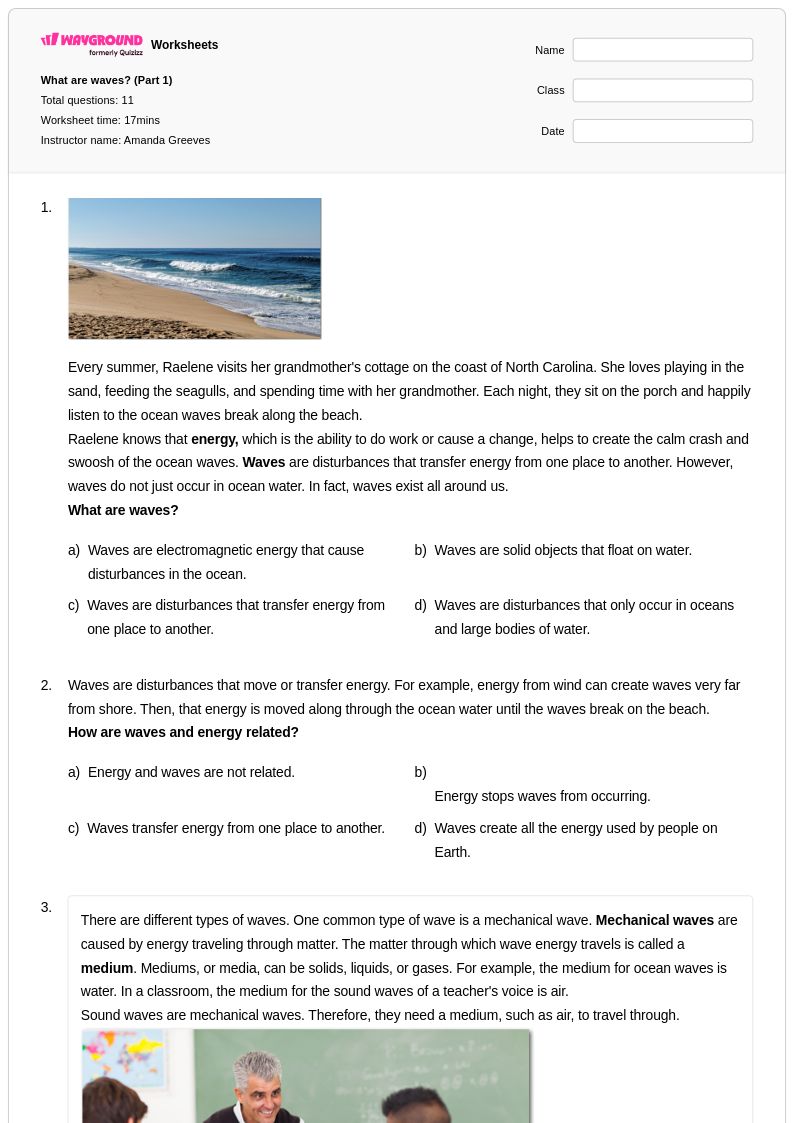
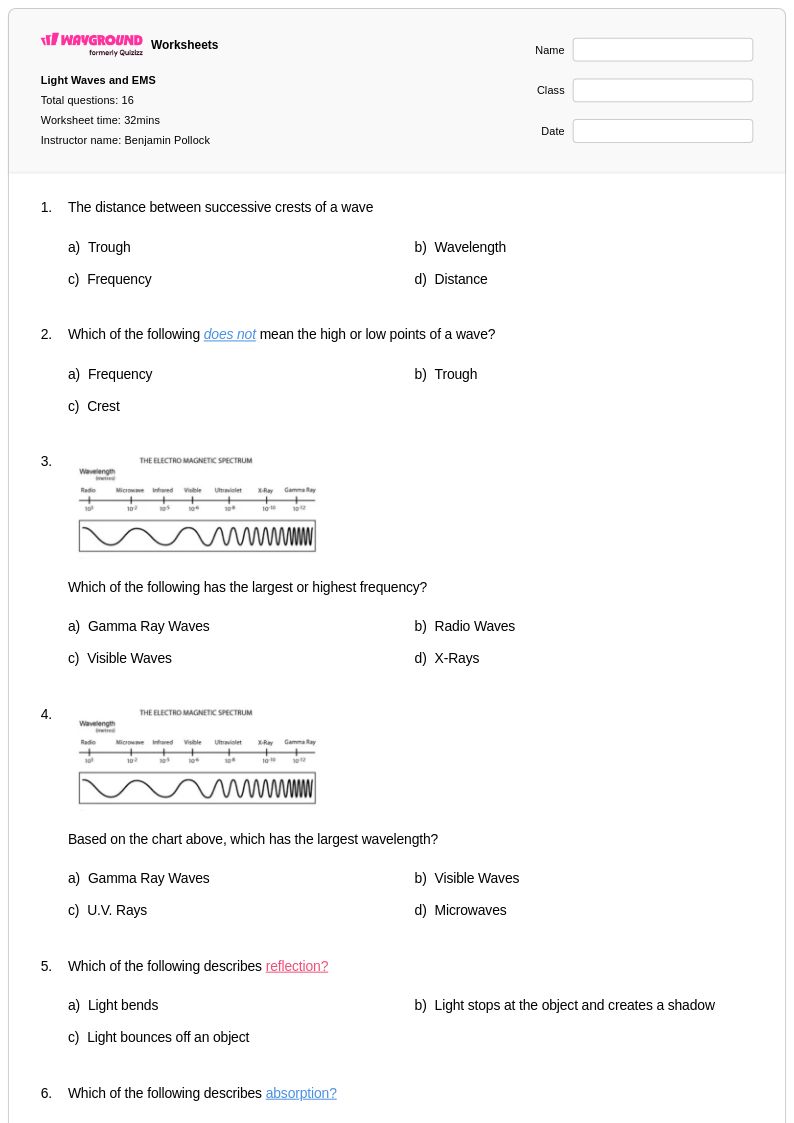
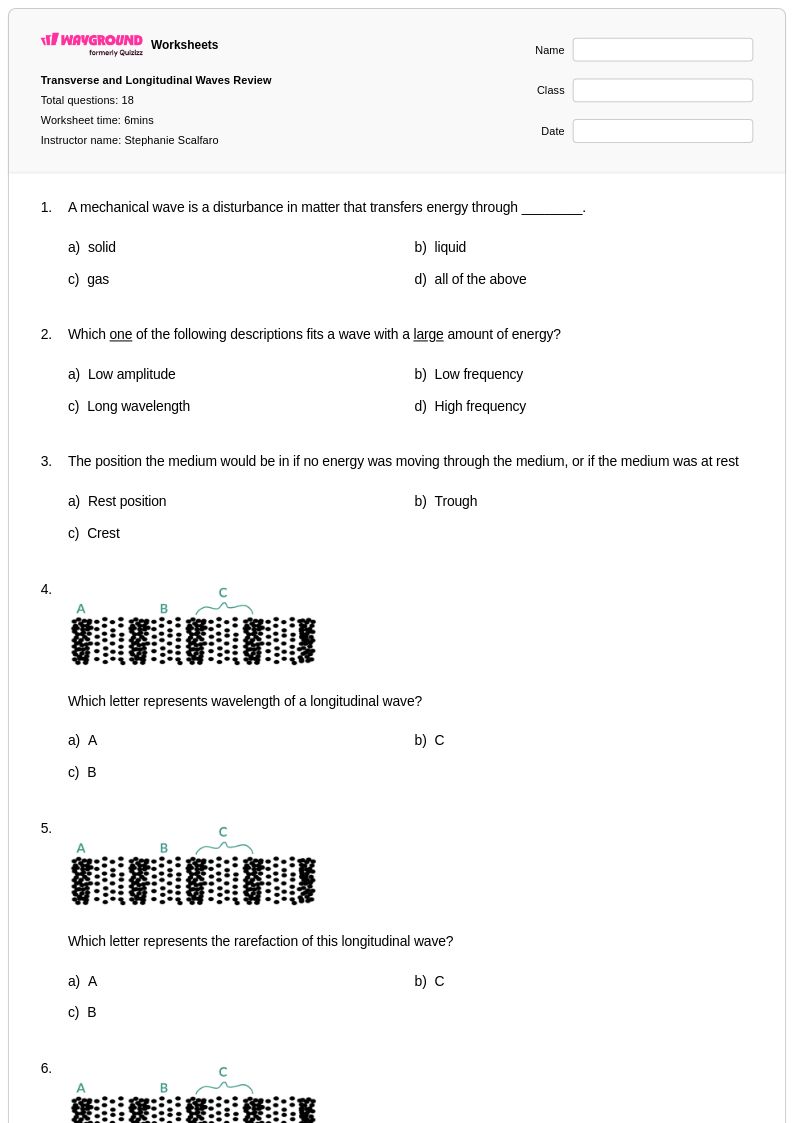
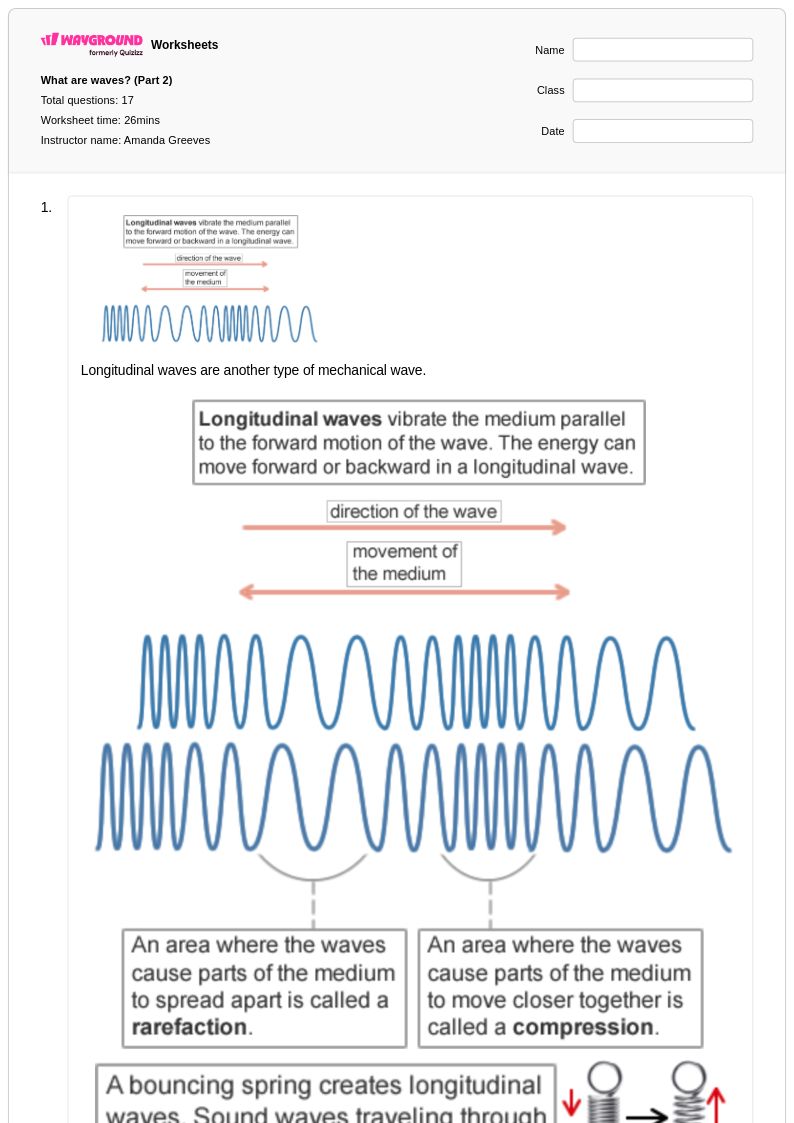
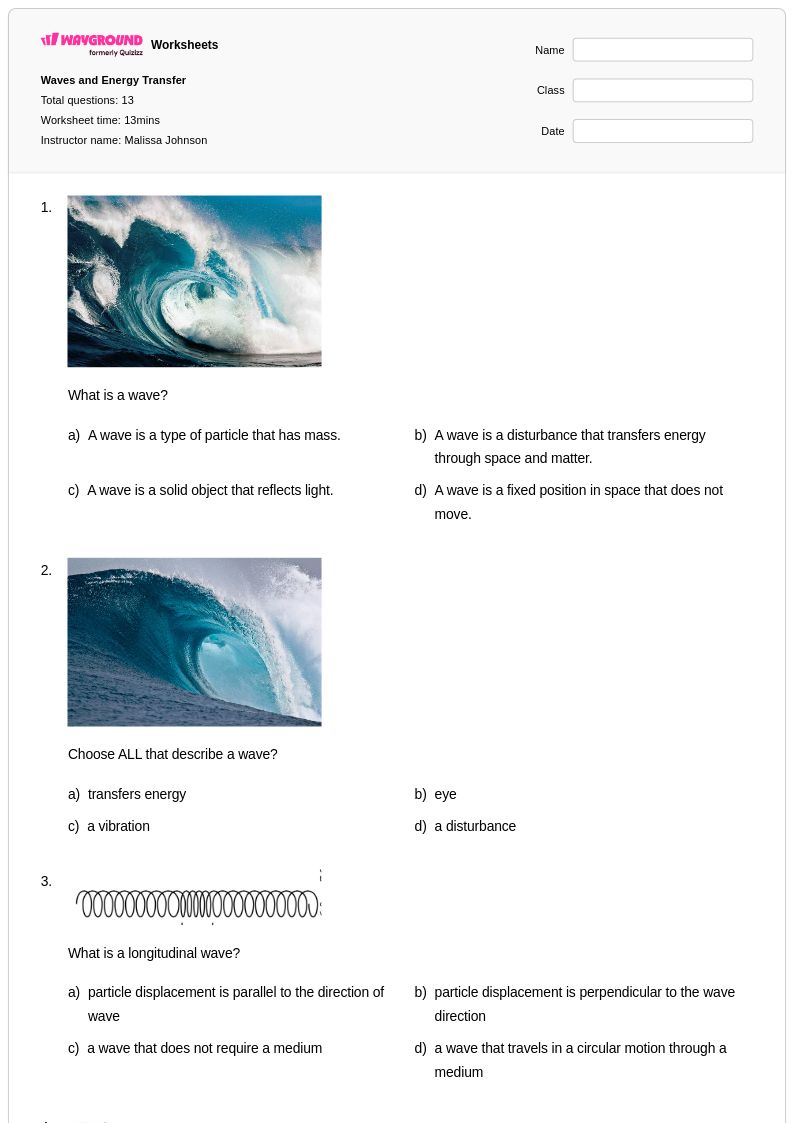
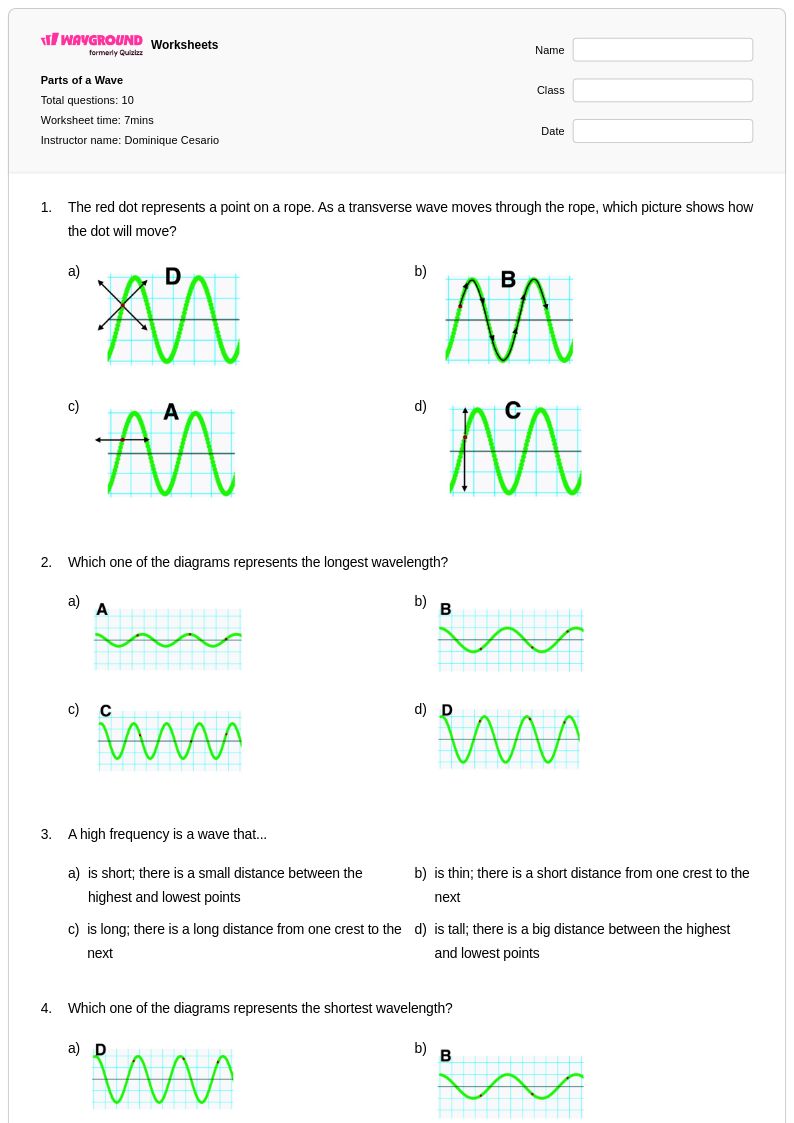
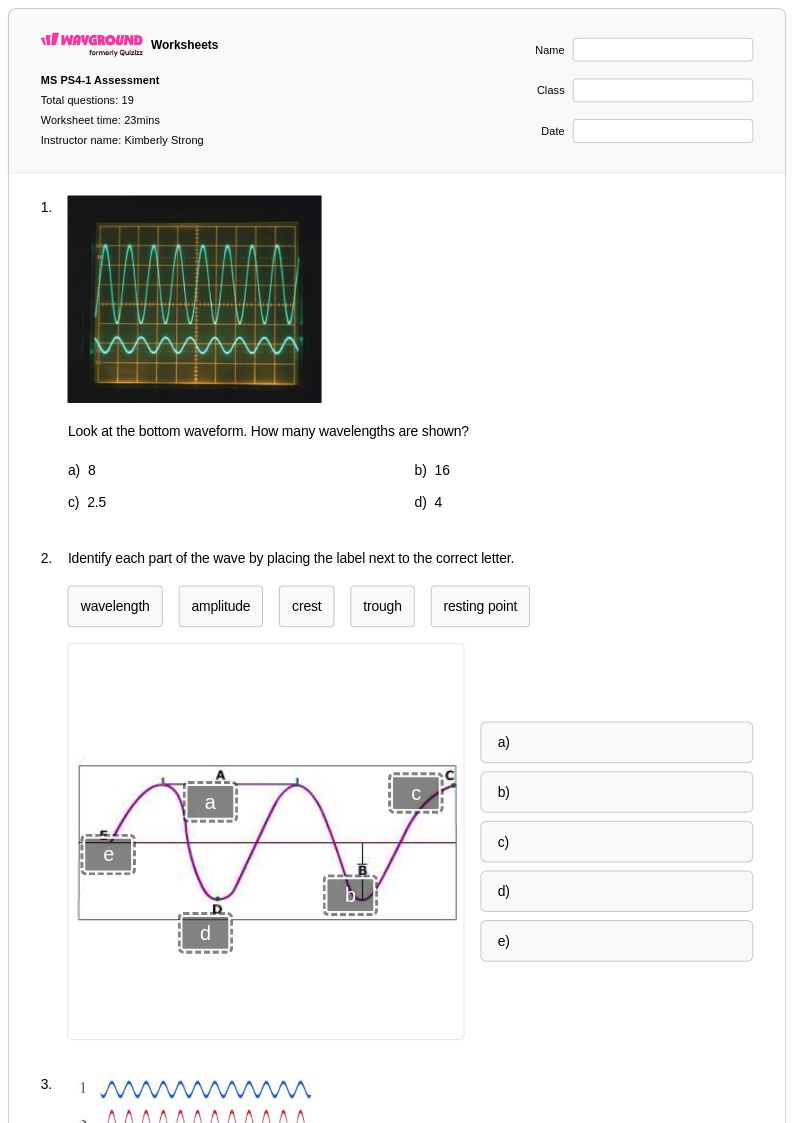
Wave Action worksheets for Year 6 students available through Wayground (formerly Quizizz) provide comprehensive practice materials that help young learners understand the fundamental properties and behaviors of waves in physics. These carefully designed worksheets guide students through essential concepts including wave amplitude, frequency, wavelength, and how waves transfer energy through different mediums without transferring matter. Students work through practice problems that demonstrate mechanical waves like sound and water waves, exploring how these phenomena occur in everyday life and natural environments. Each worksheet comes with detailed answer keys that allow educators to efficiently assess student understanding, while the free printables offer flexible options for classroom instruction, homework assignments, and independent study sessions focusing on this critical physics foundation.
Wayground (formerly Quizizz) empowers educators with millions of teacher-created resources specifically designed to support Year 6 wave action instruction through robust search and filtering capabilities that help locate materials aligned with specific learning standards and objectives. Teachers can easily differentiate instruction by accessing worksheets at varying complexity levels, from basic wave identification exercises to more advanced problems involving wave calculations and real-world applications. The platform's flexible customization tools enable educators to modify existing materials or combine multiple resources to meet diverse classroom needs, while both printable pdf formats and digital versions accommodate different teaching preferences and technology availability. These comprehensive worksheet collections streamline lesson planning while providing targeted resources for remediation, skill reinforcement, and enrichment activities that deepen student comprehension of wave properties and behaviors.
FAQs
How do I teach wave action to my physics students?
Teaching wave action effectively starts with establishing the distinction between mechanical and electromagnetic waves, then building toward properties like frequency, wavelength, amplitude, and wave speed. Hands-on demonstrations such as using a slinky to model transverse and longitudinal waves give students a concrete reference before introducing equations. From there, layering in phenomena like reflection, refraction, interference, and diffraction helps students understand how waves behave when they encounter boundaries or interact with other waves.
What are good practice exercises for wave properties like frequency, wavelength, and wave speed?
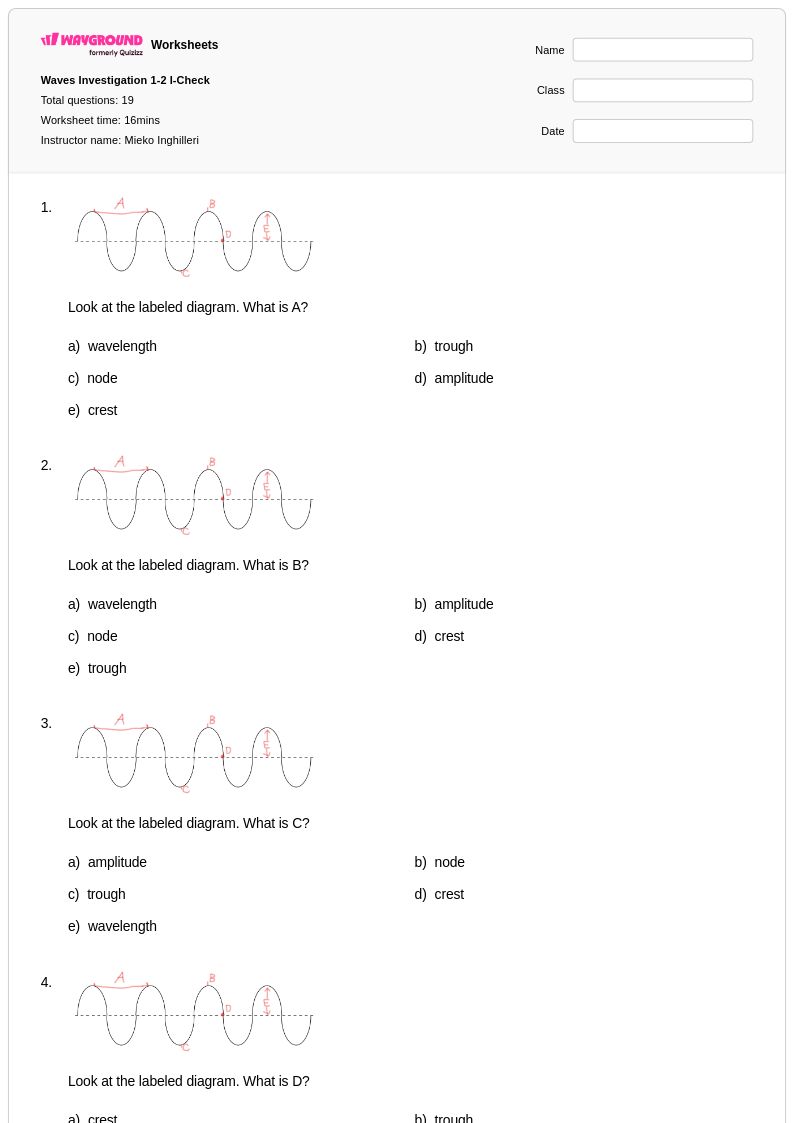
Effective practice exercises for wave properties include calculation problems using the wave speed equation (v = fλ), where students solve for an unknown given two values. Diagram-based problems that ask students to identify or measure amplitude, wavelength, and frequency from a drawn wave reinforce visual comprehension alongside numerical fluency. Problems involving wave behavior in different media, such as how wave speed changes when a wave moves from air to water, build deeper conceptual understanding.
What mistakes do students commonly make when working with wave equations and properties?
One of the most frequent errors is confusing wavelength and amplitude, since both are measured in units of length but represent fundamentally different properties. Students also commonly misapply the wave speed equation by conflating wave speed with frequency, assuming a higher frequency always means a faster wave even when the medium stays constant. When working with interference, students often struggle to distinguish constructive from destructive interference, particularly in diagrams where superposition must be applied carefully.
How do I differentiate wave action instruction for students at different ability levels?
For students who need additional support, focusing first on foundational wave properties with guided practice and visual representations builds the conceptual foundation before introducing equations. Advanced learners can be challenged with complex interference pattern problems, wave behavior across multiple media, and real-world applications such as sound engineering or electromagnetic wave transmission. On Wayground, teachers can apply individual accommodations including read aloud support, reduced answer choices, and extended time so every student accesses wave action content at an appropriate level of challenge.
How do I use Wayground's wave action worksheets in my classroom?
Wayground's wave action worksheets are available as printable PDFs for traditional classroom use and in digital formats for technology-integrated environments, so they work whether students are completing independent practice on paper or submitting assignments online. Teachers can also host worksheets directly as a quiz on Wayground, enabling real-time student responses and automated grading. Each worksheet includes complete answer keys, which makes them practical for both in-class instruction and independent or homework assignments.
How do I assess student understanding of wave phenomena like reflection, refraction, and diffraction?
Assessing wave phenomena effectively requires both conceptual and applied question types. Scenario-based problems, where students predict what happens to a wave as it crosses a boundary or passes through a gap, reveal whether students understand the underlying principles rather than just memorizing definitions. Diagram annotation tasks, where students label or draw wave behavior for reflection, refraction, and diffraction, are particularly effective at exposing gaps in spatial reasoning about wave interactions.