

Wayground
balanced or unbalanced chemical equations - Printable Science Worksheets 8th Grade - Wayground

balanced or unbalanced chemical equations

Crystal Norton

Created by Crystal Norton

20 questions

8th Grade

Science

Updated Oct 2026

This Grade 8 science worksheet gives students focused practice identifying and evaluating balanced and unbalanced chemical equations. The 20 multiple-choice questions ask students to compare the number of atoms on each side of an equation, determine whether equations satisfy the law of conservation of mass, and explain why an equation is not balanced. Students also identify reactants and products, interpret chemical equations, and count atoms such as aluminum using coefficients and subscripts. Designed for middle school science instruction, this worksheet supports lessons on chemical reactions, conservation of mass, and reading chemical equations. Teachers can use the questions for guided practice, independent review, or a quick check of students’ ability to distinguish coefficients from subscripts and verify atom counts. It is a free printable worksheet with a complete answer key for efficient checking and feedback.

Worksheet settings

Font size

S
M
L
XL
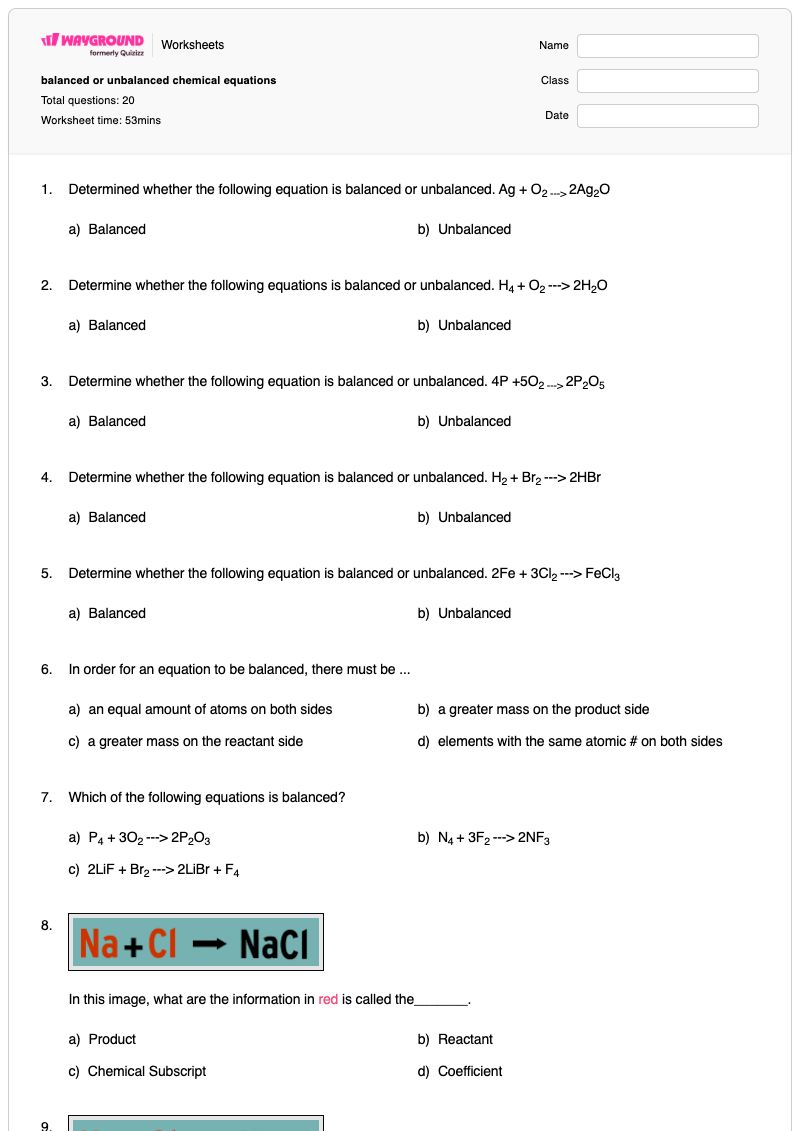
WaygroundWorksheets

balanced or unbalanced chemical equations

Total questions: 20

Name
Class
Date
1.

Determined whether the following equation is balanced or unbalanced. Ag + O2 ---> 2Ag2O

a)

Balanced

b)

Unbalanced

2.

Determine whether the following equations is balanced or unbalanced. H4 + O2 ---> 2H2O

a)

Balanced

b)

Unbalanced

3.

Determine whether the following equation is balanced or unbalanced. 4P +5O2 ---> 2P2O5

a)

Balanced

b)

Unbalanced

4.

Determine whether the following equation is balanced or unbalanced. H2 + Br2 ---> 2HBr

a)

Balanced

b)

Unbalanced

5.

Determine whether the following equation is balanced or unbalanced. 2Fe + 3Cl2 ---> FeCl3

a)

Balanced

b)

Unbalanced

6.

In order for an equation to be balanced, there must be ...

a)

an equal amount of atoms on both sides

b)

a greater mass on the product side

c)

a greater mass on the reactant side

d)

elements with the same atomic # on both sides

7.

Which of the following equations is balanced?

a)

P4 + 3O2 ---> 2P2O3

b)

N4 + 3F2 ---> 2NF3

c)

2LiF + Br2 ---> 2LiBr + F4

8.
In this image, what are the information in red is called the_______.
a)
Product
b)
Reactant
c)
Chemical Subscript
d)
Coefficient
9.
In this image, what are the information to the right of the arrow (in black) is called the_______.
In this image, what are the information to the right of the arrow (in black) is called the_______.
a)
Product
b)
Reactant
c)
Chemical Subscript
10.
The law of conservation of mass states that....
a)
Matter can be made
b)
Matter can be destroyed
c)
Matter can neither be made or destroyed
d)
Matter can evaporate
11.
Is this balanced?...
Al + O2 --> 2Al2O3
a)
Yes!
b)
NO!
12.
At the end of chemical reactions, what is the total mass of the reactants compared to the total mass of the products?
a)
the product is doubled
b)
the product is half the mass of the reactants
c)
the mass is the same
d)
the mass changes depending on the reaction
13.
Why is the following chemical equation not balanced?
H2 + O2 --> H2O
a)
each side of the equation has a different number of oxygen atoms
b)
each side of the equation has a different number of hydrogen atoms
c)
each side has the same mass
14.
How many atoms of aluminum are on each side of the following equation: 4Al + 3O2 --> 2Al2 O3
a)
2
b)
6
c)
1
d)
4
15.
How many atoms of aluminum are on each side of the following equation: 4Al + 3O2 --> 2Al2 O3
a)
2
b)
6
c)
1
d)
4
16.
Is the following equation balanced or unbalanced?
Fe + S --> FeS
a)
balanced
b)
unbalanced
17.
What coefficient should be used to make the following equation balanced?
N2+O2--> _NO 
a)
1
b)
2
c)
3
d)
4
18.

Identify if the following equation is unbalanced or balanced.

O3+2C→3OC

a)

Unbalanced

b)

Balanced

19.
The small numbers in a chemical formula: (the BLUE numbers)

The small numbers in a chemical formula:

(the BLUE numbers)

a)

Subscripts

b)

Coefficients

c)

Numbers

d)

Molecules

20.
The red numbers in the image below represent ________
a)
subscripts
b)
coefficients
c)
I don't know, and don't want to try
d)
None of the answers are correct
WaygroundAnswer Key

balanced or unbalanced chemical equations

Total questions: 20

1.
b)

Unbalanced

2.
a)

Balanced

3.
a)

Balanced

4.
a)

Balanced

5.
b)

Unbalanced

6.
a)

an equal amount of atoms on both sides

7.
a)

P4 + 3O2 ---> 2P2O3

8.
b) Reactant
9.
a) Product
10.
c) Matter can neither be made or destroyed
11.
b) NO!
12.
c) the mass is the same
13.
a) each side of the equation has a different number of oxygen atoms
14.
d) 4
15.
d) 4
16.
a) balanced
17.
b) 2
18.
a)

Unbalanced

19.
a)

Subscripts

20.
b) coefficients

FAQs

What does this worksheet cover about balanced and unbalanced chemical equations?

This Grade 8 worksheet uses 20 multiple-choice questions to help students determine whether chemical equations are balanced by comparing atom counts on the reactant and product sides. It also checks whether students can identify reactants and products, apply the law of conservation of mass, distinguish coefficients from subscripts, and count atoms in formulas.

How can I use this worksheet to teach students to identify balanced chemical equations?

First model how to count each element on both sides of an equation, using coefficients and subscripts carefully. Then have students explain their choices for the balanced-or-unbalanced items and discuss how equal atom counts reflect conservation of mass. Use the reactant, product, and aluminum-count questions to reinforce how chemical equations communicate what changes and what is conserved.

What mistakes should I watch for when students complete this chemical equations worksheet?

Students may count only the visible formula units instead of multiplying by a coefficient, or overlook a subscript when comparing atoms. They may also confuse reactants on the left of the arrow with products on the right, or assume an equation is balanced because the elements match without checking the number of atoms. Review the oxygen-count error in an unbalanced equation and ask students to show each side’s atom totals.

How do I assign and grade this balanced and unbalanced equations worksheet?

The worksheet is available as a printable PDF and as a digital quiz on Wayground, and it includes a complete answer key. Printable submissions can be graded by scanning student work with the Wayground for Teachers app. The printable option can also support schools that are reducing screen time.

How can I differentiate this chemical equations worksheet for my students?

Use the worksheet’s Advanced Settings to adjust font spacing or font size so the chemical equations and multiple-choice options are easier to read. You can also apply a dyslexia-friendly font or translate the worksheet into another language while keeping the atom-counting and reactant-product questions intact.

Where can I find more worksheets like this on Wayground?

Wayground offers a comprehensive collection of free printable worksheets and practice problems across subjects, including downloadable PDFs and answer keys to support essential skills and concepts. Browse more resources at https://wayground.com/en-us/worksheets.