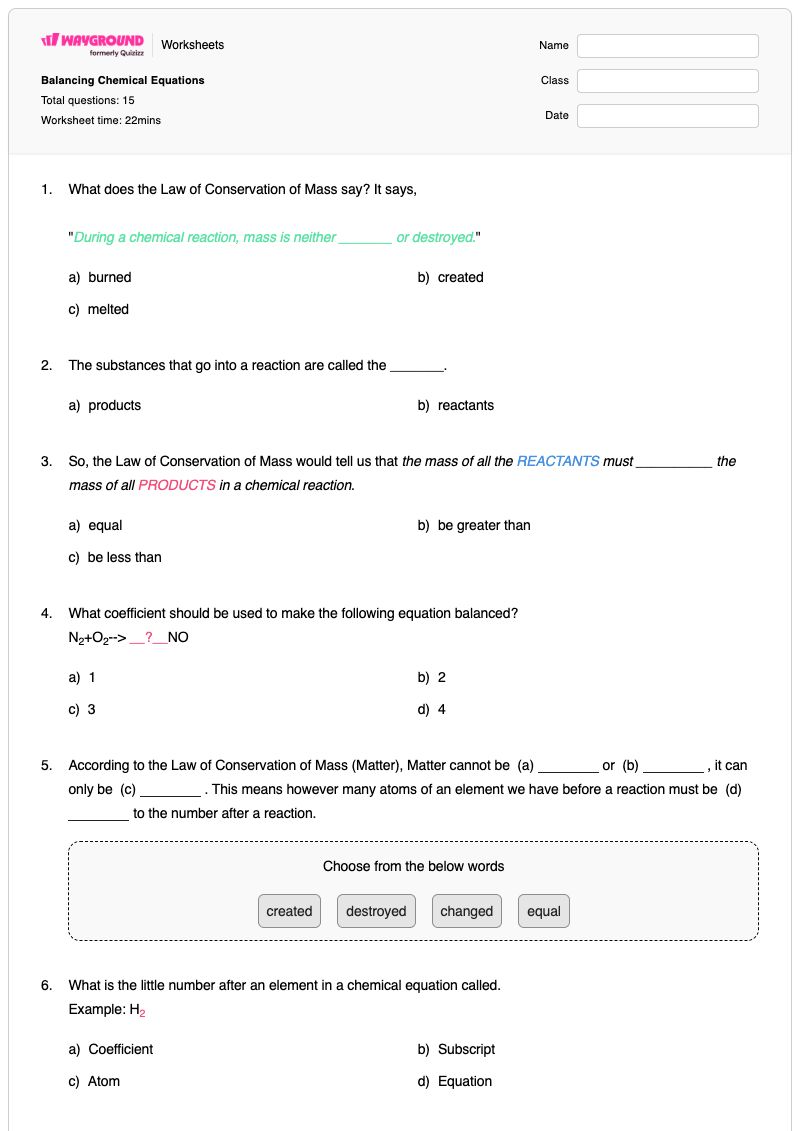
This Grade 8 science worksheet builds foundational skills for balancing chemical equations through the Law of Conservation of Mass. Students identify reactants and products, distinguish coefficients from subscripts, determine the number of elements and atoms represented in chemical formulas, and select coefficients that make equations balanced. The set includes 15 questions: 14 multiple-choice items and one dropdown item.
Students apply atom-counting and equation-reading skills to examples such as nitrogen and oxygen forming nitric oxide, iron reacting with oxygen, and magnesium reacting with hydrochloric acid. The questions also ask students to evaluate whether equations are balanced and interpret what a formula reveals about the atoms in a substance. This free printable worksheet is designed for Grade 8 science practice, review, or formative assessment and includes a complete answer key for efficient checking.
Worksheet settings
Font size
S
M
L
XL
Worksheets
Balancing Chemical Equations
Total questions: 15
Name
Class
Date
1.
What does the Law of Conservation of Mass say? It says,
"During a chemical reaction, mass is neither _______ or destroyed."
a)
burned
b)
created
c)
melted
2.
The substances that go into a reaction are called the _______.
a)
products
b)
reactants
3.
So, the Law of Conservation of Mass would tell us that the mass of all the REACTANTS must __________ the mass of all PRODUCTS in a chemical reaction.
a)
equal
b)
be greater than
c)
be less than
4.
What coefficient should be used to make the following equation balanced?
N2+O2--> __?__NO
a)
1
b)
2
c)
3
d)
4
5.
According to the Law of Conservation of Mass (Matter), Matter cannot be (a) or (b) , it can only be (c) . This means however many atoms of an element we have before a reaction must be (d) to the number after a reaction.
Choose from the below words
created
destroyed
changed
equal
6.
What is the little number after an element in a chemical equation called. Example: H2
a)
Coefficient
b)
Subscript
c)
Atom
d)
Equation
7.
Which of the following equations are correctly balanced?
a)
12CO2 +H2O --> C6H12O6 + O2
b)
CO2 + 9H2O --> C6H12O6 + O2
c)
CO2 + H2O --> 3C6H12O6 + O2
d)
6CO2 + 6H2O --> C6H12O6 + 6O2
8.
Is the following equation balanced? 4Fe + 3O2 --> 2Fe2O3
a)
yes
b)
no
9.
What is the right part of a chemical equation called... 2H2 + O2--> 2H2O
a)
Reactants
b)
Products
c)
Yields
d)
Chemical Equation
10.
How many elements are in C6H12O6?
a)
1
b)
2
c)
3
d)
4
11.
What is the number before a chemical formula called? Ex: 2H2 + O2 --> 2H2O
a)
Coefficient
b)
Subscript
c)
Atom
d)
Equation
12.
How many atoms are in the neurotransmitter serotonin? The formula for serotonin is C10H12N2O
a)
10
b)
20
c)
25
d)
23
13.
What information could a student determine from only the chemical formula of a protein?
a)
The color of the protein
b)
The number of molecules in each sequence of the protein
c)
The physical arrangement of atoms in the structure of the protein
d)
The number of atoms of each element in the protein
14.
Is the following equation balanced? 2C2H2 + 5O2 --> 4CO2 + 2H2O
a)
yes
b)
no
15.
How many HCl molecules do you need to balance this equation? Mg + __HCl ---> MgCl2 + H2
a)
1
b)
2
c)
3
d)
4
Answer Key
Balancing Chemical Equations
Total questions: 15
1.
b)
created
2.
b)
reactants
3.
a)
equal
4.
b)
2
5.
created, destroyed, changed, equal
6.
b)
Subscript
7.
d)
6CO2 + 6H2O --> C6H12O6 + 6O2
8.
a) yes
9.
b) Products
10.
c) 3
11.
a) Coefficient
12.
c) 25
13.
d) The number of atoms of each element in the protein
14.
a) yes
15.
b) 2
140 %
Browse by subjects
Browse by grades
Browse by format
FAQs
What does this balancing chemical equations worksheet help students learn?
This Grade 8 worksheet helps students use the Law of Conservation of Mass to balance chemical equations by counting atoms on both sides and selecting appropriate coefficients. Its 14 multiple-choice questions and one dropdown item also reinforce reactants, products, coefficients, subscripts, and the information conveyed by chemical formulas.
How can I use this worksheet to teach balancing chemical equations?
Introduce the worksheet by modeling how to count each element on both sides of an equation without changing subscripts, then use the terminology items to distinguish reactants, products, coefficients, and subscripts. Have students explain why equations such as 4Fe + 3O₂ → 2Fe₂O₃ are balanced before completing the coefficient-selection and yes-or-no items independently.
What mistakes should I watch for when students complete this worksheet?
Watch for students changing subscripts instead of adding coefficients, or counting molecules rather than individual atoms when checking an equation. Students may also confuse reactants with products, mistake a subscript for a coefficient, or overlook an element when counting atoms in formulas such as C₁₀H₁₂N₂O.
How do I assign and grade this worksheet?
This worksheet is available as a printable PDF and as a digital quiz on Wayground, so you can use the same 15-item practice set in either format. It includes a complete answer key, and printable submissions can be graded by scanning student work with the Wayground for Teachers app.
How can I differentiate this chemical equations worksheet for my students?
Use the worksheet’s Advanced Settings to adjust font spacing and font size so the chemical formulas, coefficients, and atom-counting items are easier to read. You can also apply a dyslexia-friendly font or translate the worksheet into another language while preserving its equation-balancing format.
Where can I find more free worksheets like this on Wayground?
Wayground offers a comprehensive collection of free printable worksheets and practice problems across all subjects, with downloadable PDFs and answer keys to support essential skills and concepts. Browse more resources at https://wayground.com/en-us/worksheets.


 Worksheets