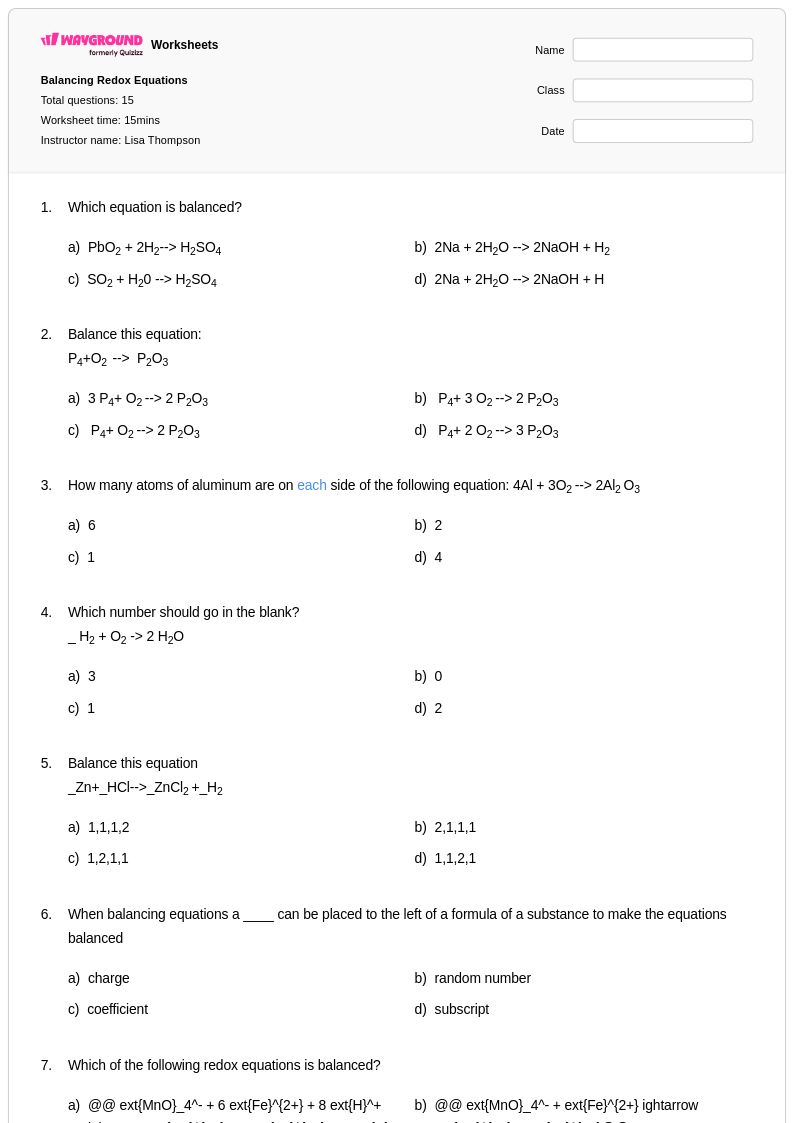
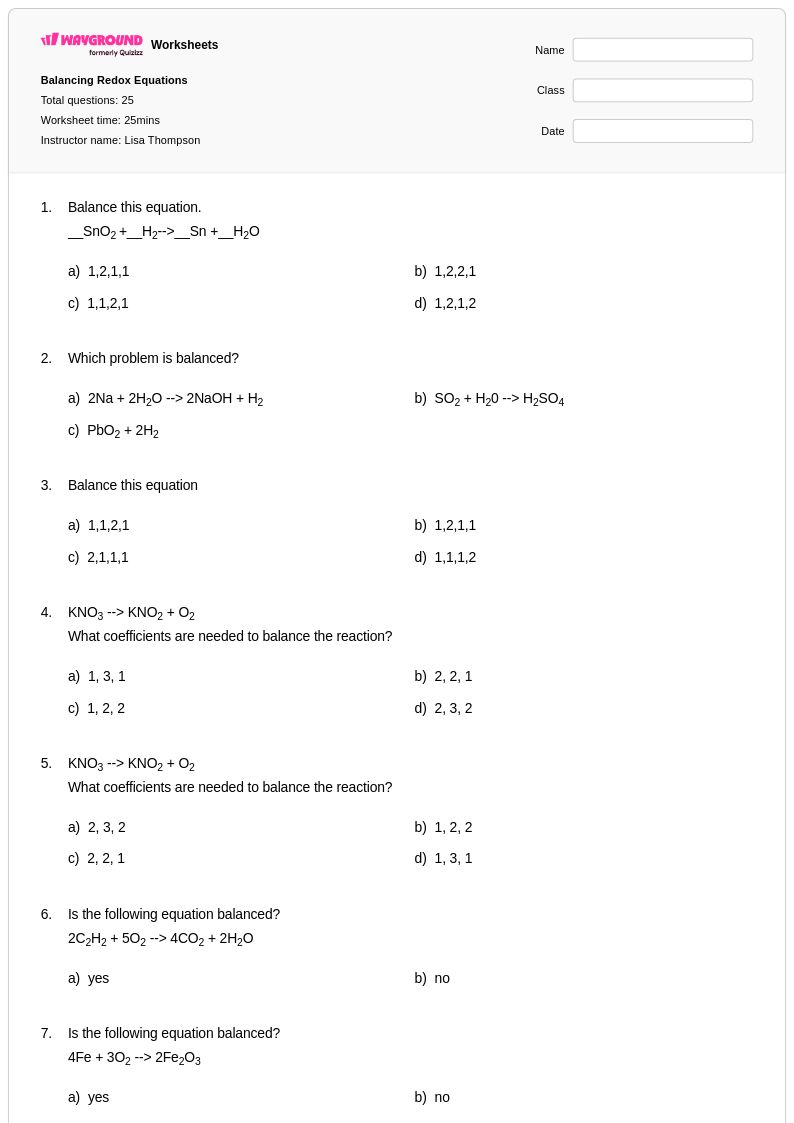
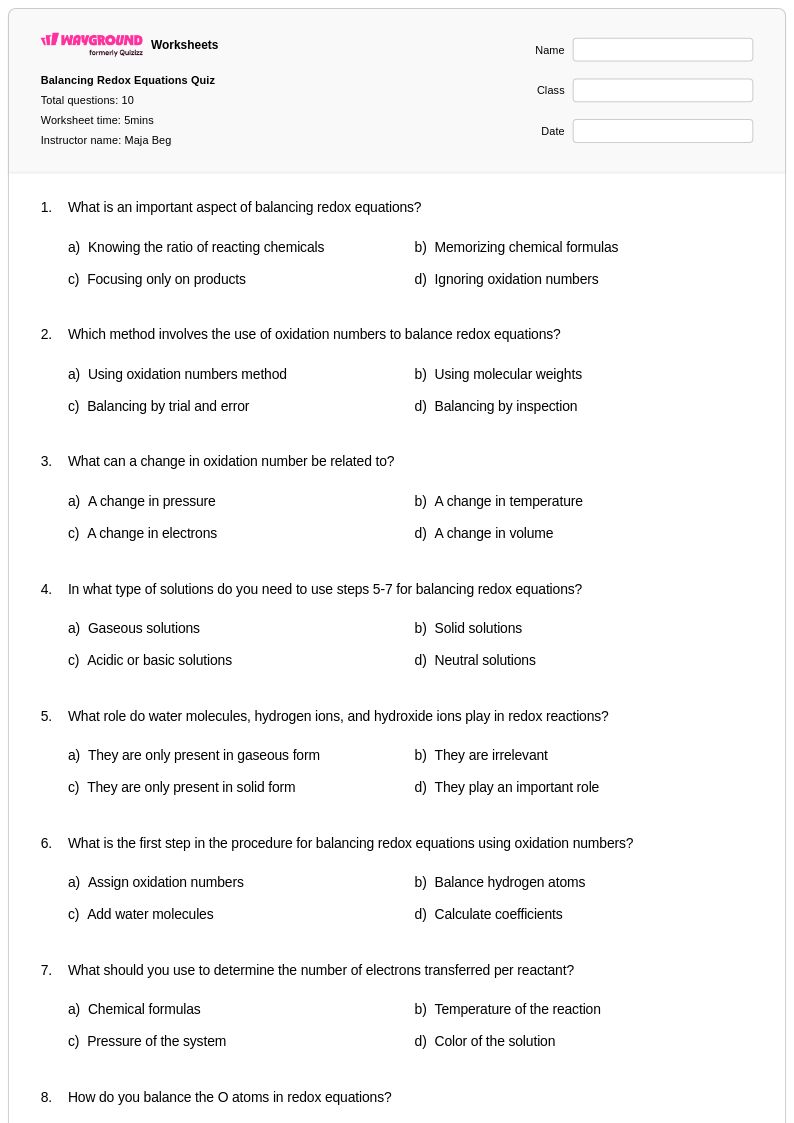
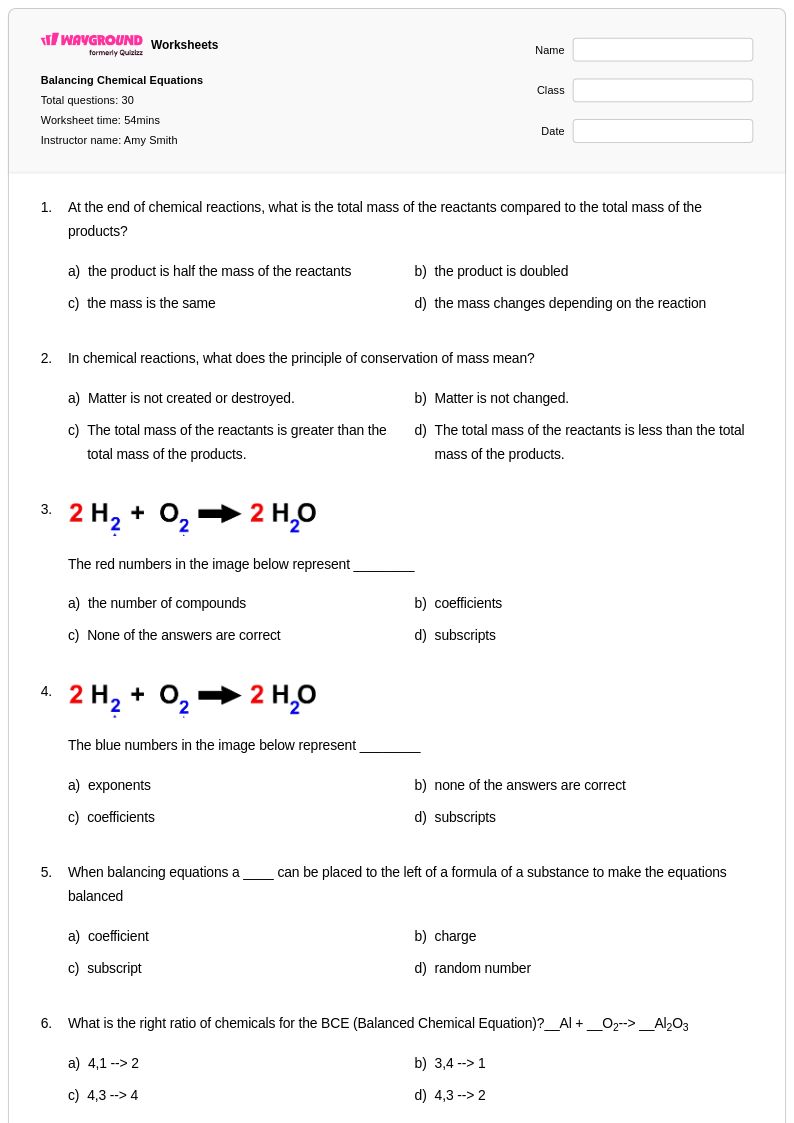
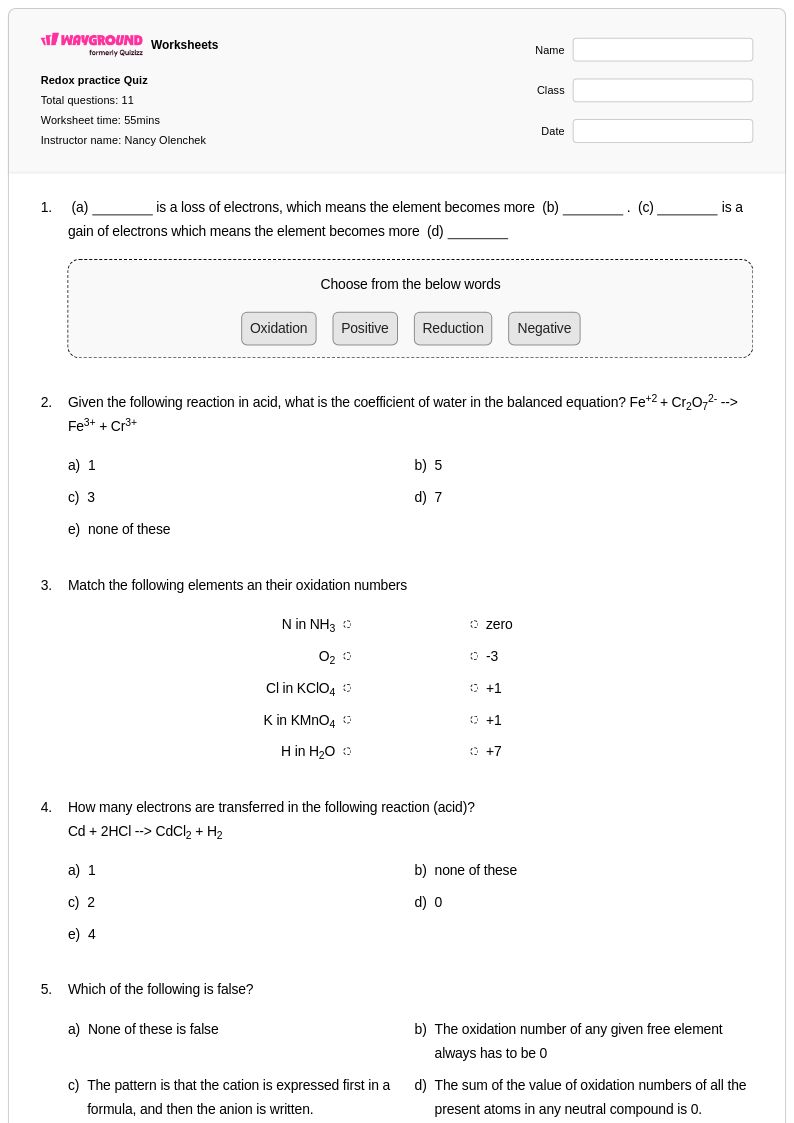
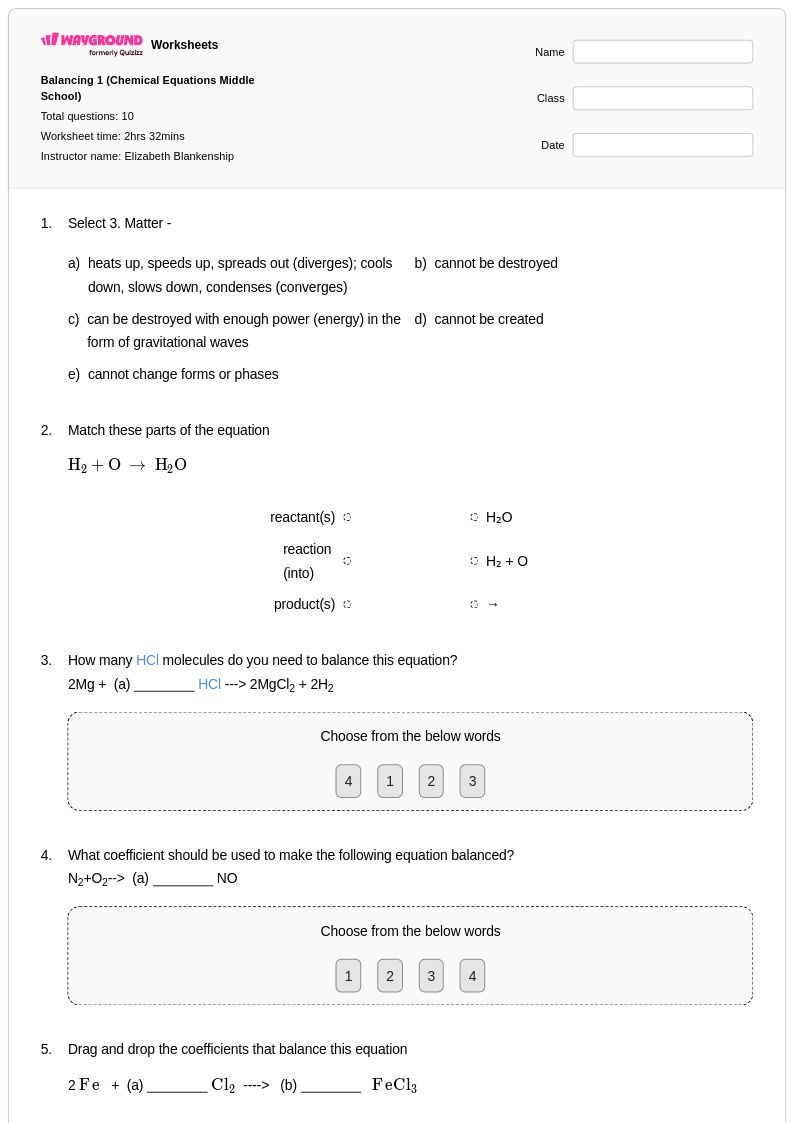
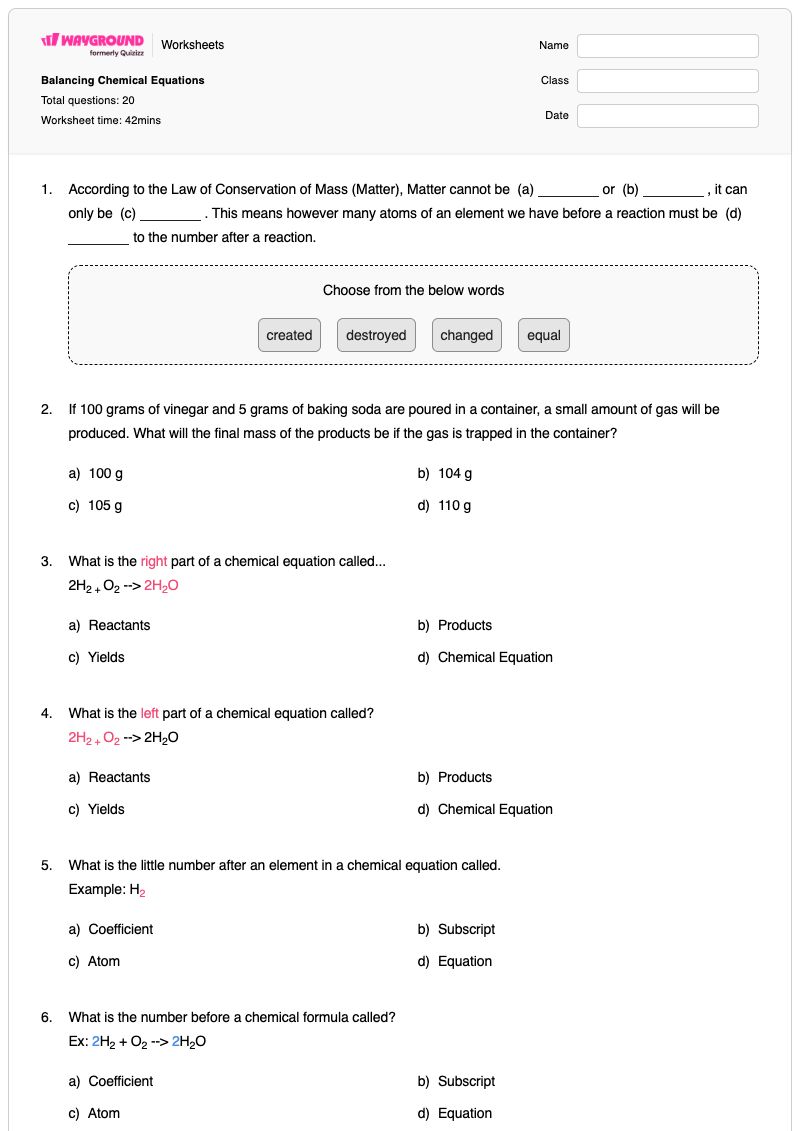
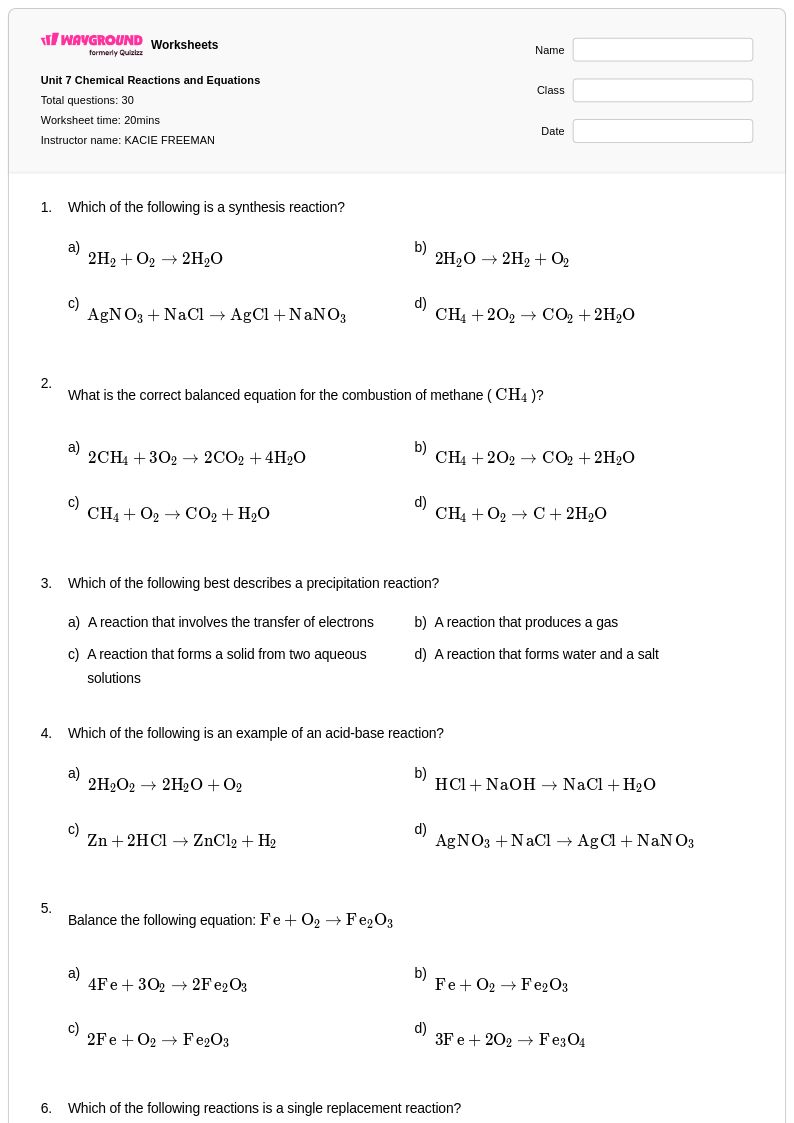
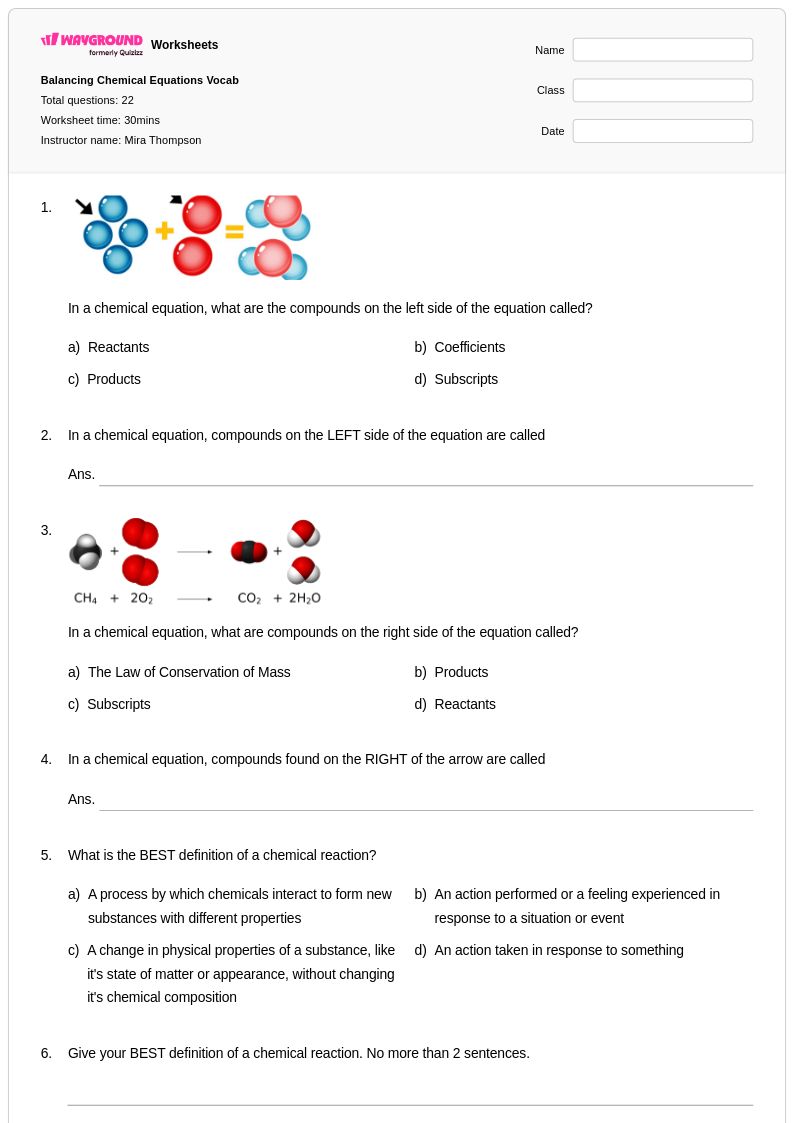
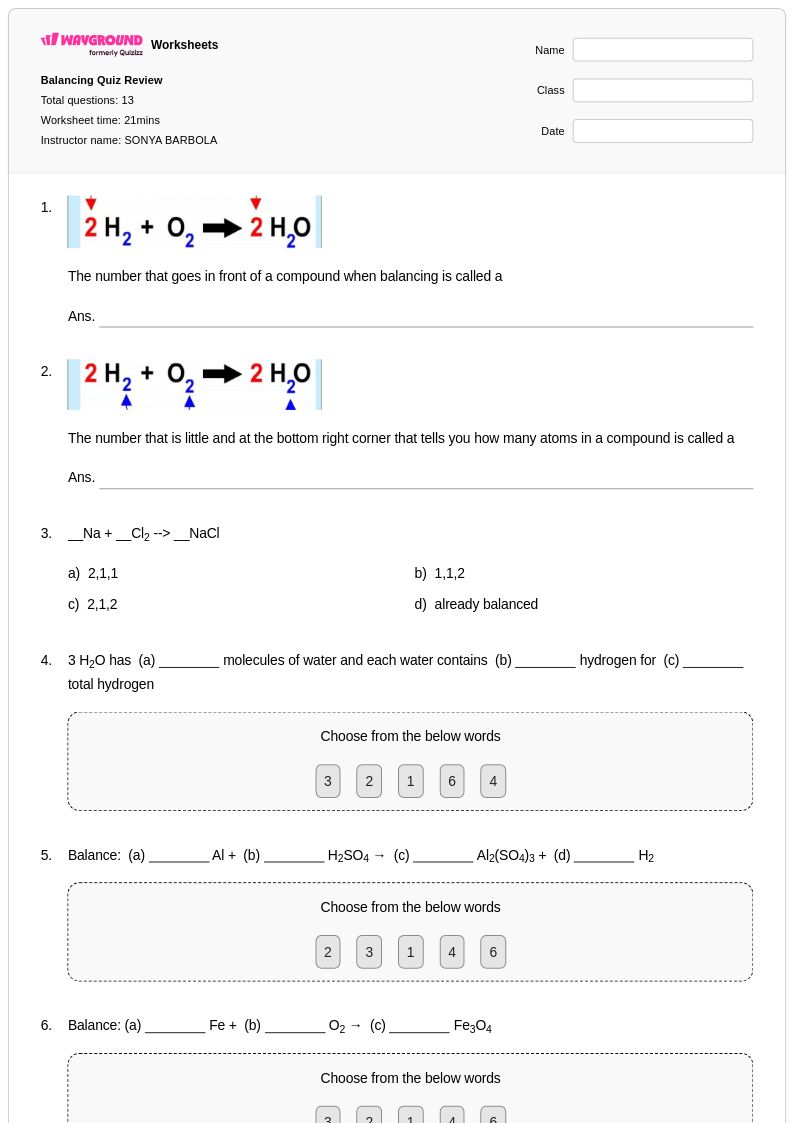
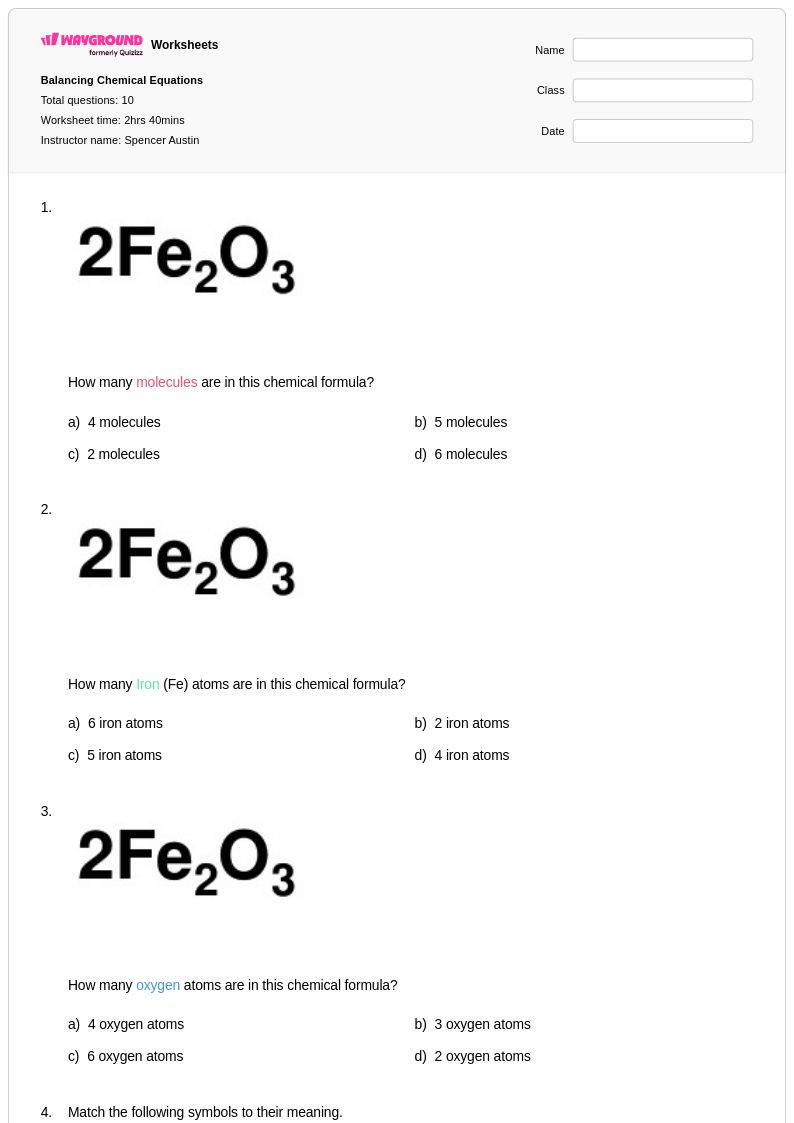
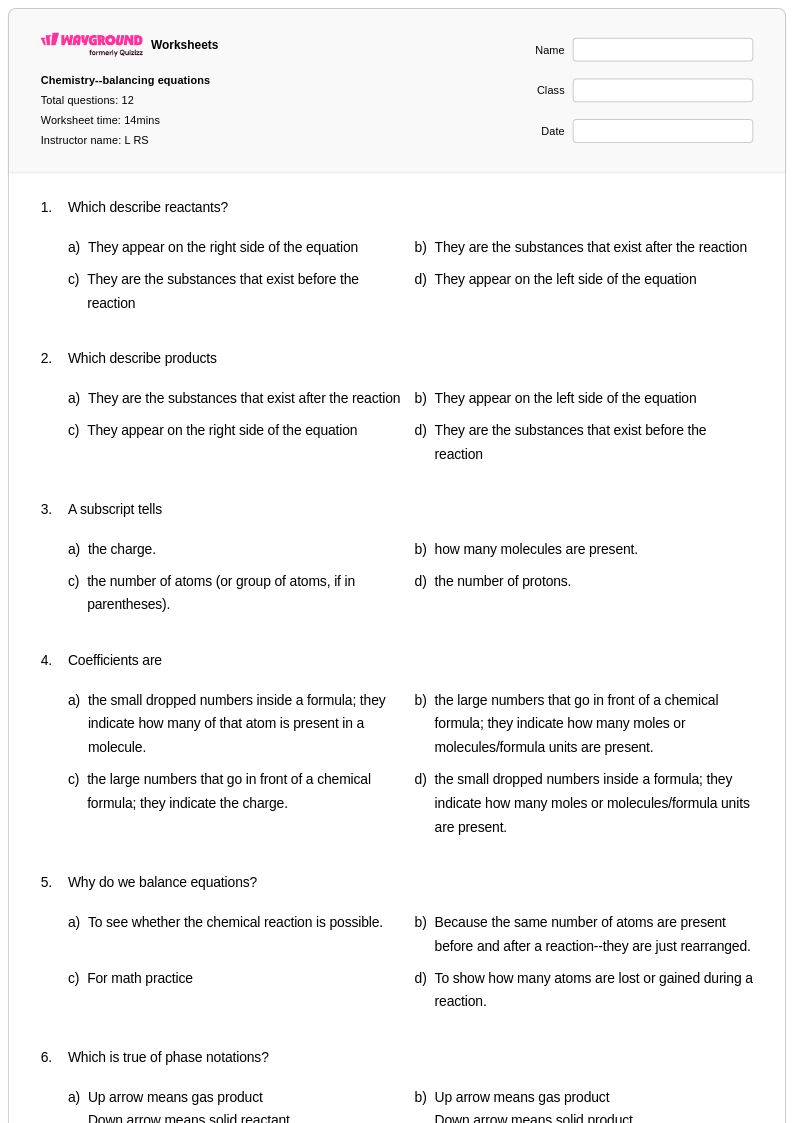
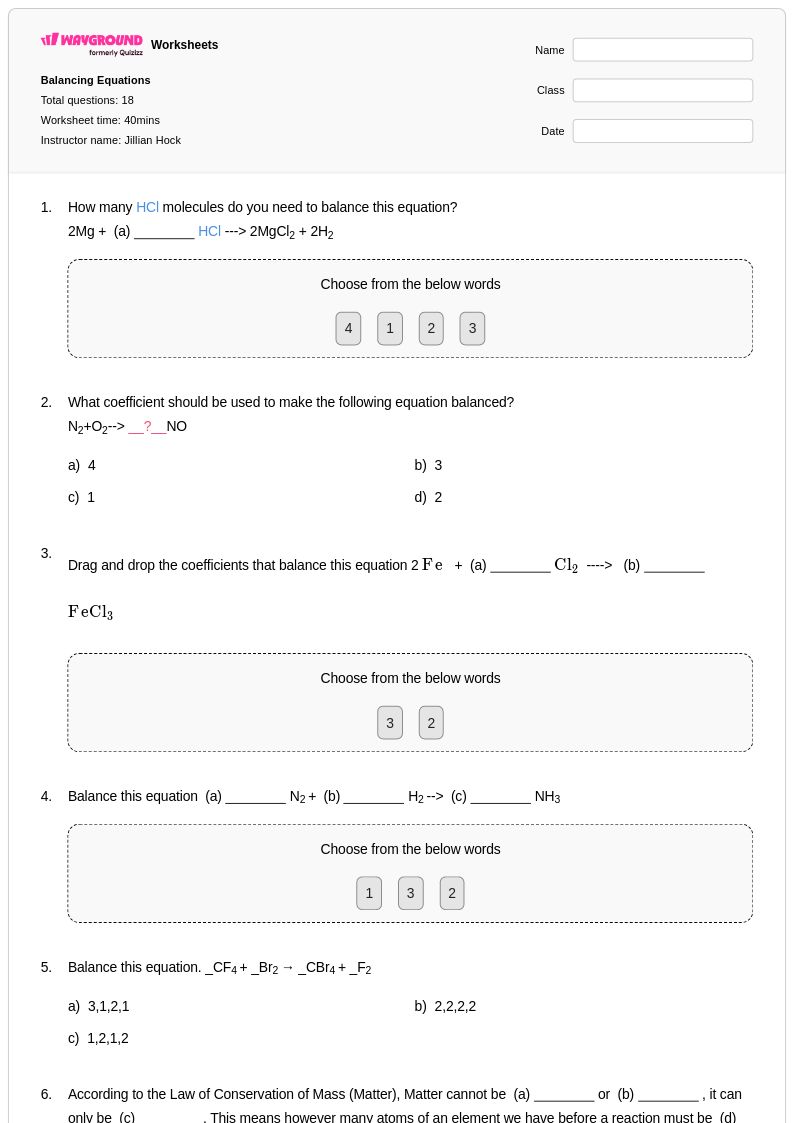
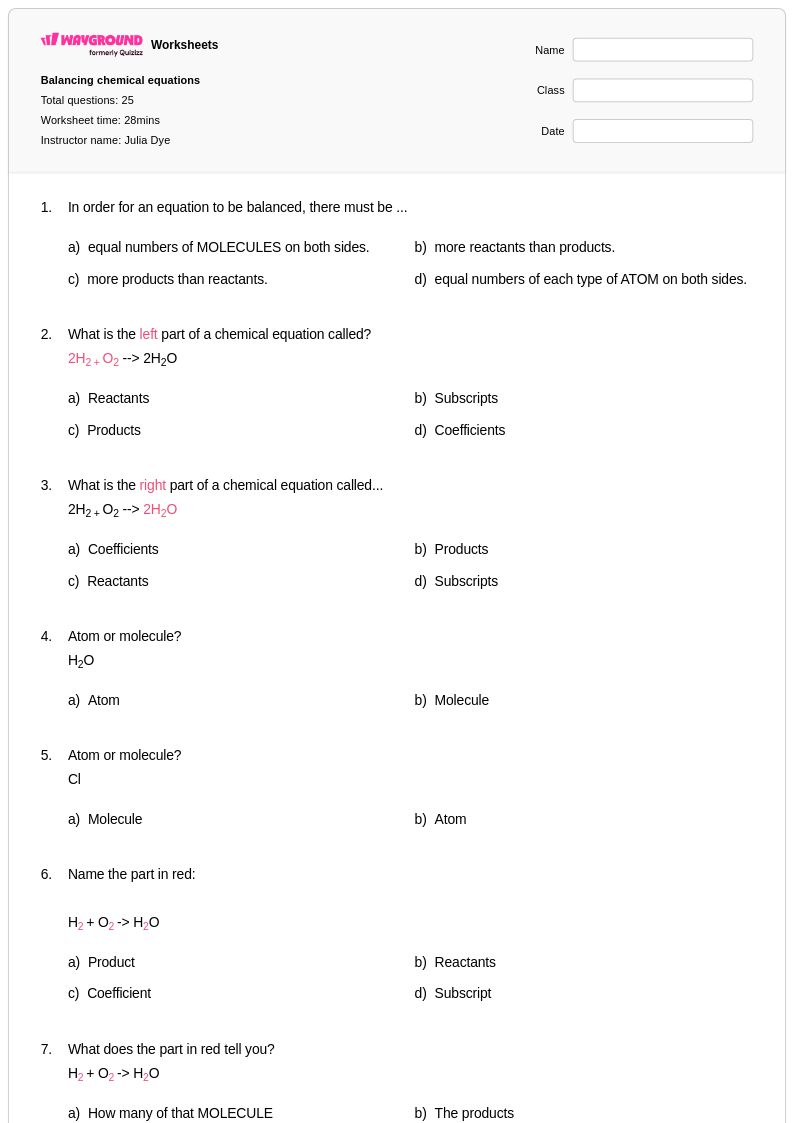
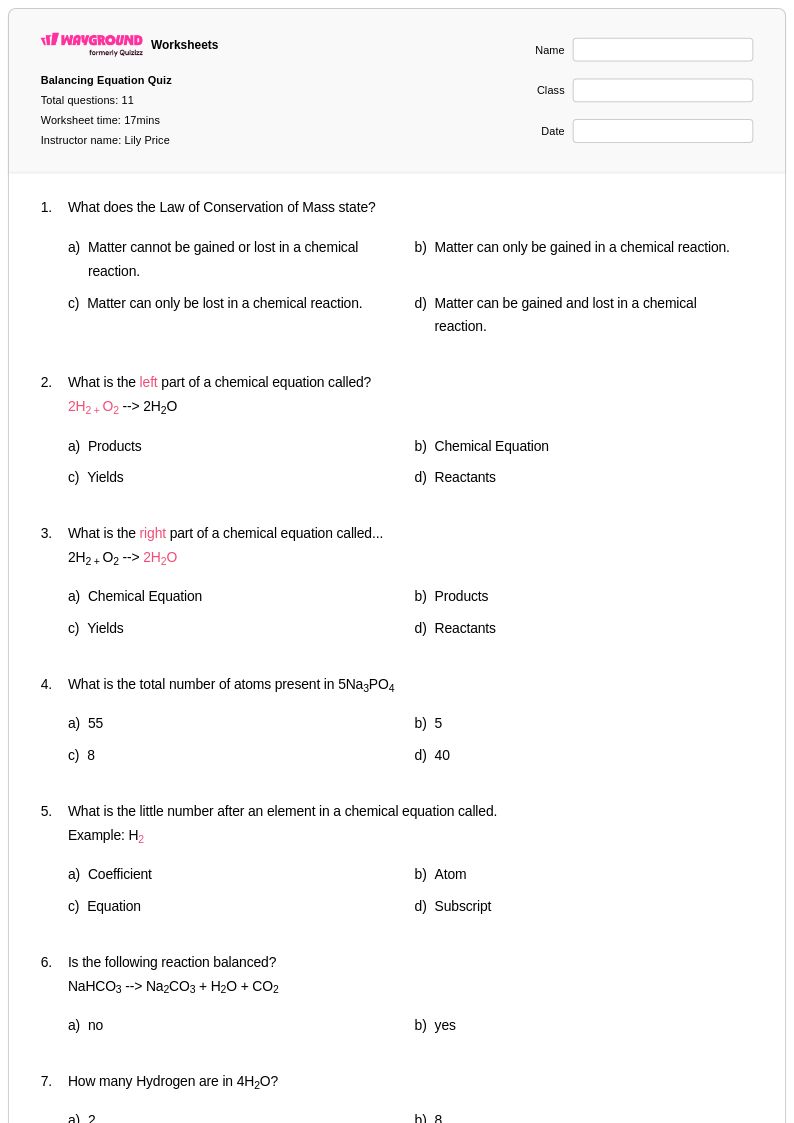
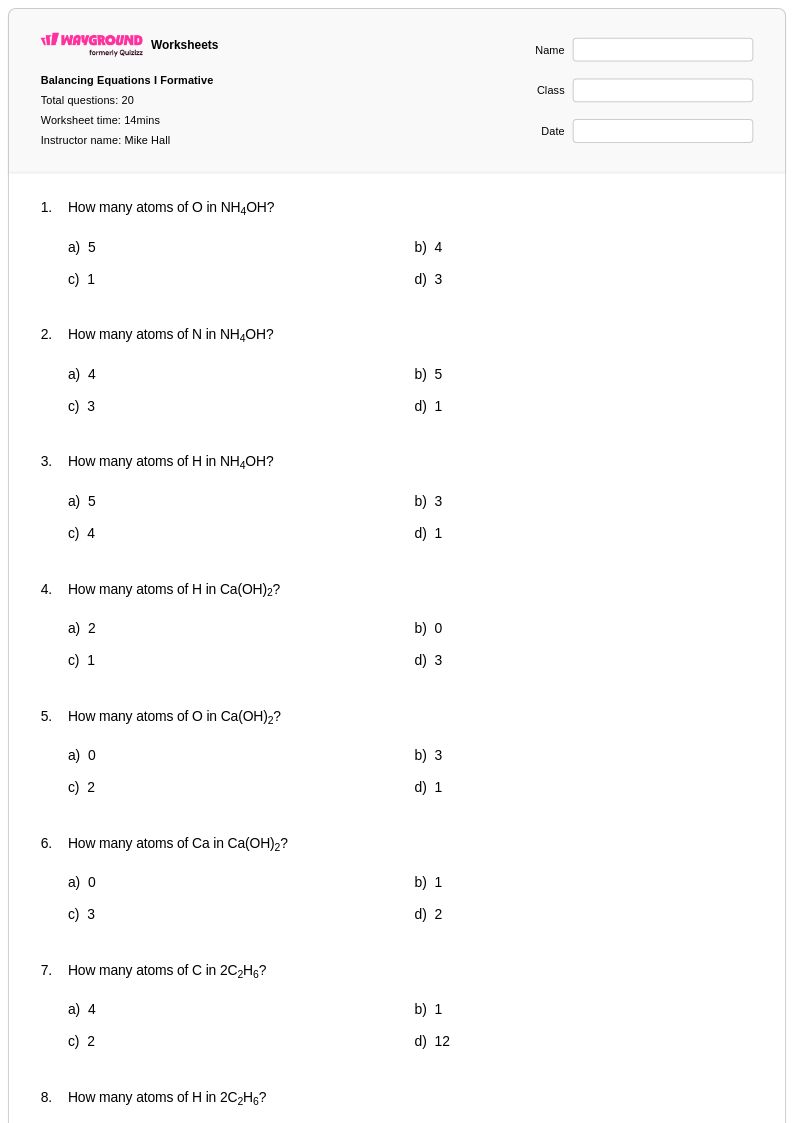
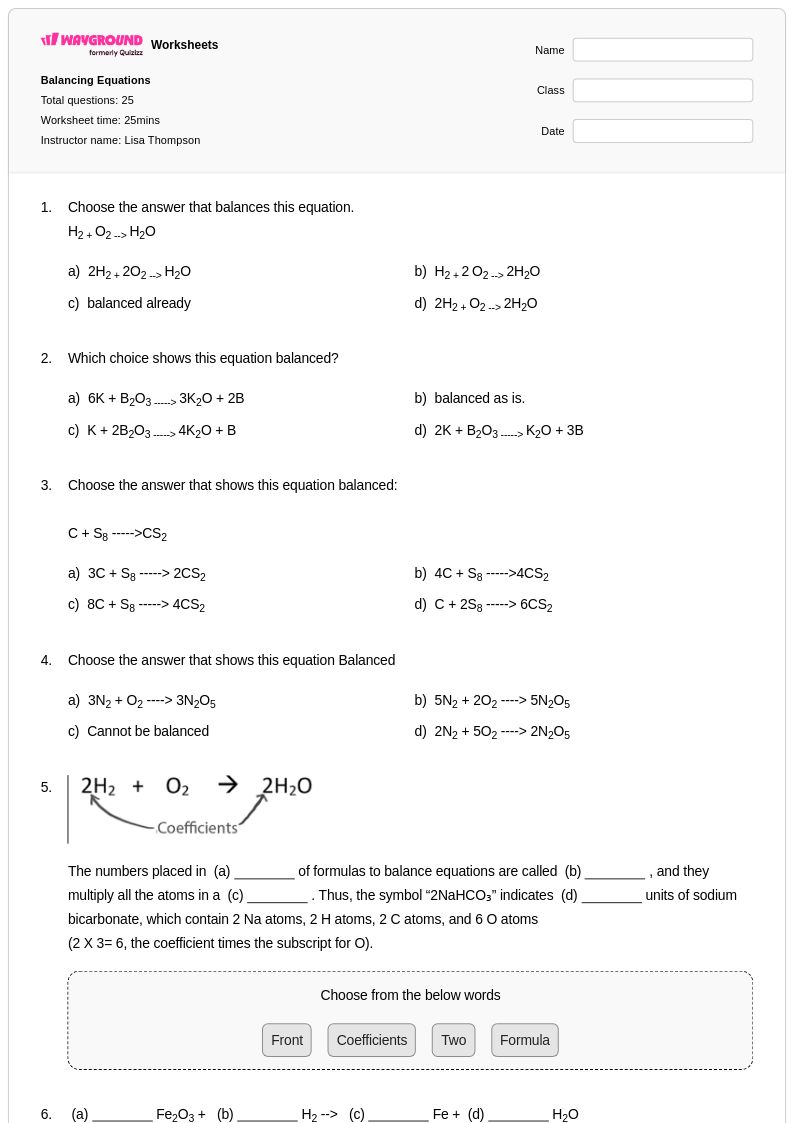
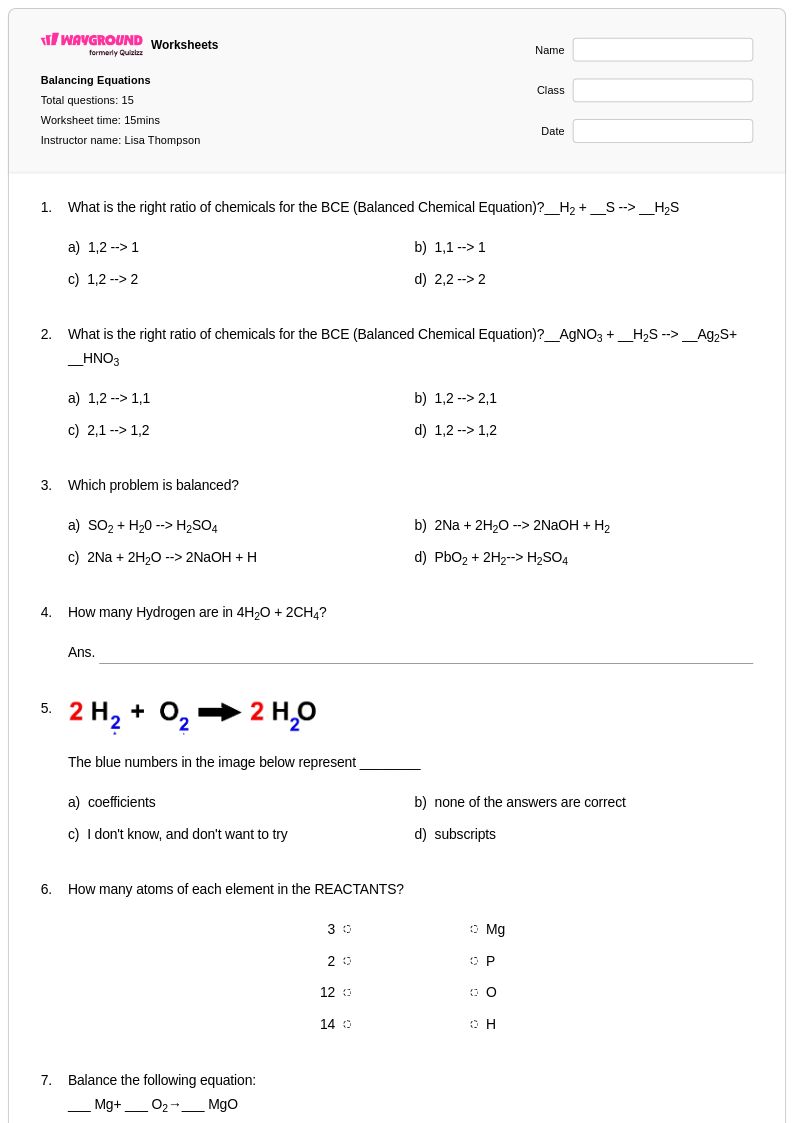
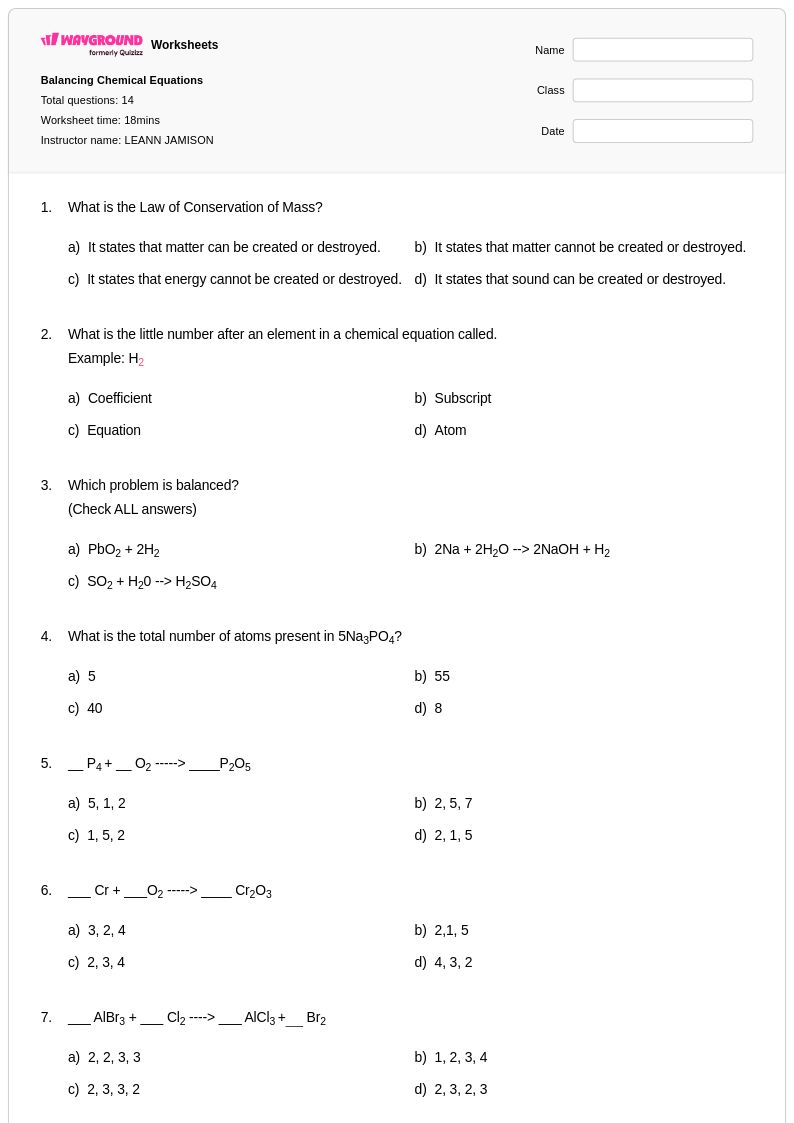
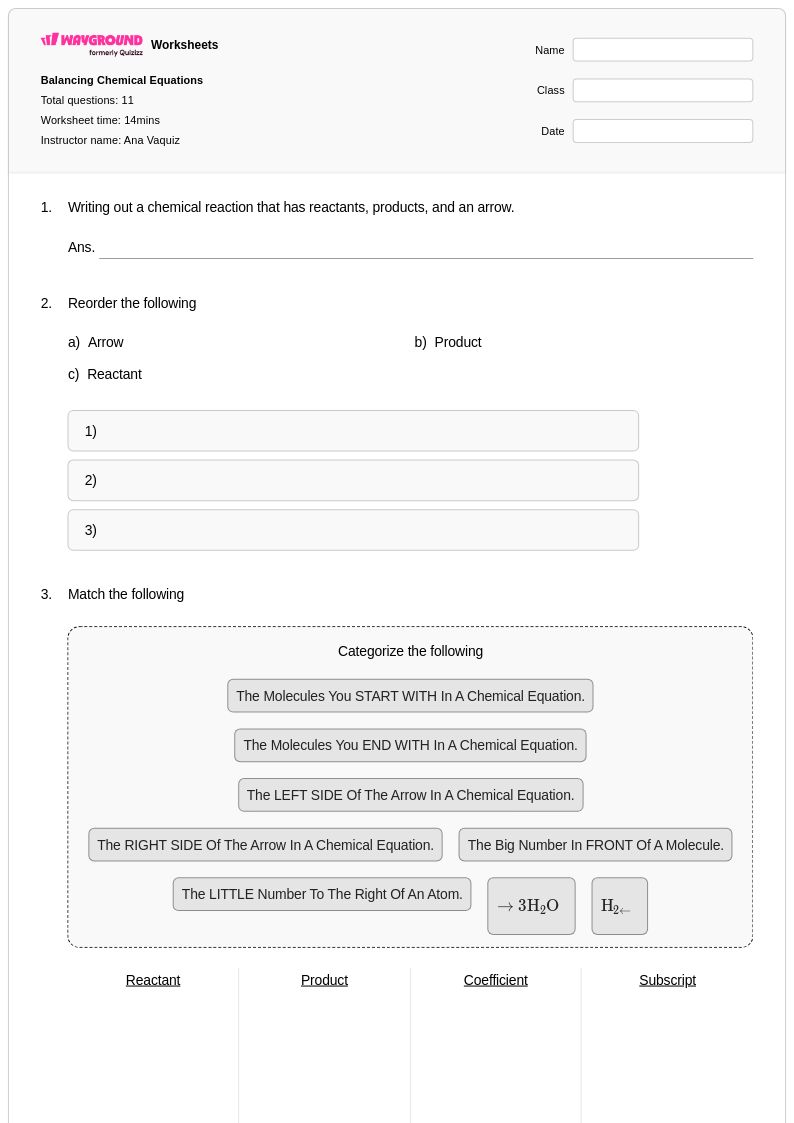
Master balancing redox equations with Wayground's comprehensive collection of free worksheets, featuring step-by-step practice problems, printable PDFs, and detailed answer keys to strengthen electrochemistry skills.
Balancing redox equations represents one of the most challenging yet essential skills in electrochemistry, requiring students to master the systematic approach of equalizing electron transfer in oxidation-reduction reactions. Wayground's comprehensive collection of balancing redox equations worksheets provides targeted practice with both the half-reaction method and the oxidation number approach, enabling students to develop proficiency in identifying oxidizing and reducing agents, writing balanced half-reactions, and combining them into complete balanced equations. These meticulously crafted practice problems range from simple metal displacement reactions to complex multi-step processes involving permanganate, dichromate, and other common oxidizing agents, with complete answer keys that guide students through each methodical step. The free printable worksheets and pdf resources emphasize the fundamental principles of electron conservation and charge balance, ensuring students build the analytical thinking skills necessary for advanced electrochemistry concepts.
Wayground's extensive library of millions of teacher-created resources makes it effortless for educators to locate precisely the right balancing redox equations materials for their specific classroom needs. The platform's sophisticated search and filtering capabilities allow teachers to quickly identify worksheets aligned with relevant chemistry standards, while differentiation tools enable seamless customization for students at varying skill levels, from introductory practice with simple reactions to advanced multi-electron transfer processes. Available in both digital and printable pdf formats, these resources support flexible lesson planning whether teachers need structured practice for skill development, targeted remediation for struggling students, or enrichment challenges for advanced learners. The comprehensive collection ensures that educators have immediate access to high-quality materials that reinforce the systematic problem-solving approach essential for mastering redox equation balancing.
FAQs
How do I teach students to balance redox equations step by step?
The most effective approach is to teach the half-reaction method as a structured algorithm: separate the equation into oxidation and reduction half-reactions, balance atoms and charge in each half-reaction individually, multiply each by the appropriate factor so electrons cancel, then combine and simplify. Introduce this method in acidic solution first before moving to basic conditions, and require students to explicitly label oxidation states at each step so they can verify electron conservation before combining half-reactions. Practicing with familiar oxidizing agents such as permanganate and dichromate gives students repeated exposure to the most commonly tested reaction types.
What are the most common mistakes students make when balancing redox equations?
The most frequent error is neglecting to balance charge after balancing atoms, leading to equations that conserve mass but violate electron conservation. Students also commonly forget to add water molecules and hydrogen ions when working in acidic solution, or hydroxide ions and water when working in basic solution, which throws off both atom and charge balance. A third persistent mistake is failing to multiply the half-reactions by the correct coefficients before combining them, resulting in unequal electron transfer across the two half-reactions.
When should I introduce the oxidation number method versus the half-reaction method?
The oxidation number method is useful for simpler molecular equations and helps students build intuition about which atoms are being oxidized and reduced, making it a reasonable entry point early in the unit. However, the half-reaction method is more systematic and reliable for complex ionic equations, particularly those involving polyatomic oxidizing agents in aqueous solution, and is the method most emphasized in AP and college-level chemistry courses. Most teachers introduce the oxidation number method first for conceptual grounding, then transition to the half-reaction method as the primary problem-solving tool.
What practice exercises help students get better at balancing redox equations?
Structured worksheets that progress from simple metal displacement reactions to multi-electron transfer processes involving reagents like permanganate and dichromate are especially effective because they build procedural fluency before introducing complexity. Having students work through problems that require both acidic and basic solution conditions in the same practice set reinforces when and how to add water, hydrogen ions, or hydroxide ions. Answer keys that show each intermediate step, rather than only the final balanced equation, help students identify exactly where their reasoning broke down.
How can I differentiate redox equation balancing practice for students at different skill levels?
For students who are still developing fluency, start with reactions involving only two elements and single-electron transfers, and provide partially completed half-reactions as scaffolding. Advanced students benefit from multi-step problems involving less familiar oxidizing agents and reactions that must be balanced in basic solution. On Wayground, teachers can apply accommodations such as reduced answer choices to lower cognitive load for struggling students, or extended time settings for students who need more processing time, while the rest of the class works under standard conditions without being notified of any changes.
How do I use Wayground's balancing redox equations worksheets in my classroom?
Wayground's balancing redox equations worksheets are available as printable PDFs for traditional classroom use and in digital formats for technology-integrated or hybrid learning environments. Teachers can also host the worksheets as a quiz directly on Wayground, which allows for structured online assessment. Each worksheet includes a complete answer key, so teachers can use them for independent practice, guided review, or formative assessment without additional preparation time.