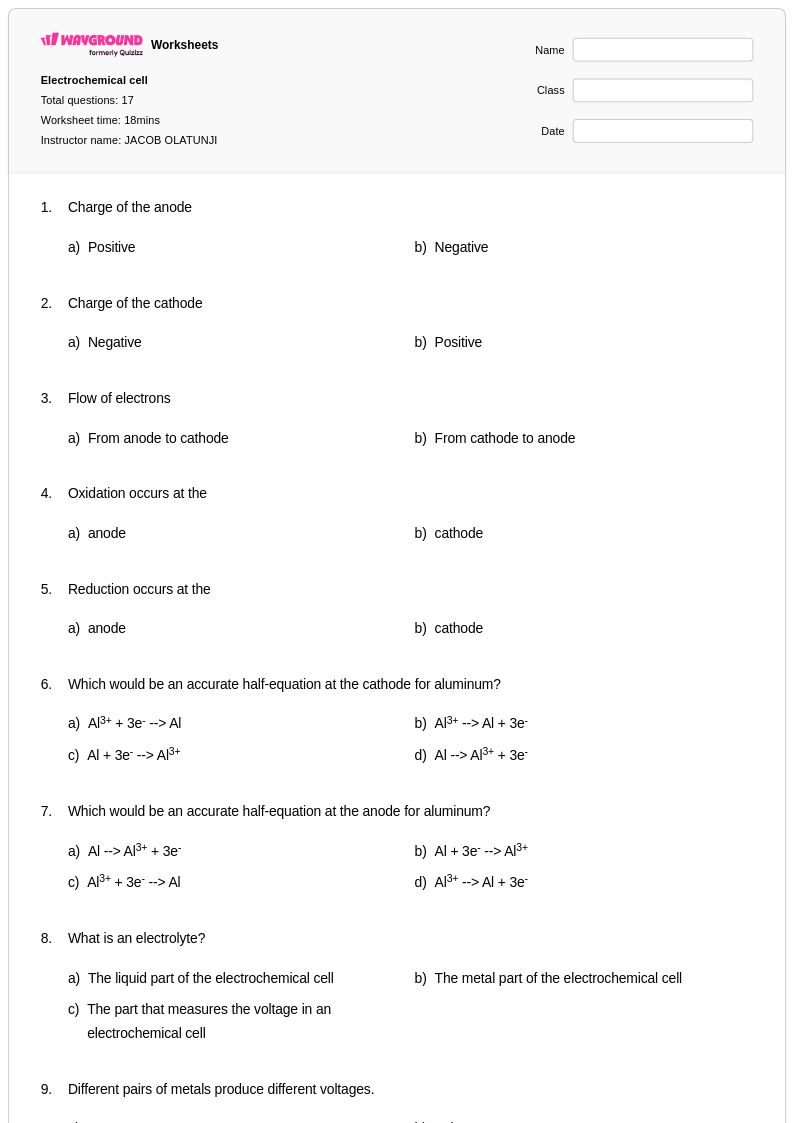
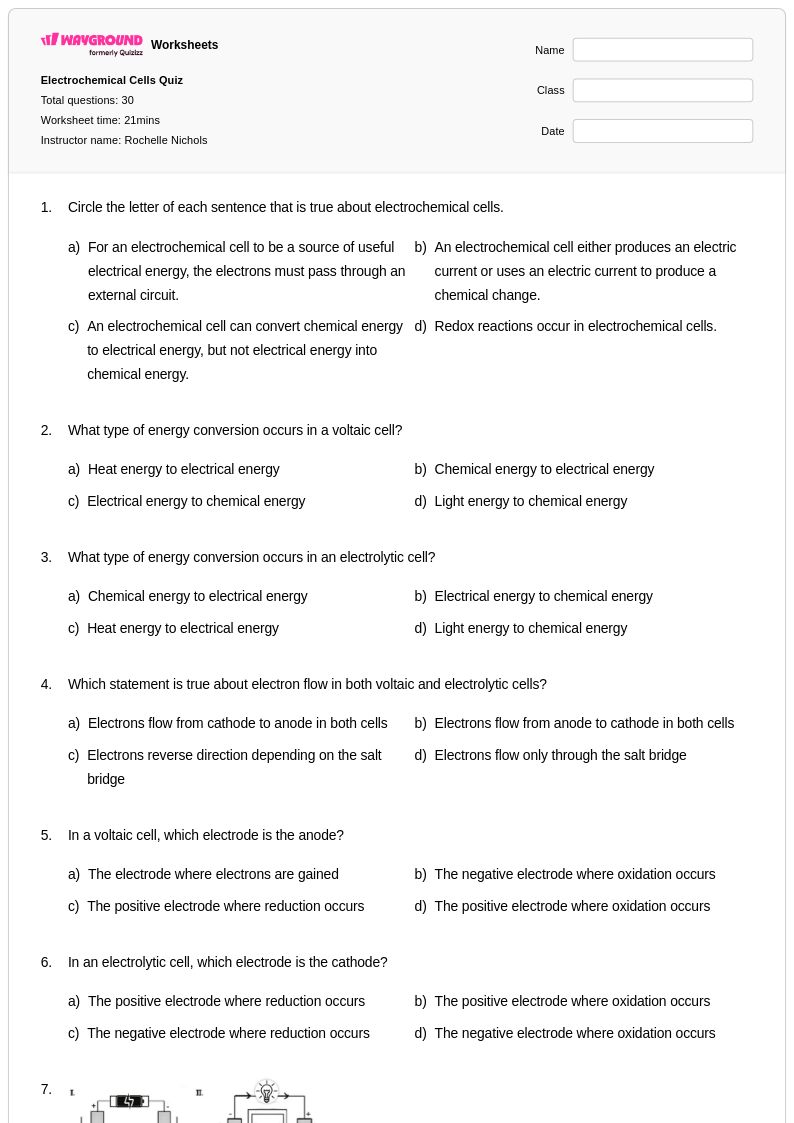
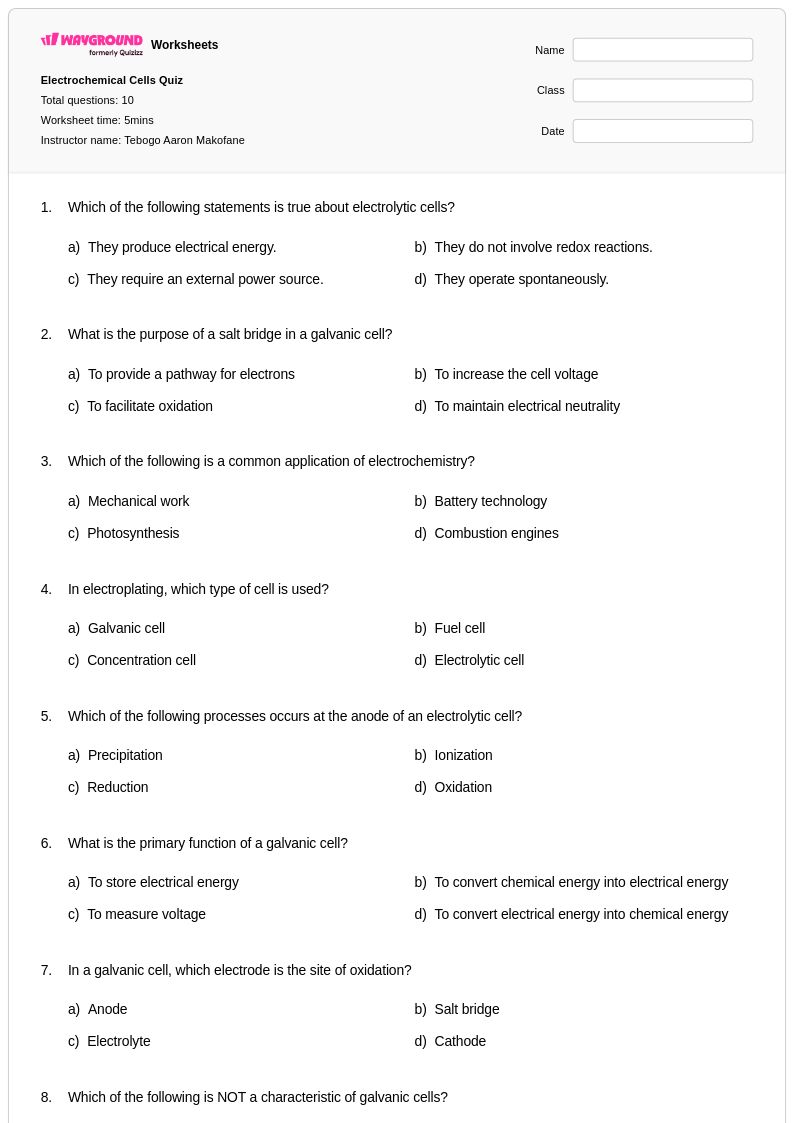
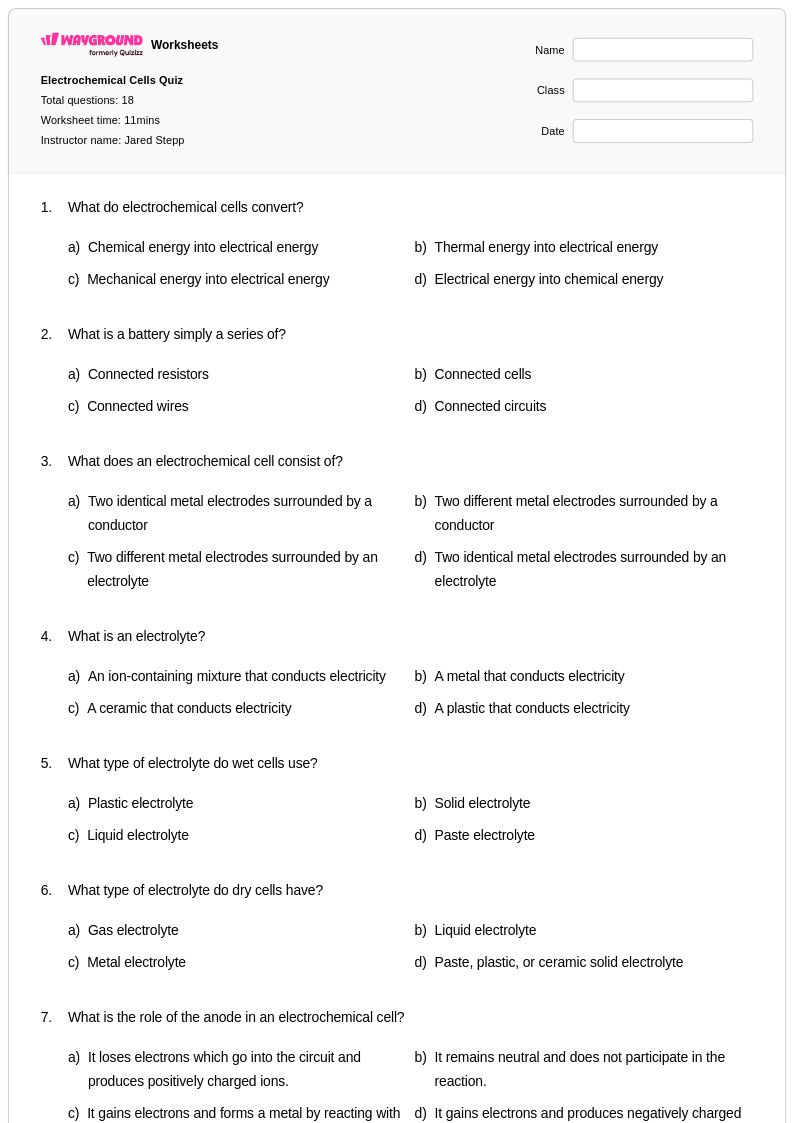
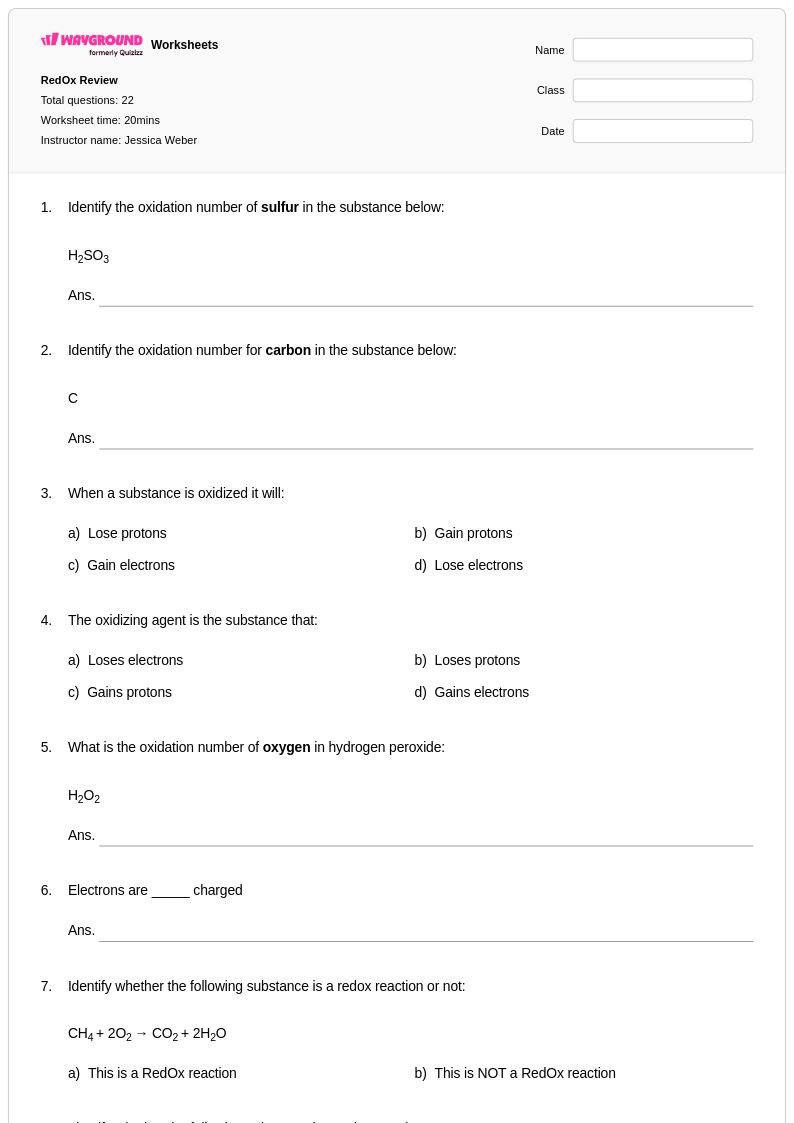
Explore Wayground's free electrochemical cell worksheets and printables featuring practice problems with answer keys to help students master redox reactions, galvanic cells, and electrode potentials in chemistry.
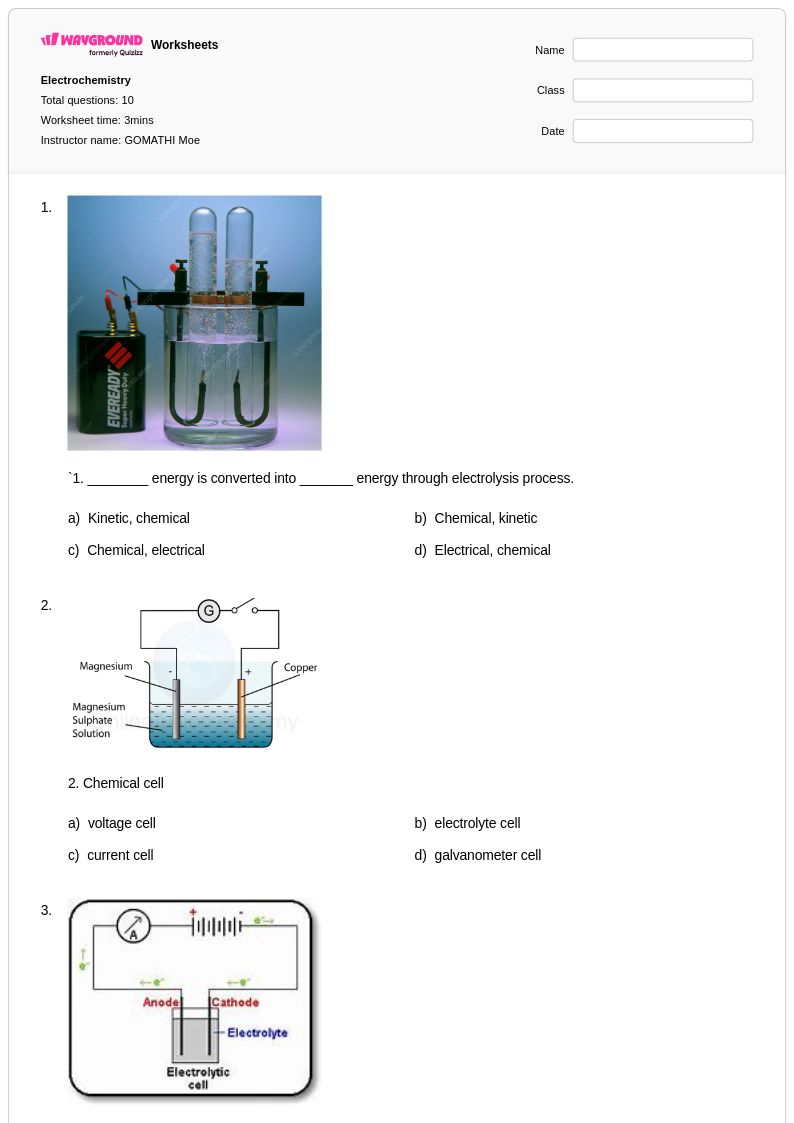
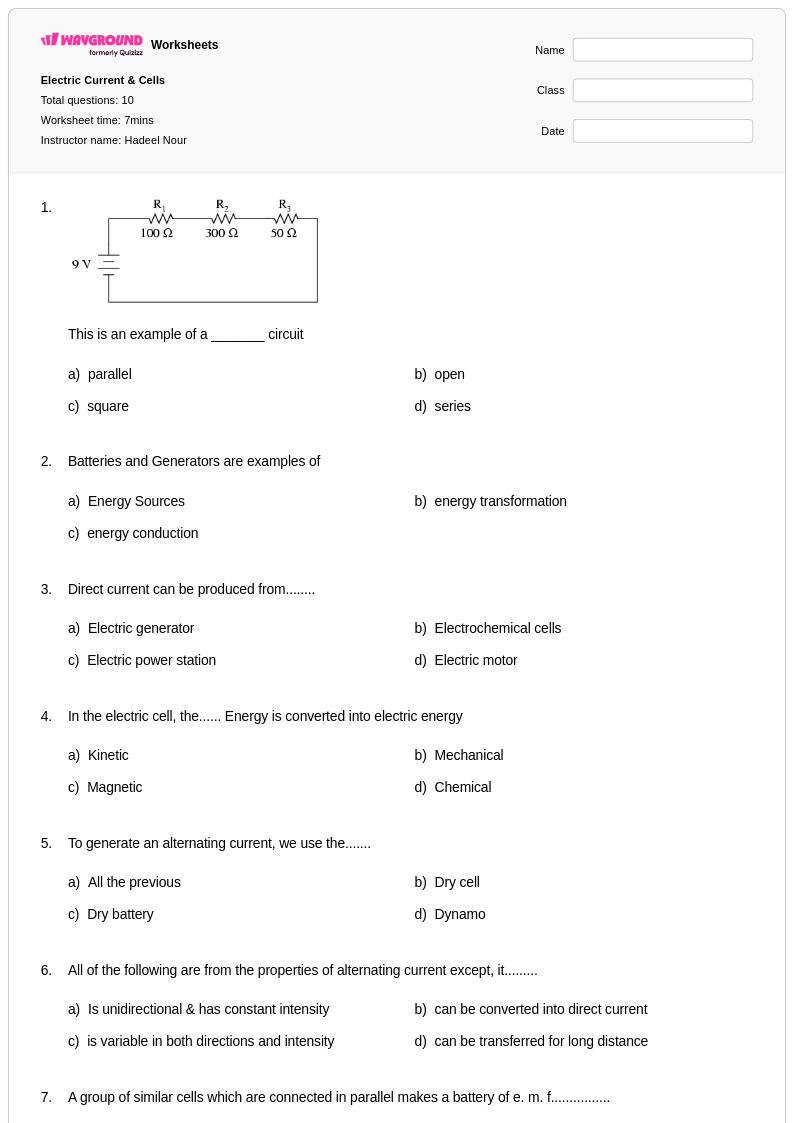
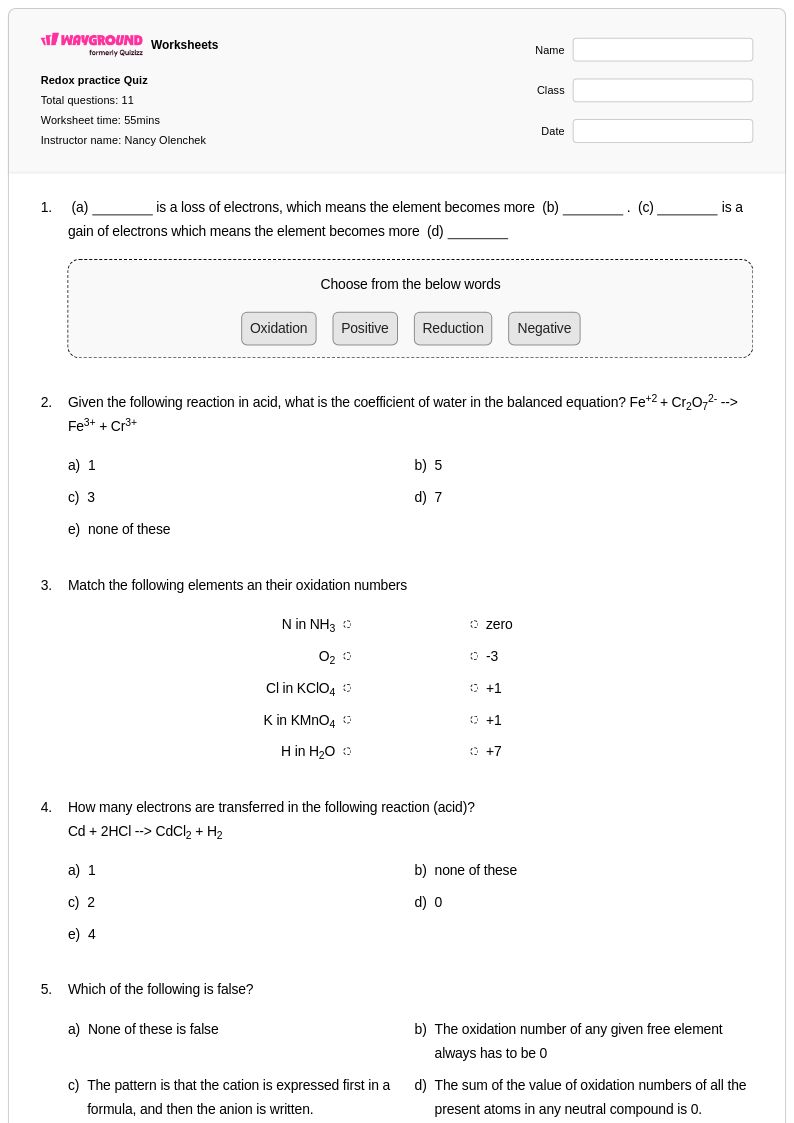
Electrochemical cell worksheets available through Wayground (formerly Quizizz) provide comprehensive practice materials that guide students through the fundamental principles of redox reactions, galvanic cells, and electrolytic processes. These expertly designed resources strengthen critical analytical skills by challenging students to interpret cell diagrams, calculate standard electrode potentials, and predict spontaneous reactions using thermodynamic principles. The worksheet collections include detailed practice problems covering topics such as the Nernst equation, battery construction, corrosion mechanisms, and industrial electrochemical applications. Each resource comes with a complete answer key and is available as free printables in convenient pdf format, allowing students to work systematically through complex electrochemical concepts while developing problem-solving strategies essential for advanced chemistry coursework.
Wayground (formerly Quizizz) supports chemistry educators with an extensive collection of millions of teacher-created electrochemical cell resources that streamline lesson planning and enhance classroom instruction. The platform's robust search and filtering capabilities enable teachers to quickly locate materials aligned with specific chemistry standards while accessing differentiation tools that accommodate diverse learning needs and skill levels. These customizable worksheet collections are available in both printable and digital formats, including downloadable pdf versions that facilitate seamless integration into existing curriculum frameworks. Teachers can utilize these comprehensive resources for targeted skill practice, remediation of challenging electrochemical concepts, and enrichment activities that extend learning beyond basic cell notation to advanced applications in energy storage, metal refining, and analytical chemistry techniques.
FAQs
How do I teach electrochemical cells to high school chemistry students?
Start by grounding students in redox reactions before introducing cell notation, then build toward galvanic and electrolytic cells as distinct but related systems. Use cell diagrams to make abstract electron flow concrete, and connect standard electrode potentials to spontaneity through Gibbs free energy. Anchoring each concept to a real-world application — such as battery construction or corrosion — helps students retain the underlying principles and see why the math matters.
What exercises help students practice electrochemical cell concepts?
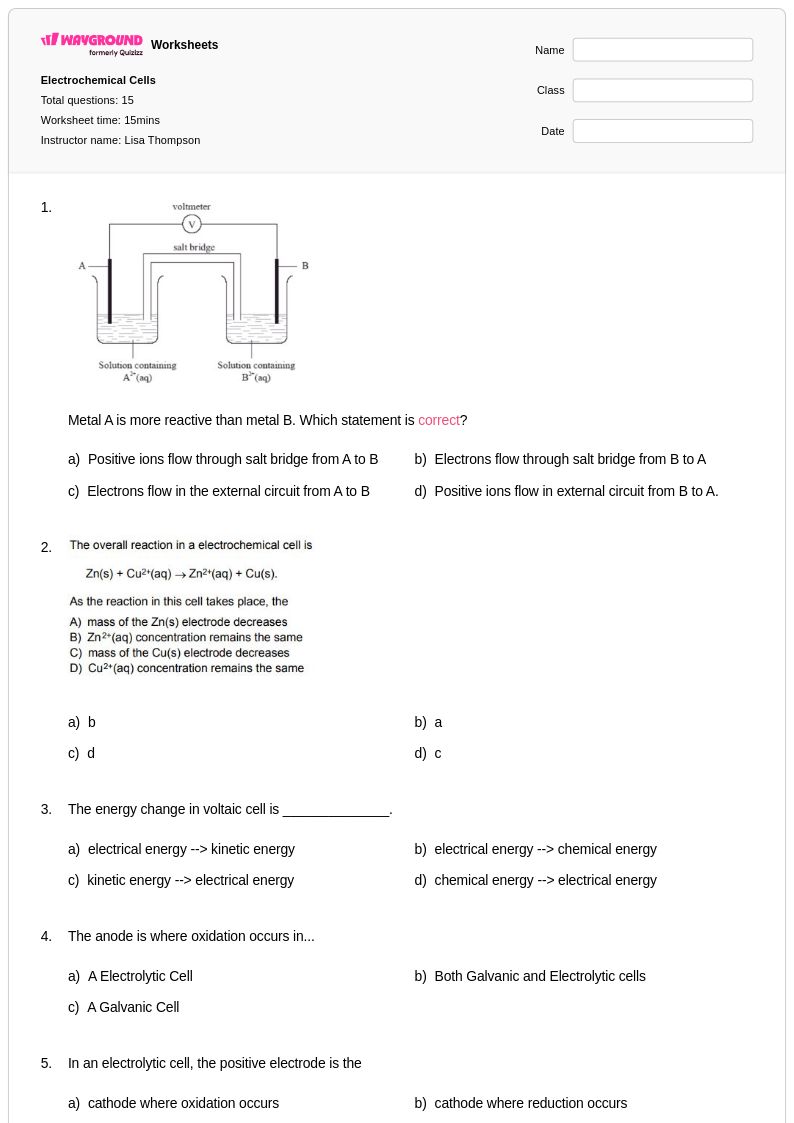
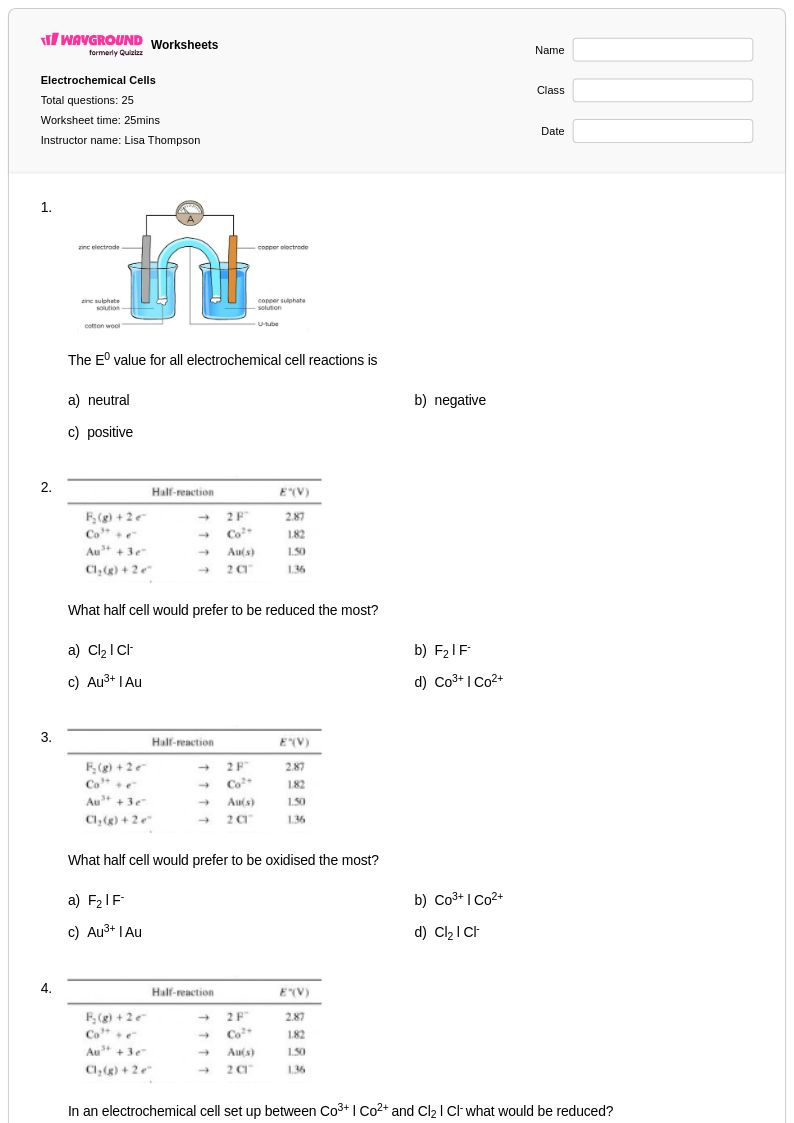
Effective practice includes interpreting cell diagrams, calculating standard electrode potentials using half-reaction tables, and applying the Nernst equation to non-standard conditions. Students also benefit from problems that ask them to predict whether a reaction is spontaneous and to identify the anode, cathode, and direction of electron flow. Layering these problem types progressively — from identification to calculation to prediction — builds the analytical fluency needed for advanced chemistry assessments.
What mistakes do students commonly make when working with electrochemical cells?
One of the most persistent errors is confusing the anode and cathode between galvanic and electrolytic cells, since the charge convention reverses depending on the cell type. Students also frequently misapply the Nernst equation by using incorrect concentration values or forgetting to account for the number of electrons transferred. Another common mistake is treating standard electrode potentials as additive without adjusting for the direction of the half-reaction, which leads to sign errors in cell potential calculations.
How do I use Wayground's electrochemical cell worksheets in my chemistry class?
Wayground's electrochemical cell worksheets are available as printable PDFs for traditional classroom use and in digital formats for technology-integrated environments, including the option to host them as a quiz directly on Wayground. Every worksheet includes a complete answer key, making them practical for independent practice, homework, or in-class review. Digital delivery also allows teachers to apply student-level accommodations such as extended time or read-aloud support, ensuring the materials are accessible to diverse learners without disrupting the rest of the class.
How do I differentiate electrochemical cell instruction for students at different skill levels?
For students still building foundational skills, focus practice on identifying cell components and balancing half-reactions before introducing potential calculations. More advanced students can work through Nernst equation problems, corrosion scenarios, and industrial applications such as metal refining or electrolysis. On Wayground, teachers can apply accommodations like reduced answer choices or read-aloud support to individual students, so differentiated practice can happen within the same assignment without singling anyone out.
How does the Nernst equation connect to real-world electrochemical applications?
The Nernst equation describes how cell potential changes when ion concentrations deviate from standard conditions, which is exactly what happens inside batteries, biological cells, and industrial electrolytic processes. In practice, this means students who master the Nernst equation can explain why a battery's voltage drops as it discharges or how concentration gradients drive electrochemical signaling. Grounding Nernst equation practice in these applications helps students see the equation as a predictive tool rather than an isolated formula.