Free Printable Functional Group Identification worksheets
Master functional group identification in chemistry with Wayground's comprehensive collection of free worksheets, featuring practice problems, printables, and answer keys to help students recognize and classify organic molecule structures.
Explore printable Functional Group Identification worksheets
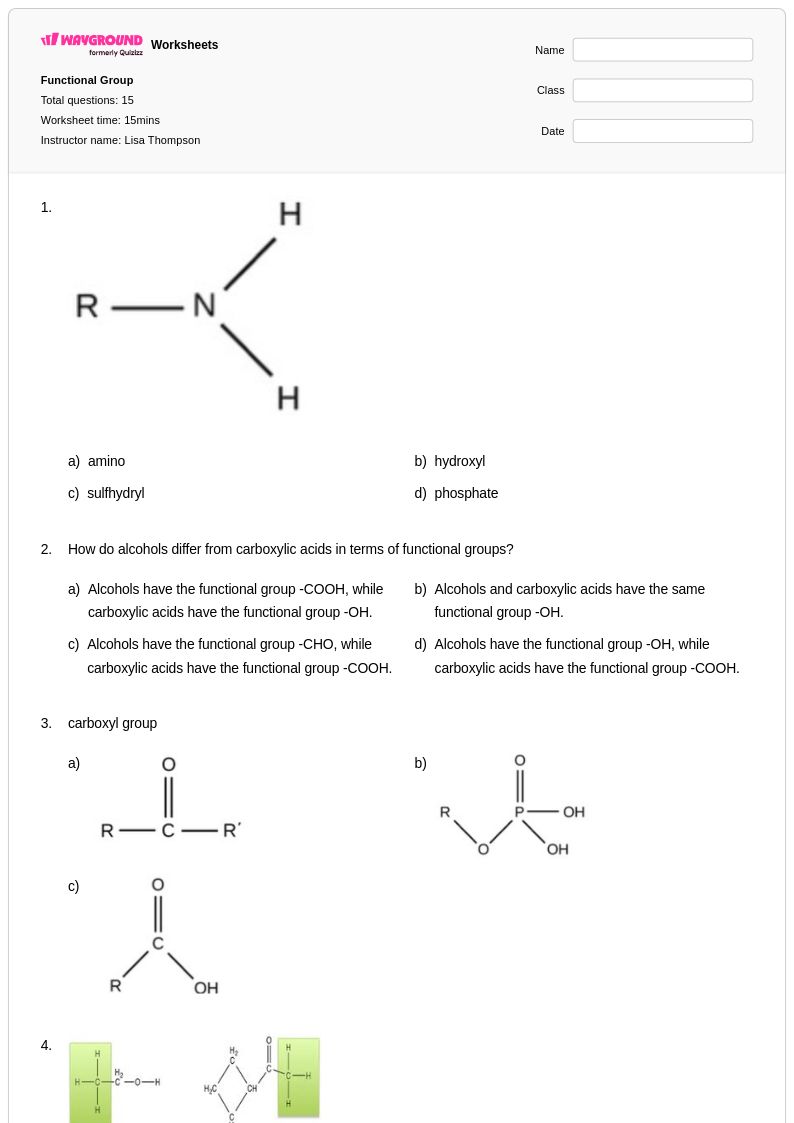
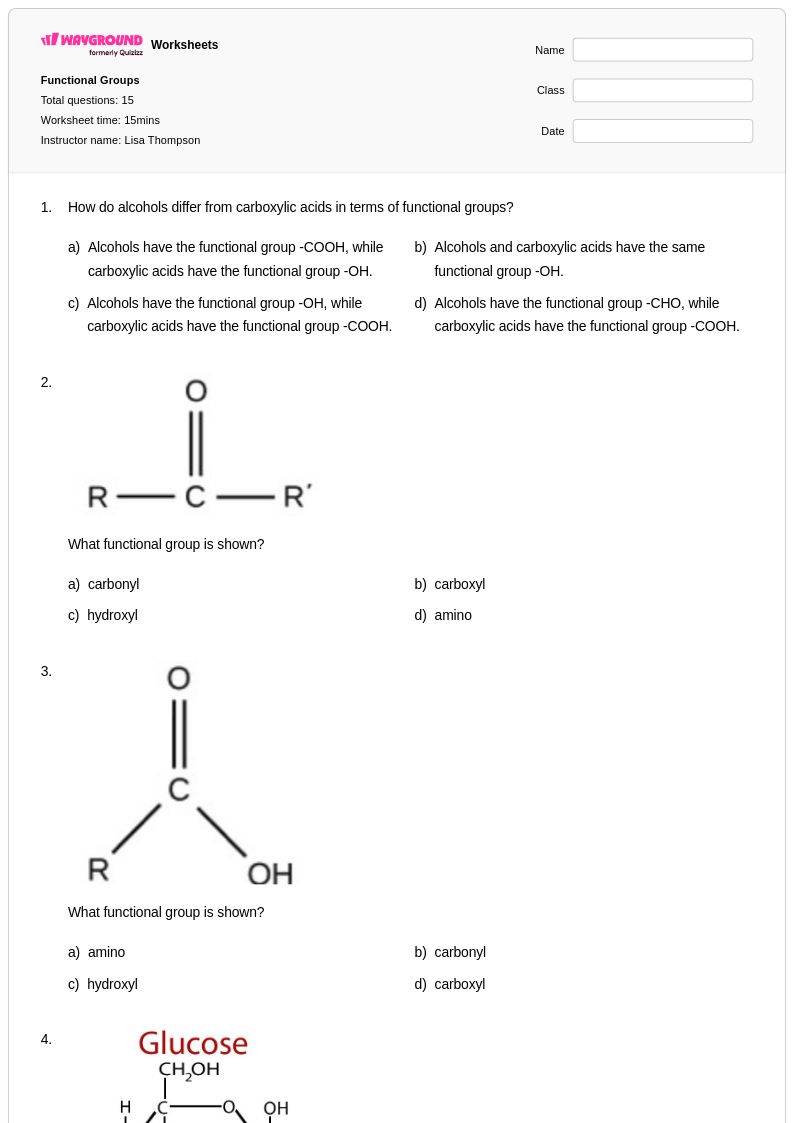
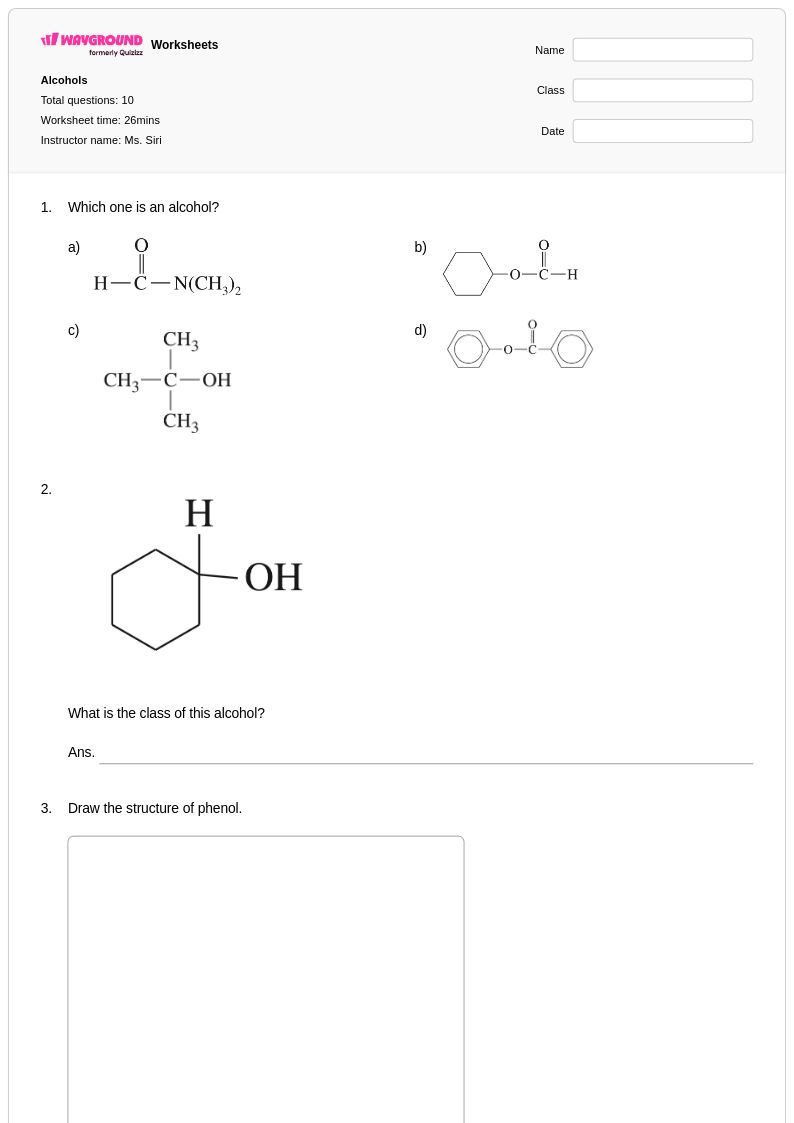
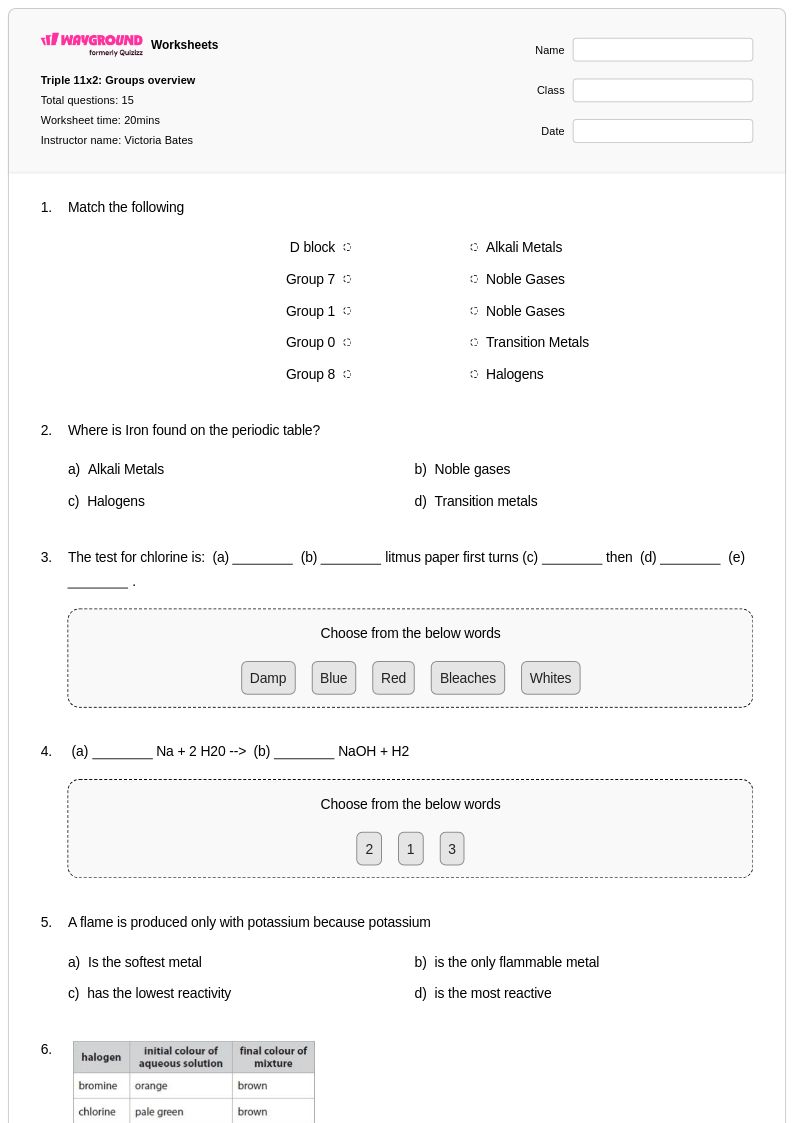
Functional group identification worksheets available through Wayground (formerly Quizizz) provide comprehensive practice materials designed to strengthen students' ability to recognize and classify organic molecular structures. These expertly crafted resources focus on developing critical analytical skills as students learn to identify common functional groups including alcohols, aldehydes, ketones, carboxylic acids, esters, ethers, and amines within complex organic compounds. Each worksheet collection includes detailed practice problems that progress from basic recognition exercises to more challenging multi-functional group molecules, complete with answer keys and comprehensive explanations. These free printable resources serve as essential tools for reinforcing classroom instruction and building the foundational knowledge necessary for advanced organic chemistry concepts, allowing students to develop confidence in structural analysis through repeated practice with diverse molecular examples.
Wayground (formerly Quizizz) empowers chemistry educators with access to millions of teacher-created functional group identification worksheets that can be easily searched, filtered, and customized to meet specific classroom needs. The platform's robust collection includes resources aligned with various chemistry standards, enabling teachers to select materials that perfectly match their curriculum requirements and student ability levels. Educators can differentiate instruction by choosing from worksheets that range from introductory functional group recognition to advanced synthesis and reaction prediction problems, with flexible customization options that allow for modifications to difficulty level, problem types, and molecular complexity. These versatile resources are available in both printable PDF formats for traditional classroom use and digital formats for interactive learning, making them invaluable for lesson planning, targeted skill remediation, enrichment activities, and ongoing assessment of student progress in organic chemistry fundamentals.
FAQs
How do I teach functional group identification in chemistry?
Start by introducing one functional group at a time, using structural diagrams to show students where the group appears within a larger organic molecule. Build fluency through repeated visual exposure before asking students to identify groups independently. Connecting each functional group to its chemical behavior — for example, explaining why carboxylic acids are acidic — helps students move beyond memorization toward genuine structural reasoning. Scaffolded worksheets that progress from single-group molecules to multi-functional compounds are effective for building confidence incrementally.
What exercises help students practice identifying functional groups in organic molecules?
Effective practice exercises include labeling functional groups on drawn structural formulas, classifying molecules by functional group type, and distinguishing between similar groups such as aldehydes and ketones or esters and carboxylic acids. Worksheets that present increasingly complex molecules push students to locate multiple functional groups within a single compound, which mirrors the demands of advanced organic chemistry. Varied problem formats — recognition, classification, and comparison — help reinforce the skill from multiple angles.
What mistakes do students commonly make when identifying functional groups?
The most frequent error is confusing structurally similar groups, particularly aldehydes and ketones, which both contain a carbonyl group but differ in whether that carbonyl is terminal or internal. Students also struggle to distinguish carboxylic acids from esters because both contain a carbonyl adjacent to an oxygen. Another common mistake is overlooking functional groups in complex molecules, especially when multiple groups are present. Targeted practice with side-by-side comparisons of easily confused groups is one of the most effective ways to address these misconceptions.
How do I use functional group identification worksheets in my class?
Functional group identification worksheets on Wayground are available as printable PDFs for traditional classroom use and in digital formats for technology-integrated environments, including the option to host them as a quiz directly on Wayground. Printable versions work well for guided practice, note-taking, or homework, while digital formats support interactive review sessions or self-paced practice. Because the worksheets include answer keys, they are also well suited for student self-assessment or peer review activities.
How can I differentiate functional group identification practice for students at different skill levels?
Wayground allows teachers to choose from worksheets that range from basic recognition of single functional groups to advanced problems involving multi-functional molecules and reaction prediction, making it straightforward to match materials to student readiness. For students who need additional support during digital sessions, Wayground's accommodation tools include read-aloud options and reduced answer choices, which lower cognitive load without altering the core chemistry content. This makes it possible to serve students at different levels within the same lesson without requiring separate lesson plans.
How do functional group identification worksheets support organic chemistry instruction?
Functional group identification is foundational to all of organic chemistry — students who cannot reliably recognize groups will struggle with reaction mechanisms, nomenclature, and synthesis problems later in the course. Worksheets provide the repeated structural analysis practice that builds the automatic recognition students need before tackling those more advanced topics. Using worksheets as a formative checkpoint after introducing each functional group helps teachers identify gaps before students move on to reaction-based content.