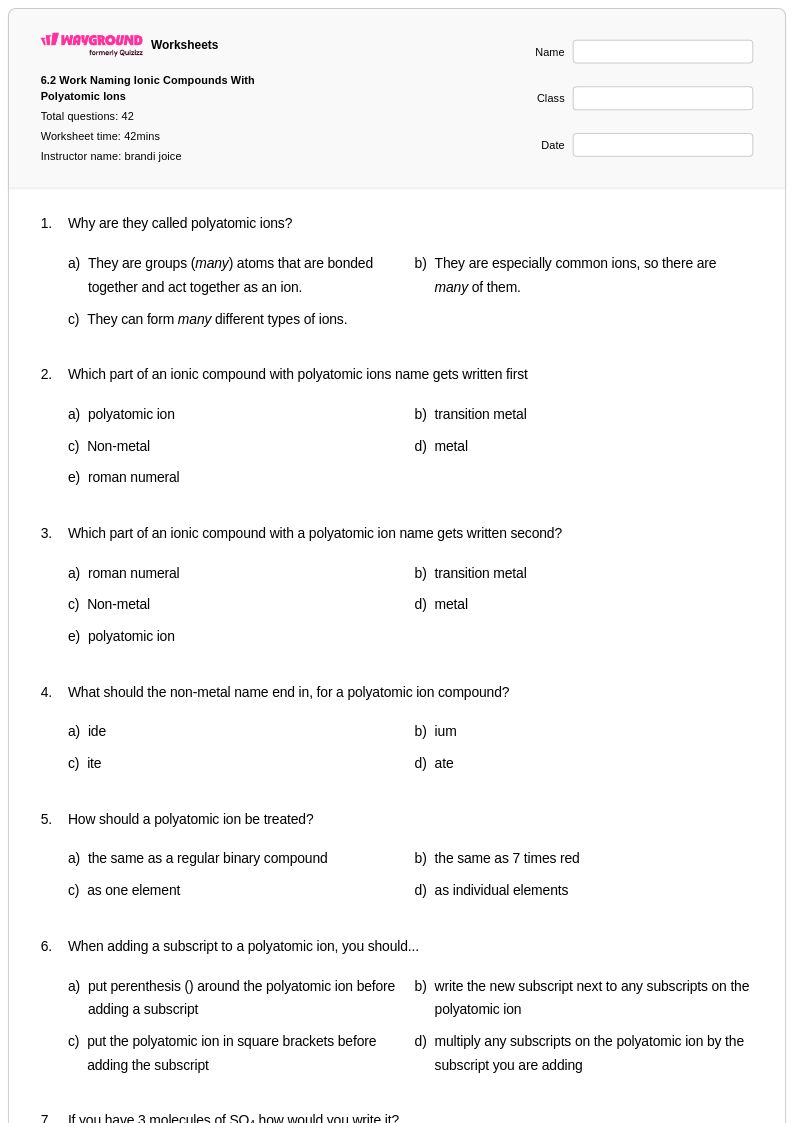
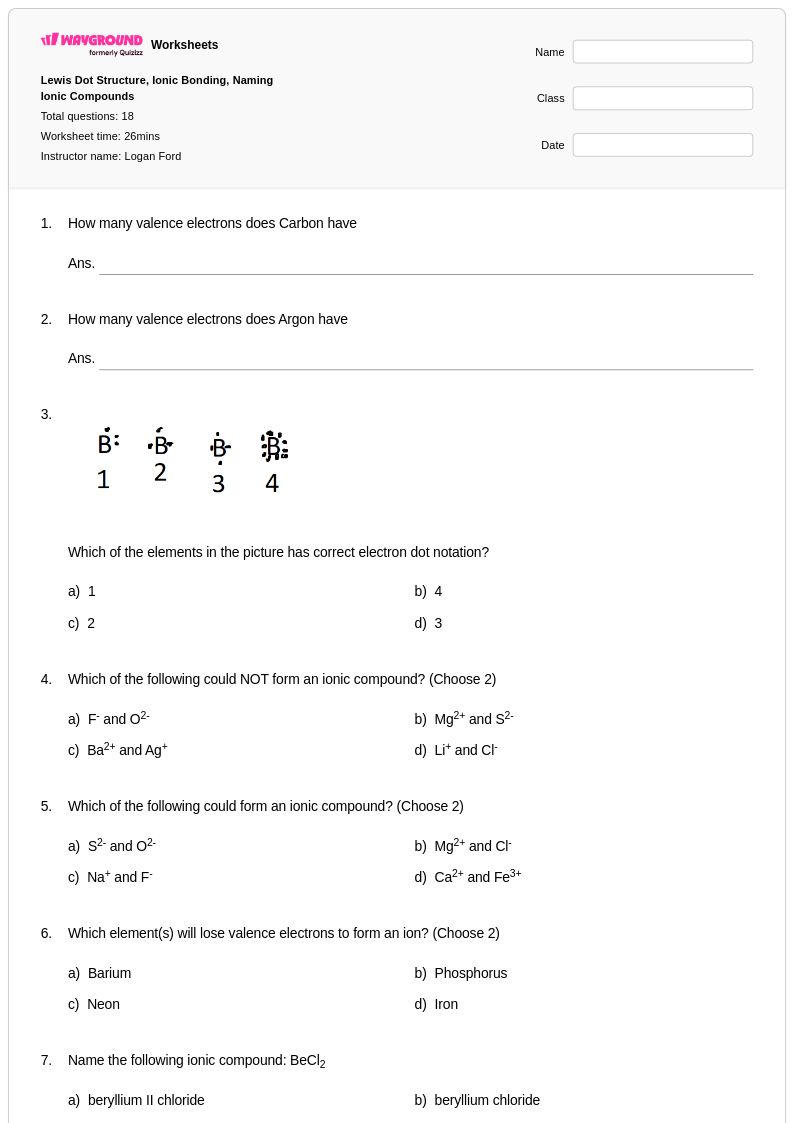
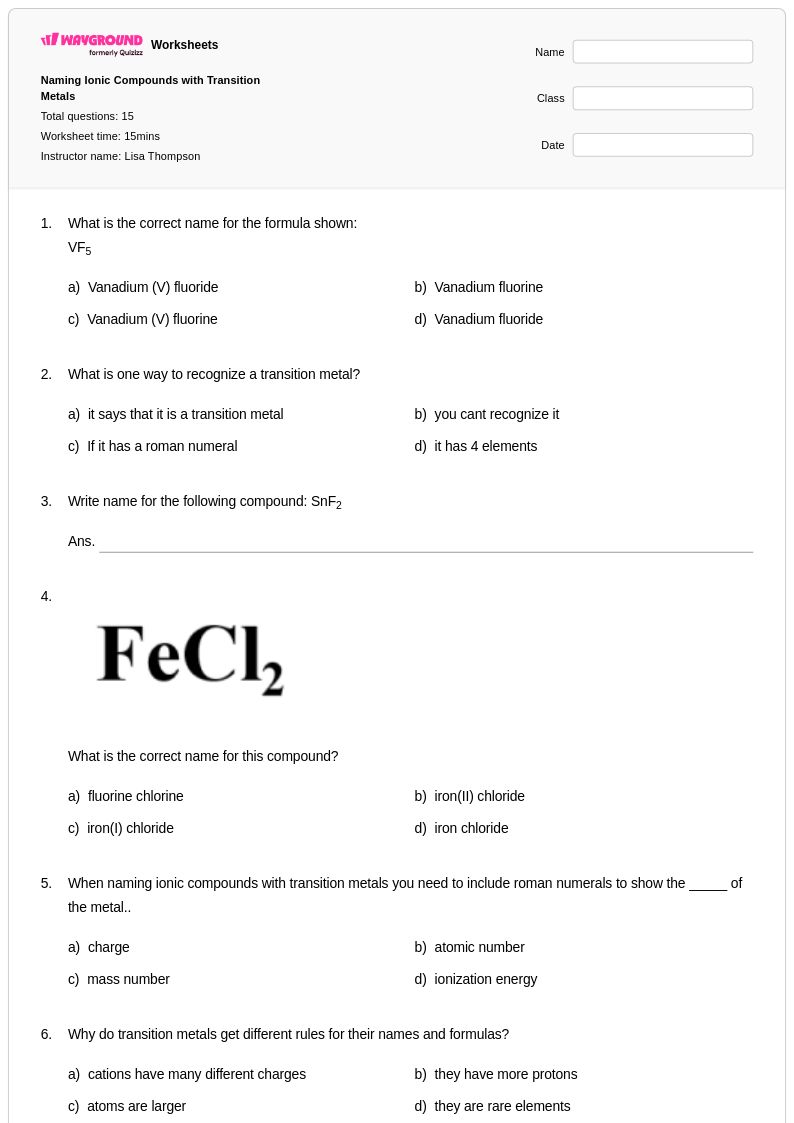
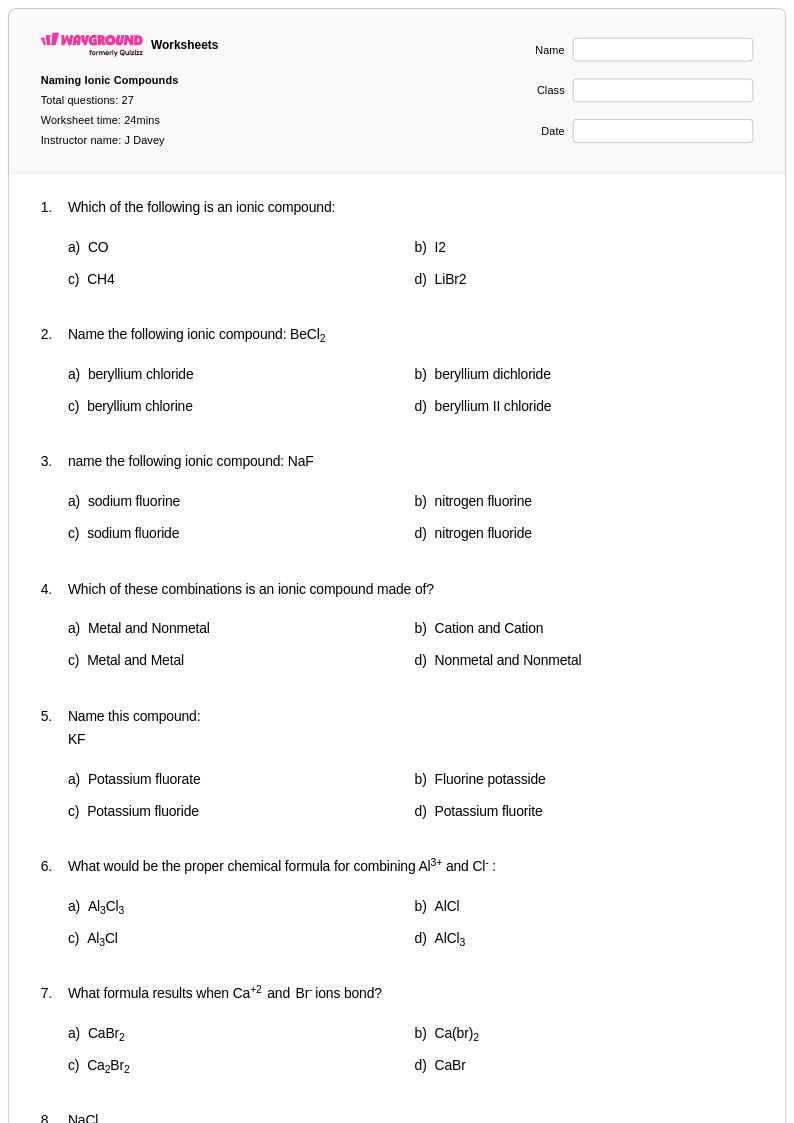
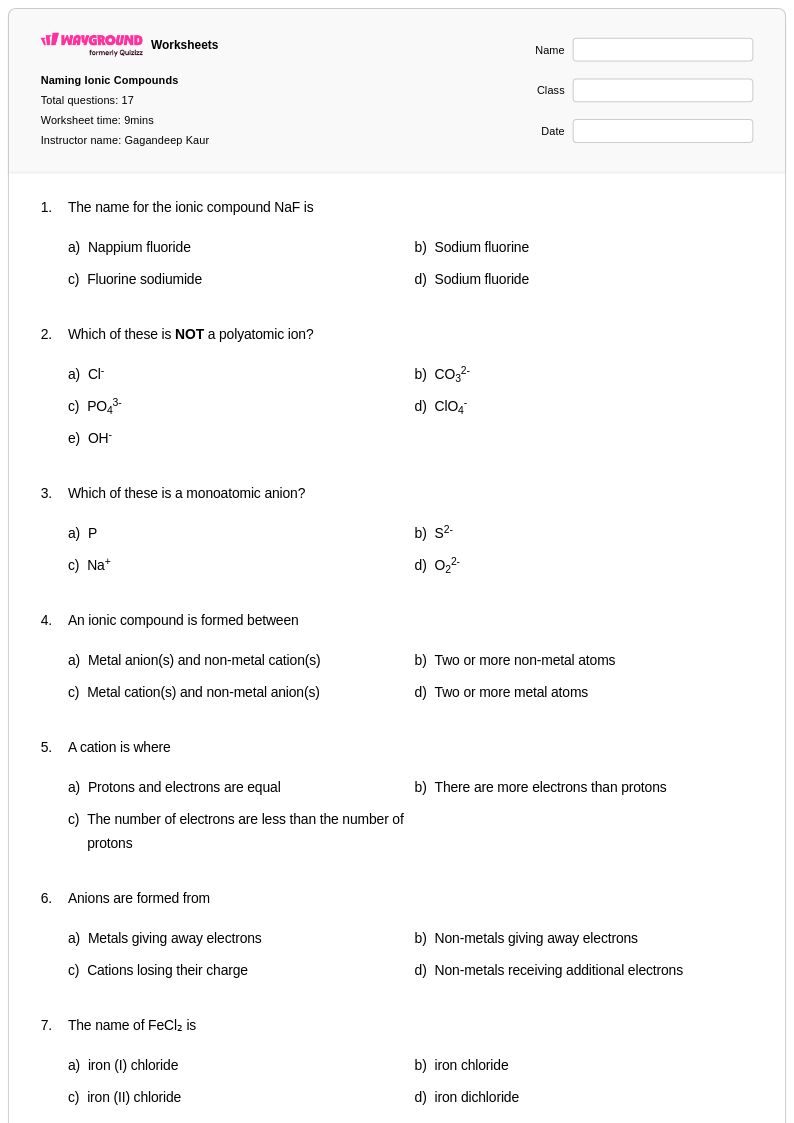
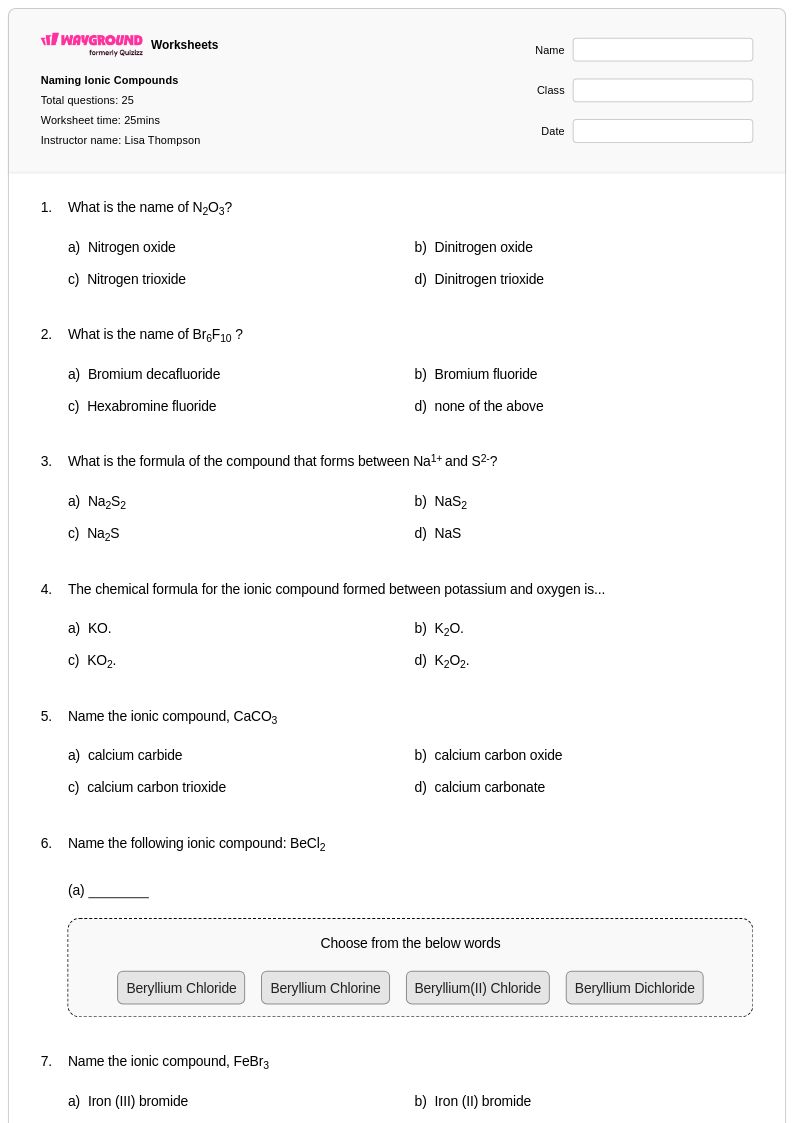
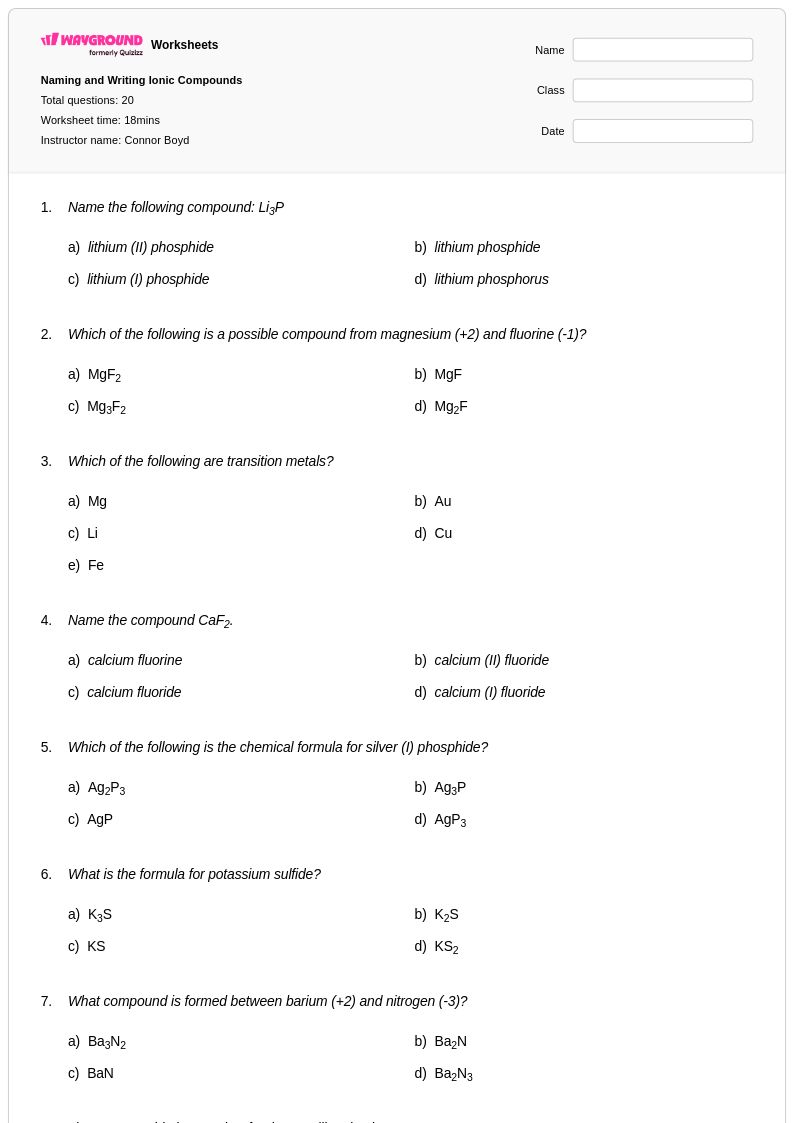
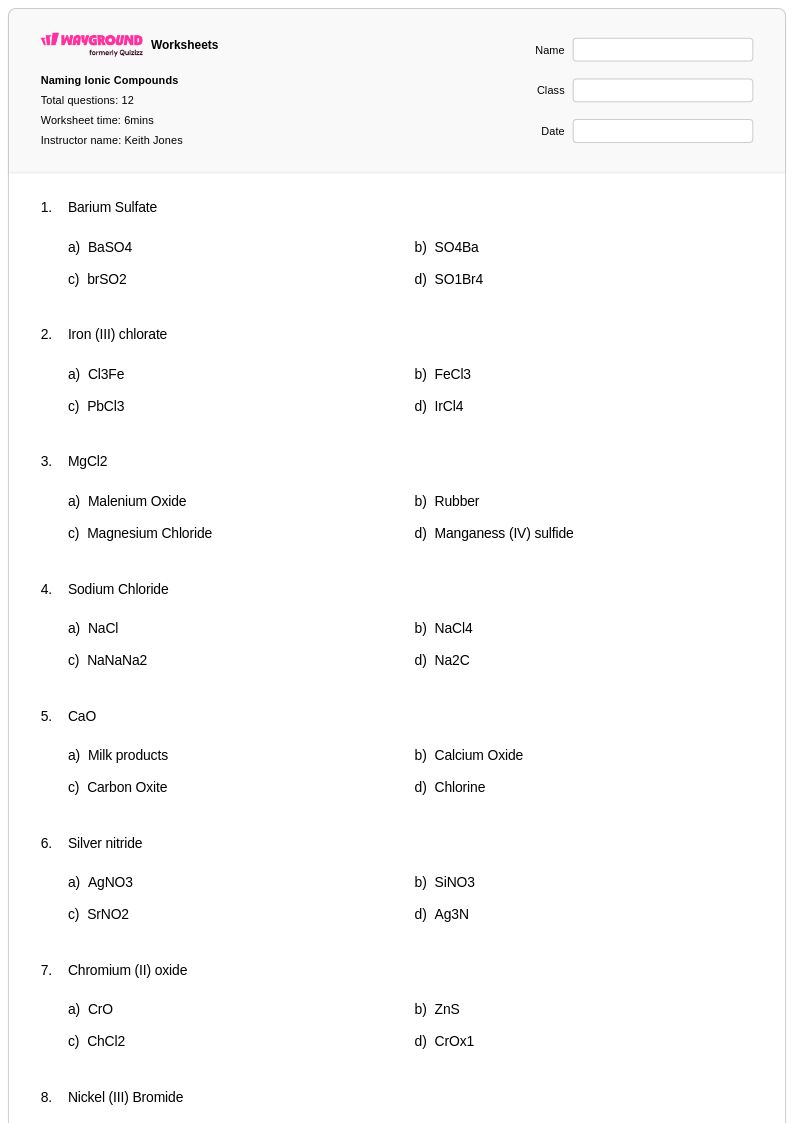
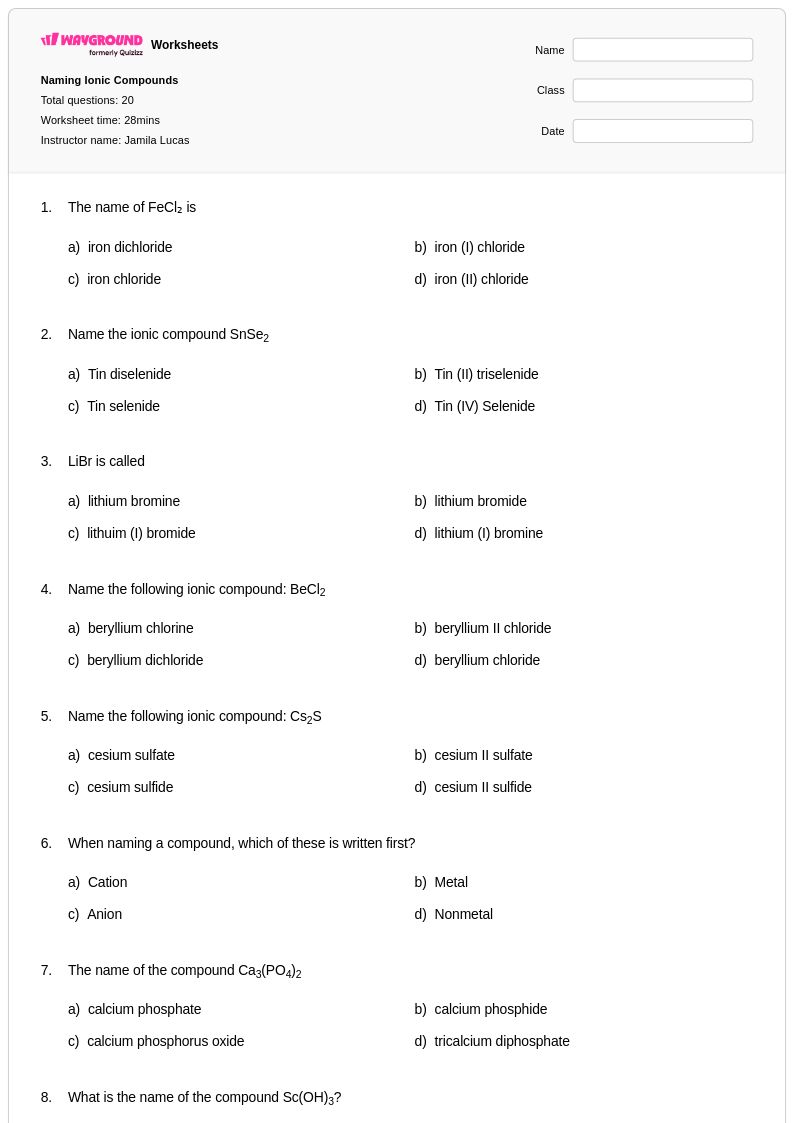
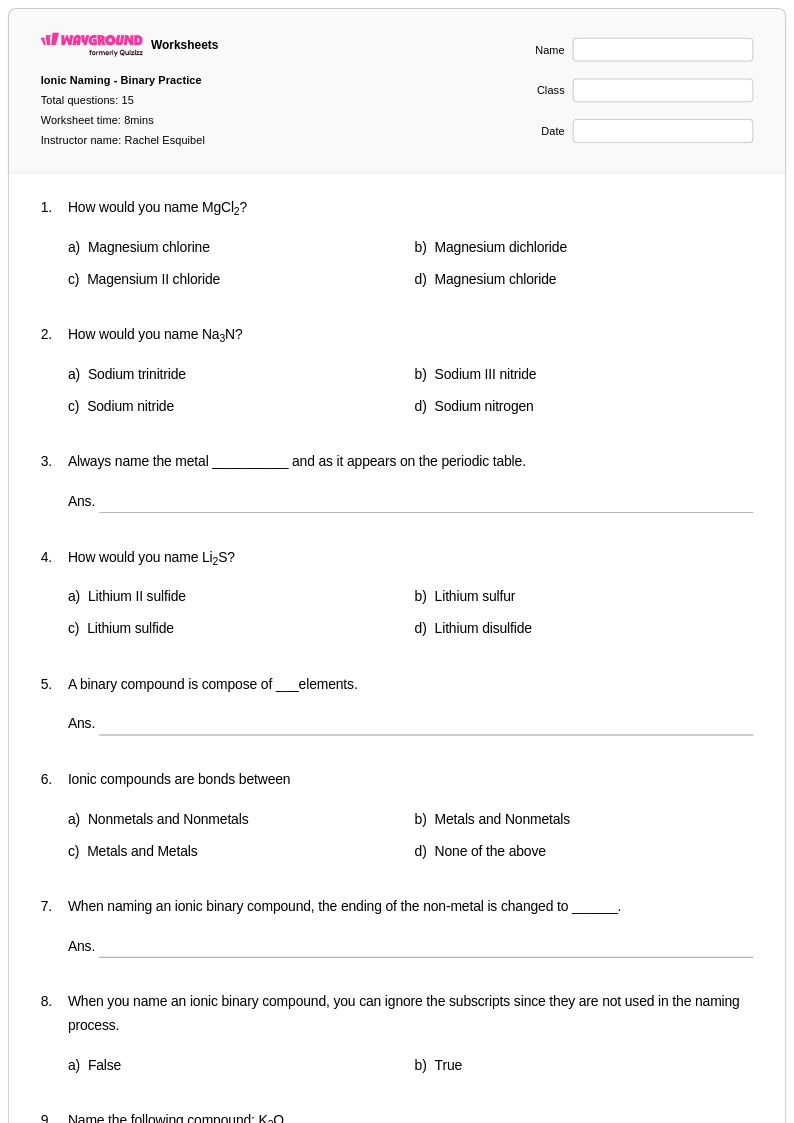
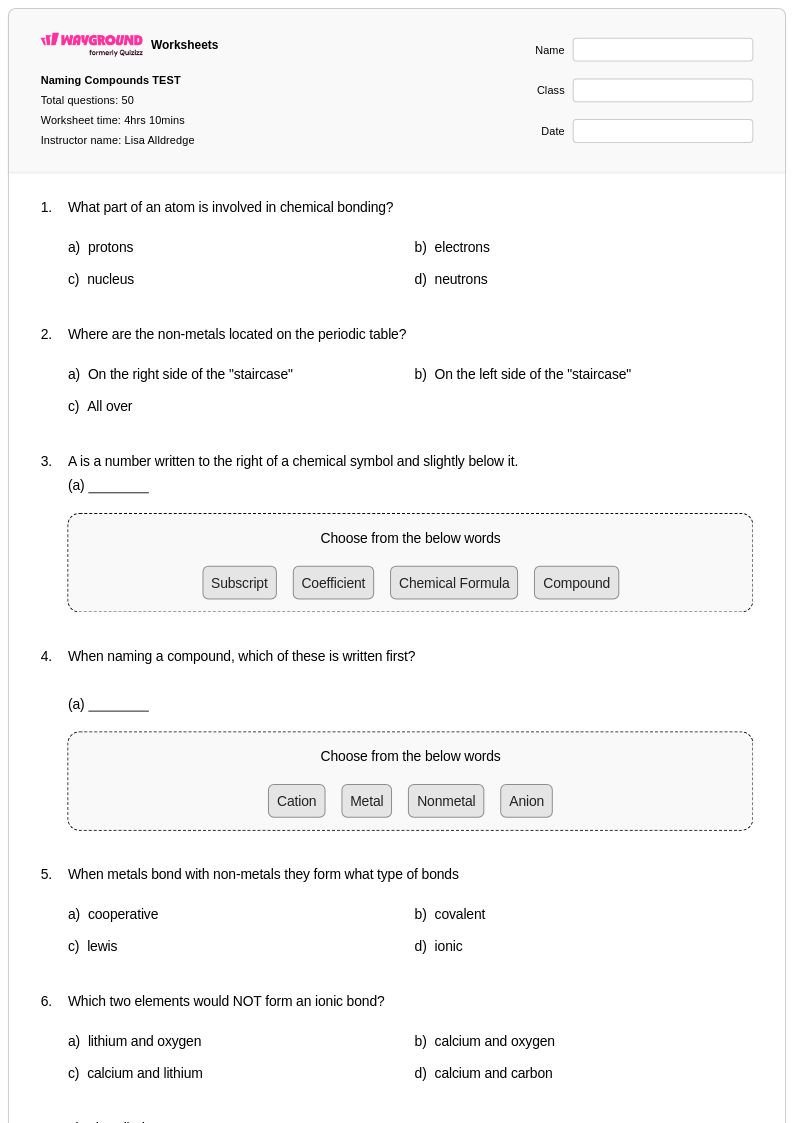
Master naming ionic compounds with Wayground's comprehensive collection of free chemistry worksheets, featuring engaging practice problems, printable PDFs, and detailed answer keys to help students confidently identify and name ionic chemical formulas.
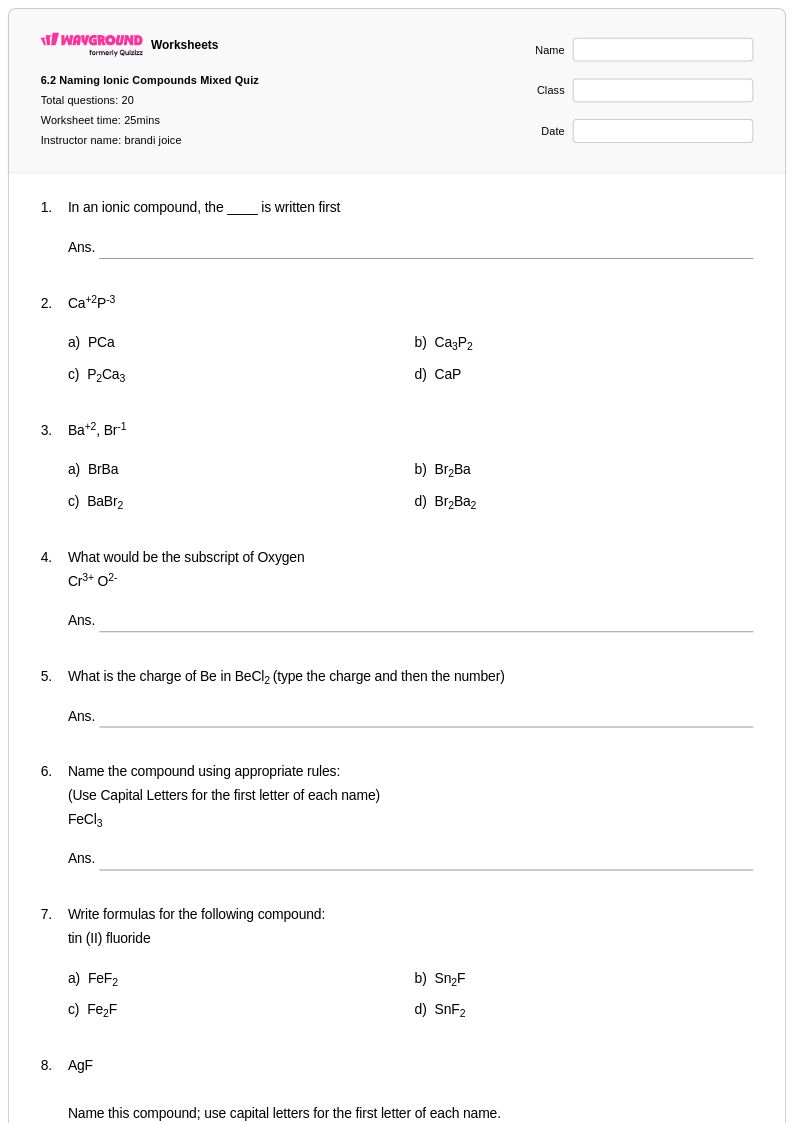
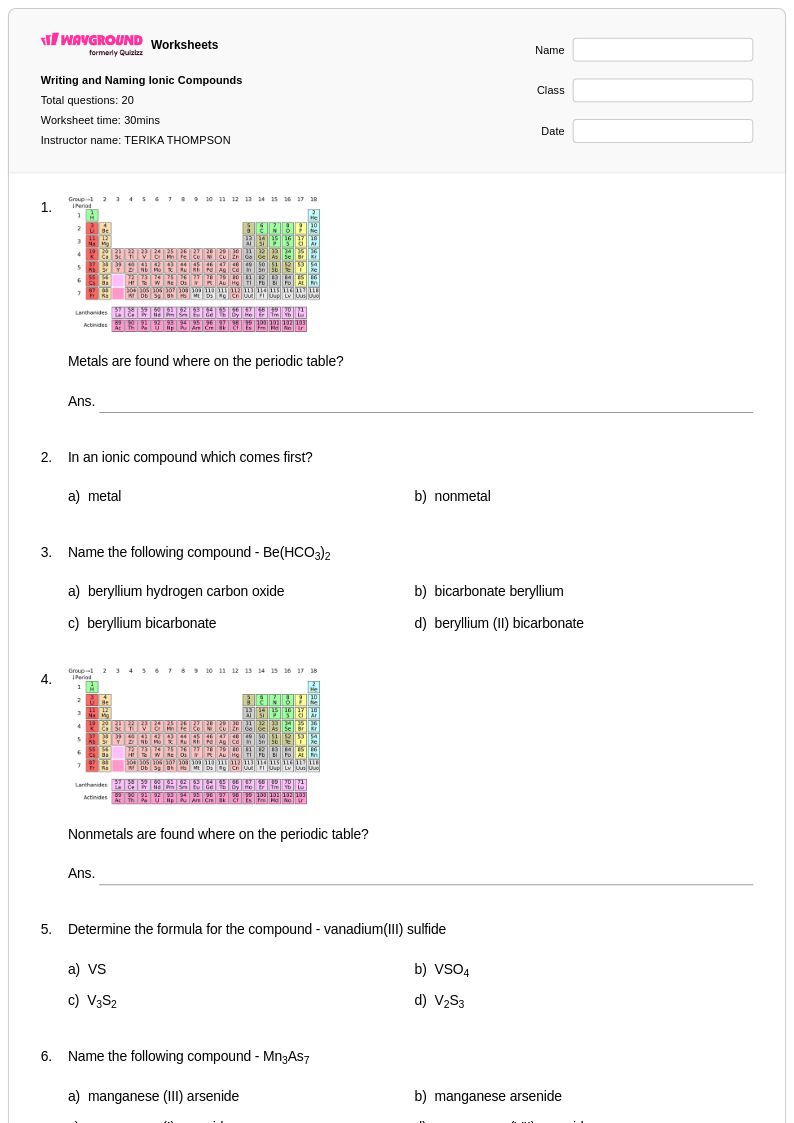
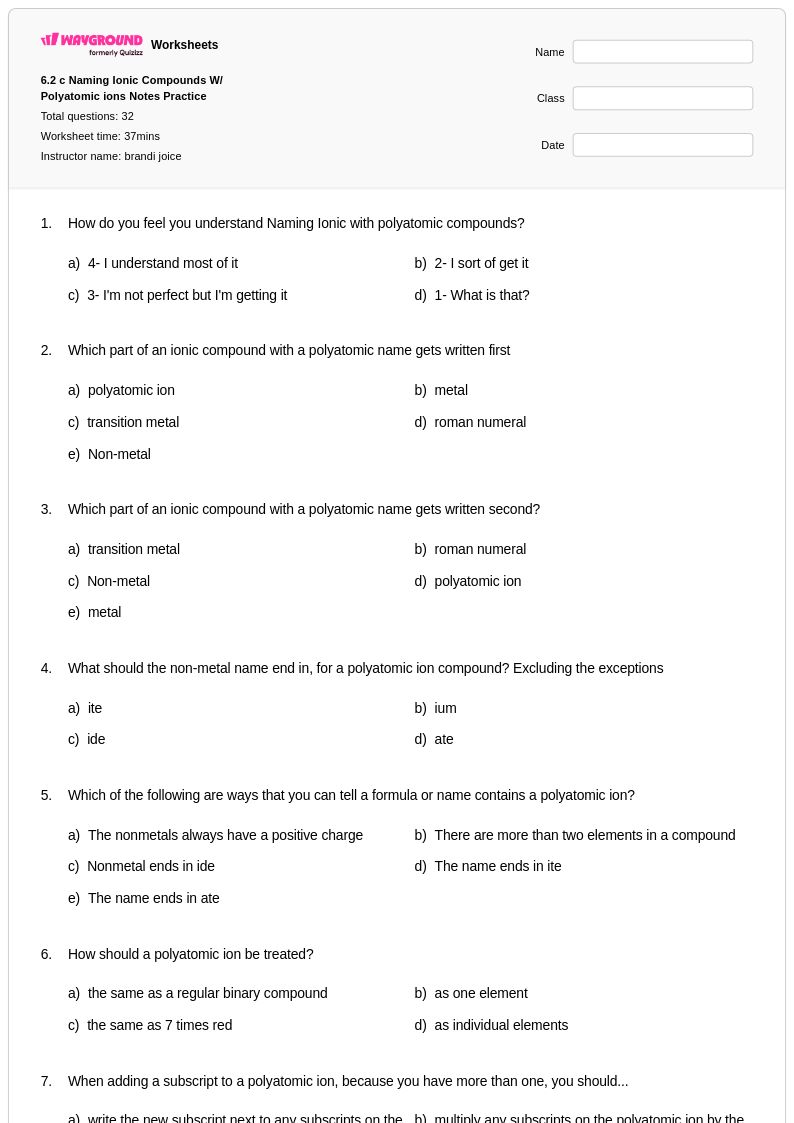
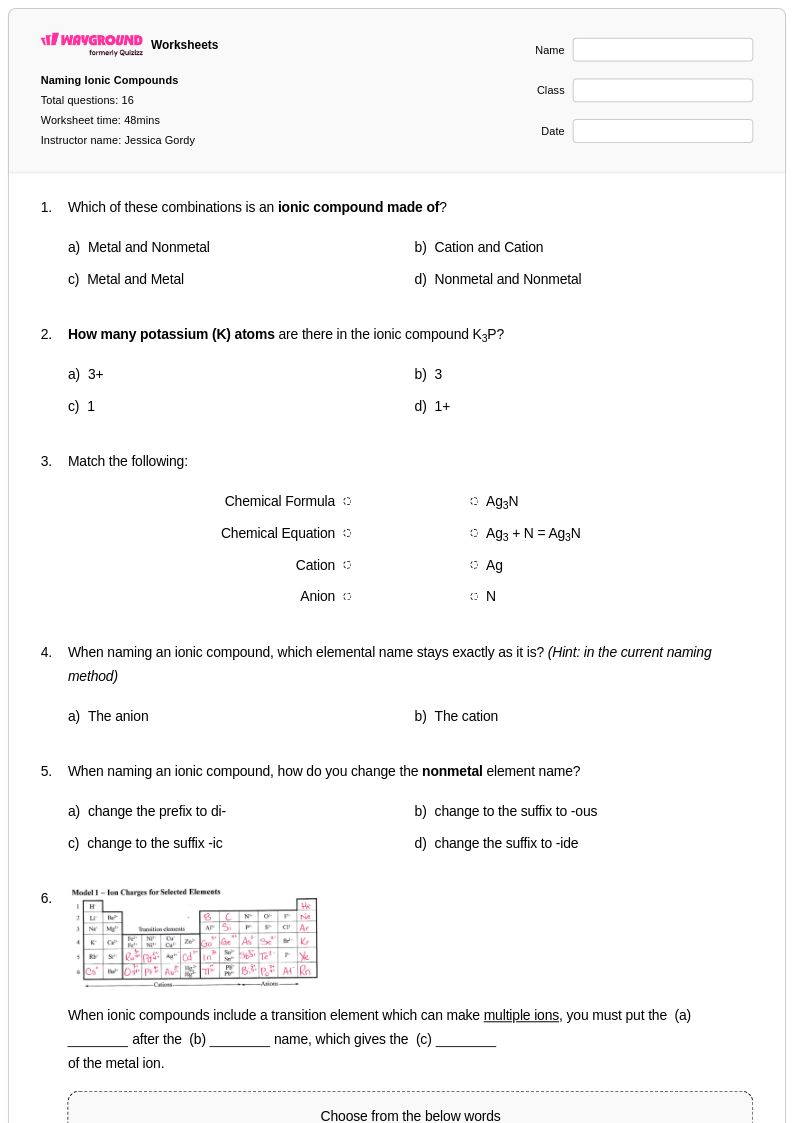
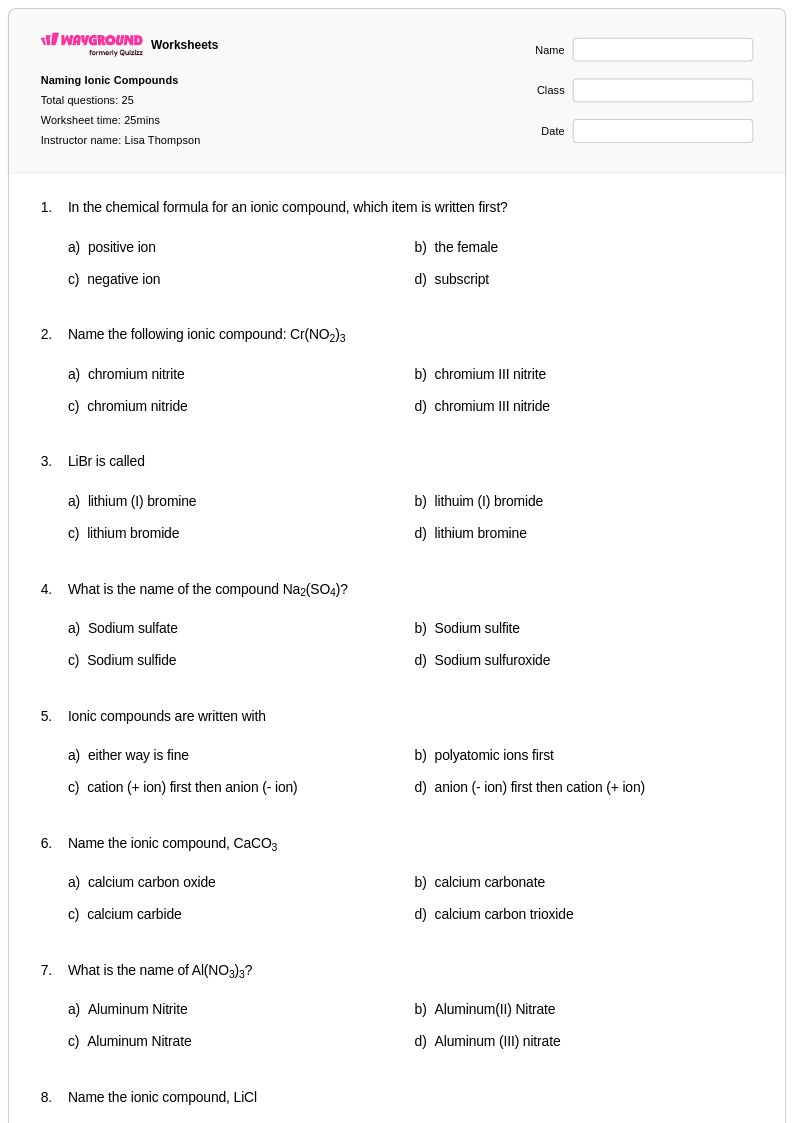
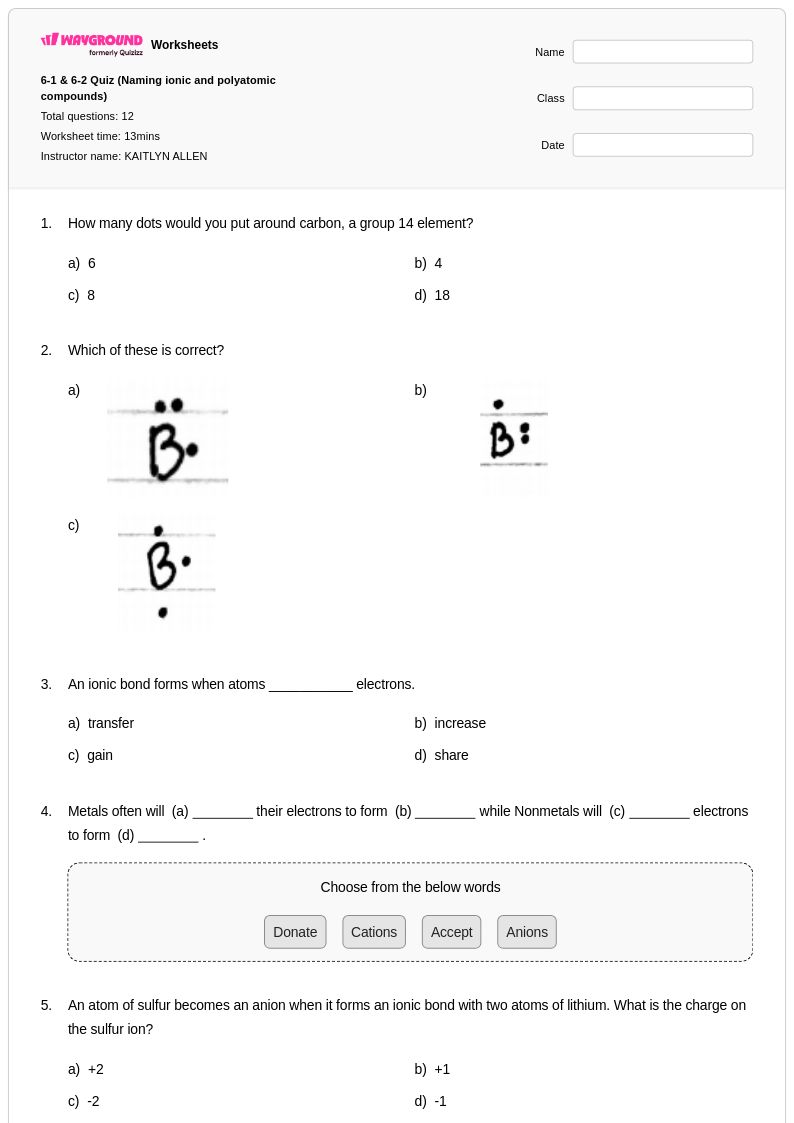
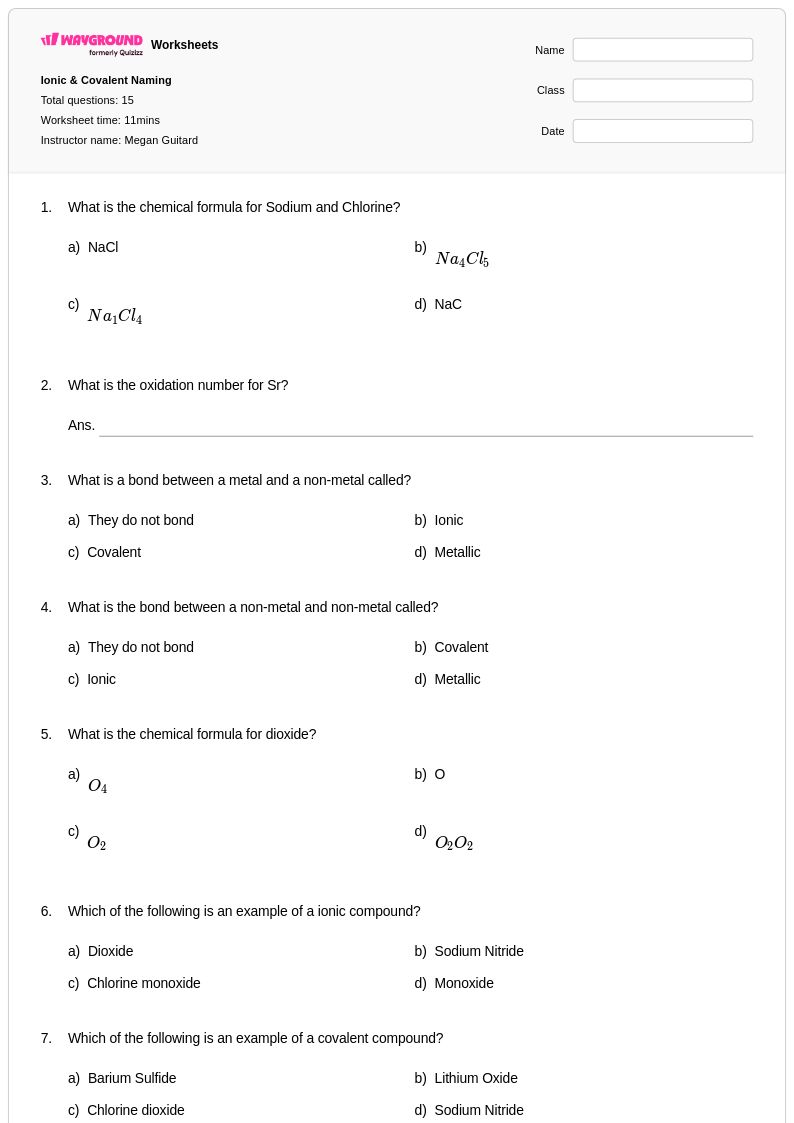
Naming ionic compounds represents a fundamental skill in chemistry education that requires students to master the systematic approach to identifying and writing chemical formulas based on the charges of ions. Wayground's extensive collection of naming ionic compounds worksheets provides comprehensive practice opportunities that help students develop proficiency in recognizing cation and anion combinations, applying correct naming conventions, and understanding the relationship between ionic charges and chemical formulas. These carefully designed worksheets include a variety of practice problems ranging from simple binary ionic compounds to more complex polyatomic ion combinations, complete with answer keys that enable immediate feedback and self-assessment. Available as free printable resources and downloadable pdf formats, these materials strengthen students' understanding of ionic bonding principles while building confidence in chemical nomenclature through systematic practice.
Wayground, formerly Quizizz, empowers chemistry educators with millions of teacher-created resources specifically focused on ionic compound nomenclature, offering robust search and filtering capabilities that allow instructors to quickly locate materials aligned with their curriculum standards and student needs. The platform's differentiation tools enable teachers to customize worksheets for various skill levels, supporting both remediation for struggling students and enrichment activities for advanced learners. With flexible formatting options available in both printable and digital formats, including comprehensive pdf collections, educators can seamlessly integrate these resources into classroom instruction, homework assignments, or independent study sessions. This extensive repository streamlines lesson planning while providing teachers with reliable, standards-aligned materials that facilitate targeted skill practice and assessment in chemical nomenclature.
FAQs
How do I teach students to name ionic compounds step by step?
Start by teaching students to identify whether the compound is binary (two elements) or contains a polyatomic ion, then have them determine the cation and anion separately. Students should practice writing the cation name first, followed by the anion name with its '-ide' suffix for simple anions or the unchanged name for polyatomic ions. Using a consistent decision-making sequence, rather than memorizing isolated rules, helps students build a transferable process they can apply across compound types.
What exercises help students practice naming ionic compounds?
Effective practice includes formula-to-name exercises where students identify the cation and anion from a given formula, and name-to-formula exercises where they must recall charges and construct the correct ratio. Adding polyatomic ion reference tables to early practice reduces cognitive overload and lets students focus on applying naming conventions rather than memorization. Gradually removing scaffolds, such as the reference table, as fluency builds is an effective progression strategy.
What mistakes do students commonly make when naming ionic compounds?
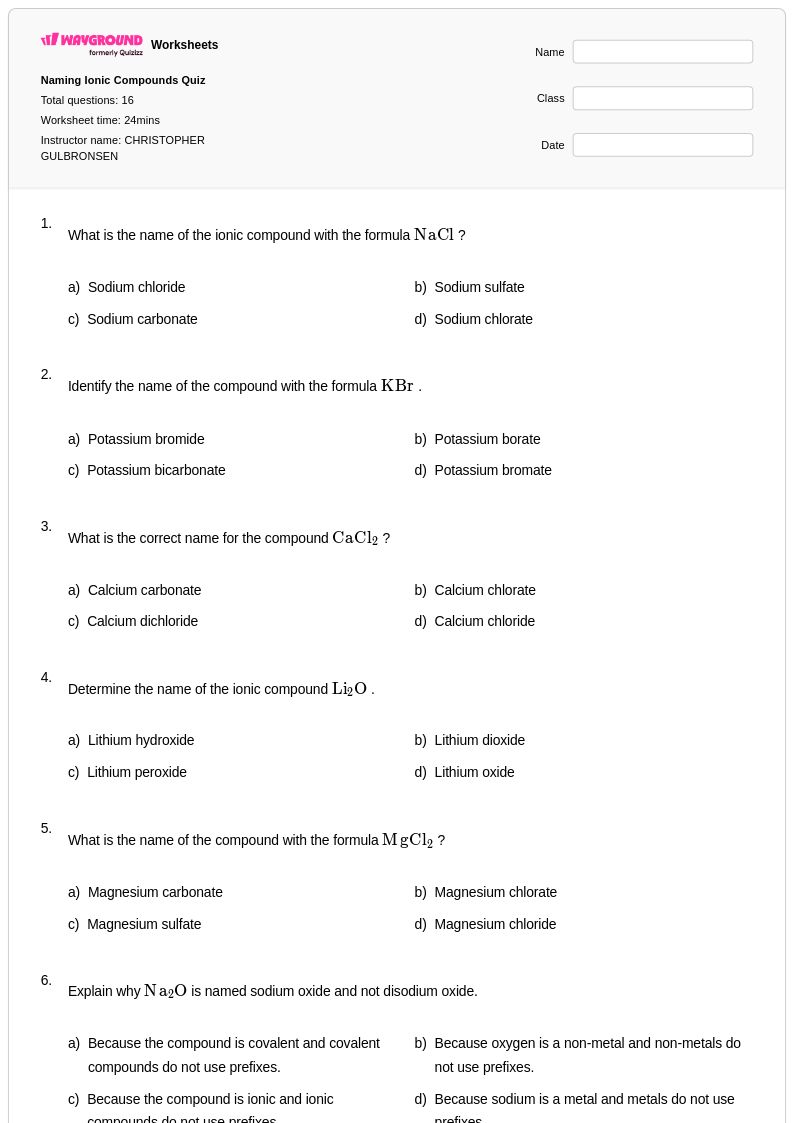
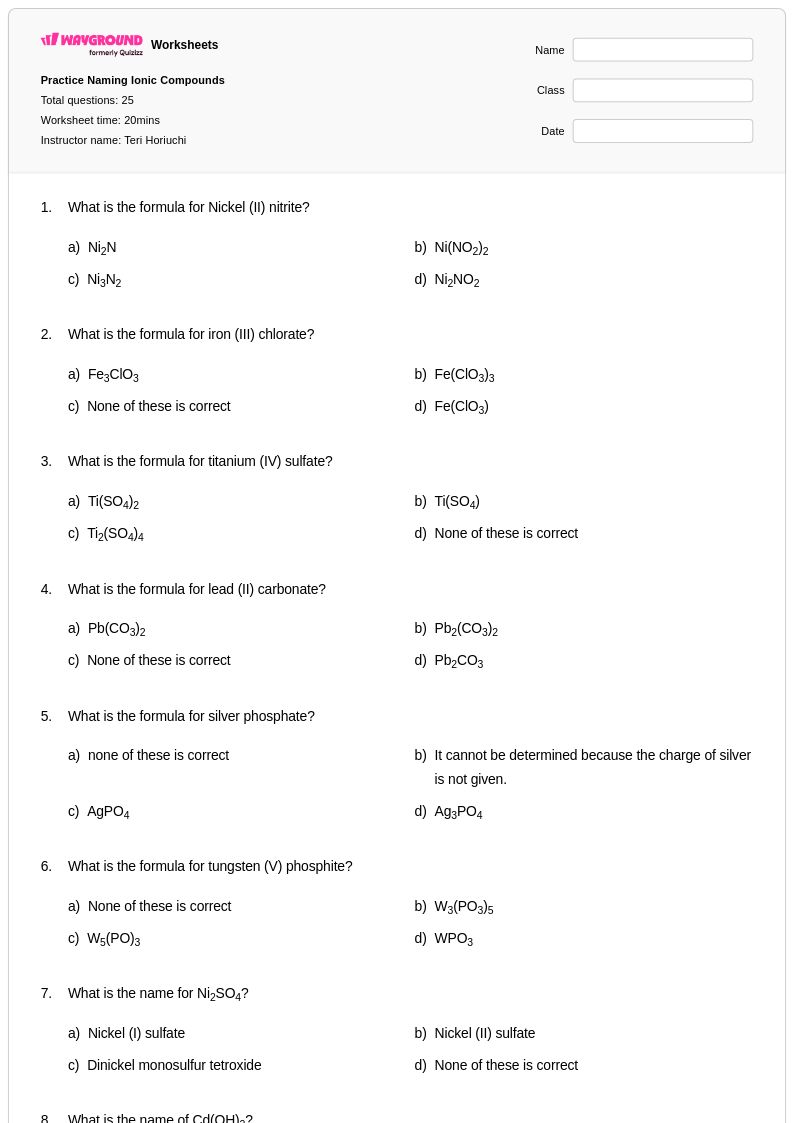
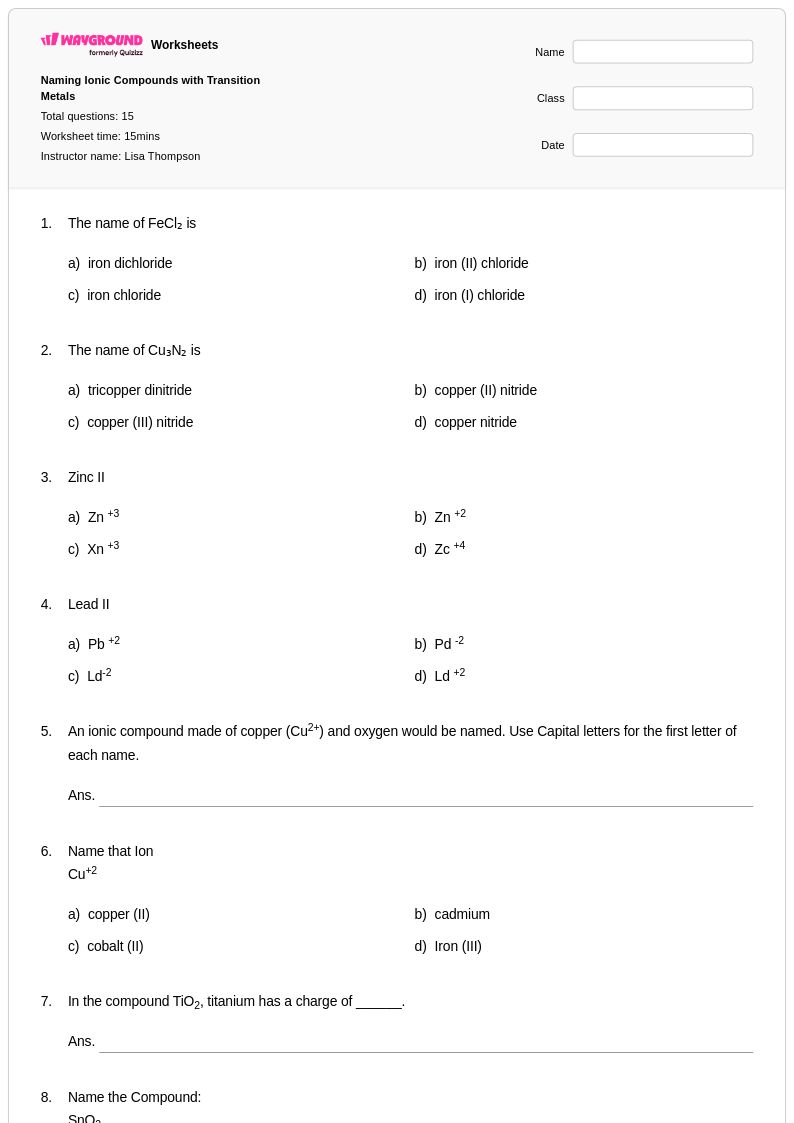
One of the most common errors is confusing ionic and covalent naming rules, particularly using prefixes like 'mono-' or 'di-' for ionic compounds, which is incorrect. Students also frequently forget to include Roman numerals when naming transition metals with variable charges, such as writing 'iron chloride' instead of 'iron(II) chloride' or 'iron(III) chloride'. A third frequent mistake is misidentifying polyatomic ions, either breaking them apart incorrectly or confusing similar ions such as nitrate and nitrite.
How do I help students who struggle to tell transition metal compounds apart when naming them?
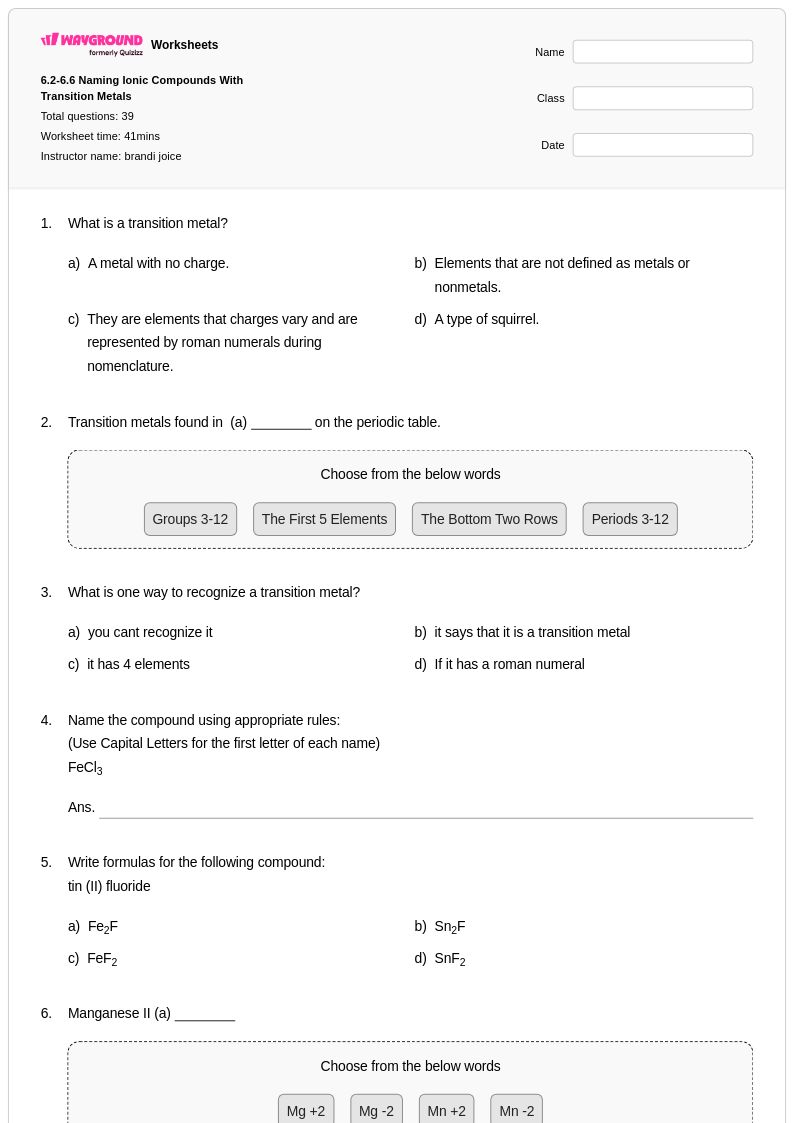
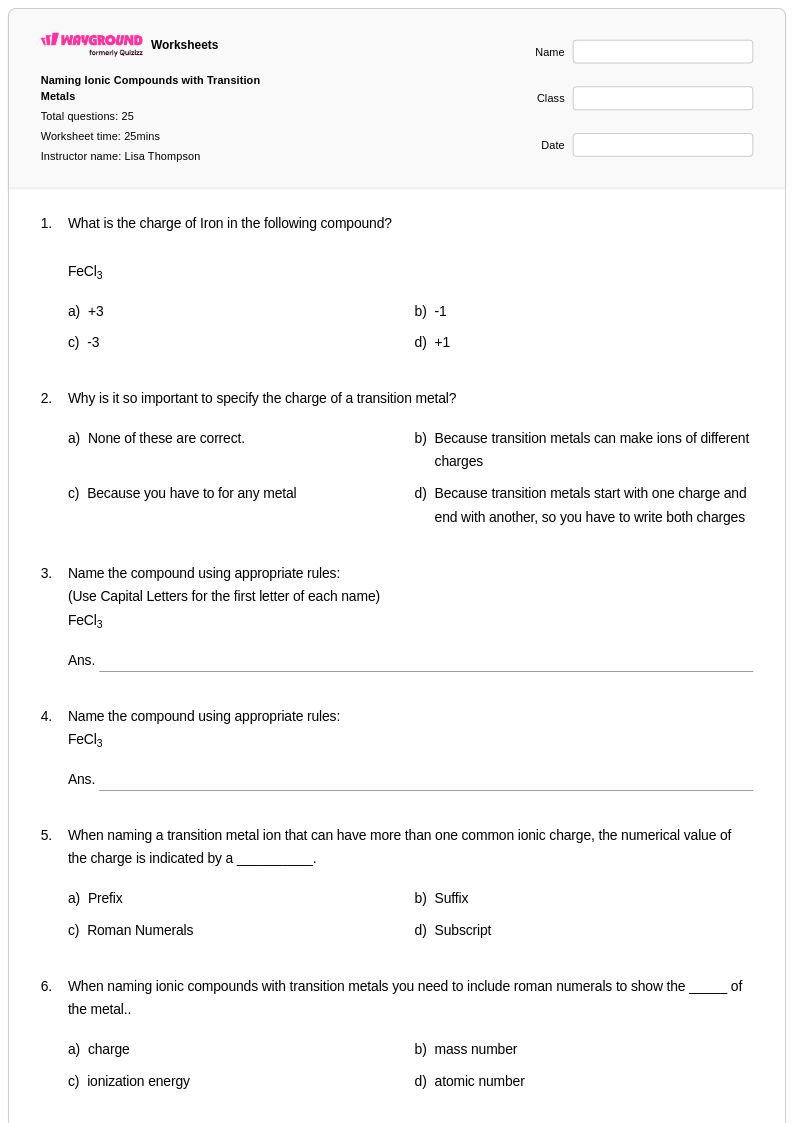
Teach students to use the anion's charge to work backwards and determine the transition metal's oxidation state before writing the name. For example, in FeCl3, since chloride carries a 1- charge and there are three of them, the iron must be 3+, making it iron(III) chloride. Providing worked examples that explicitly show this charge-balancing reasoning, rather than just the final answer, gives struggling students a reliable problem-solving strategy they can replicate independently.
How do I use naming ionic compounds worksheets effectively in my classroom?
These worksheets work well as structured practice after direct instruction on nomenclature rules, either as guided class work or independent homework assignments. Because they are available as printable PDFs and in digital formats, teachers can deploy them in traditional paper-based settings or technology-integrated classrooms, and can also host them as a quiz on Wayground for real-time feedback. Using the included answer keys for immediate self-assessment helps students identify and correct errors before misconceptions become entrenched.
How do I differentiate naming ionic compounds practice for students at different skill levels?
For students still building foundational skills, begin with simple binary ionic compounds using metals with fixed charges before introducing variable-charge metals or polyatomic ions. Advanced students can be challenged with multi-step problems that require them to identify the compound type, determine charges, and write both names and formulas without reference aids. On Wayground, teachers can apply accommodations such as reduced answer choices or read-aloud support to individual students, allowing the same worksheet to serve mixed-ability classrooms without requiring separate materials.