Free Printable Graham's Law of Effusion worksheets
Explore Wayground's free Graham's Law of Effusion worksheets and printables featuring practice problems with answer keys to help students master gas diffusion rates and molecular velocity calculations in chemistry.
Explore printable Graham's Law of Effusion worksheets
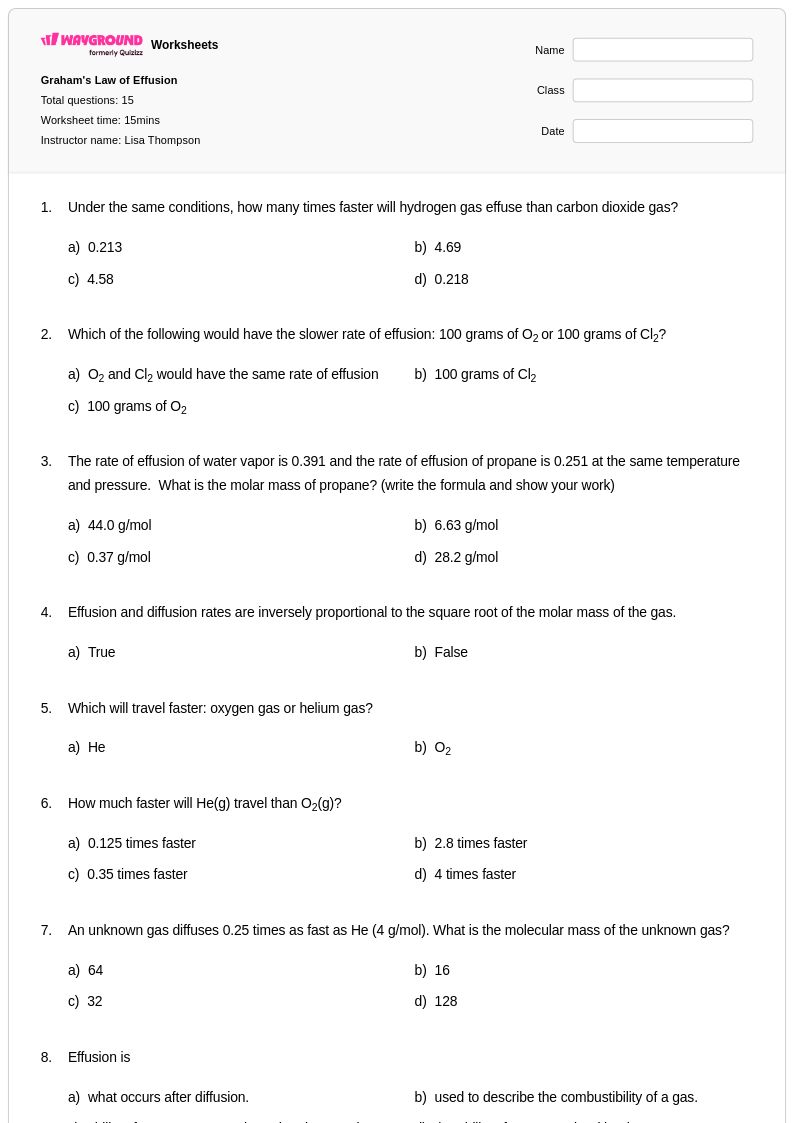
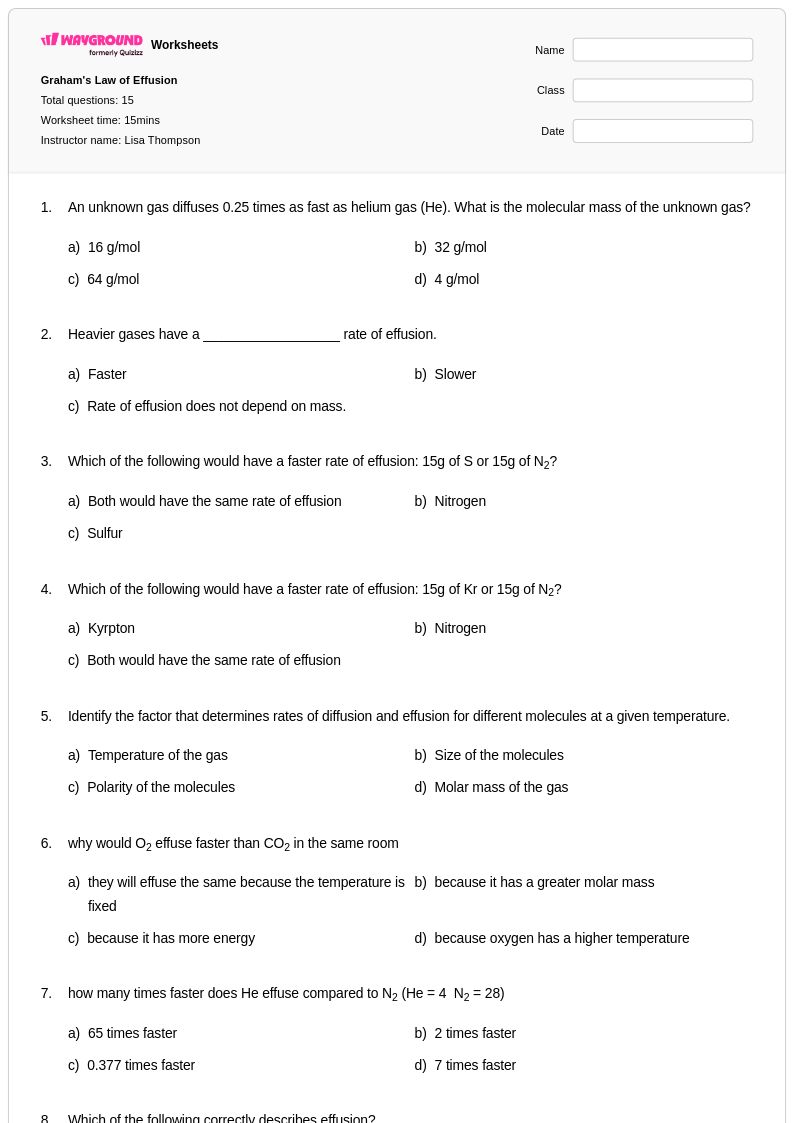
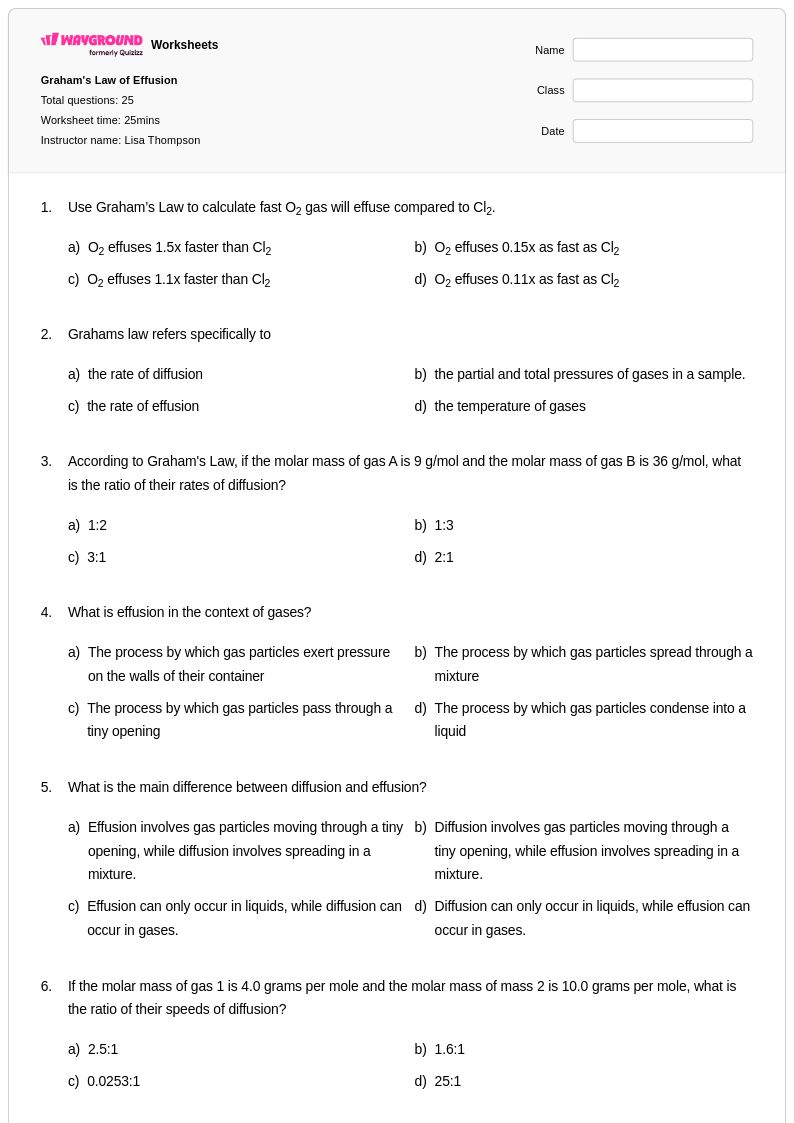
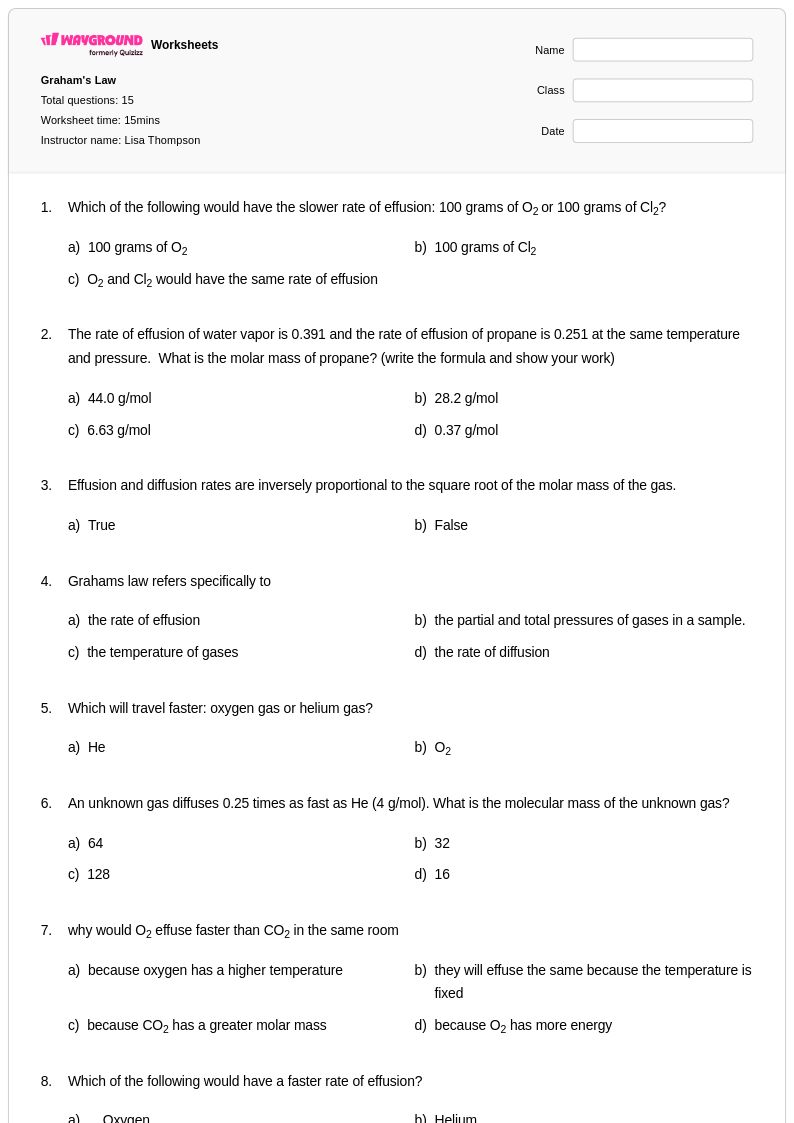
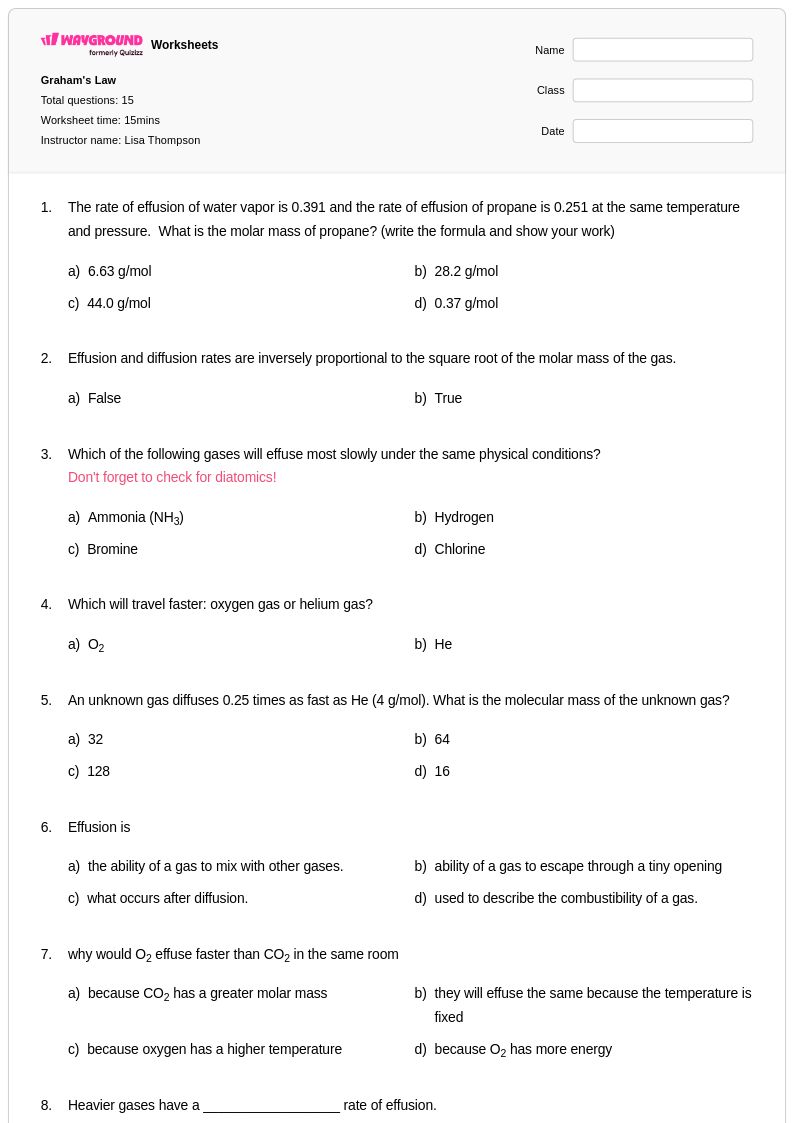
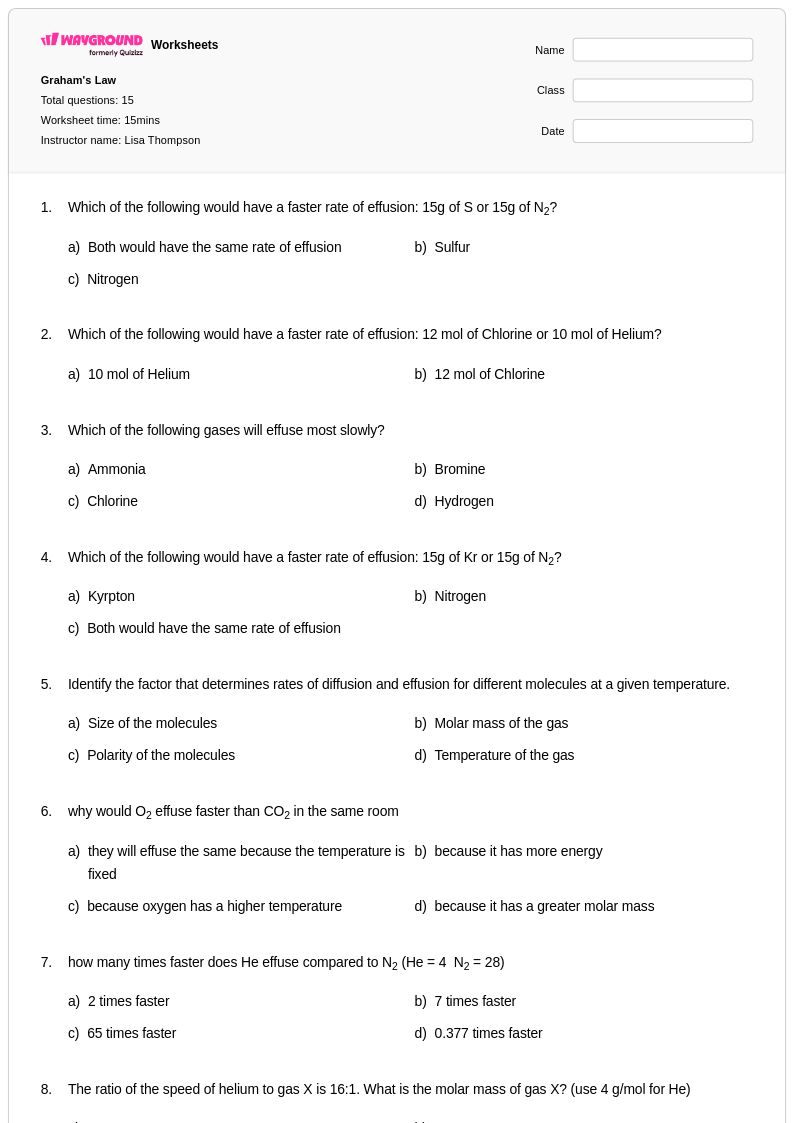
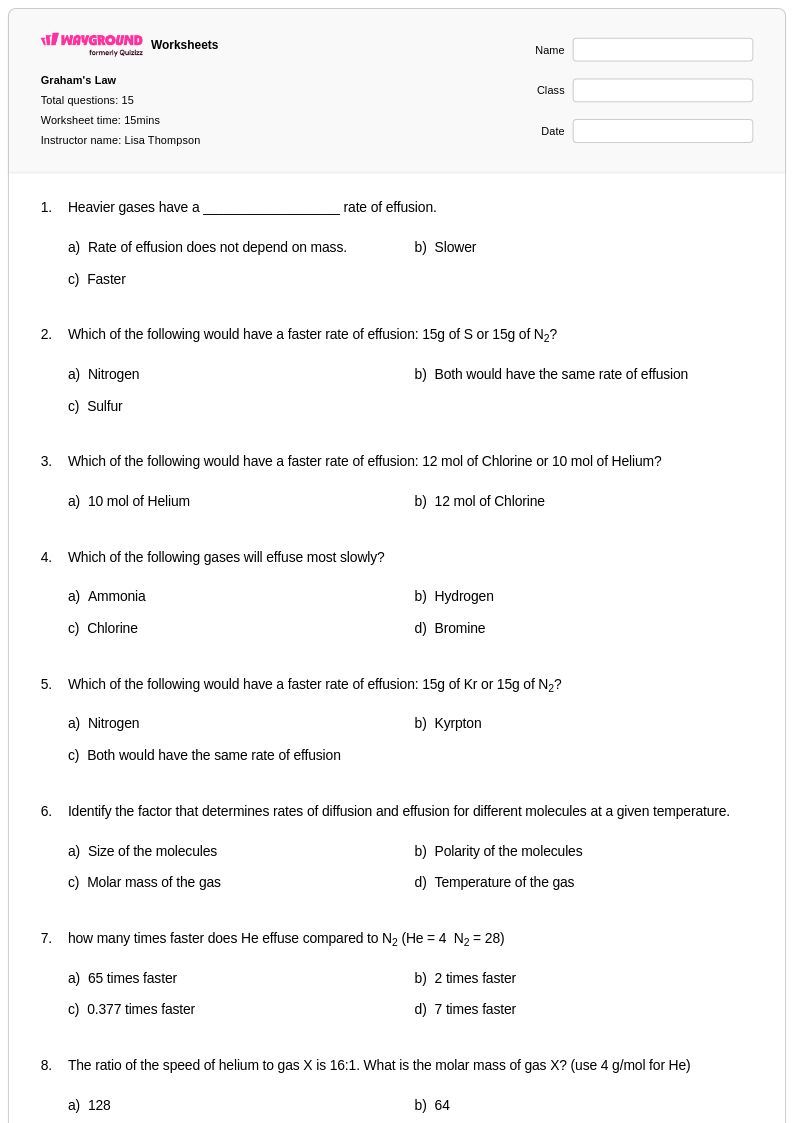
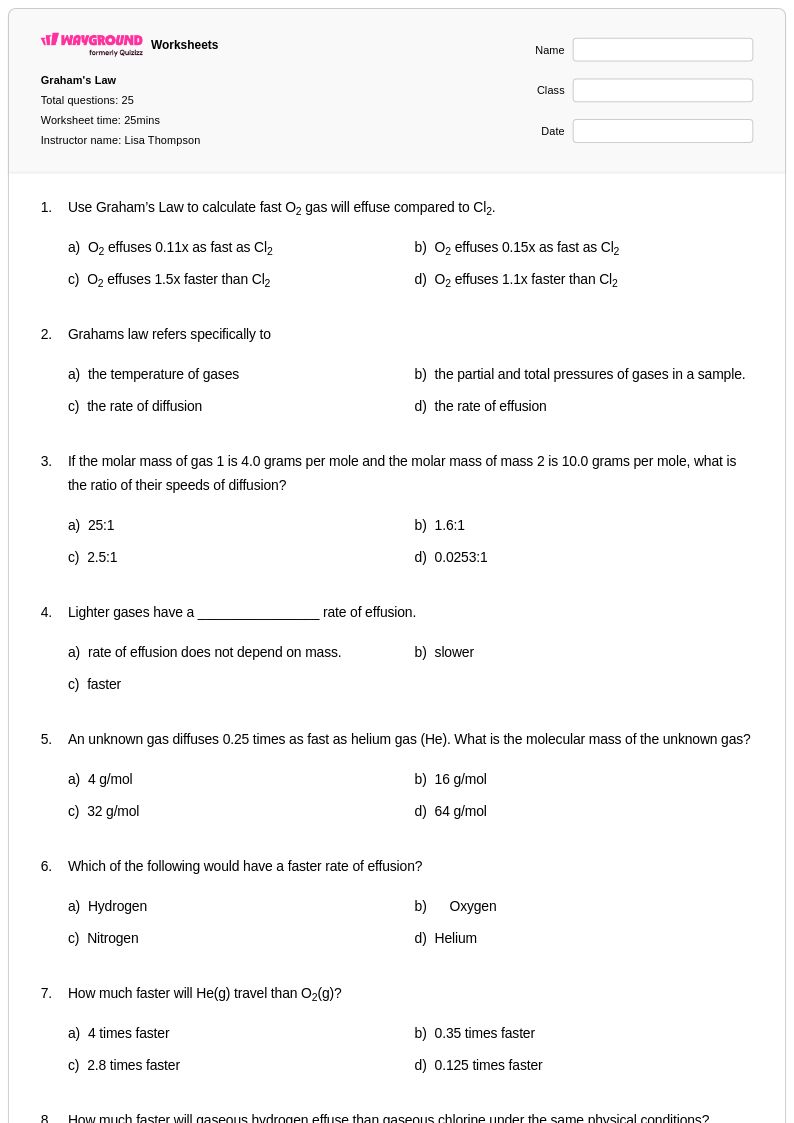
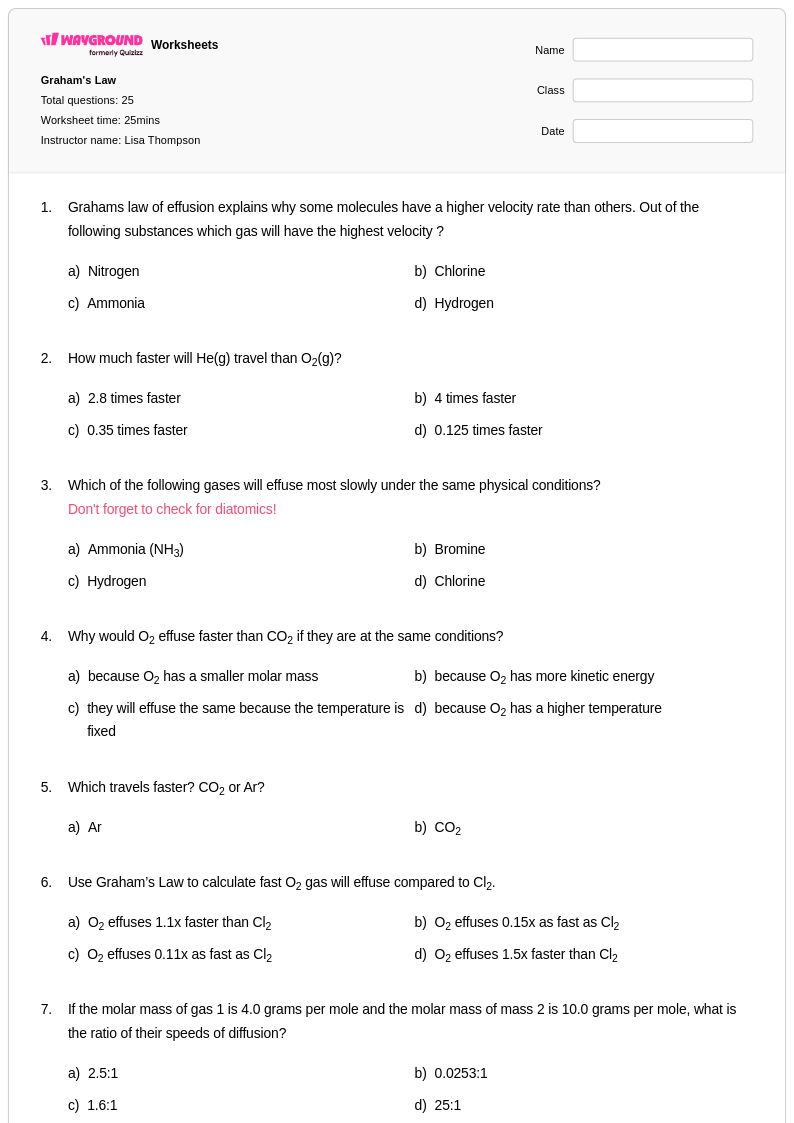
Graham's Law of Effusion worksheets available through Wayground (formerly Quizizz) provide comprehensive practice materials that help students master this fundamental chemistry principle governing the rates at which gases escape through small openings. These expertly designed worksheets strengthen critical analytical skills by guiding students through calculations involving molecular mass relationships, velocity comparisons, and effusion rate determinations across various gas samples. Each worksheet collection includes detailed answer keys and step-by-step solution guides, enabling students to verify their understanding of the mathematical relationships that govern effusion processes. The free printable resources feature carefully structured practice problems that progress from basic conceptual questions to complex multi-step calculations, ensuring students develop both theoretical knowledge and practical problem-solving abilities essential for advanced chemistry coursework.
Wayground (formerly Quizizz) supports chemistry educators with an extensive collection of millions of teacher-created Graham's Law of Effusion resources, featuring robust search and filtering capabilities that allow instructors to quickly locate materials aligned with specific learning standards and curriculum requirements. The platform's differentiation tools enable teachers to customize worksheets based on individual student needs, whether for remediation of struggling learners or enrichment of advanced students ready for more challenging applications. These flexible resources are available in both printable pdf formats for traditional classroom use and digital formats for online learning environments, making lesson planning more efficient while providing multiple pathways for skill practice. Teachers can seamlessly integrate these materials into their instruction for targeted remediation sessions, comprehensive review activities, or assessment preparation, ensuring all students achieve mastery of effusion rate calculations and the underlying kinetic molecular theory concepts.
FAQs
How do I teach Graham's Law of Effusion to chemistry students?
Start by grounding students in kinetic molecular theory — specifically the relationship between molecular mass and particle speed — before introducing the mathematical formula. Use concrete comparisons like hydrogen versus oxygen gas to make the inverse square root relationship tangible. Once students can reason conceptually about why lighter gases effuse faster, transition to quantitative problem-solving using the standard ratio form of Graham's Law.
What types of practice problems help students get better at Graham's Law calculations?
Effective practice should progress from single-step problems — such as finding the effusion rate ratio of two known gases — to multi-step problems where students must determine an unknown molecular mass from an observed effusion rate comparison. Including problems that require unit analysis and problems set in real-world contexts (like identifying an unknown gas in a lab scenario) strengthens both procedural fluency and conceptual application.
What mistakes do students commonly make when solving Graham's Law problems?
The most frequent error is inverting the mass-to-rate relationship — students often place the larger molar mass in the numerator when it should produce a smaller rate ratio. A second common mistake is confusing effusion rate with effusion time; these are inversely related, and students who conflate the two will consistently set up proportions backwards. Explicitly drilling the distinction between rate and time early in instruction prevents these errors from becoming entrenched.
How do I use Graham's Law of Effusion worksheets in my chemistry class?
Graham's Law of Effusion worksheets on Wayground are available as printable PDFs for traditional classroom use and in digital formats for technology-integrated environments, including the option to host them as a quiz directly on Wayground. The structured progression from conceptual questions to complex multi-step calculations makes them effective for guided practice, independent review, or pre-assessment before a unit test. Answer keys are included with each worksheet, allowing students to self-check and teachers to focus feedback on persistent misconceptions.
How does Graham's Law of Effusion connect to broader chemistry concepts students are learning?
Graham's Law is a direct application of kinetic molecular theory, linking macroscopic gas behavior to molecular-level properties like mass and velocity. Teaching it alongside ideal gas law concepts reinforces the idea that gas behavior can be predicted mathematically from physical properties. This connection makes it a useful bridge topic between introductory gas laws and more advanced thermodynamics or reaction kinetics content.
How can I differentiate Graham's Law worksheets for students at different levels?
For struggling students, begin with problems where both molar masses are given and only the rate ratio must be calculated, reducing cognitive load before introducing unknown variables. Advanced students can be challenged with multi-gas comparison problems or questions that require back-solving for an unknown molecular mass. On Wayground, teachers can also apply individual accommodations — such as read aloud support or reduced answer choices — to specific students while other students work through the standard version without disruption.