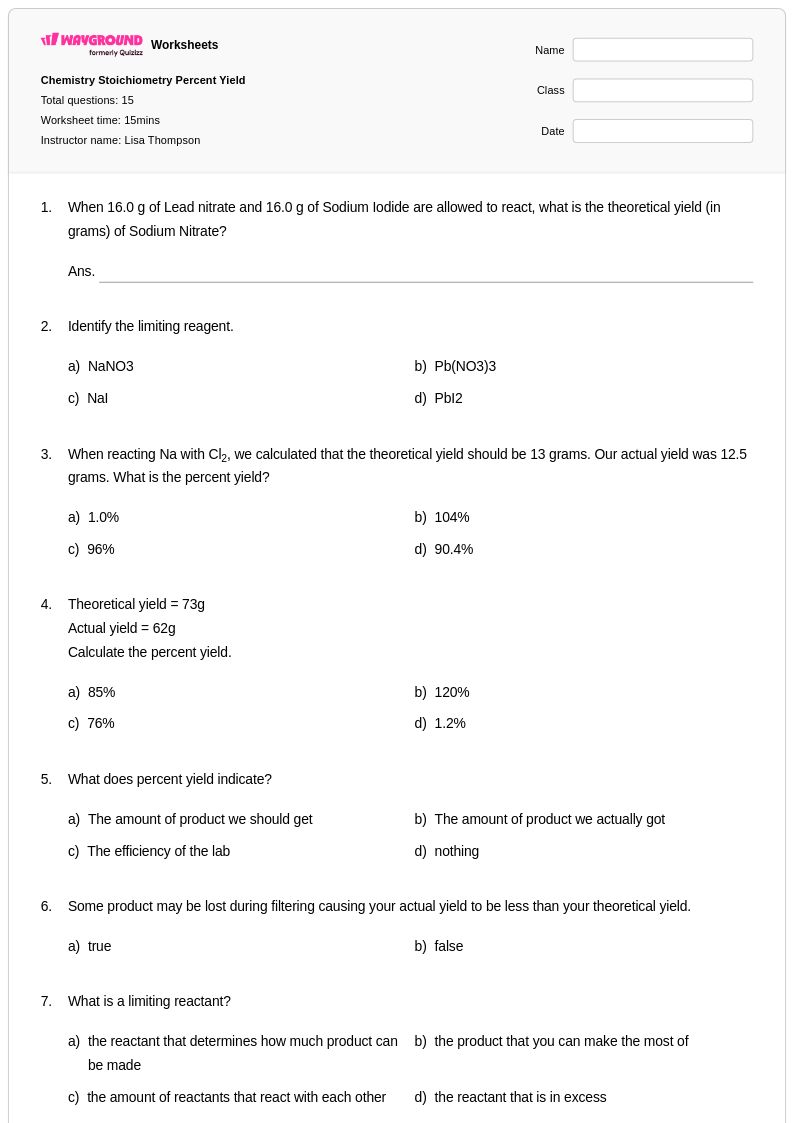
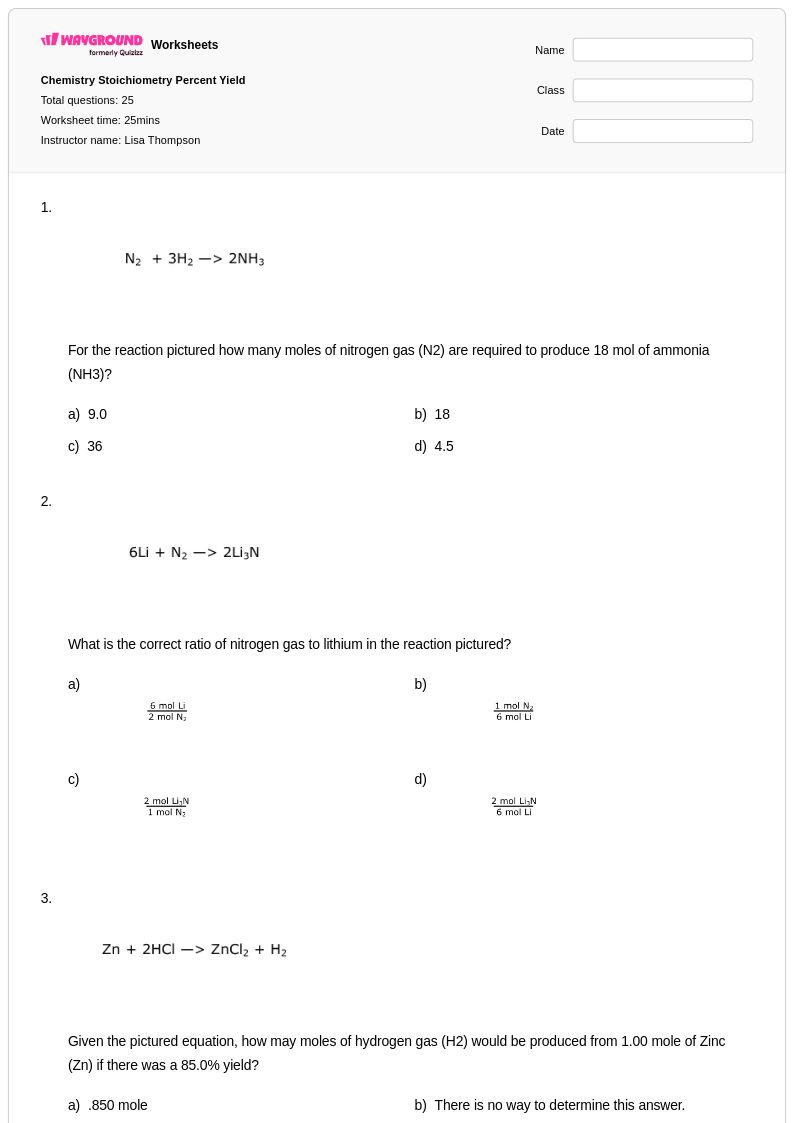
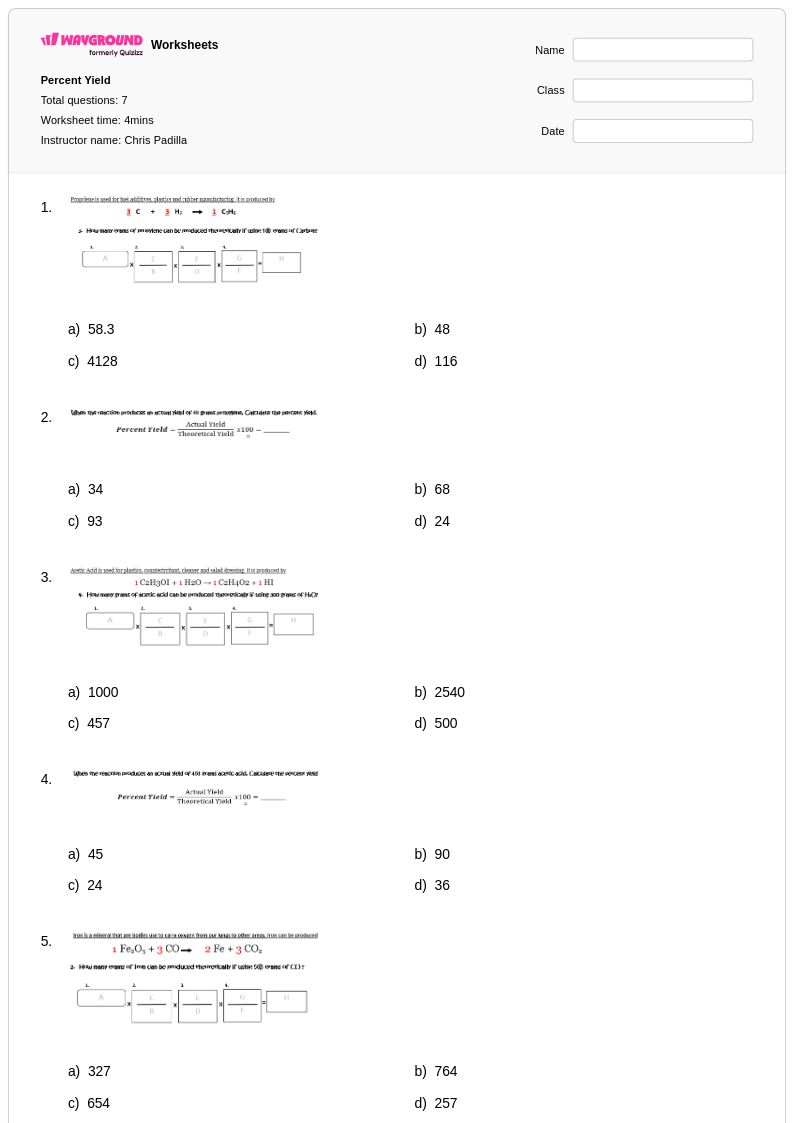
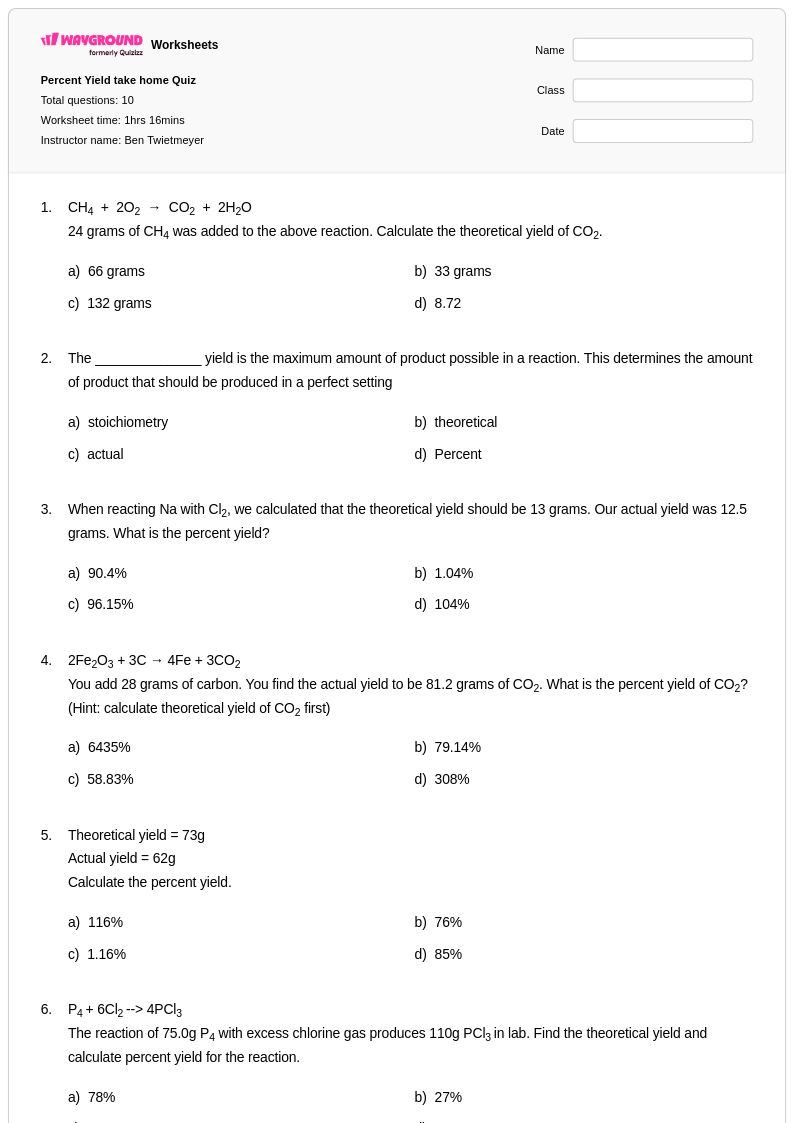
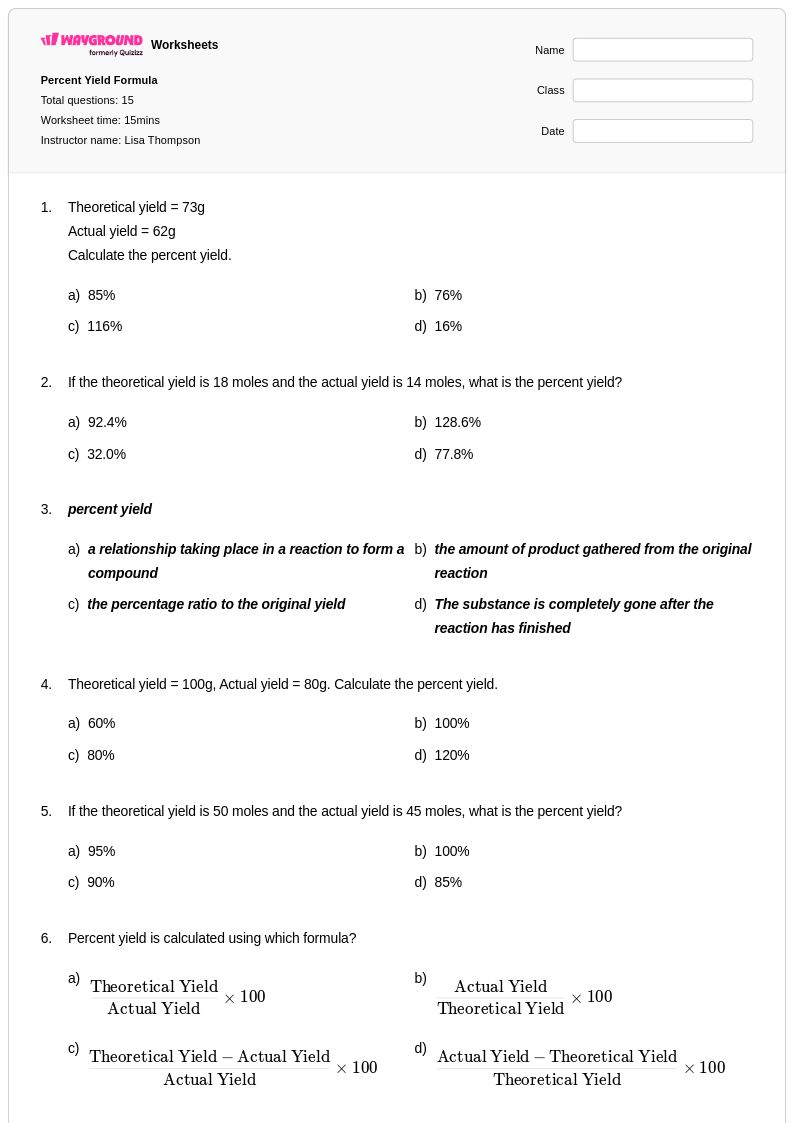
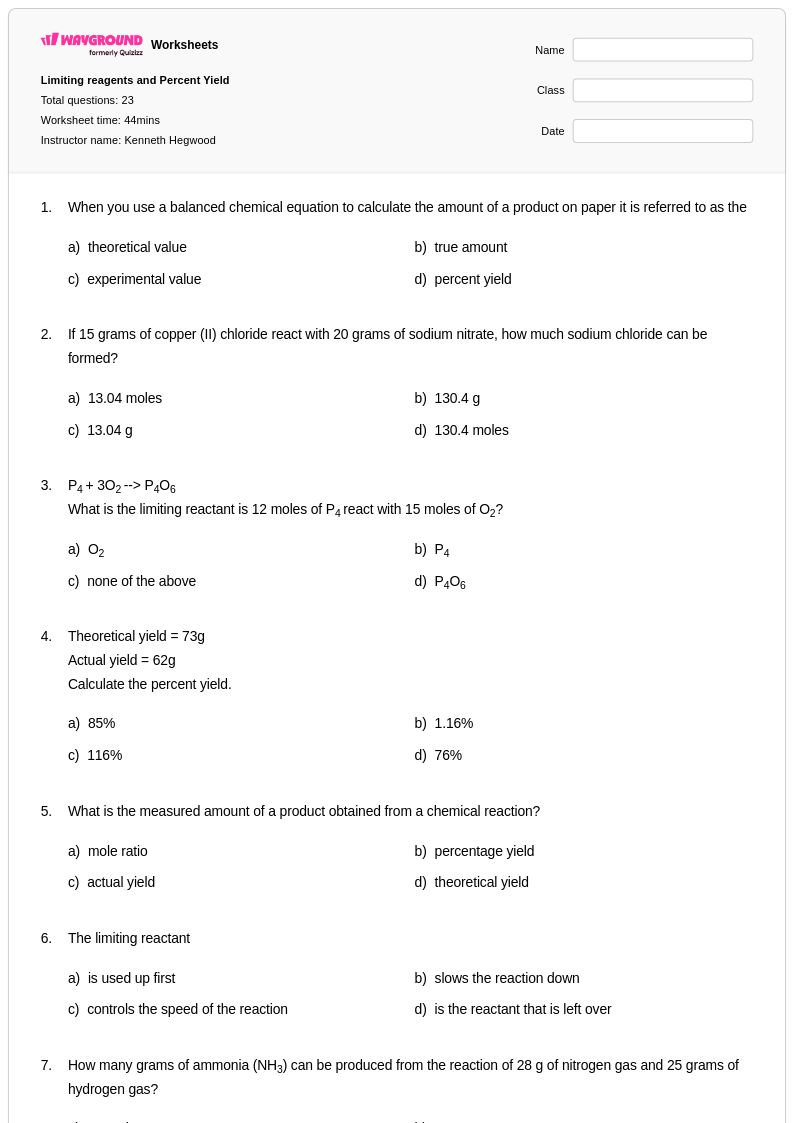
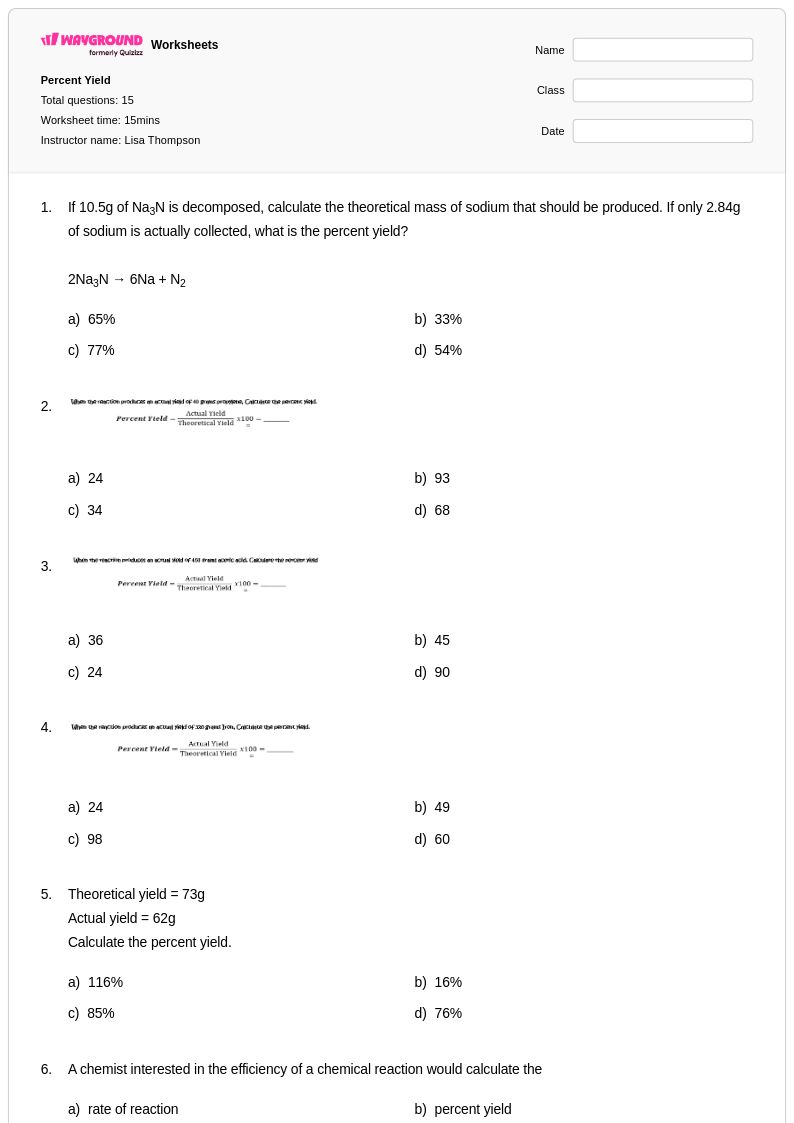
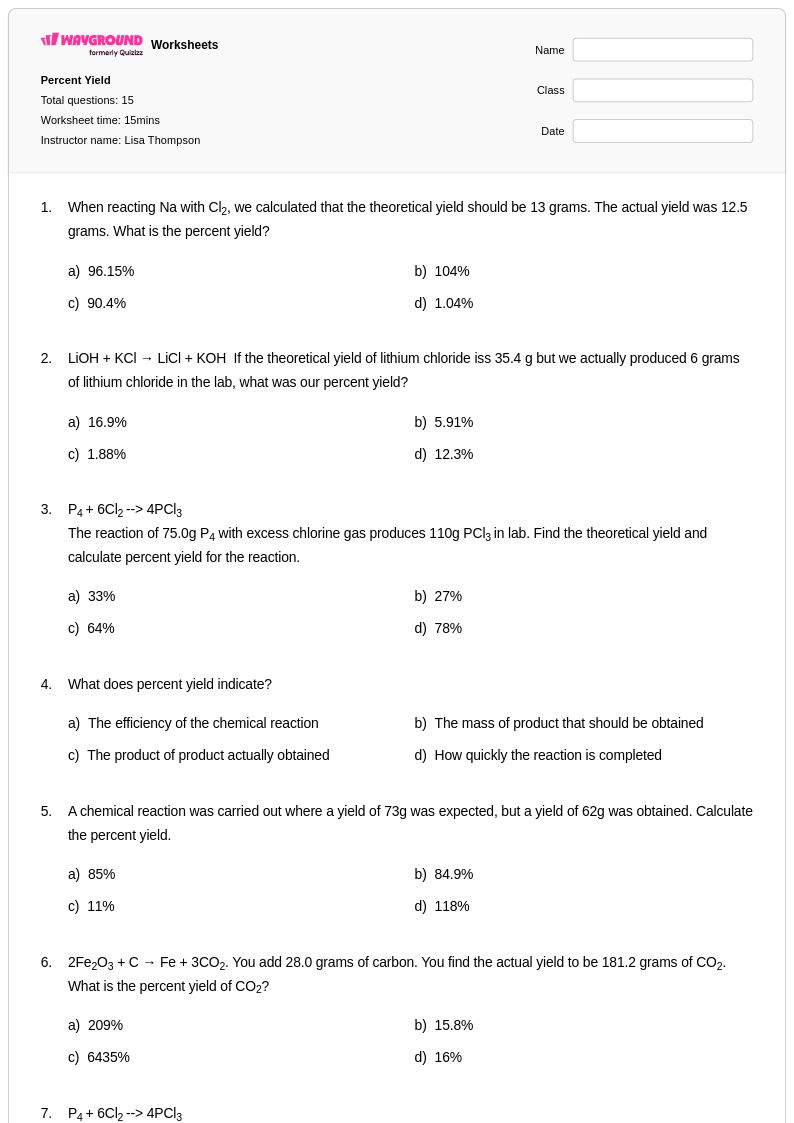
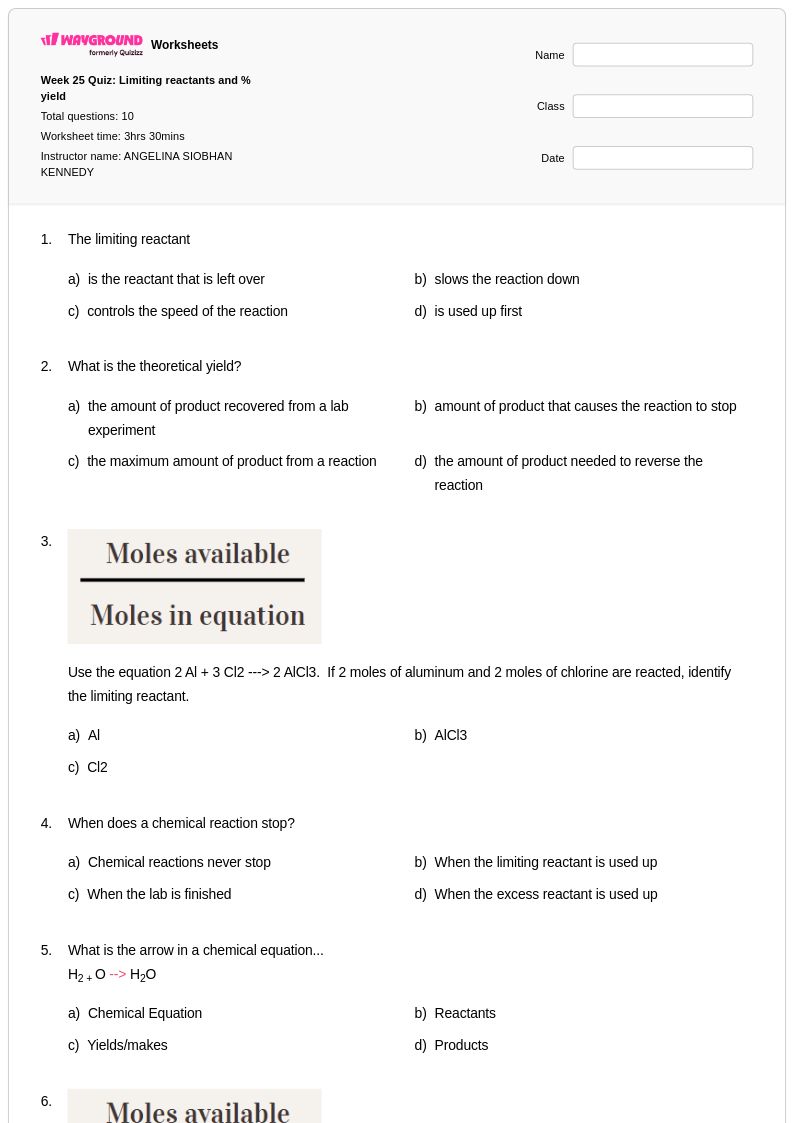
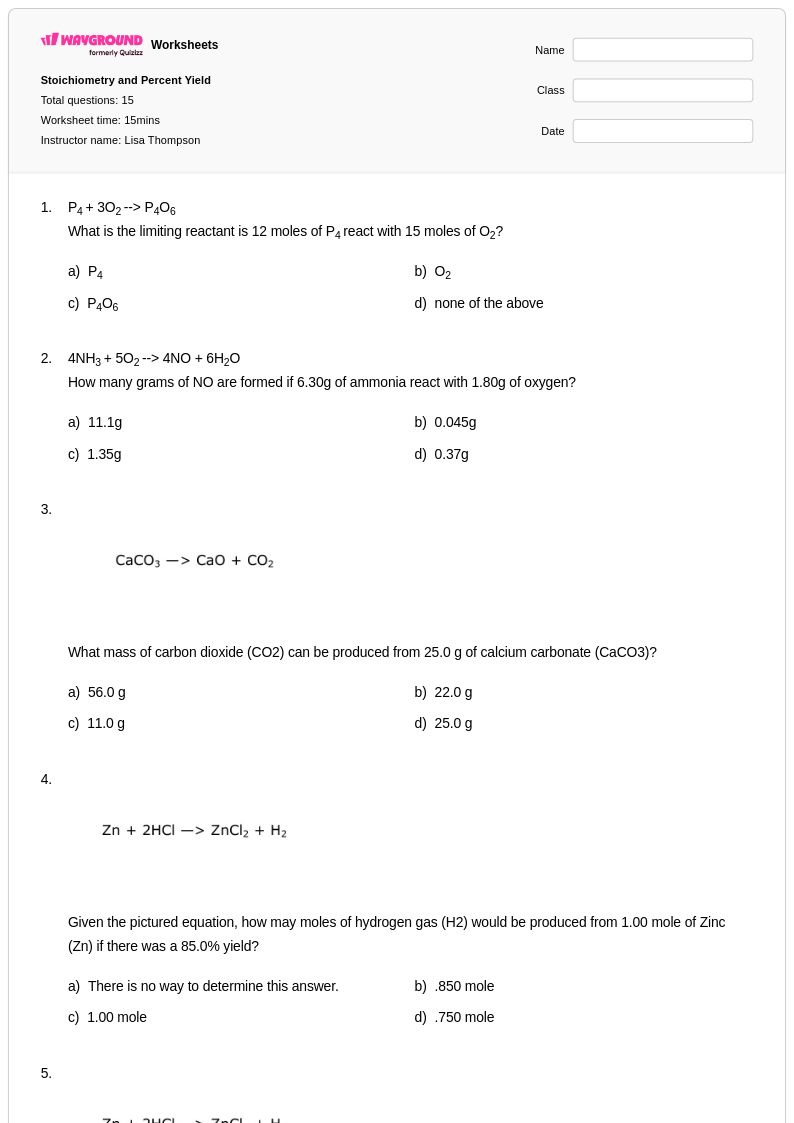
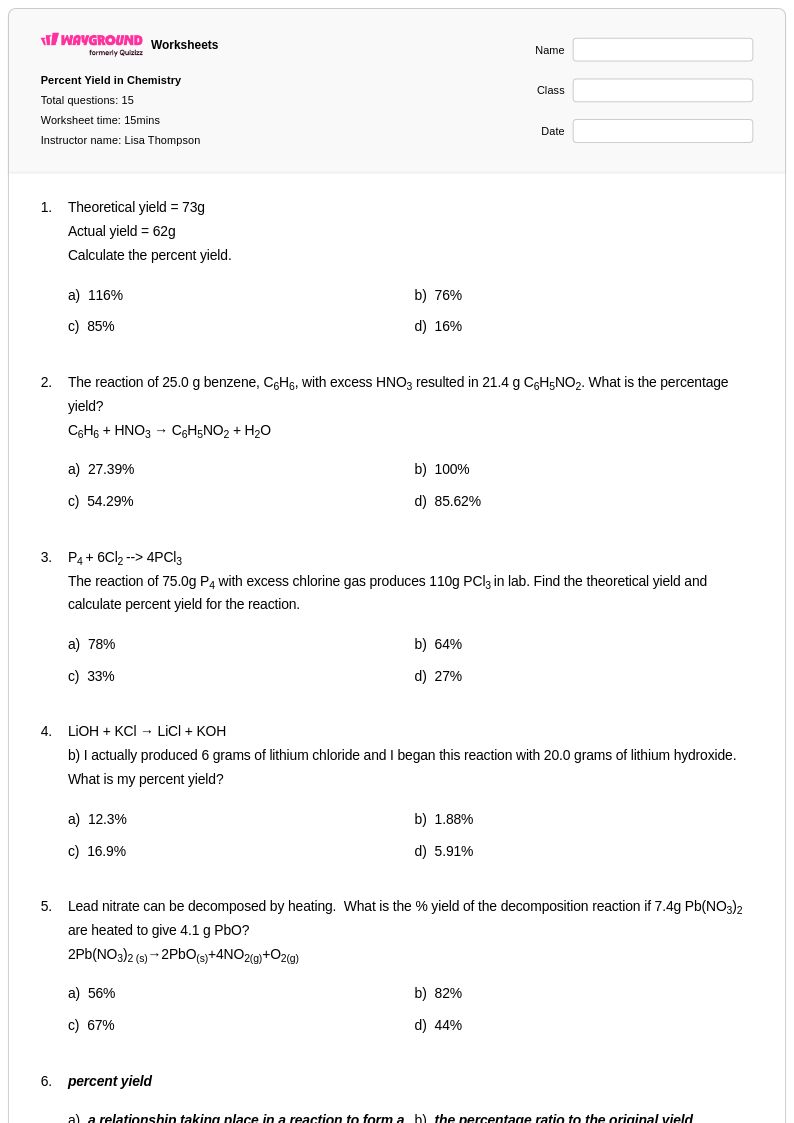
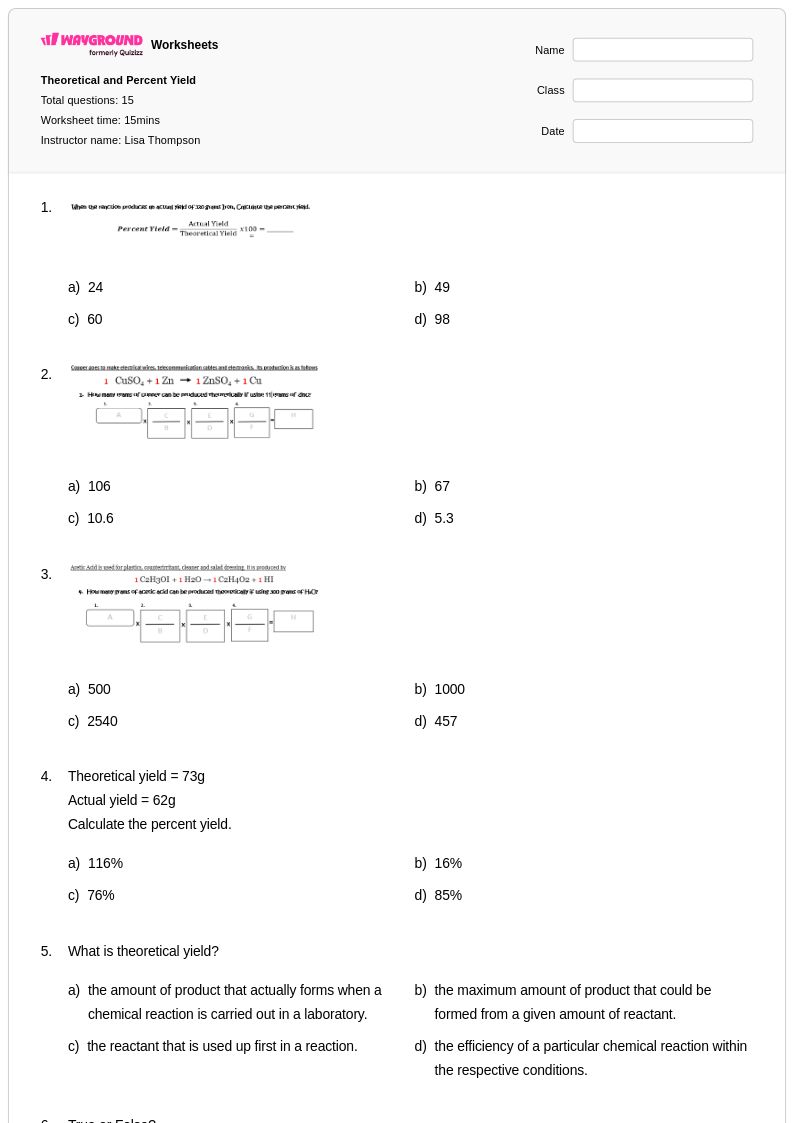
Master percent yield calculations with Wayground's comprehensive collection of free chemistry worksheets, featuring step-by-step practice problems, printable PDFs, and detailed answer keys to strengthen theoretical and practical understanding.
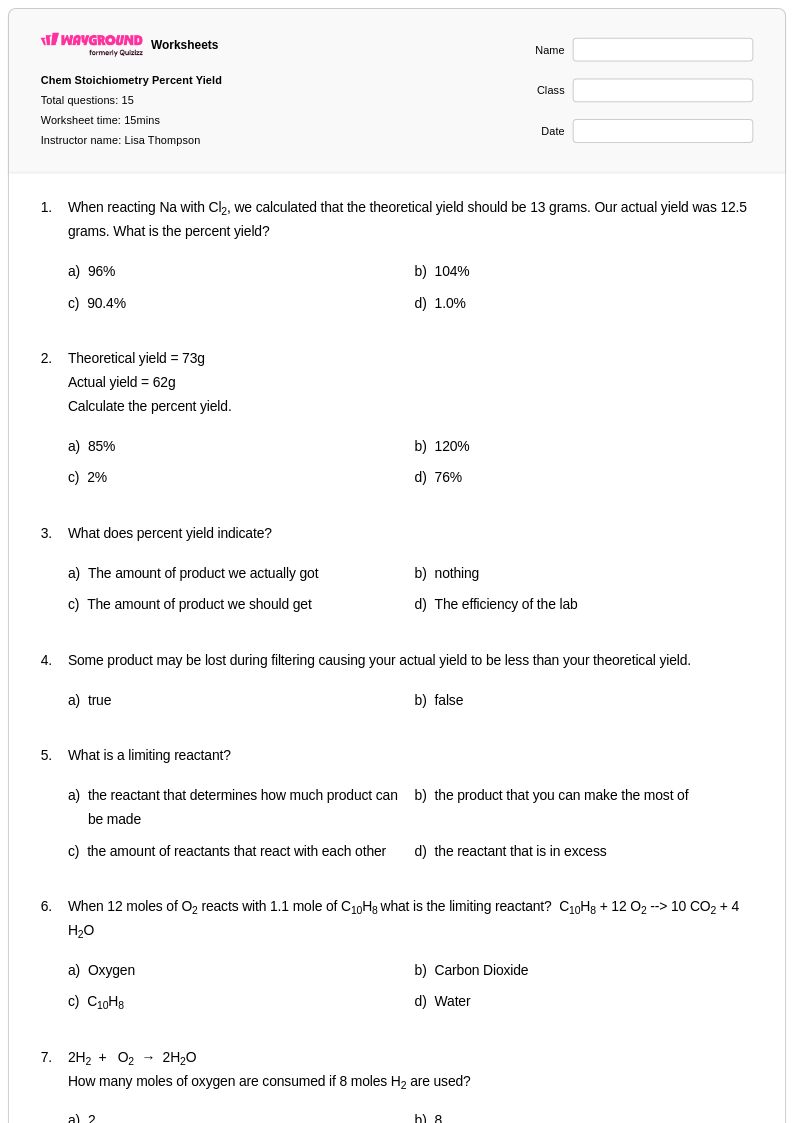
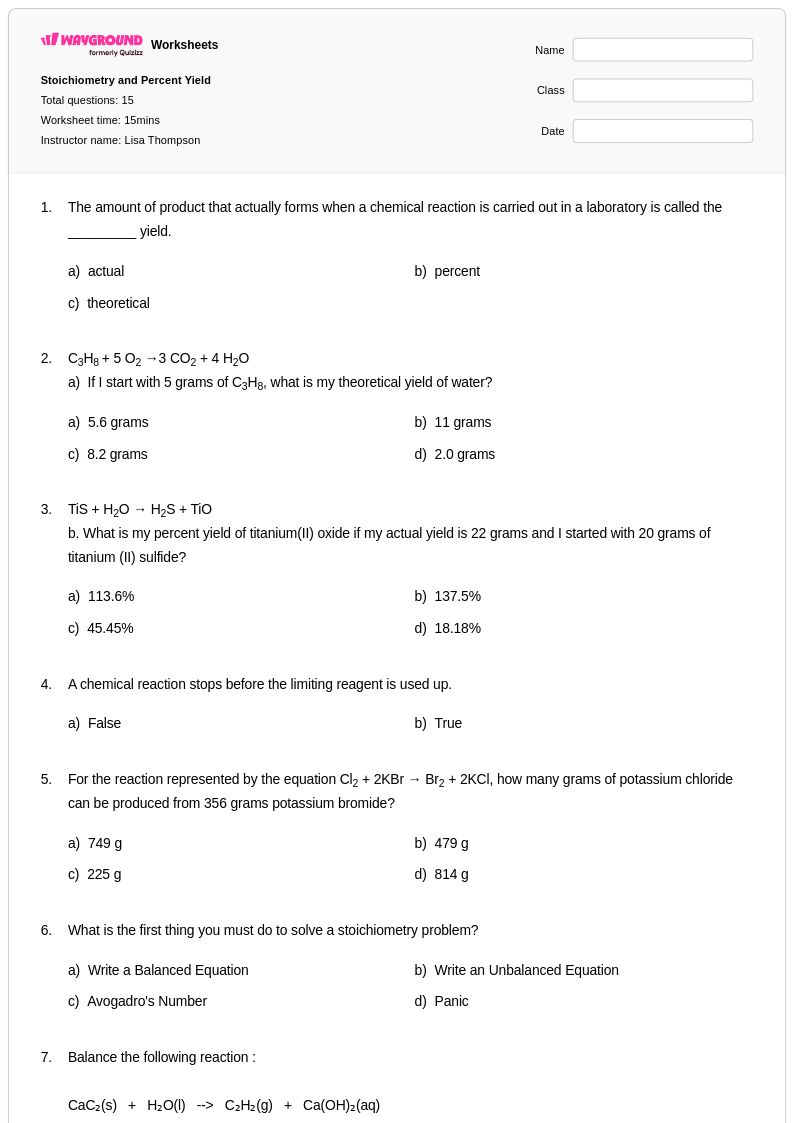
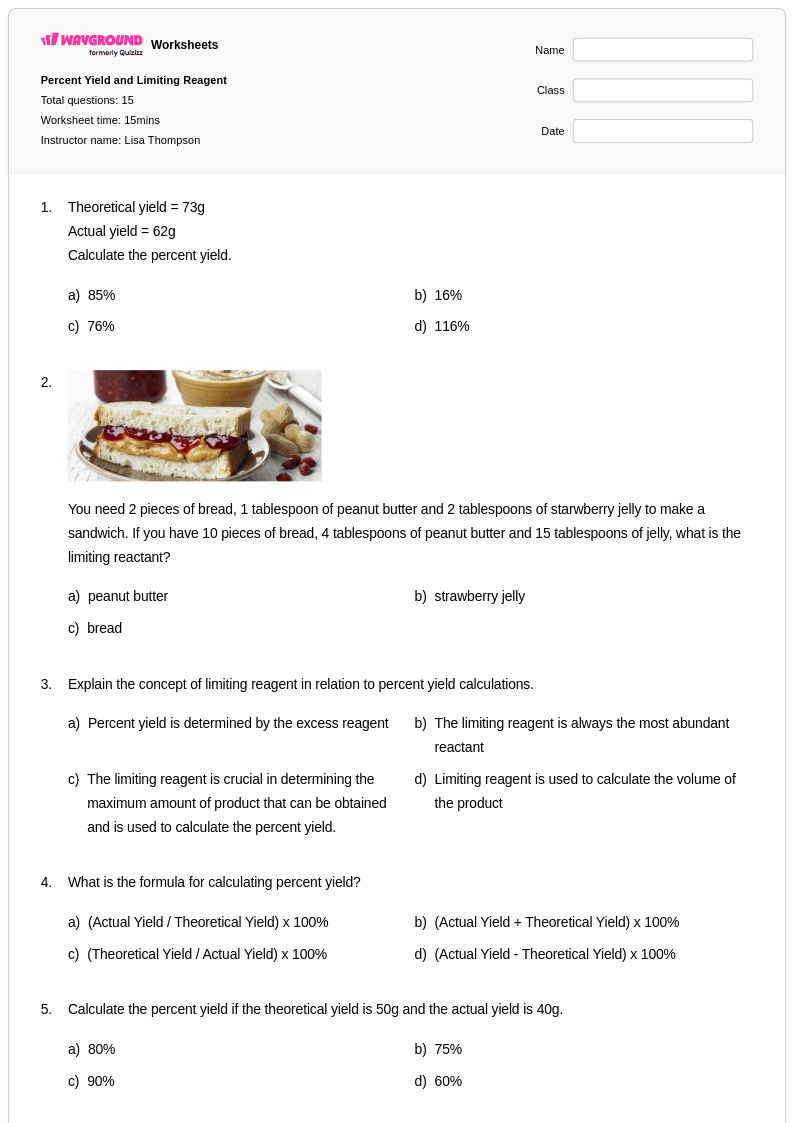
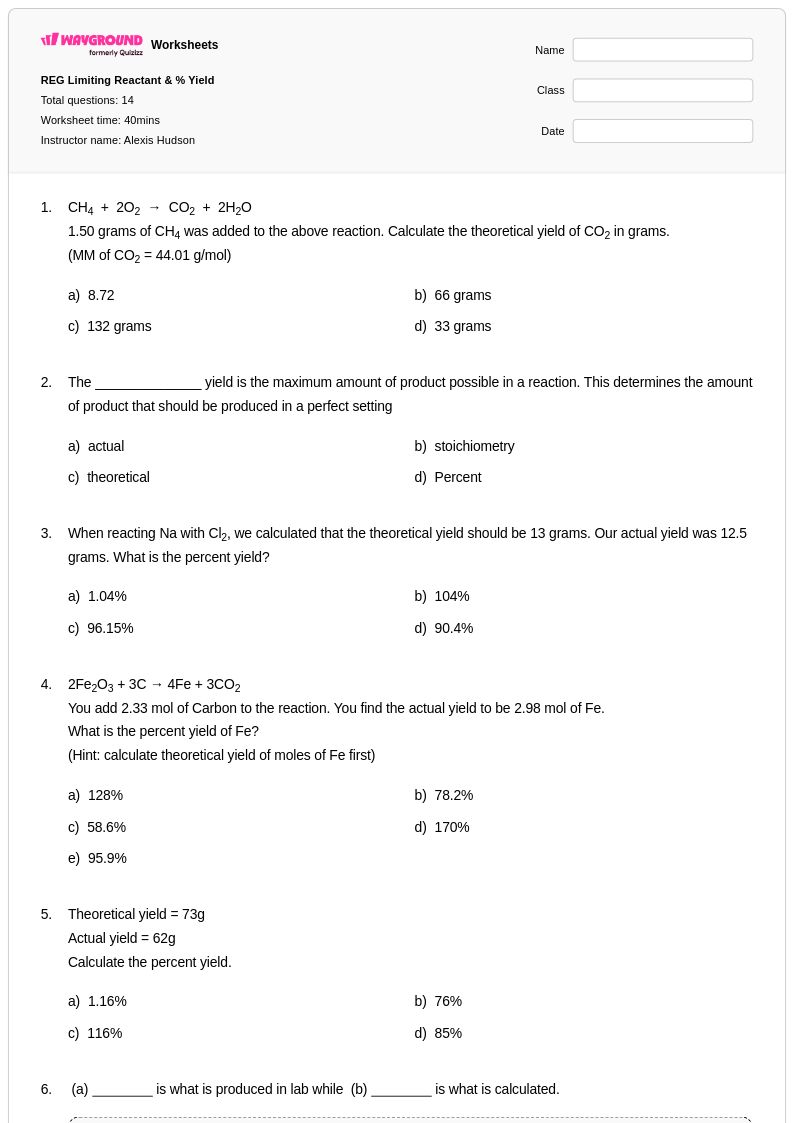
Percent yield worksheets available through Wayground (formerly Quizizz) provide comprehensive practice in one of chemistry's most essential quantitative concepts, helping students master the relationship between theoretical and actual yields in chemical reactions. These expertly designed resources strengthen critical analytical skills including stoichiometric calculations, percentage computations, and laboratory data interpretation, while building proficiency in identifying limiting reactants and understanding reaction efficiency. Students work through diverse practice problems that range from basic percent yield calculations to complex multi-step synthesis scenarios, with each worksheet featuring detailed answer keys that facilitate self-assessment and targeted review. The collection includes both printable pdf formats for traditional classroom use and interactive digital versions, ensuring accessibility across different learning environments while providing free resources that support rigorous chemistry instruction.
Wayground (formerly Quizizz) empowers educators with millions of teacher-created percent yield worksheets that can be easily located through robust search and filtering capabilities, enabling quick identification of materials aligned with specific curriculum standards and learning objectives. The platform's differentiation tools allow instructors to customize worksheet difficulty levels and problem types to meet diverse student needs, whether providing foundational practice for struggling learners or advanced challenges for high-achieving students. These flexible resources seamlessly support lesson planning by offering both printable worksheets for homework assignments and digital formats for interactive classroom activities, while comprehensive answer keys and detailed solution guides facilitate efficient grading and enable targeted remediation. Teachers can leverage this extensive collection to create scaffolded learning experiences that build student confidence in percent yield calculations while preparing them for advanced topics in chemical kinetics and reaction optimization.
FAQs
How do I teach percent yield to chemistry students?
Start by ensuring students are comfortable with stoichiometry and mole ratios before introducing percent yield, since the calculation depends on accurately determining theoretical yield first. Introduce the formula — percent yield equals actual yield divided by theoretical yield, multiplied by 100 — using a concrete lab context such as a simple precipitation reaction where students can observe that real-world results rarely match ideal predictions. Connecting the concept to reaction efficiency and limiting reactants early helps students understand why percent yield matters beyond the arithmetic.
What exercises help students practice percent yield calculations?
Effective practice begins with single-step problems where the theoretical yield is given, allowing students to focus solely on applying the percent yield formula. As students gain confidence, problems should escalate to multi-step scenarios where students must first use stoichiometry to calculate theoretical yield from a balanced equation before computing percent yield. Including problems that provide actual and theoretical yields in different units — requiring unit conversion before calculating — prepares students for the kind of complexity they will encounter on assessments and in lab reports.
What mistakes do students commonly make when calculating percent yield?
The most frequent error is confusing theoretical yield with actual yield and inverting the formula, which produces a percent yield greater than 100% without students recognizing it as a red flag. Many students also skip identifying the limiting reactant in multi-step problems, using the wrong reactant's mole ratio to calculate theoretical yield and arriving at a fundamentally incorrect baseline. A third common error is unit inconsistency — students sometimes compare grams to moles or fail to convert both yields to the same unit before dividing.
How do I use Wayground's percent yield worksheets in my classroom?
Wayground's percent yield worksheets are available as printable PDFs for traditional classroom use and in digital formats for technology-integrated environments, giving teachers flexibility for homework assignments, in-class practice, or lab follow-up activities. Teachers can also host worksheets directly as a quiz on Wayground, enabling real-time student response tracking and streamlined grading. Each worksheet includes a complete answer key, which supports both teacher-led review and independent student self-assessment.
How can I differentiate percent yield instruction for students at different skill levels?
For students who are still building foundational skills, begin with problems where the balanced equation and theoretical yield are provided so they can focus exclusively on the percent yield formula without being overwhelmed by stoichiometric steps. For advanced learners, assign multi-step synthesis problems that require identifying the limiting reactant, calculating theoretical yield from scratch, and then computing percent yield — mirroring the complexity of AP Chemistry tasks. Wayground also supports individual student accommodations including extended time, read-aloud functionality, and reduced answer choices, which can be configured per student without disrupting the rest of the class.
Why is percent yield important in real-world chemistry?
Percent yield is a direct measure of how efficiently a chemical reaction converts reactants into desired products, making it a critical metric in pharmaceutical manufacturing, industrial synthesis, and materials science. A low percent yield signals potential issues such as side reactions, product loss during purification, or incomplete reactions — all of which have significant cost and safety implications at scale. Teaching students to interpret percent yield in practical contexts builds the analytical thinking they need for laboratory work and careers in chemistry-related fields.