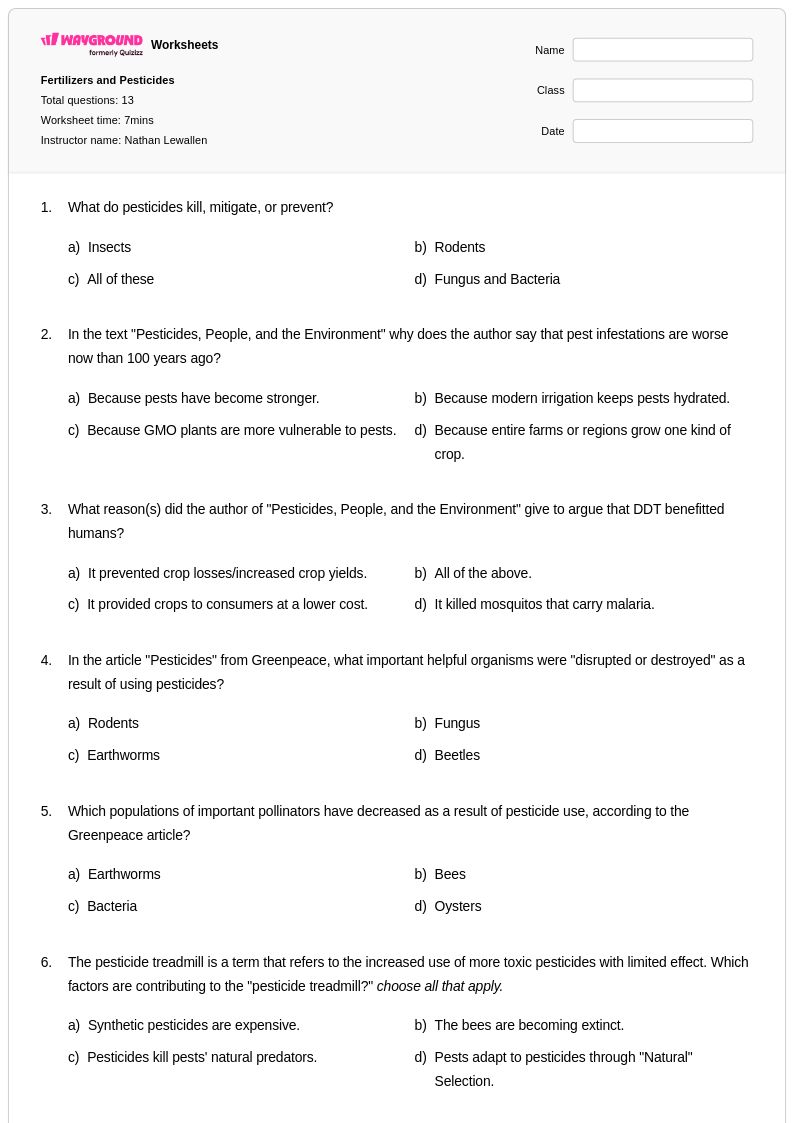
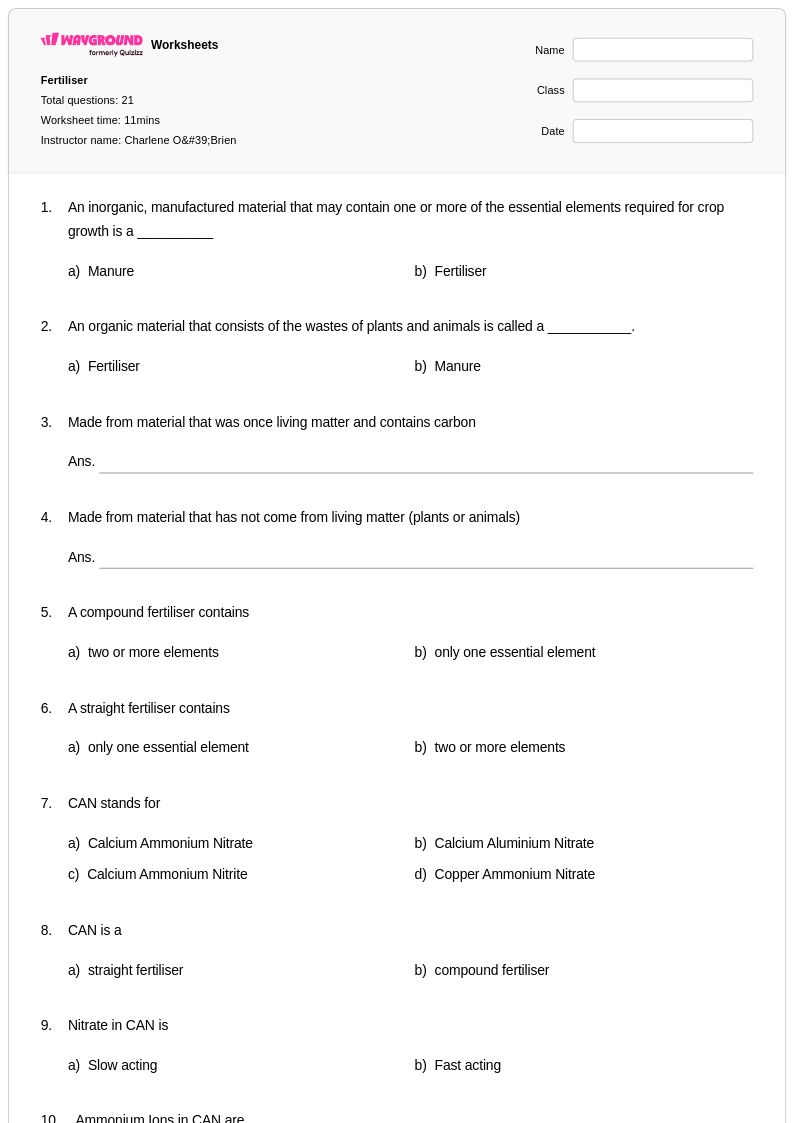
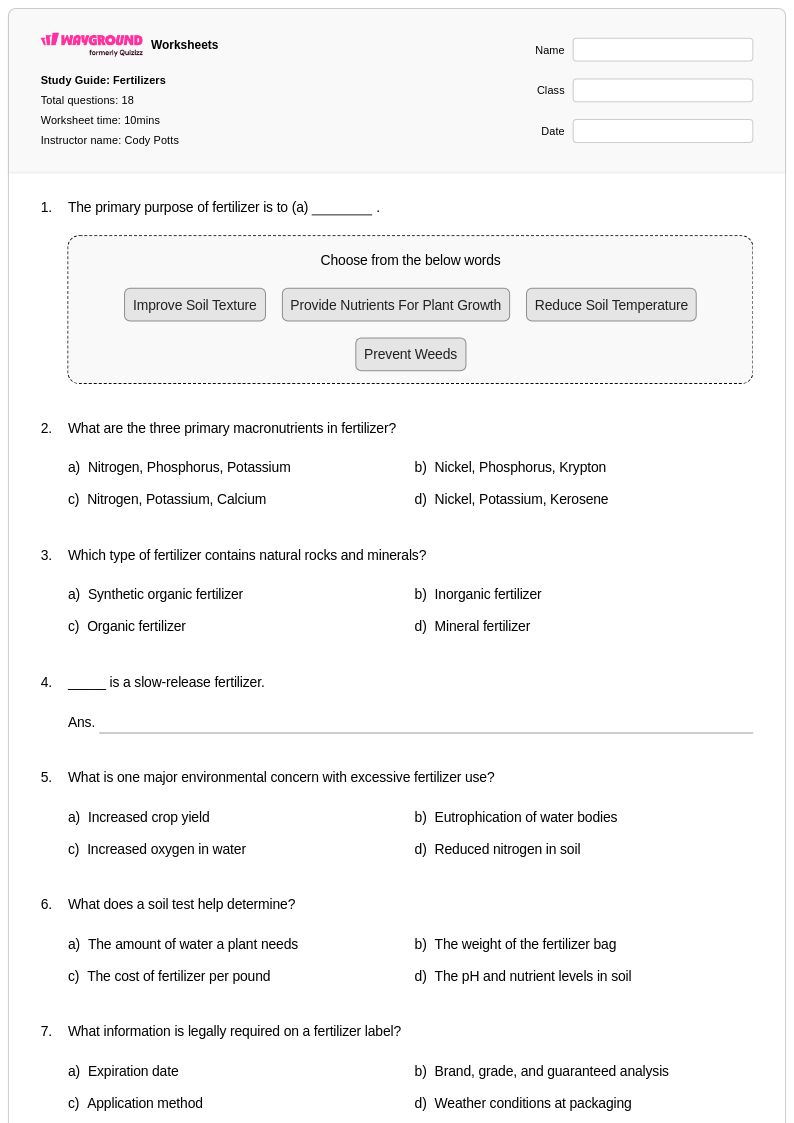
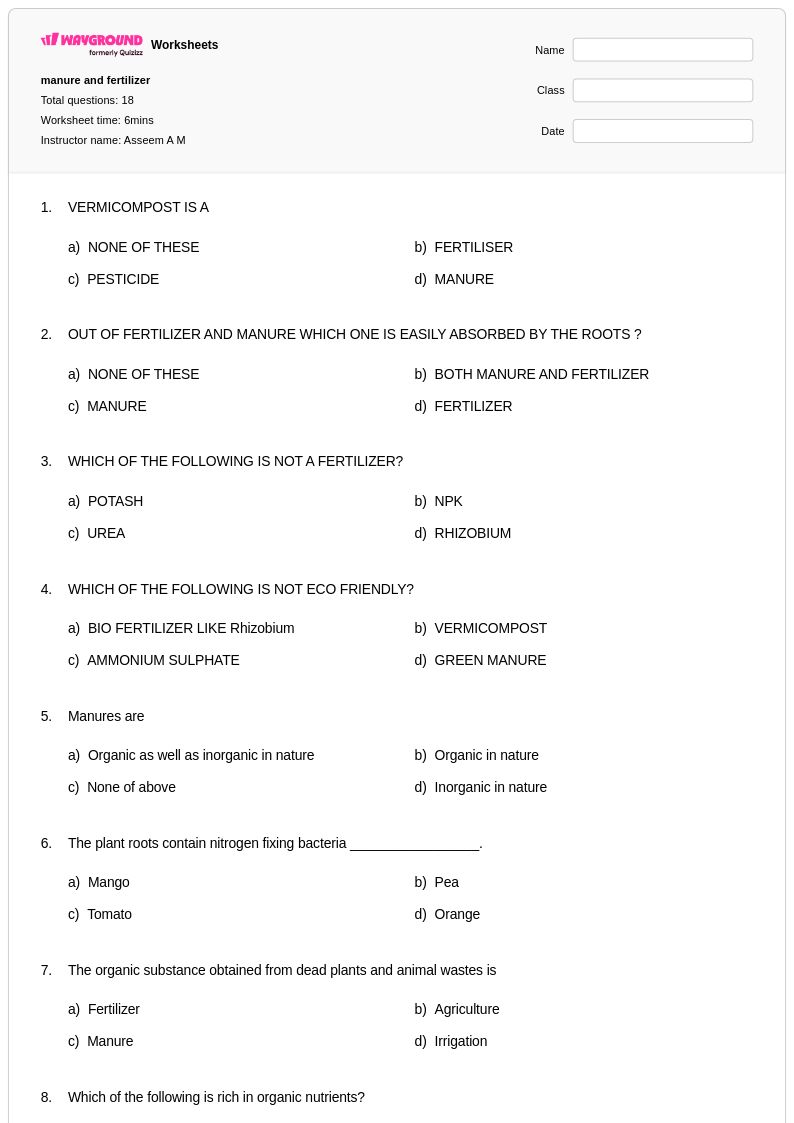
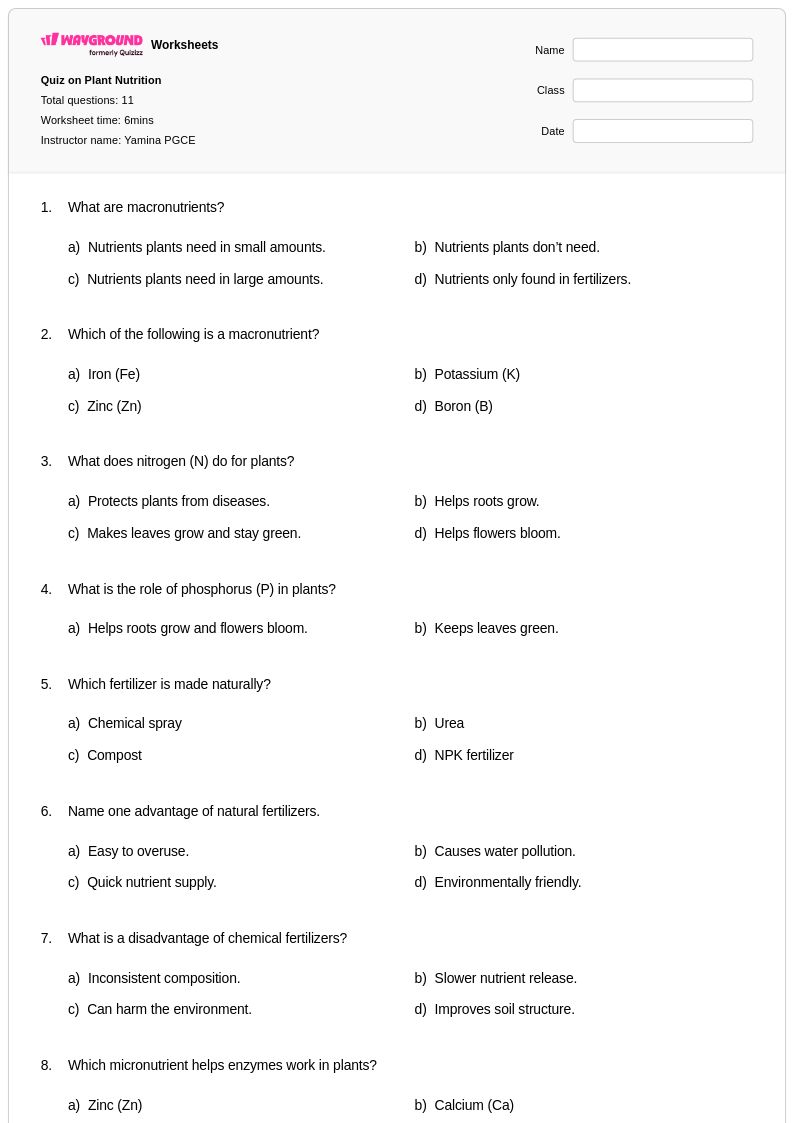
Wayground offers free printable fertilizer calculation worksheets with practice problems and answer keys to help chemistry students master stoichiometric calculations, nutrient ratios, and agricultural application formulas through comprehensive PDF resources.
Fertilizer calculation worksheets available through Wayground (formerly Quizizz) provide comprehensive practice in the quantitative analysis essential to agricultural chemistry and soil science. These expertly designed resources strengthen students' abilities to determine nutrient concentrations, calculate application rates, and analyze fertilizer compositions using stoichiometric principles and percentage calculations. The collection includes detailed answer keys that guide learners through complex problem-solving processes, from basic NPK ratio calculations to advanced dilution problems and cost-per-nutrient analyses. These free printables offer systematic practice with real-world scenarios, helping students master the mathematical skills required to optimize plant nutrition while considering environmental and economic factors.
Wayground (formerly Quizizz) empowers educators with access to millions of teacher-created fertilizer calculation resources that can be seamlessly integrated into chemistry curricula at any level. The platform's robust search and filtering capabilities allow instructors to locate materials that align with specific learning standards and match their students' computational abilities, whether focusing on basic percentage calculations or advanced agricultural chemistry applications. Teachers can customize worksheets to provide targeted remediation for struggling learners or create enrichment activities for advanced students, with flexible options for both digital delivery and pdf printables. This comprehensive resource collection supports effective lesson planning by offering varied problem types, from laboratory-style calculations to field application scenarios, ensuring students develop both theoretical understanding and practical problem-solving skills in agricultural chemistry.
FAQs
How do I teach fertilizer calculations to chemistry students?
Start by grounding students in NPK ratios and what each macronutrient percentage means on a fertilizer label before moving into quantitative problems. From there, introduce stoichiometric reasoning in the context of application rates, connecting familiar mole and percent-composition skills to real agricultural scenarios. Using field-based word problems alongside lab-style calculations helps students see the practical relevance of the math and builds transfer skills across chemistry and environmental science contexts.
What types of practice problems help students get better at fertilizer calculations?
Effective practice should span several problem types: reading and interpreting fertilizer labels, calculating nutrient concentrations from percent composition, determining application rates per unit area, and solving dilution problems for liquid fertilizers. Cost-per-nutrient analyses add an economic dimension that challenges students to apply proportional reasoning in a real-world context. Mixing routine procedural problems with scenario-based questions ensures students develop both computational fluency and conceptual understanding.
What mistakes do students commonly make when solving fertilizer calculation problems?
The most common error is misreading NPK labels — students often treat the percentages as absolute masses rather than understanding they refer to elemental nutrient content by weight of the fertilizer compound. A related mistake is unit confusion, particularly when converting between grams, kilograms, and pounds or between area units like hectares and acres. Students also frequently skip intermediate steps in multi-part problems, such as forgetting to account for dilution factors before calculating final application concentrations.
How do I use Wayground's fertilizer calculation worksheets in my classroom?
Wayground's fertilizer calculation worksheets are available as printable PDFs for traditional classroom use and in digital formats for technology-integrated environments, giving teachers flexibility for homework, in-class practice, or lab follow-up assignments. You can also host them as a live quiz directly on Wayground, which allows for real-time student response tracking. Each worksheet includes a complete answer key, so students can self-check their work or teachers can use them for efficient grading and formative feedback.
How can I differentiate fertilizer calculation worksheets for students at different skill levels?
For students still building foundational skills, begin with single-step problems focused on percent composition or basic NPK label interpretation before introducing multi-step application rate calculations. Advanced students can be challenged with combined problems that integrate stoichiometry, dilution, and cost analysis in a single scenario. On Wayground, teachers can apply accommodations such as reduced answer choices or read-aloud support to individual students without disrupting the rest of the class, making it easier to support a range of learners within the same assignment.
How do fertilizer calculation worksheets connect to broader chemistry standards?
Fertilizer calculation problems directly reinforce core chemistry skills including percent composition, stoichiometric ratios, unit conversion, and solution concentration, making them a strong applied context for standards-aligned chemistry instruction. They also bridge agricultural science and environmental chemistry, supporting interdisciplinary connections where students must weigh nutrient optimization against economic and ecological constraints. This real-world grounding helps students see chemistry as a tool for solving meaningful problems rather than an abstract set of procedures.