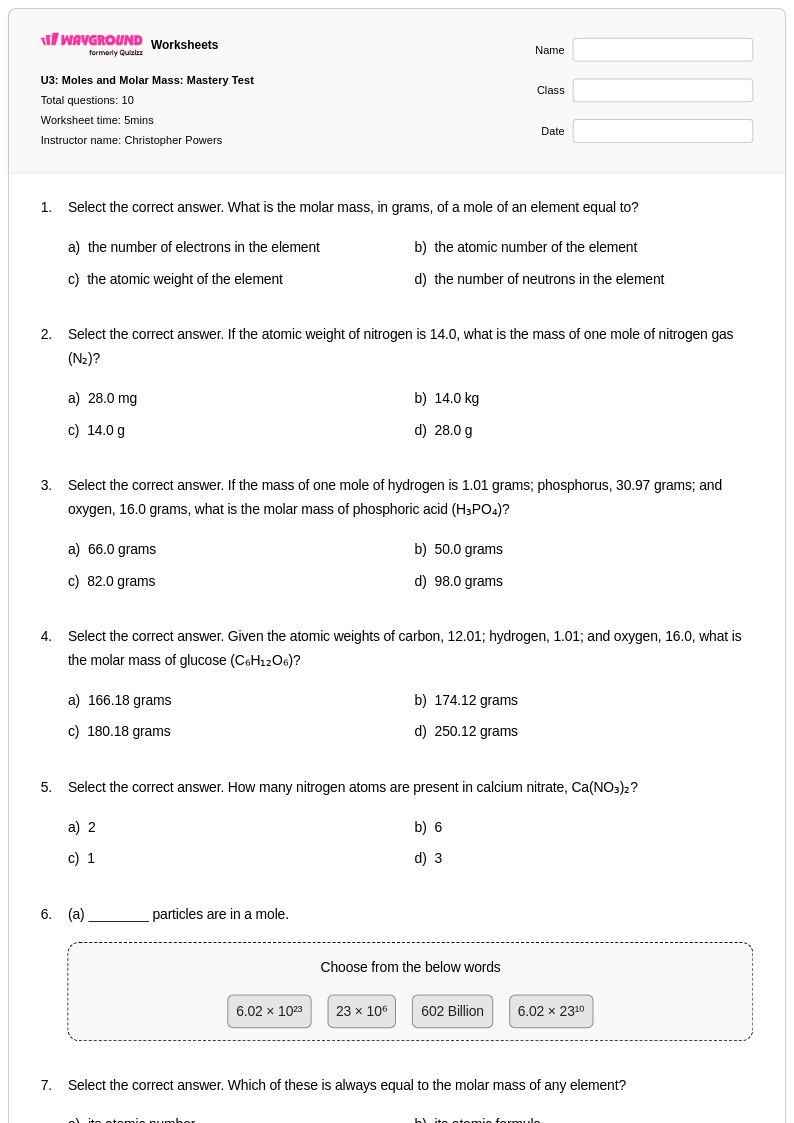
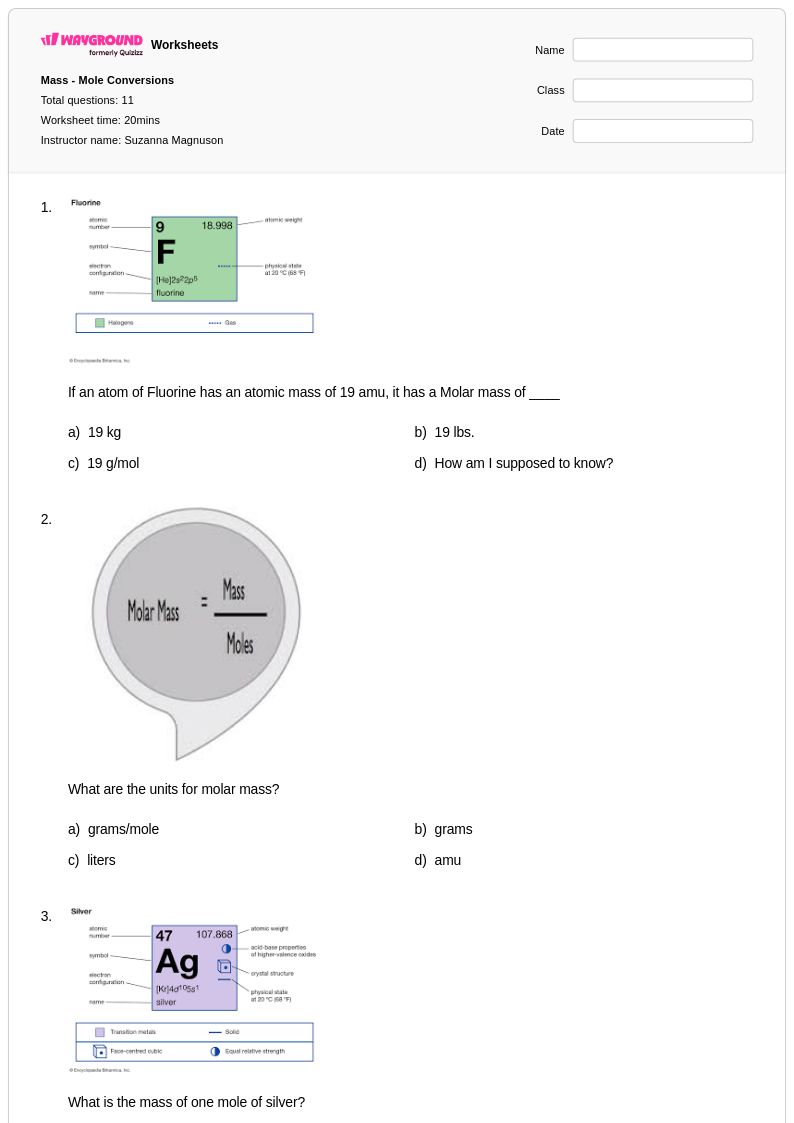
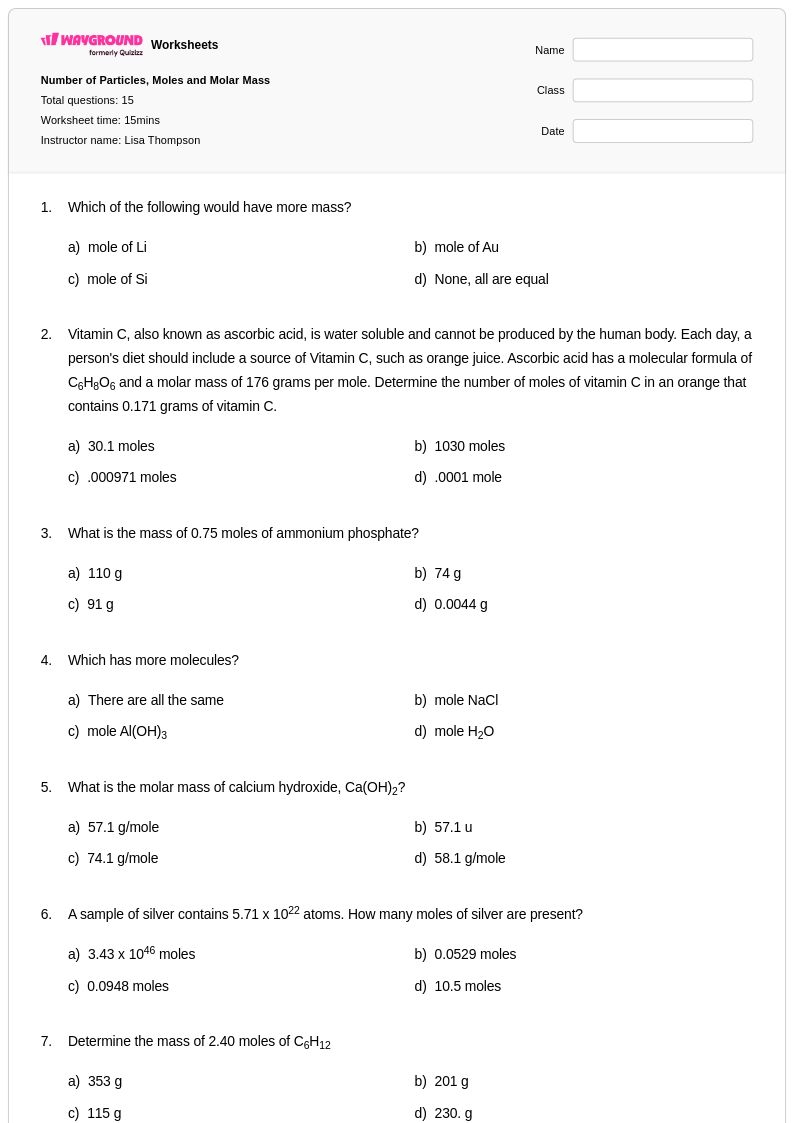
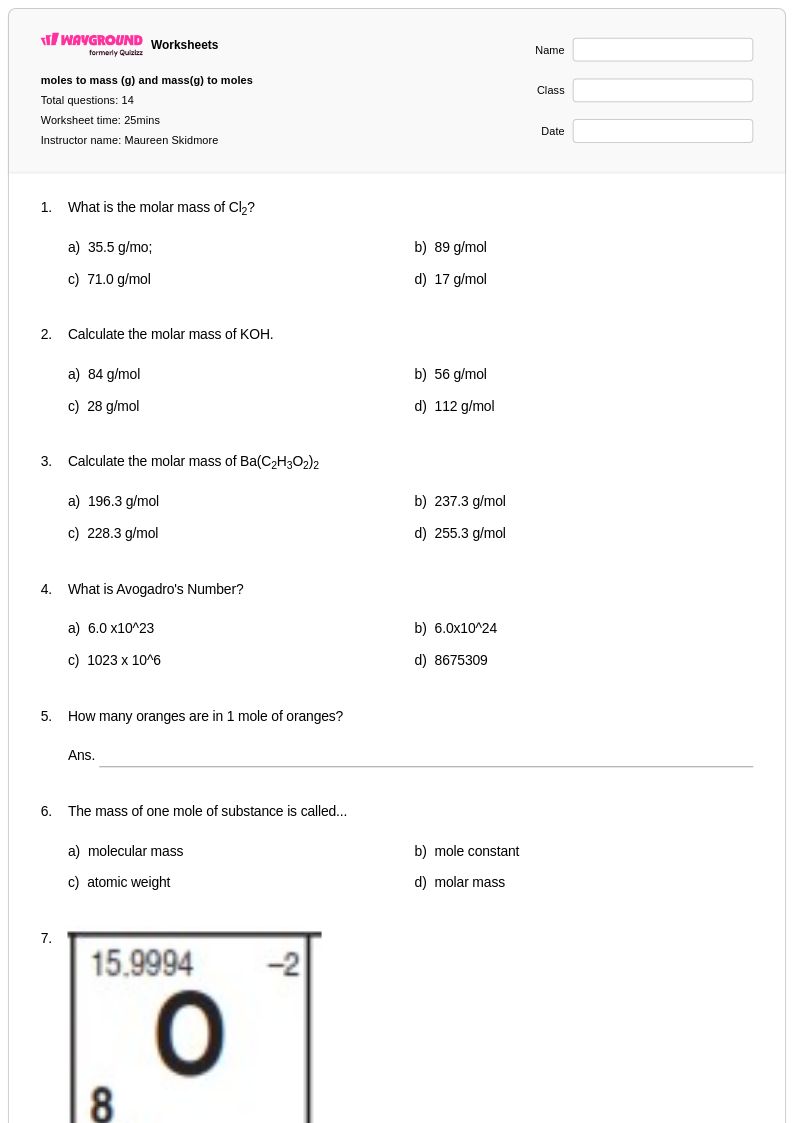
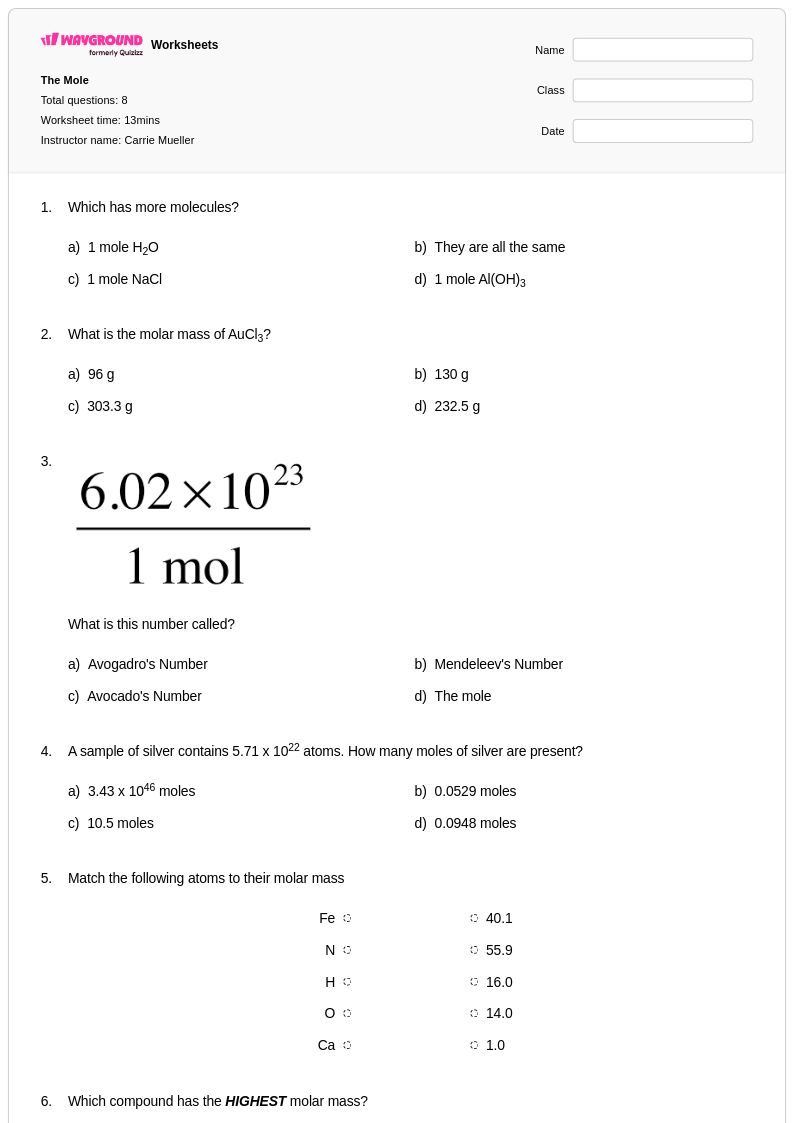
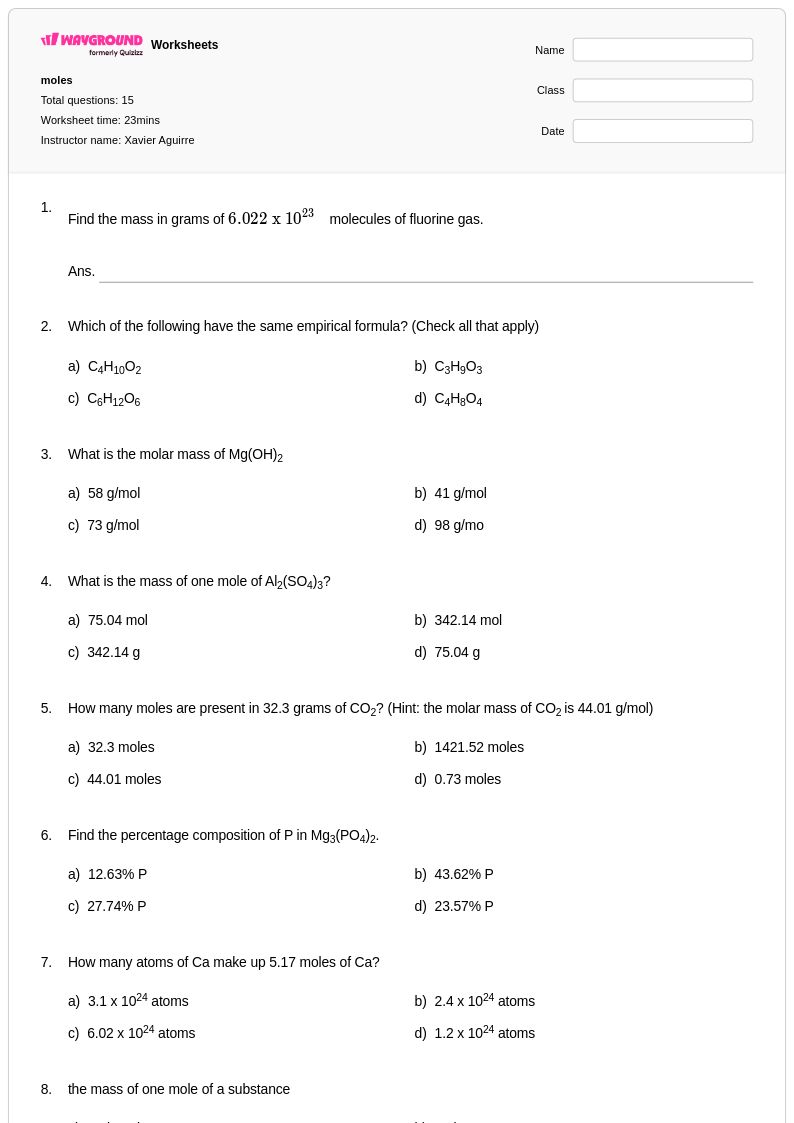
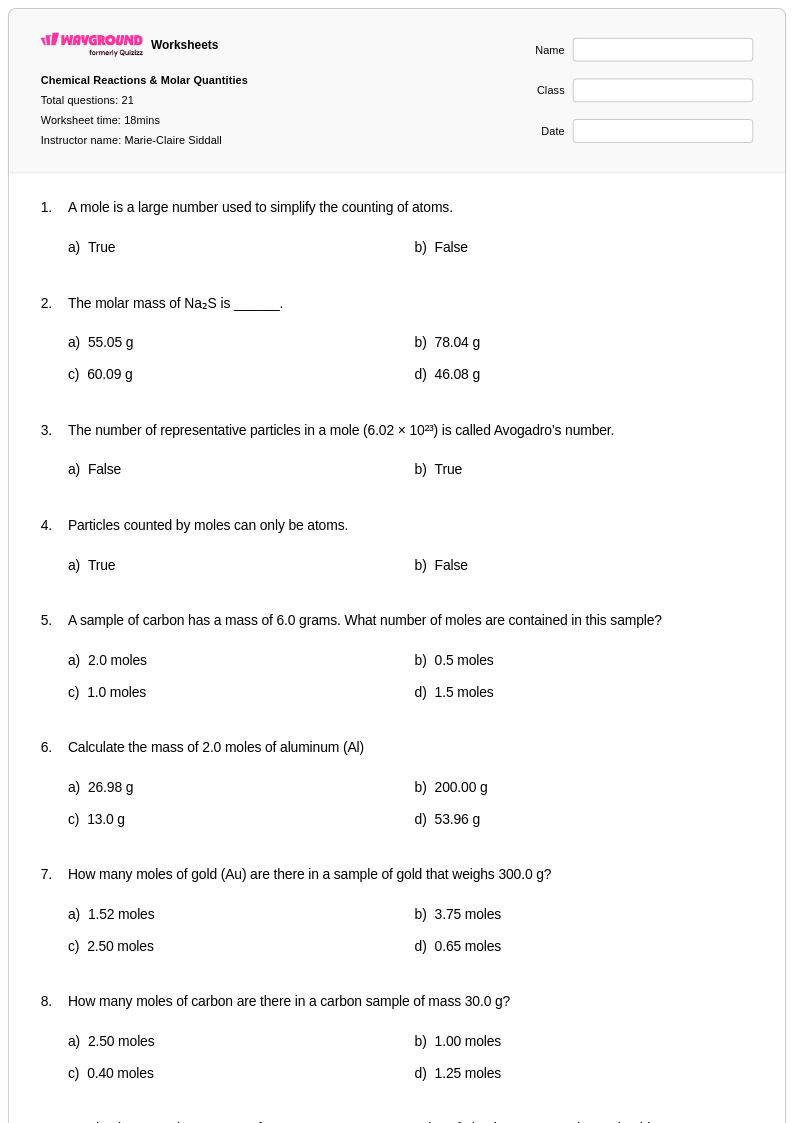
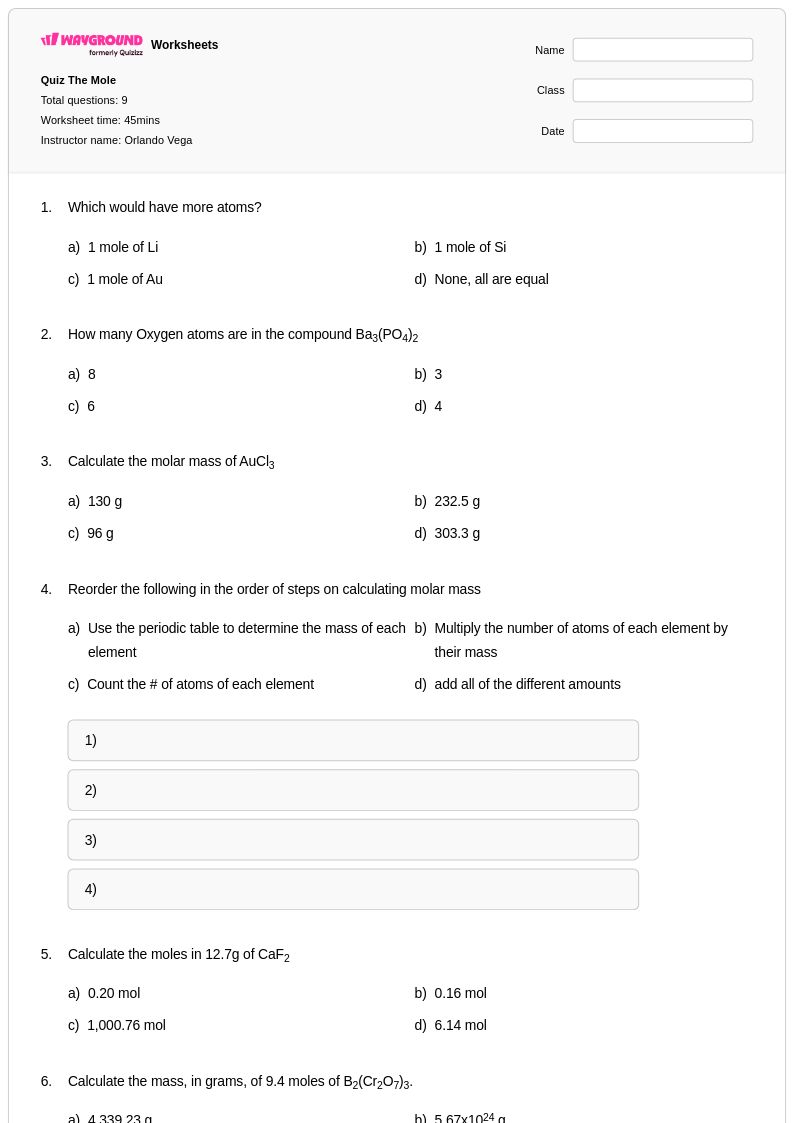
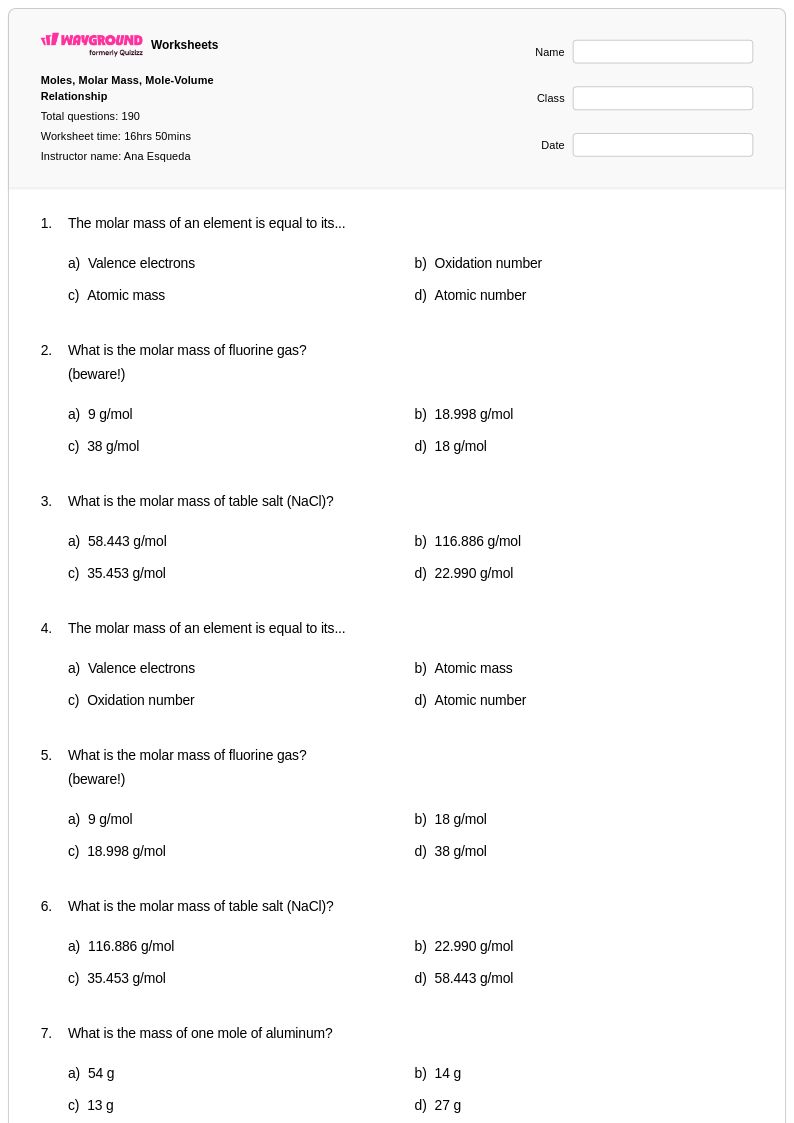
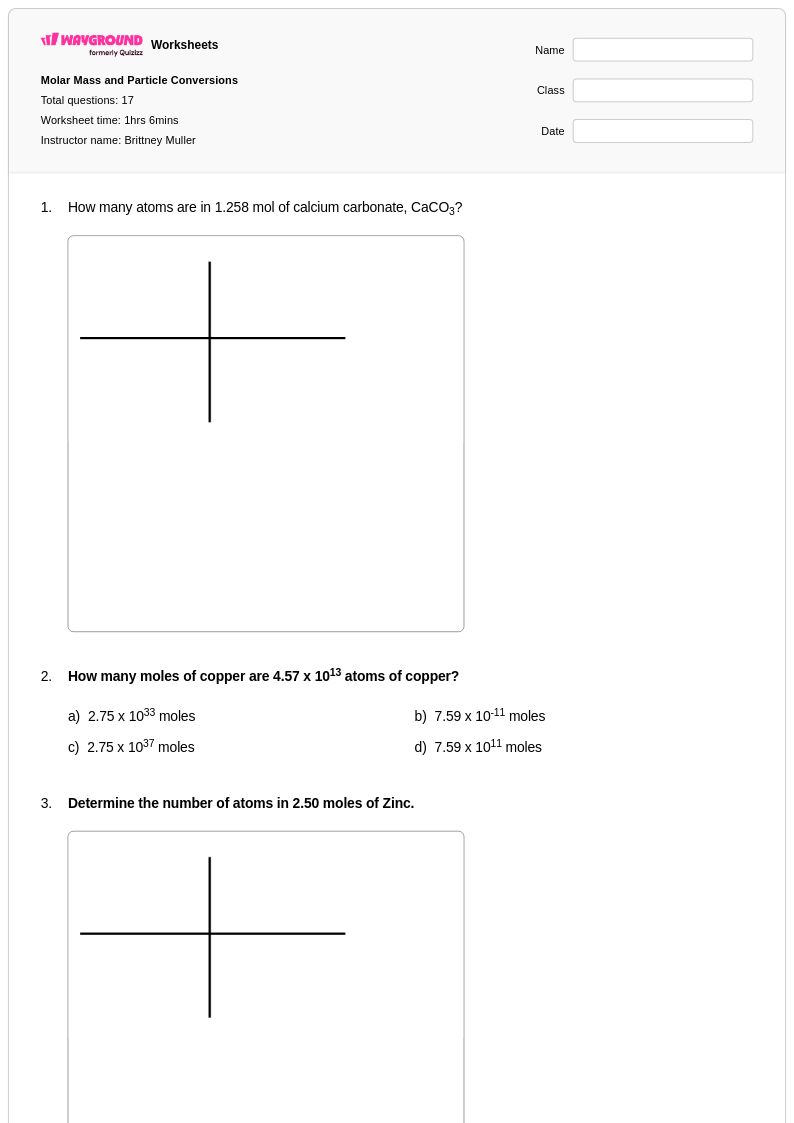
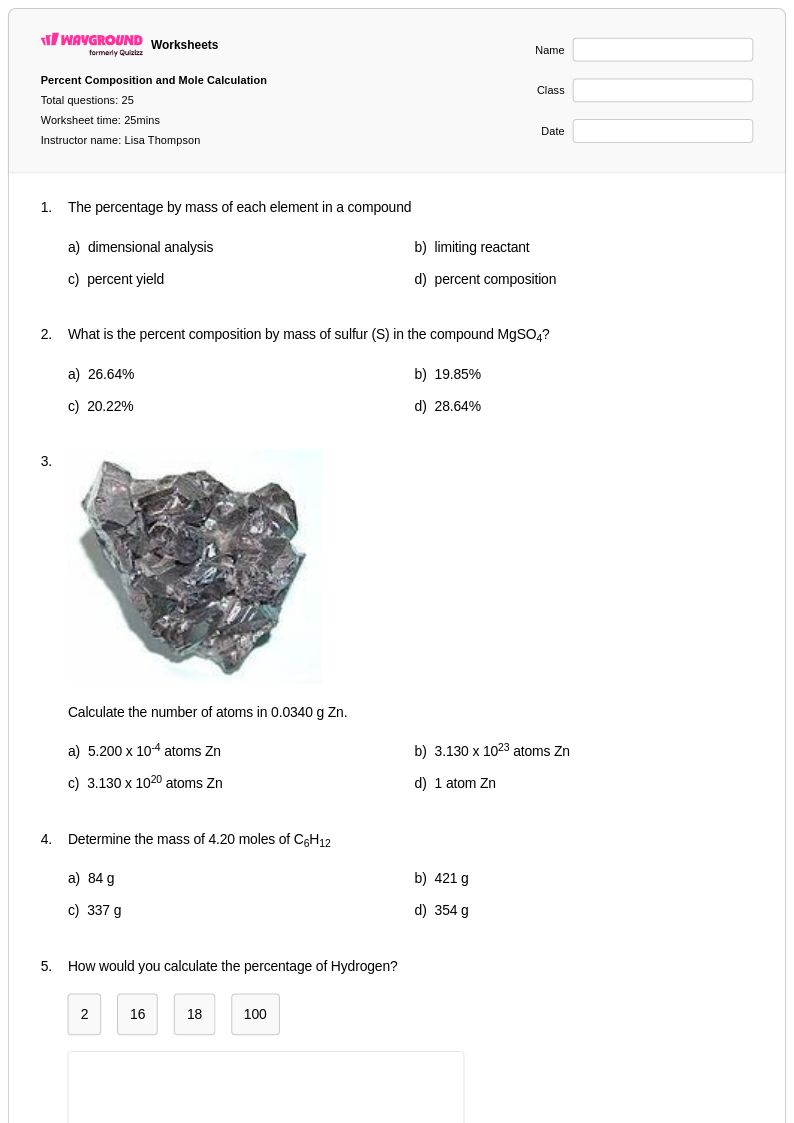
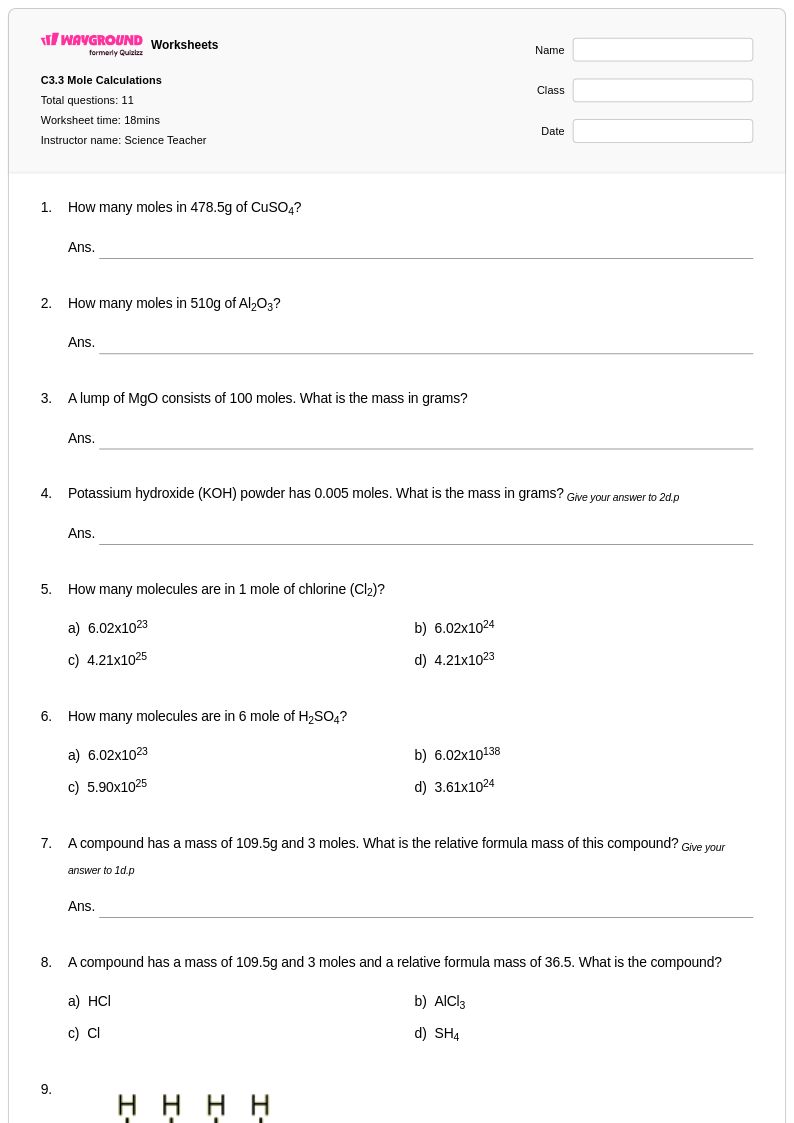
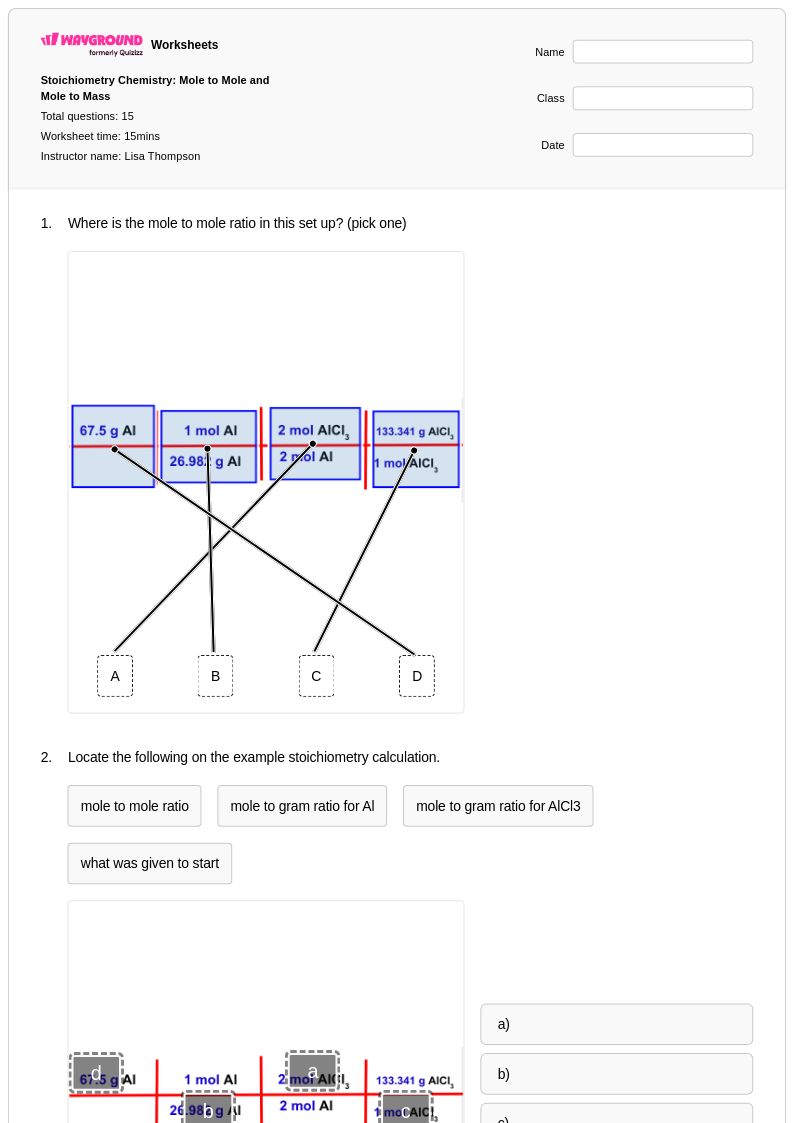
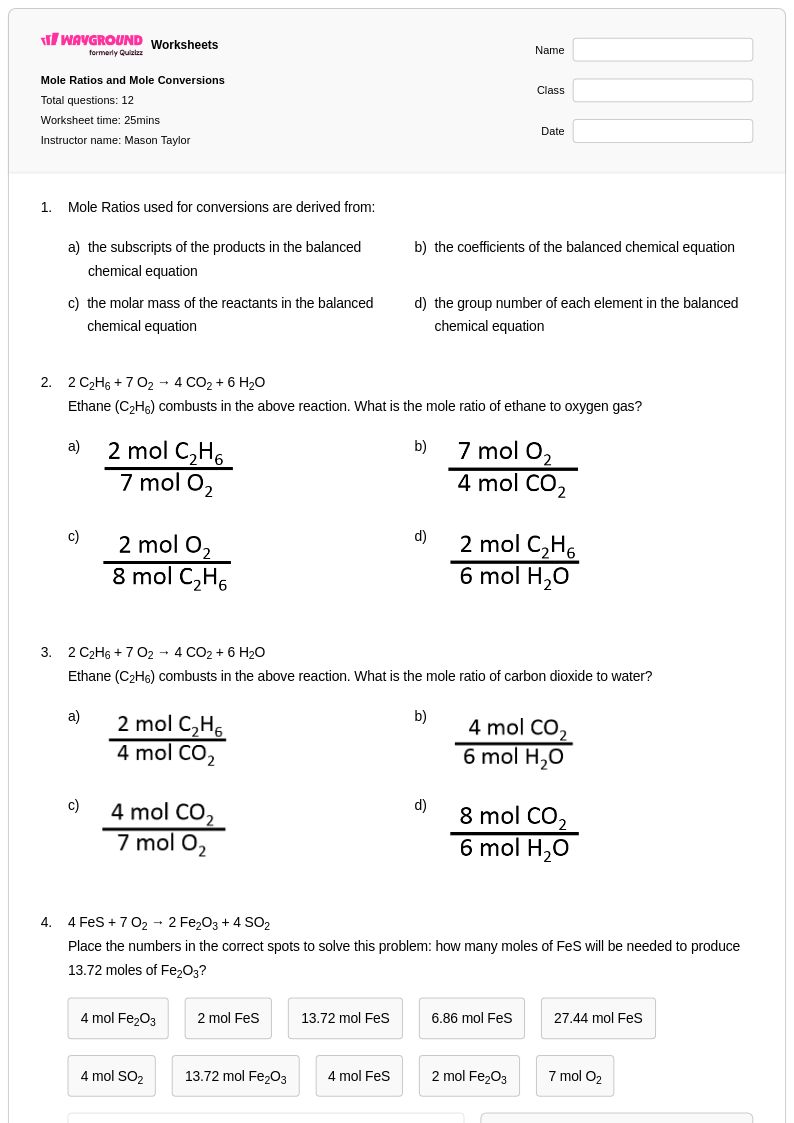
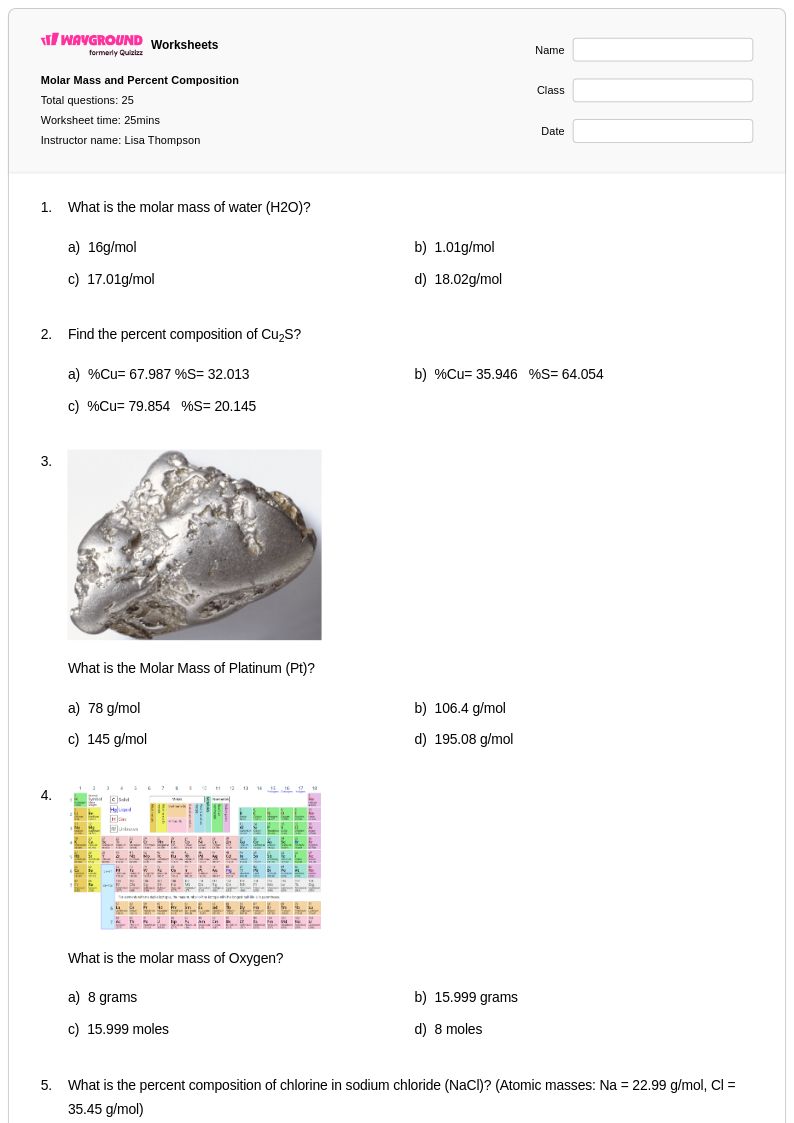
Explore Wayground's free mass and moles chemistry worksheets with printable PDFs, practice problems, and answer keys to help students master stoichiometric calculations and molecular relationships.
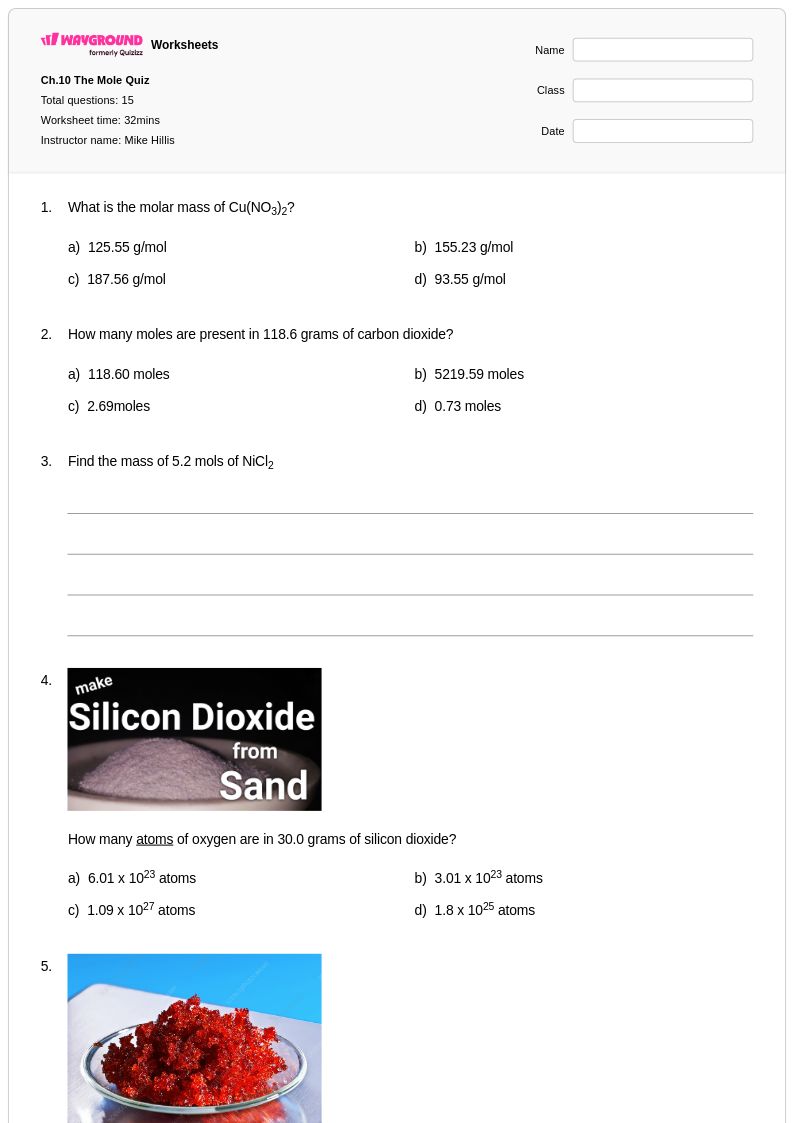
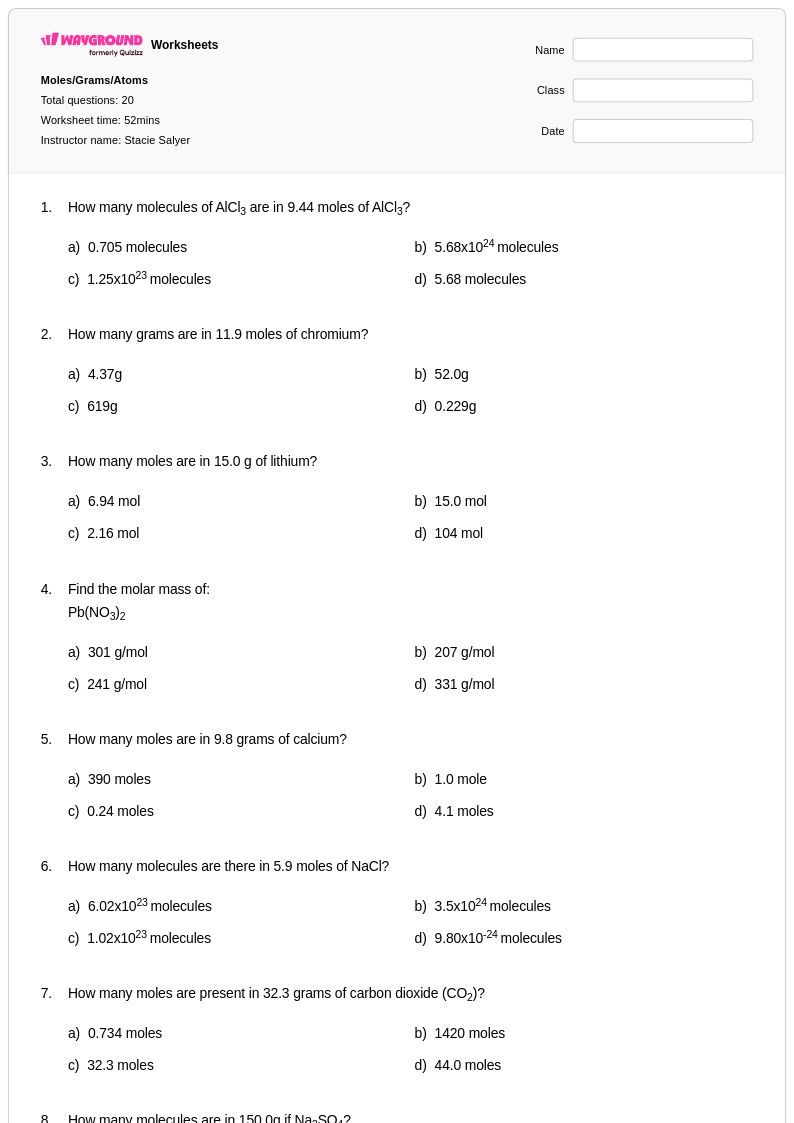
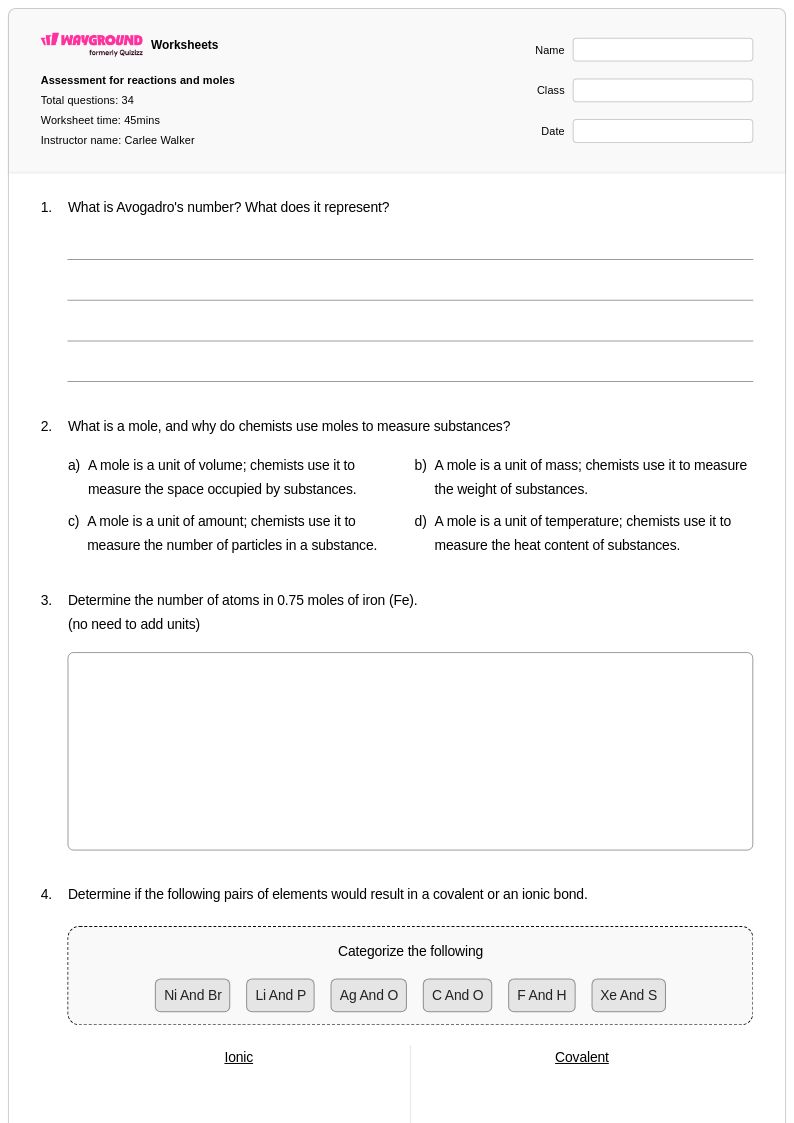
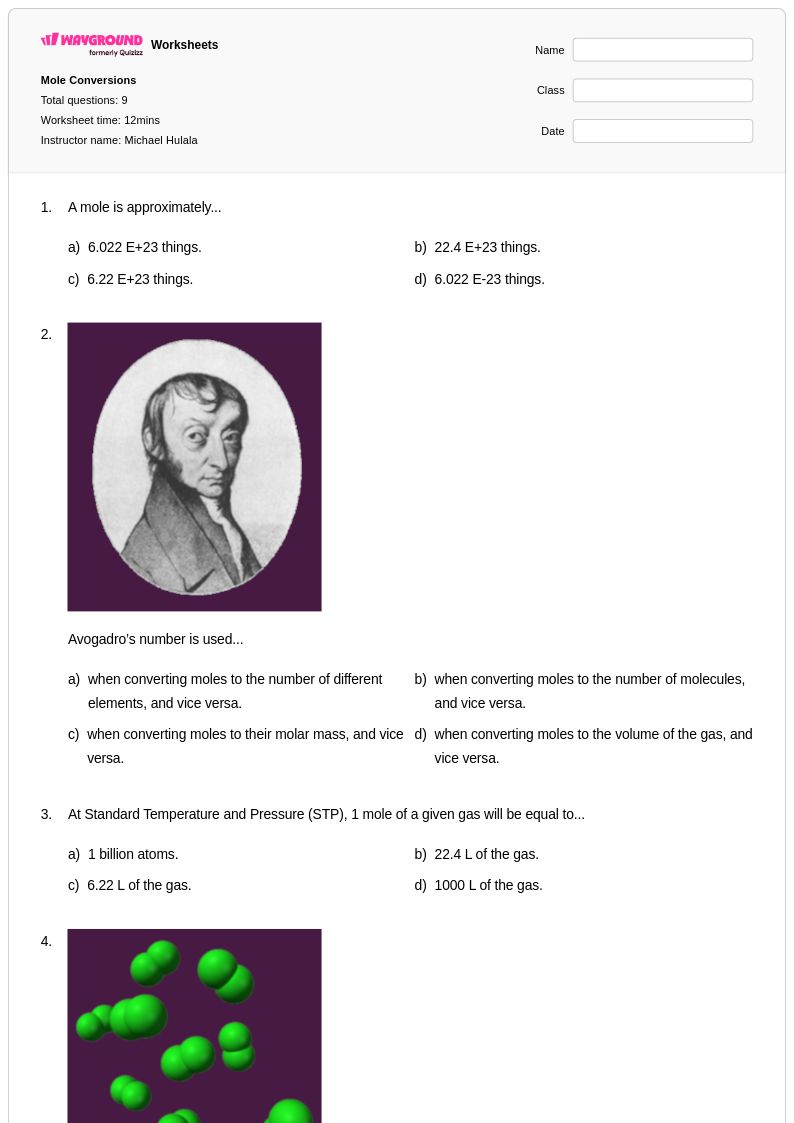
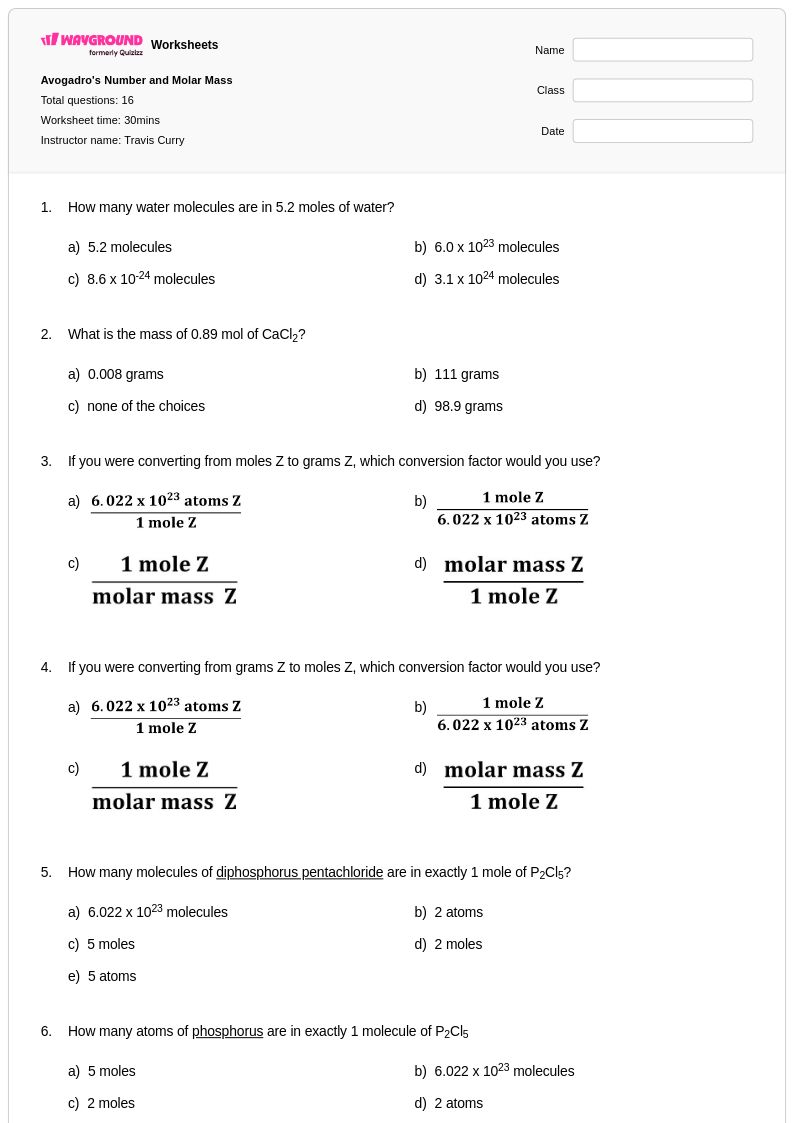
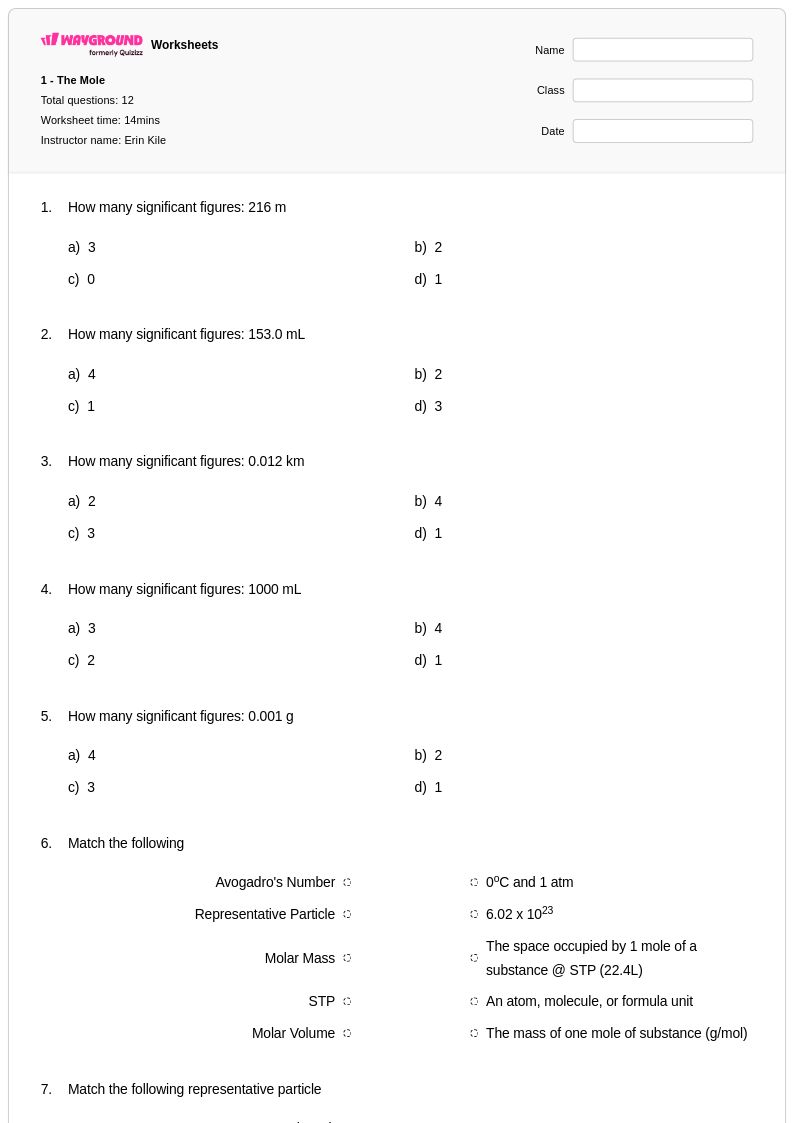
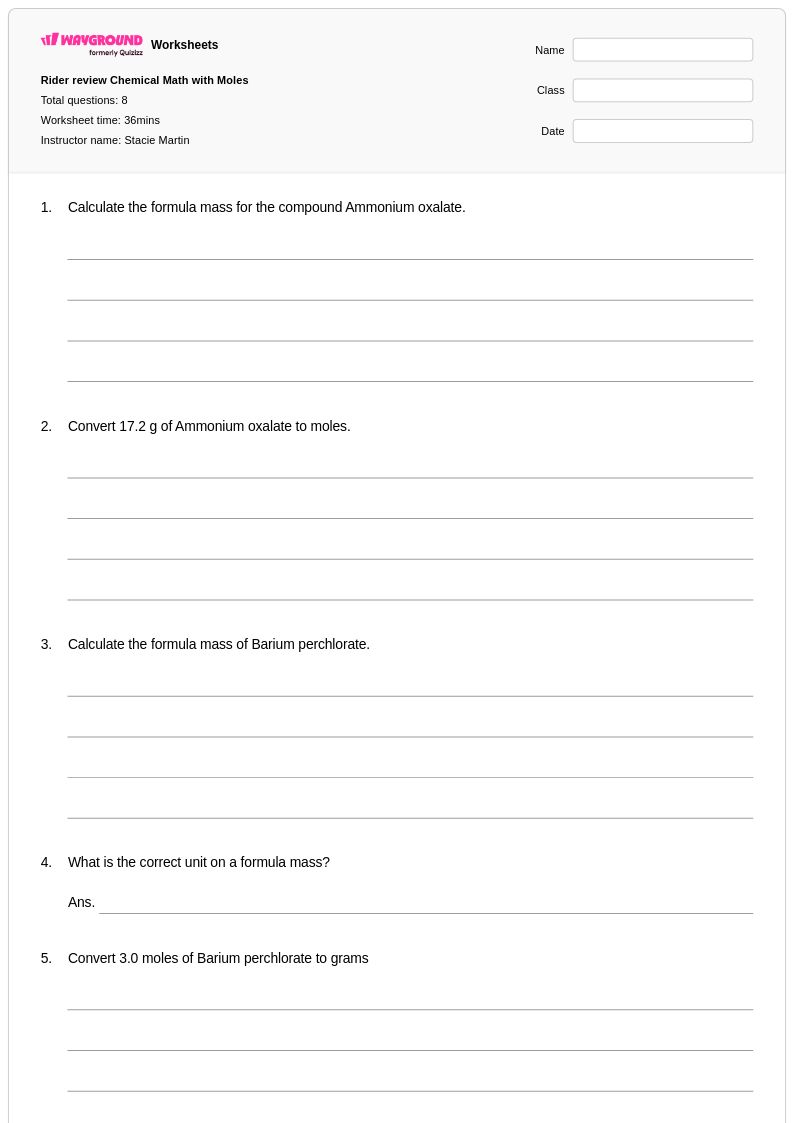
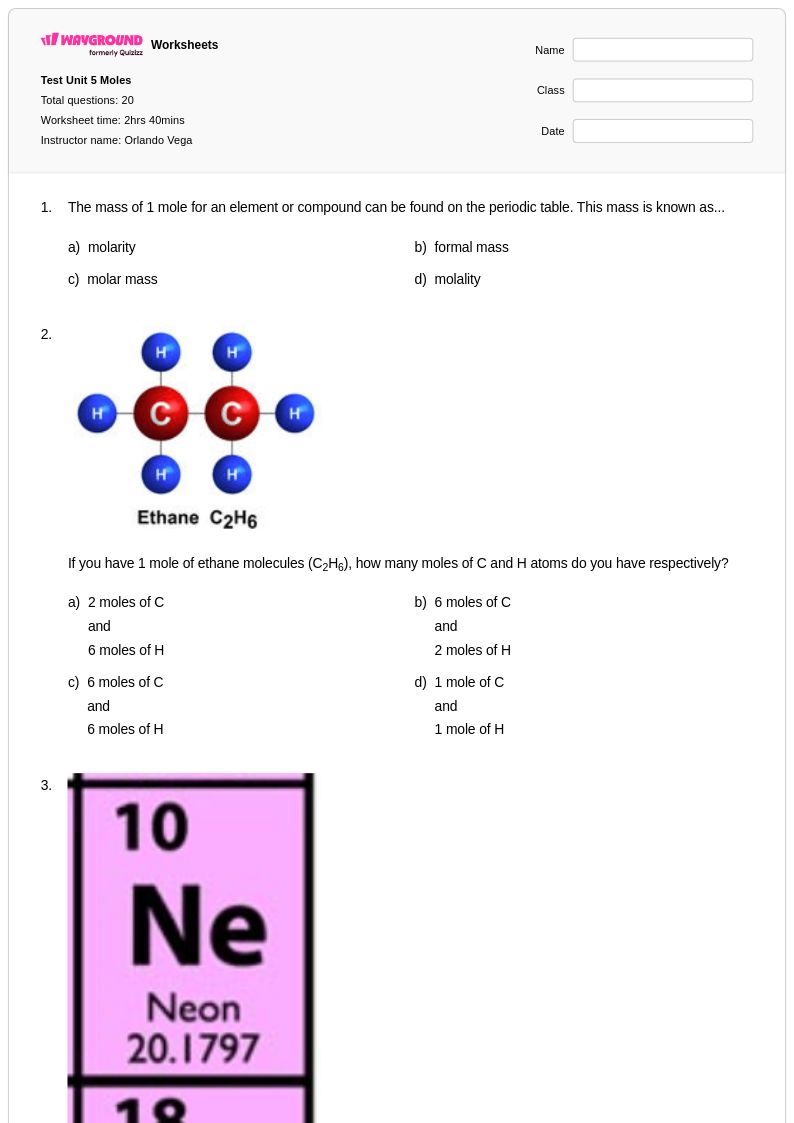
Mass and moles worksheets available through Wayground (formerly Quizizz) provide comprehensive practice with fundamental stoichiometric concepts that form the backbone of quantitative chemistry. These carefully designed resources help students master essential skills including converting between mass and molar quantities, calculating molar mass from molecular formulas, applying Avogadro's number in particle-to-mole conversions, and solving multi-step stoichiometry problems. Each worksheet collection includes detailed answer keys and step-by-step solution guides, enabling students to check their work and identify areas needing additional support. The printable pdf format makes these free resources ideal for classroom distribution, homework assignments, and independent study sessions, while the varied practice problems ensure students encounter the full range of mass and mole calculations they'll need for chemistry success.
Wayground (formerly Quizizz) empowers chemistry educators with an extensive library of millions of teacher-created mass and moles worksheets, complete with sophisticated search and filtering capabilities that allow instructors to quickly locate resources matching specific learning objectives and standards alignment requirements. The platform's differentiation tools enable teachers to customize worksheet difficulty levels and problem types to meet diverse student needs, while flexible formatting options provide both printable and digital versions for seamless integration into any instructional environment. These features significantly streamline lesson planning by offering ready-to-use materials for skill practice, targeted remediation for struggling learners, and enrichment opportunities for advanced students, allowing chemistry teachers to focus their time on instruction rather than resource creation while ensuring every student receives appropriate support in mastering these critical quantitative concepts.
FAQs
How do I teach the relationship between mass and moles to chemistry students?
Start by grounding students in the concept of molar mass as a conversion factor derived directly from the periodic table. Teach them to treat unit conversions dimensionally, using grams-per-mole as a bridge between the macroscopic (grams) and the chemical (moles). Once students are comfortable with single-step conversions, introduce multi-step problems that chain mass, moles, and particle counts together using Avogadro's number, reinforcing why each factor is applied in a given direction.
What practice problems help students get better at mass-to-mole and mole-to-mass conversions?
Effective practice moves students through three levels of complexity: first, converting a given mass of a pure element to moles; second, calculating molar mass from a molecular formula before converting; and third, solving multi-step problems that link mass, moles, and number of particles in a single calculation. Problems that require students to work in both directions, mass to moles and moles to mass, help cement the conversion factor as a tool rather than a formula to memorize.
What mistakes do students commonly make when converting between mass and moles?
The most frequent error is inverting the molar mass conversion factor, dividing when they should multiply or vice versa. Students also frequently calculate molar mass incorrectly by misreading subscripts in molecular formulas or forgetting to account for polyatomic groups. A third common mistake is confusing moles of a compound with moles of a specific element within that compound, which becomes critical when problems involve Avogadro's number and particle counts.
How do I help struggling students who can't keep track of the steps in stoichiometric calculations?
Dimensional analysis is the most reliable scaffold for students who lose track of multi-step conversions. Train students to write out every unit explicitly and cancel them visually before performing any arithmetic. For students who need additional support, Wayground's reduced answer choices accommodation can lower cognitive load during digital practice, and the Read Aloud feature ensures that students who struggle with reading do not misinterpret problem text. Breaking problems into labeled stages, identify given, identify wanted, write conversion factor, calculate, reduces the working memory demand significantly.
How do I use Wayground's mass and moles worksheets in my chemistry class?
Wayground's mass and moles worksheets are available as printable PDFs, making them easy to distribute as in-class practice, homework, or quiz materials, and in digital formats that support technology-integrated or hybrid classroom environments. Teachers can also host worksheets directly as a quiz on Wayground, enabling real-time student response tracking. Each worksheet includes complete answer keys so students can self-check and teachers can use them for efficient grading or guided review sessions.
How does Avogadro's number connect to mass and mole calculations, and how should I teach it?
Avogadro's number (6.022 × 10²³) functions as a conversion factor between moles and individual particles, just as molar mass converts between moles and grams. Teach it in tandem with molar mass so students see all three quantities, mass, moles, and particles, as a connected triad rather than separate facts. A visual roadmap or conversion triangle that shows the three-way relationship, with the appropriate conversion factor labeled on each path, helps students navigate which factor to apply without guessing.