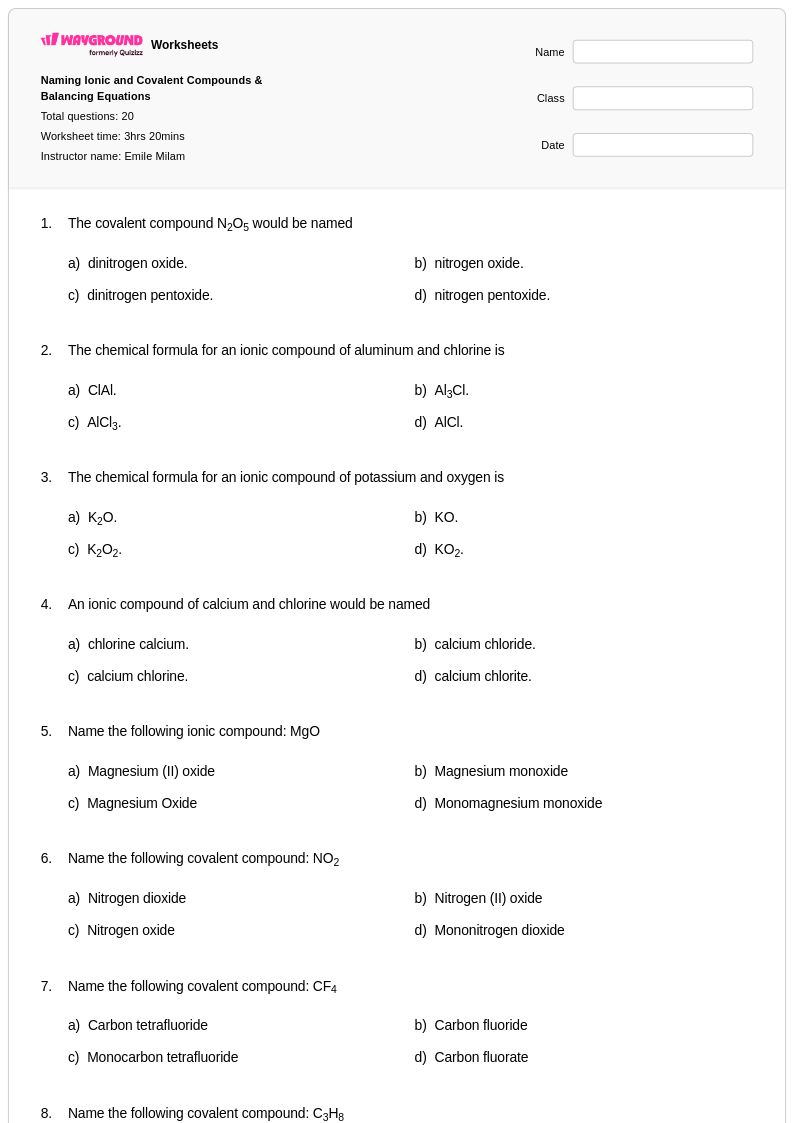
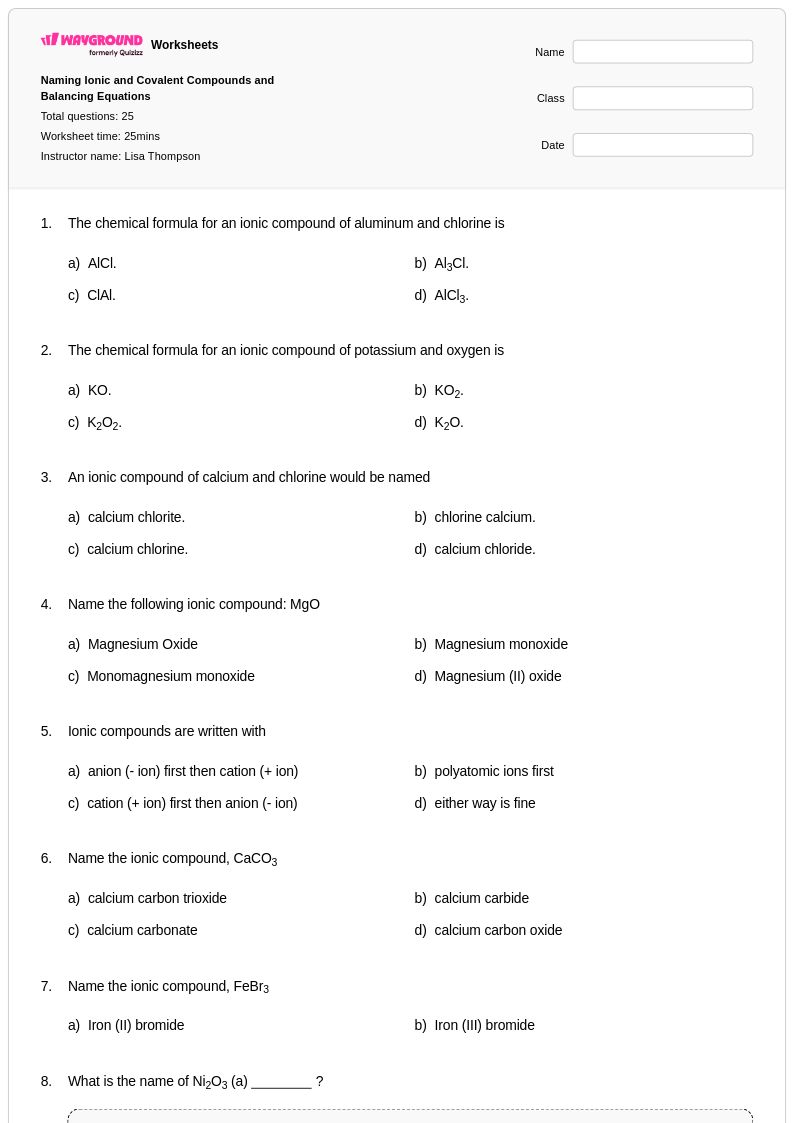
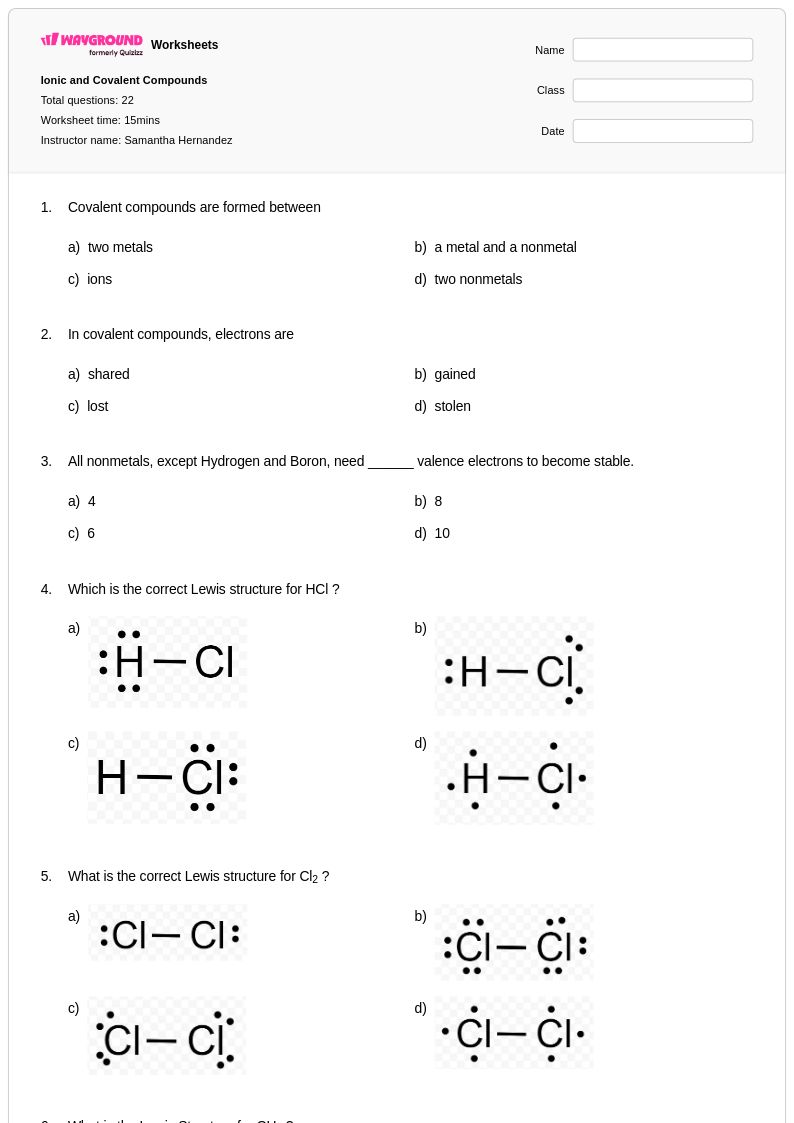
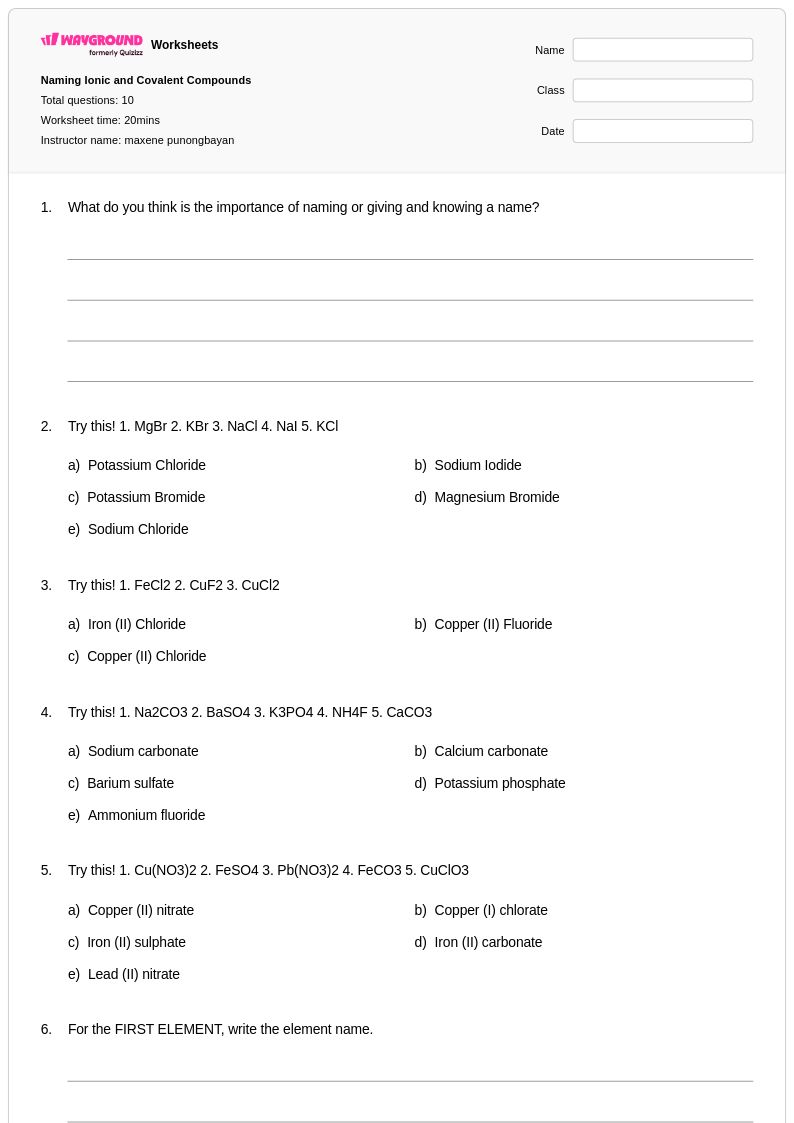
Free Printable Naming Ionic and Covalent Compounds worksheets
Free printable worksheets and practice problems help students master naming ionic and covalent compounds through comprehensive exercises with answer keys and downloadable PDFs available on Wayground.
Explore printable Naming Ionic and Covalent Compounds worksheets
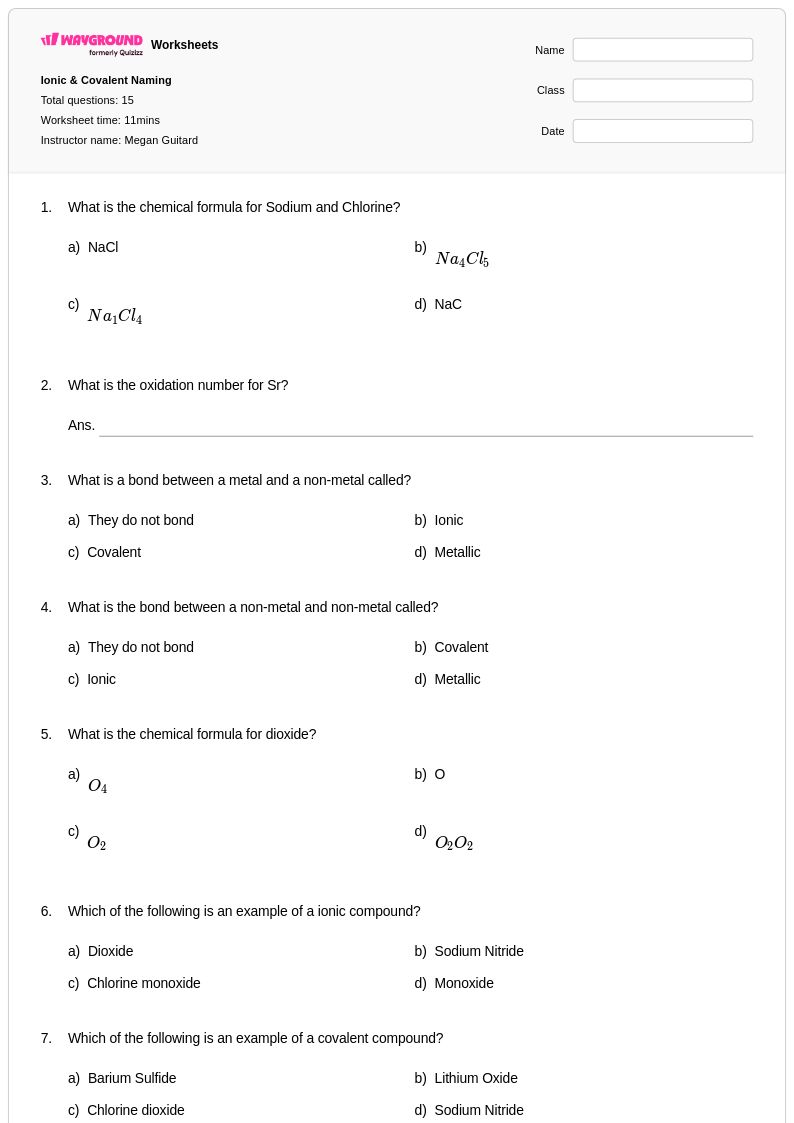
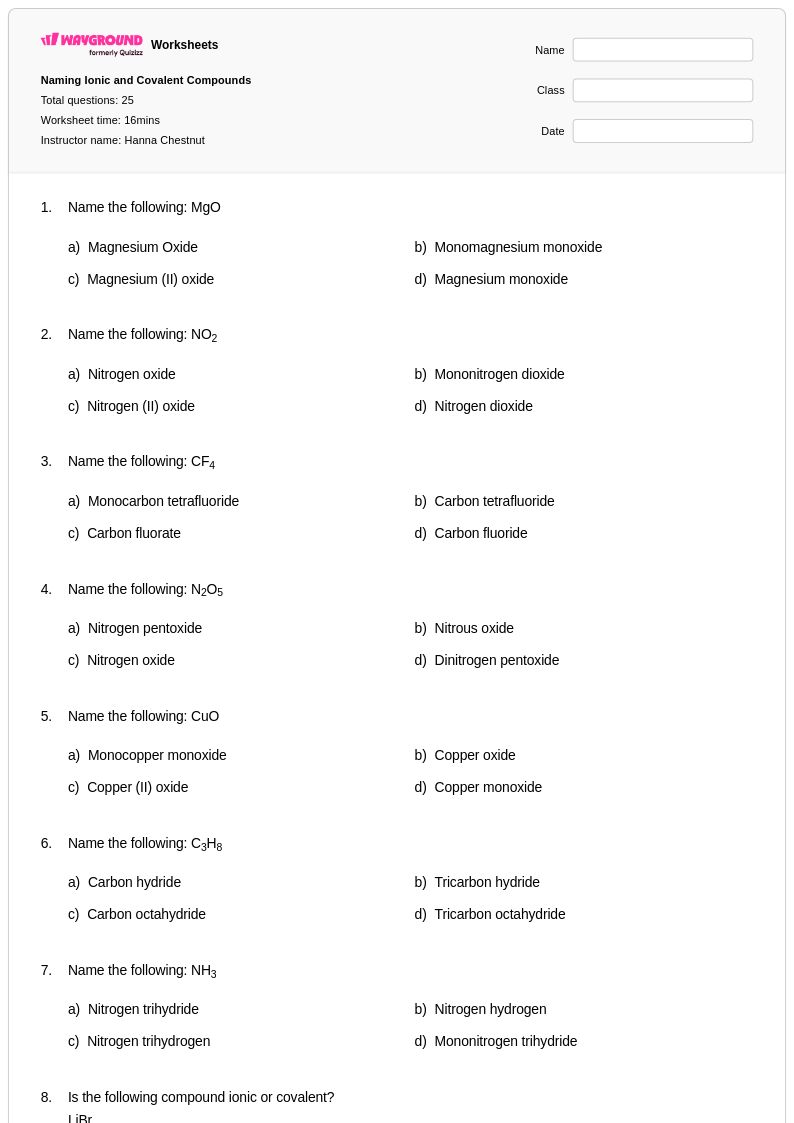
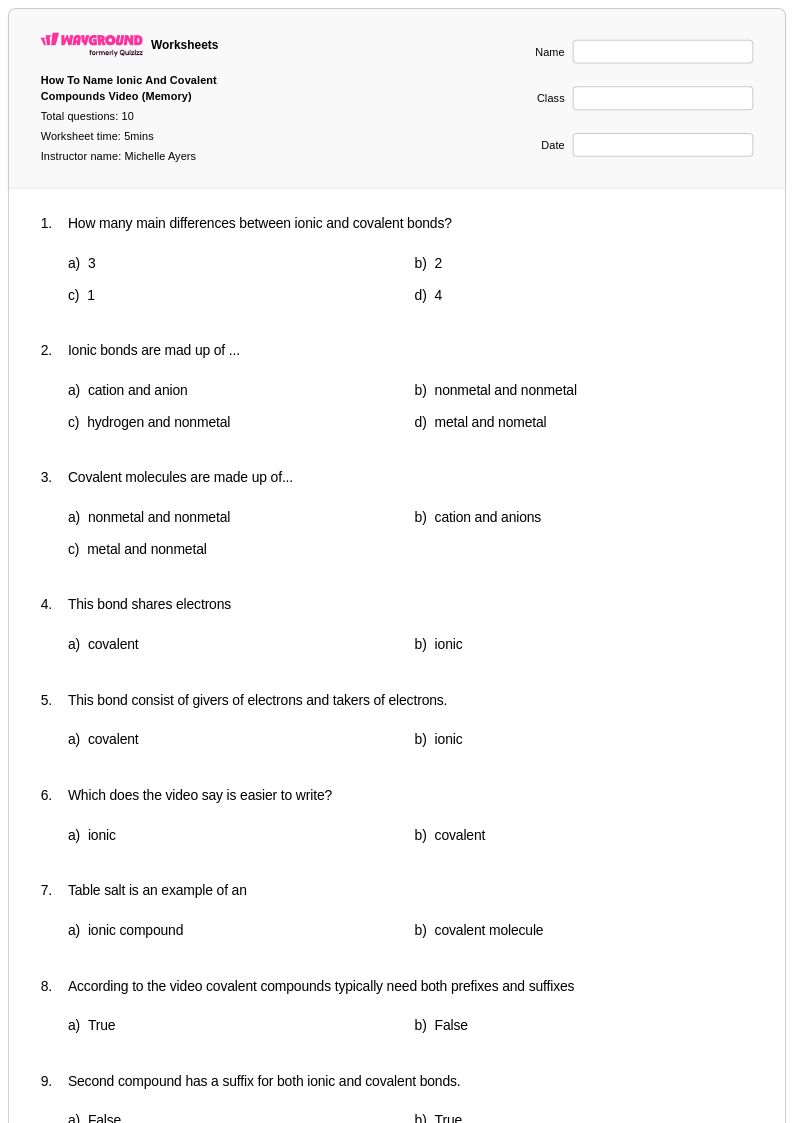
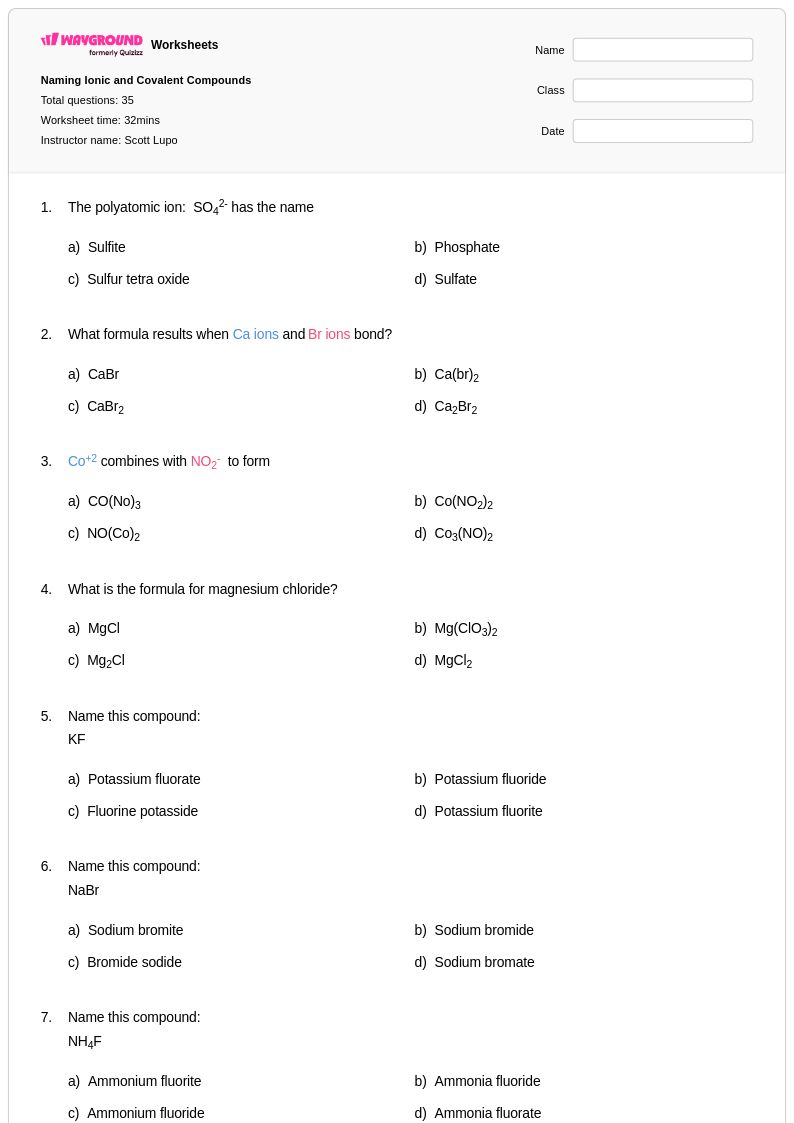
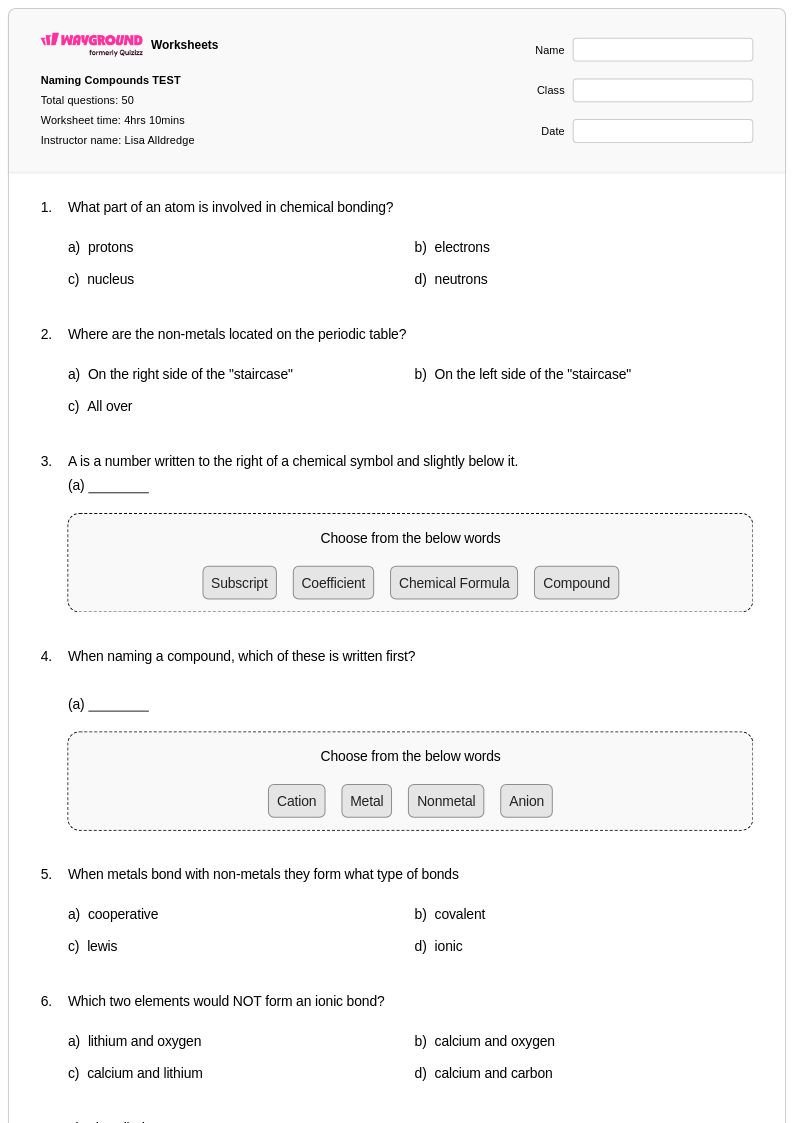
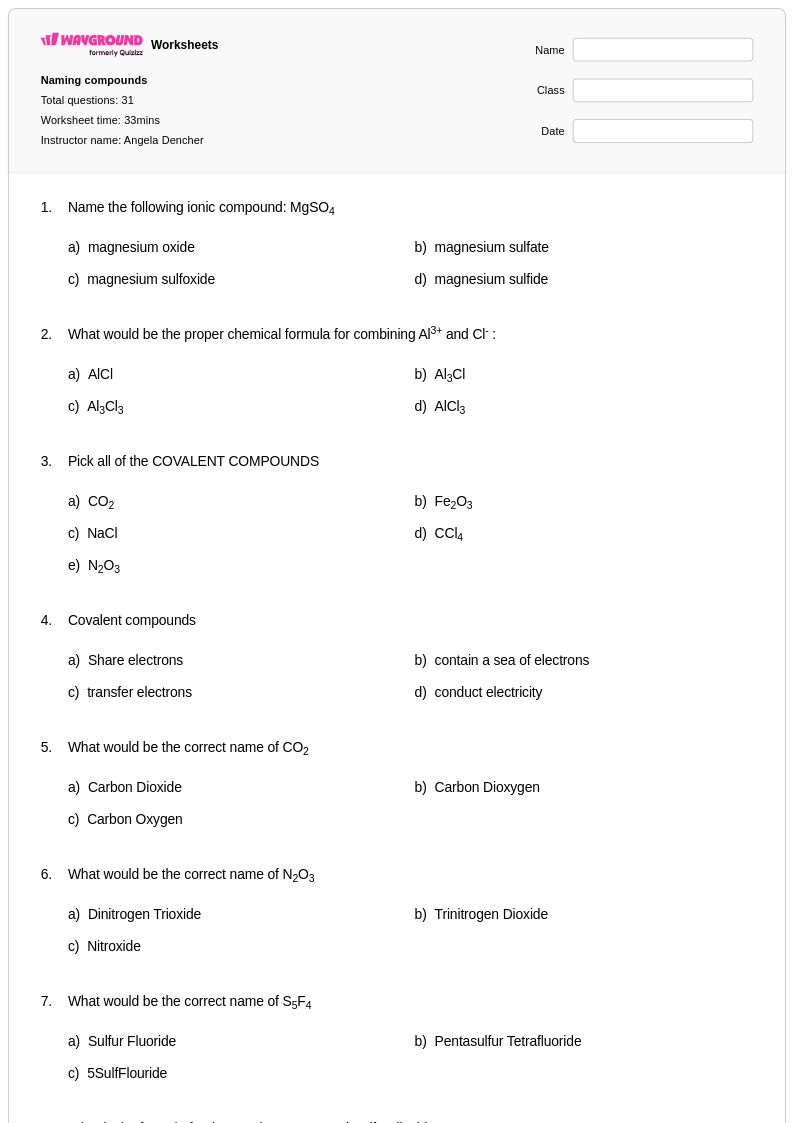
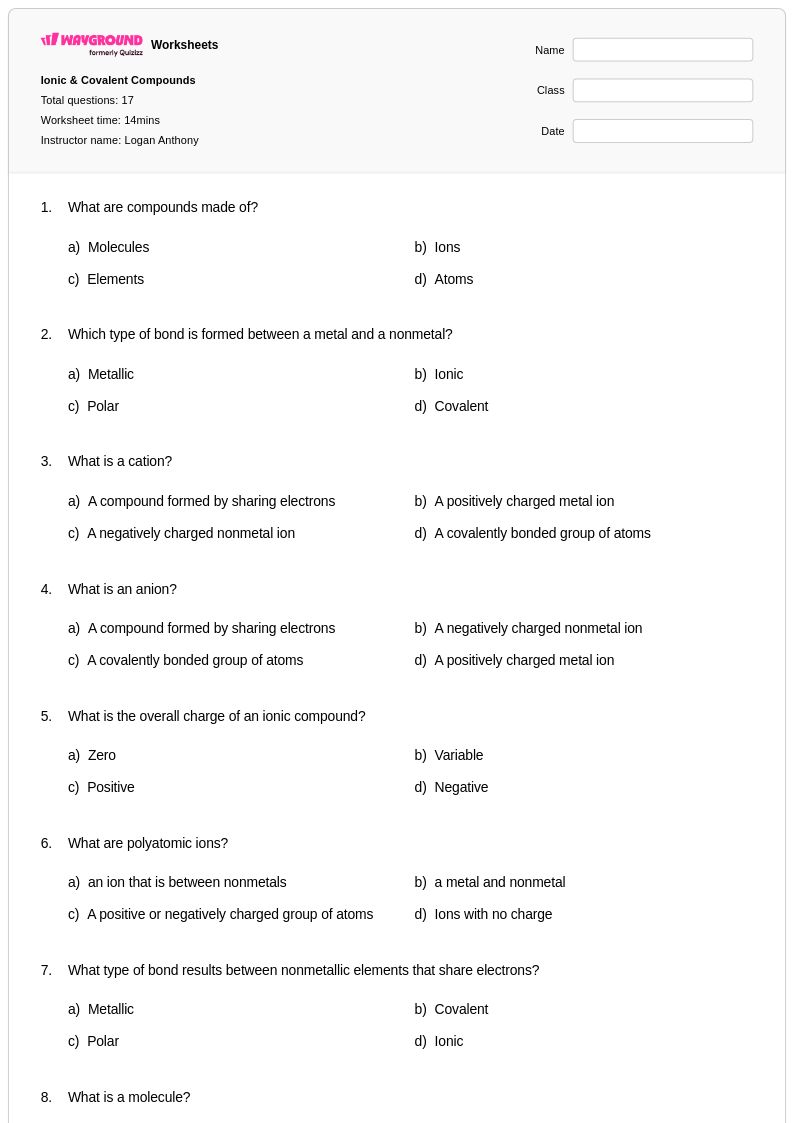
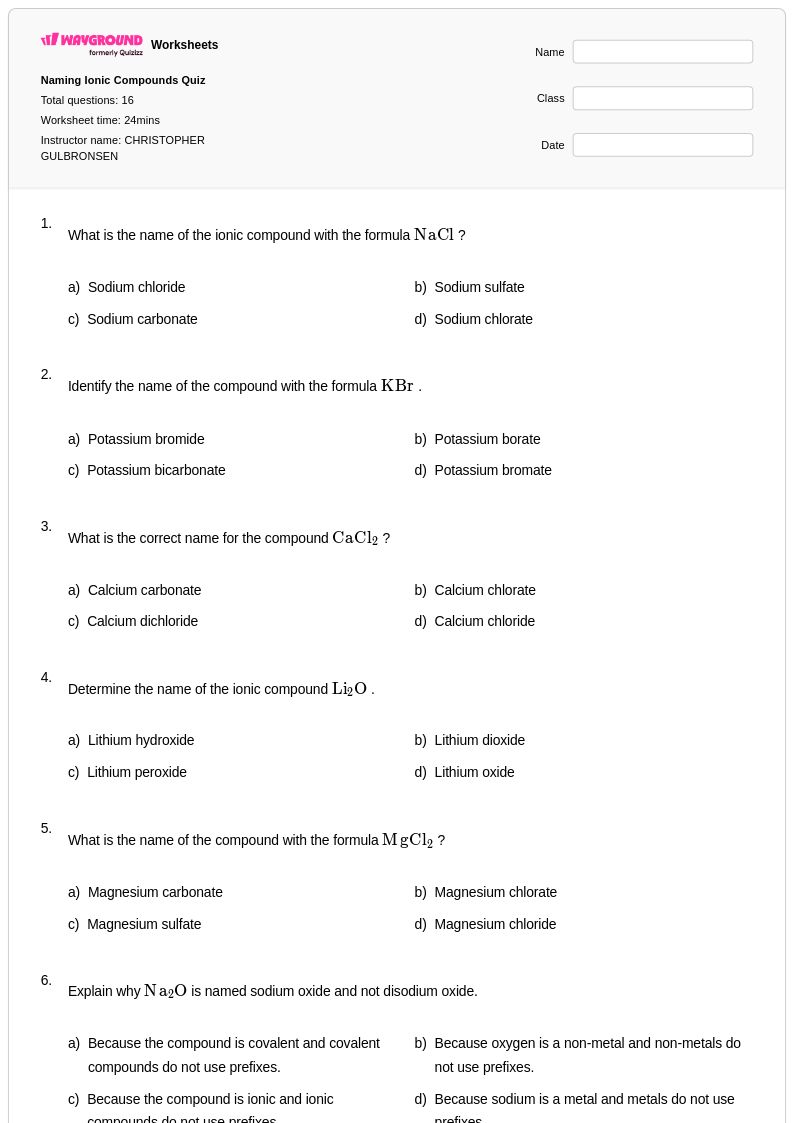
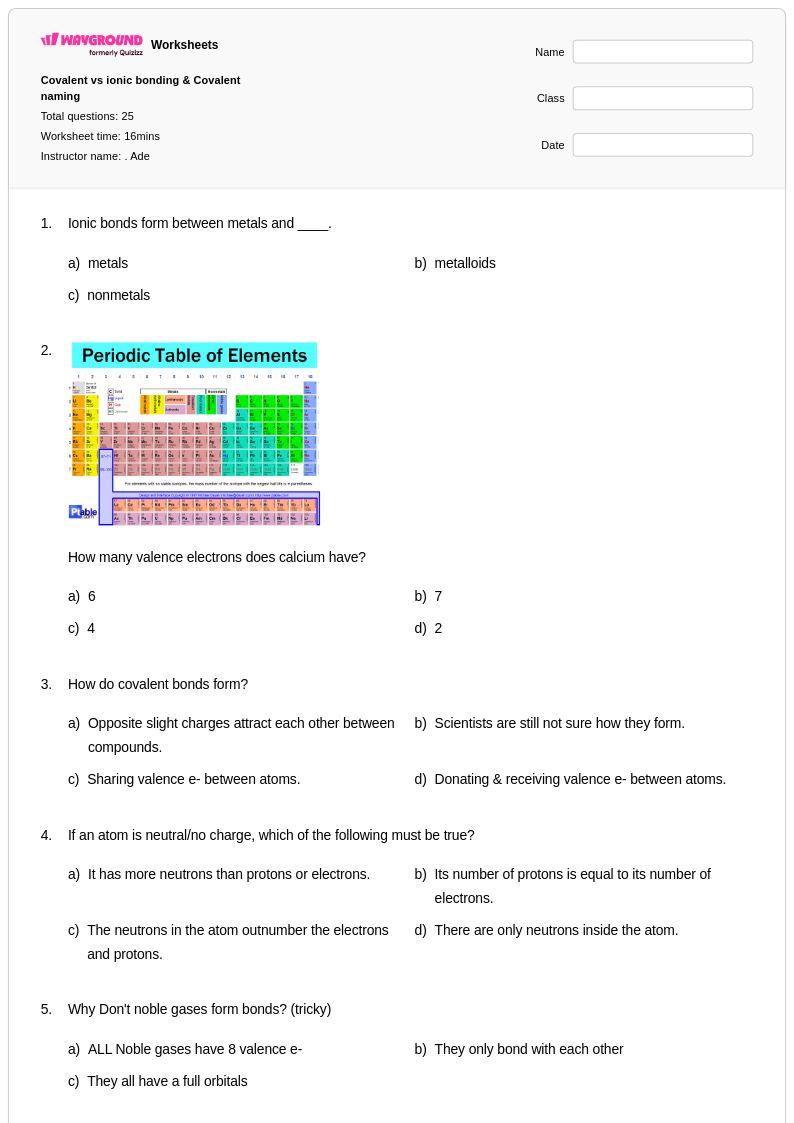
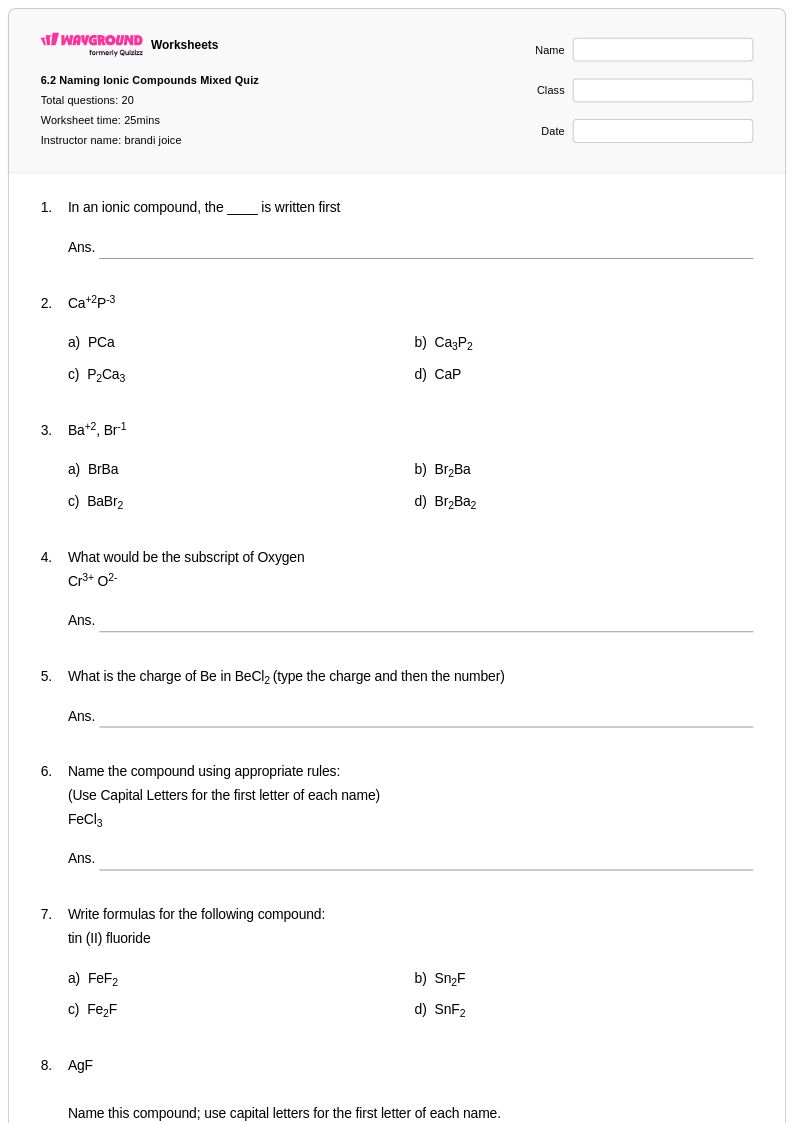
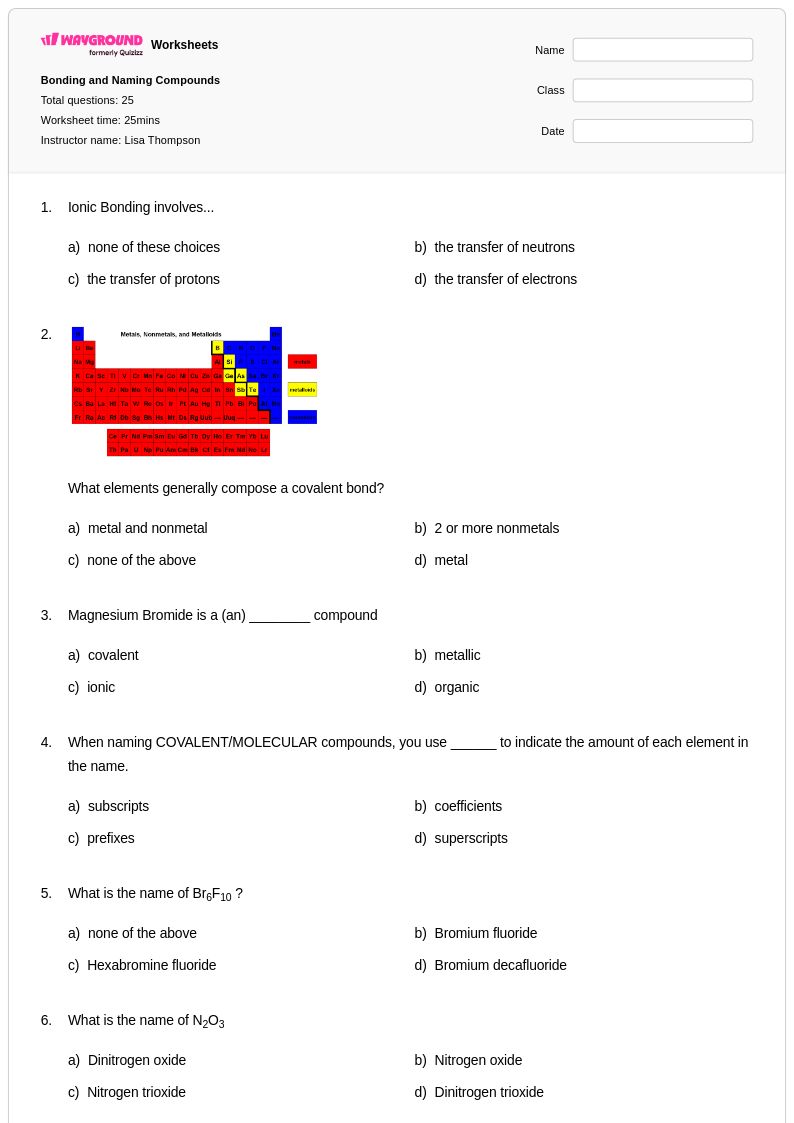
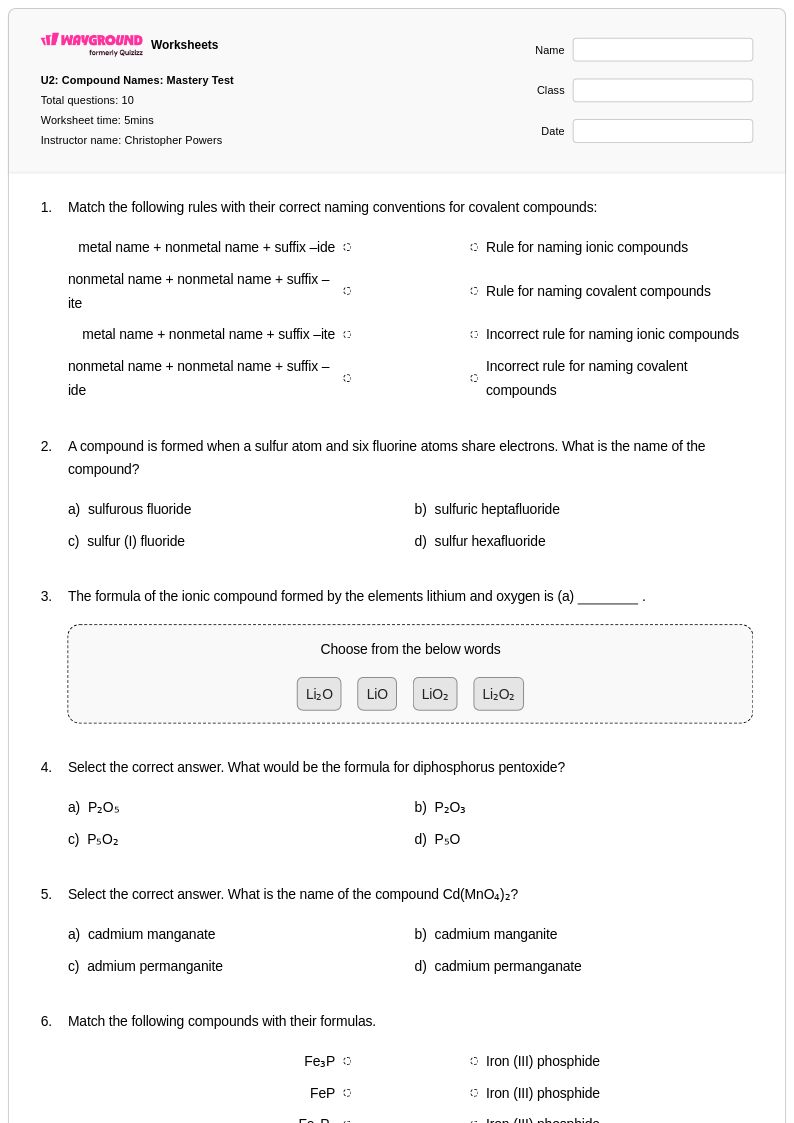
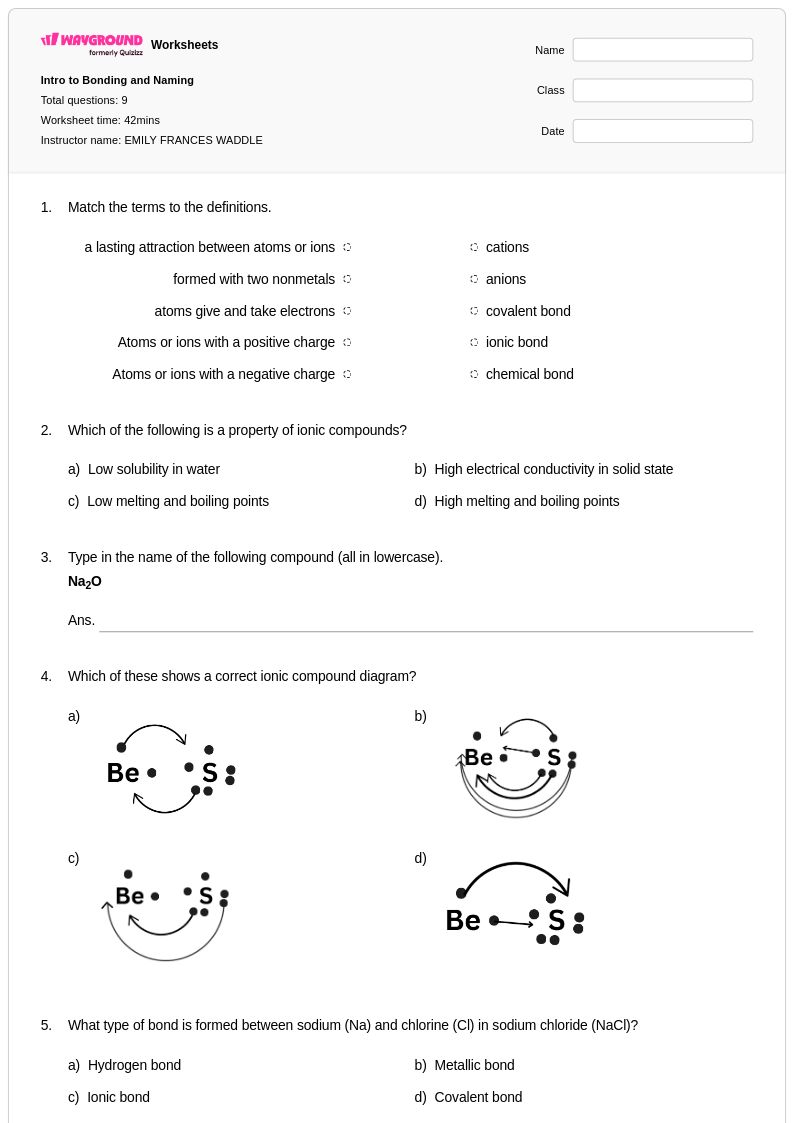
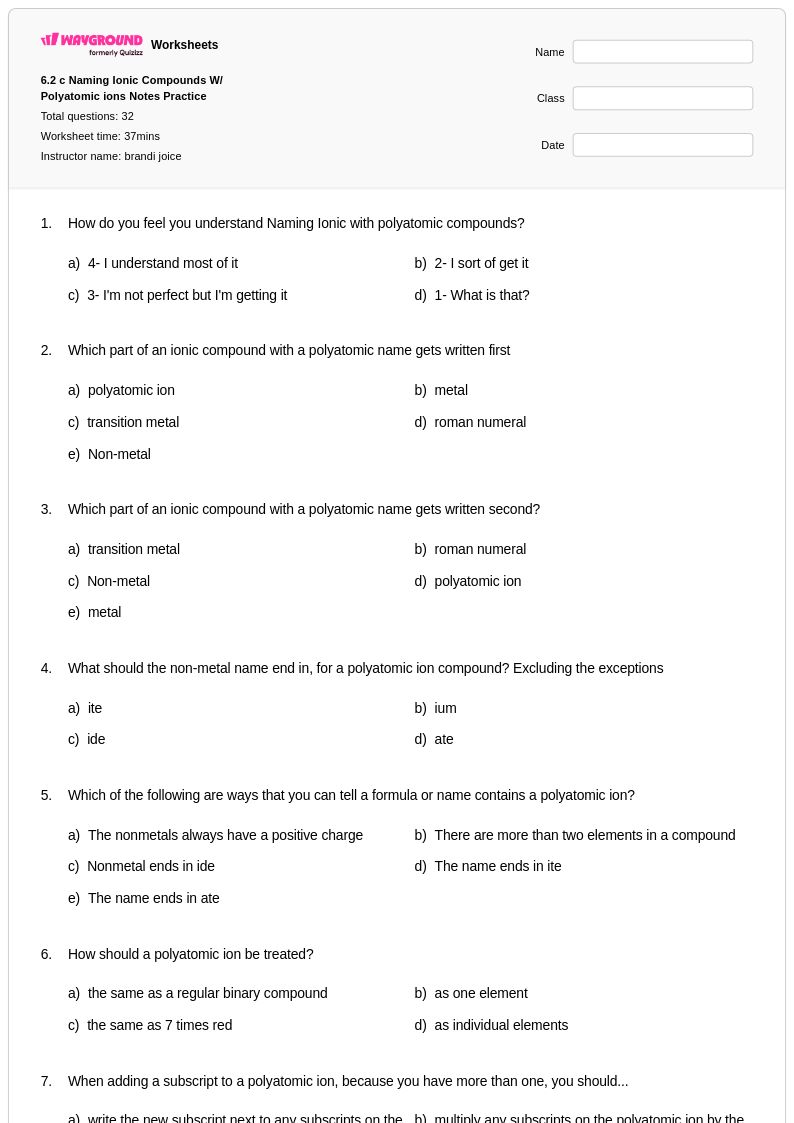
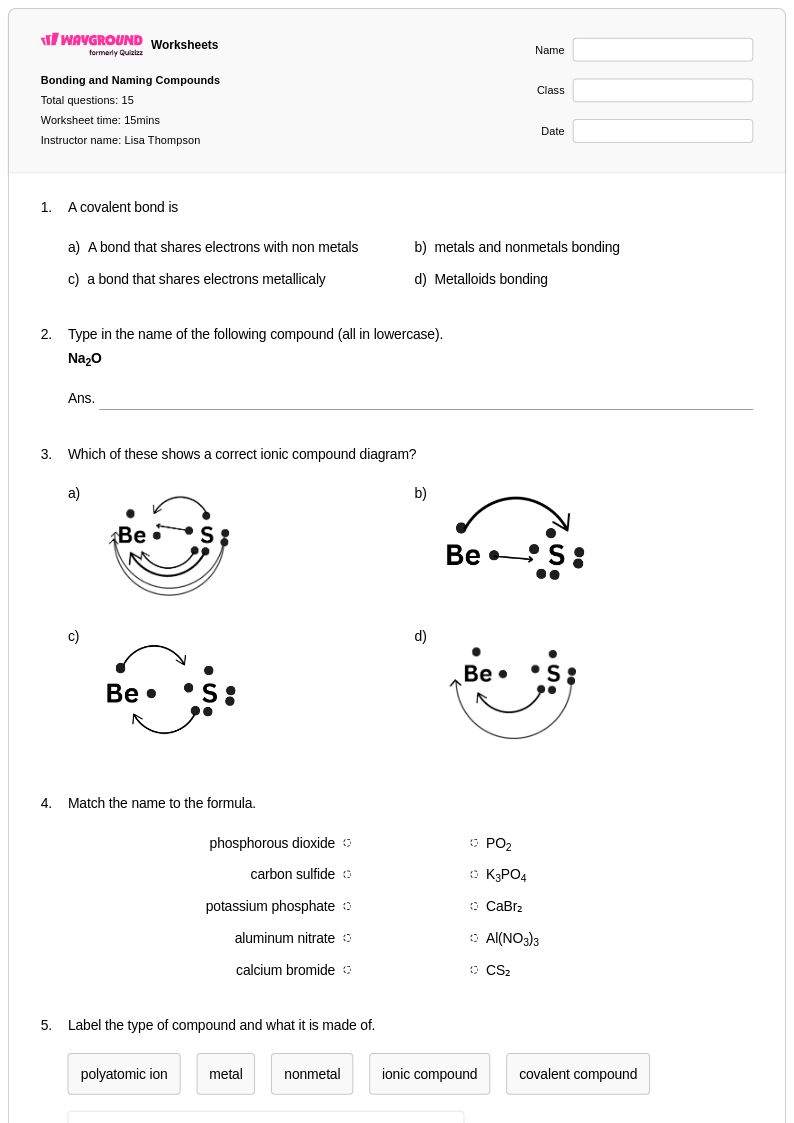
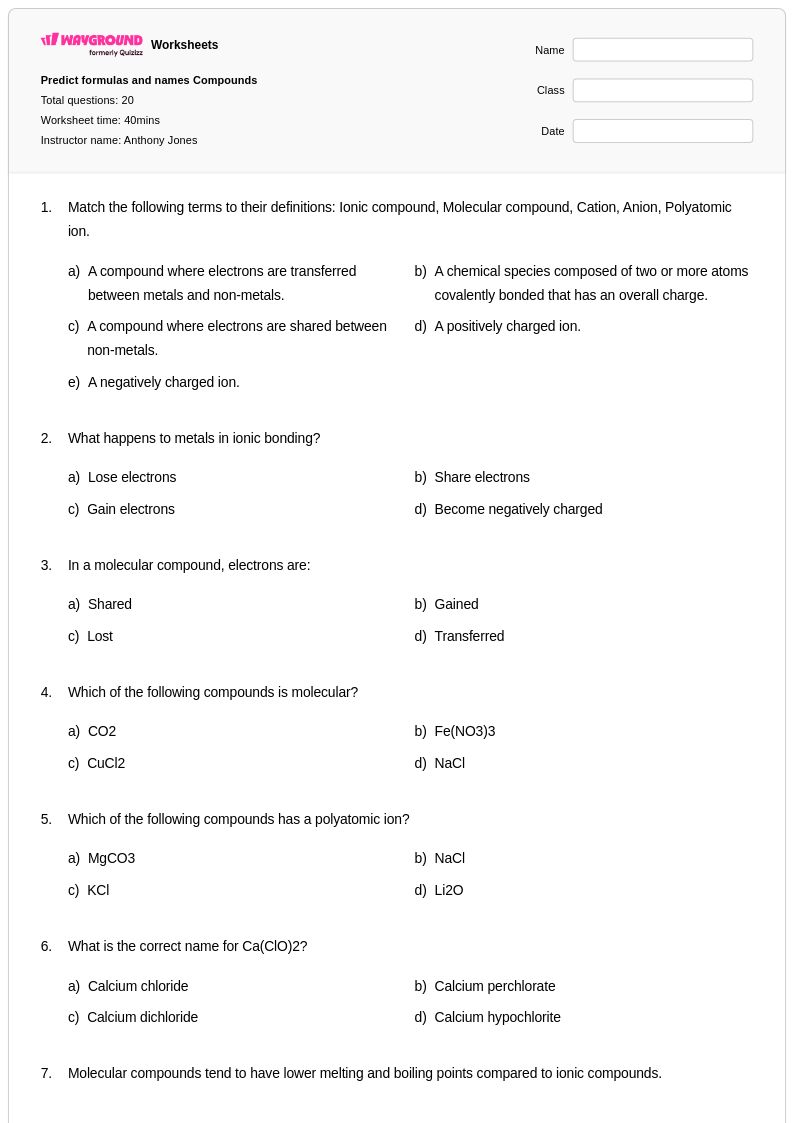
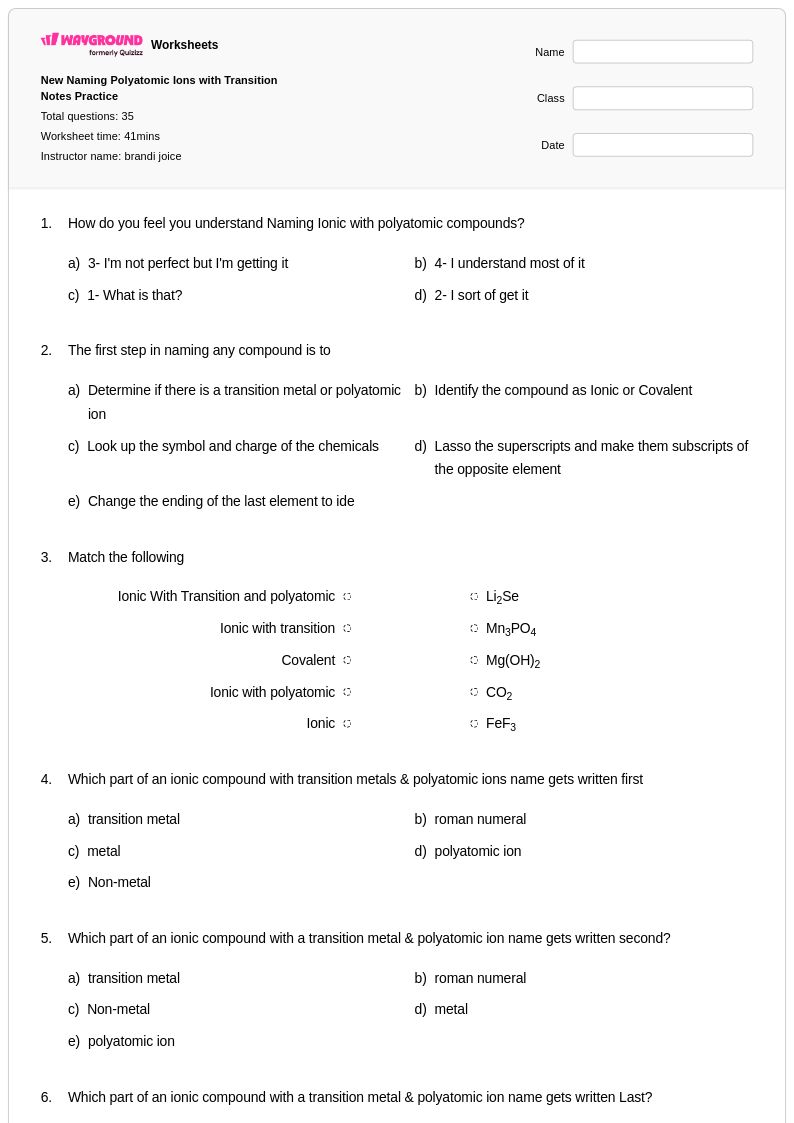
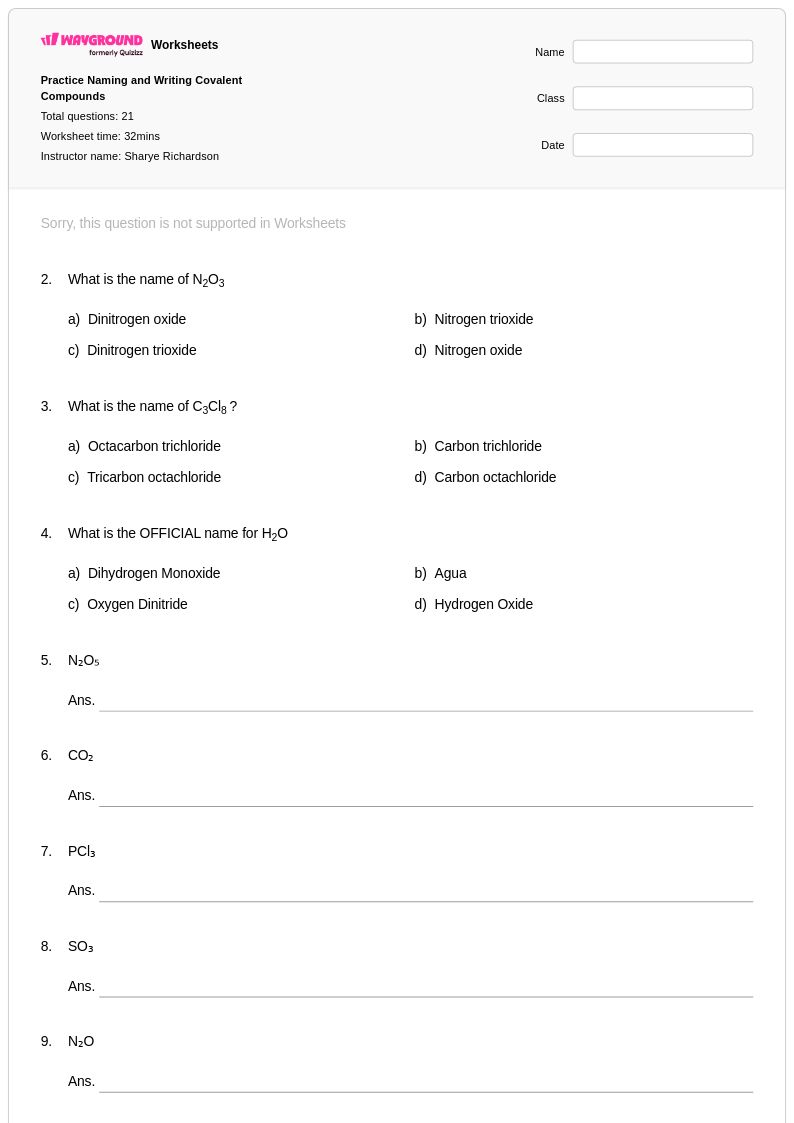
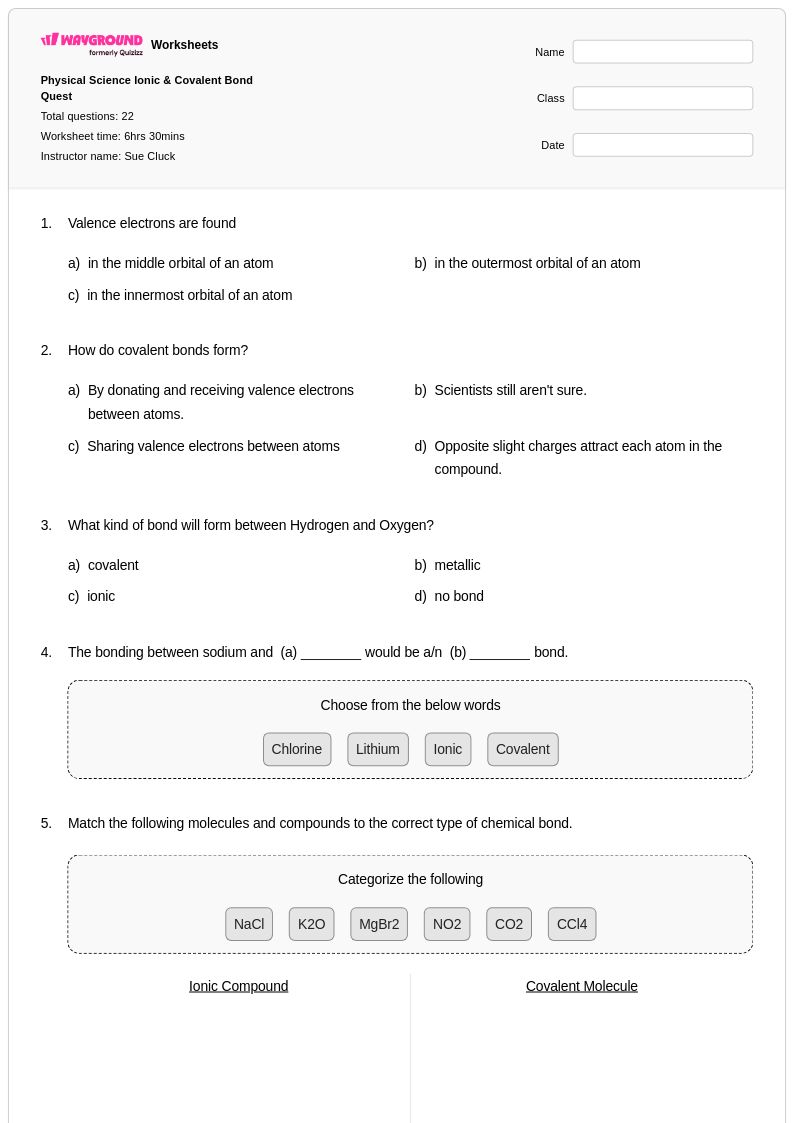
Naming ionic and covalent compounds represents a fundamental skill in chemistry that requires students to master systematic nomenclature rules and understand the underlying bonding principles. Wayground's comprehensive collection of naming ionic and covalent compounds worksheets provides structured practice opportunities that help students develop proficiency in identifying compound types, applying IUPAC naming conventions, and writing correct chemical formulas. These carefully designed resources include practice problems that progress from simple binary compounds to more complex polyatomic structures, ensuring students build confidence through incremental skill development. Each worksheet comes with a detailed answer key that enables self-assessment and immediate feedback, while the free printable pdf format makes these materials easily accessible for both classroom instruction and independent study sessions.
Wayground, formerly Quizizz, empowers chemistry educators with millions of teacher-created resources specifically focused on chemical nomenclature, offering robust search and filtering capabilities that allow instructors to locate materials perfectly aligned with their curriculum standards and student needs. The platform's sophisticated differentiation tools enable teachers to customize worksheets based on individual learning levels, whether students require foundational practice with simple ionic compounds or advanced challenges involving complex molecular structures. These versatile materials are available in both printable and digital formats, including downloadable pdf versions, providing maximum flexibility for diverse classroom environments and teaching approaches. Teachers can efficiently plan lessons, implement targeted remediation strategies, provide enrichment opportunities for advanced learners, and facilitate consistent skill practice that reinforces proper naming conventions across various compound types.
FAQs
How do I teach students to name ionic and covalent compounds?
Start by building a clear conceptual foundation: students need to understand the difference between ionic bonding (metal + nonmetal, electron transfer) and covalent bonding (nonmetal + nonmetal, electron sharing) before any naming rules are introduced. Teach ionic naming first using binary compounds, then layer in polyatomic ions and transition metals with variable charges. For covalent compounds, introduce the Greek prefix system (mono-, di-, tri-) and emphasize that prefixes are used instead of charge-based naming. Separating the two systems explicitly and practicing them in isolation before mixing compound types significantly reduces student confusion.
What exercises help students practice naming ionic and covalent compounds?
Effective practice starts with identification exercises where students determine whether a compound is ionic or covalent before applying any naming rules, because misclassification is the root of most naming errors. From there, binary compound naming drills, formula-writing from names, and matching exercises that pair chemical formulas with their IUPAC names all reinforce procedural fluency. Worksheets that progress from simple binary compounds to polyatomic ions and then to complex molecular structures are particularly useful because they build confidence incrementally rather than overwhelming students with all rules at once.
What mistakes do students commonly make when naming ionic and covalent compounds?
The most common error is applying the wrong naming system: students frequently use Greek prefixes on ionic compounds or omit them from covalent compounds. For ionic compounds, forgetting to include Roman numerals for transition metals with variable charges (e.g., writing 'iron chloride' instead of 'iron(II) chloride') is a persistent problem. Students also confuse polyatomic ion names, particularly nitrate vs. nitrite and sulfate vs. sulfite, because the suffix pattern is unfamiliar. Regular low-stakes identification and correction exercises help students catch and self-correct these patterns before assessments.
How do I use Wayground's naming ionic and covalent compounds worksheets in my class?
Wayground's naming ionic and covalent compounds worksheets are available as printable PDFs for traditional classroom use and in digital formats for technology-integrated environments, giving you flexibility regardless of your setup. You can use them for direct instruction support, independent practice, homework, or remediation, and each worksheet includes a complete answer key so students can self-assess immediately. If you want to track student responses in real time, you can host the worksheet as a quiz directly on Wayground. For students who need accommodations, Wayground allows you to enable features like read aloud, extended time, or reduced answer choices on an individual basis without disrupting the rest of the class.
How do I differentiate naming compound practice for students at different skill levels?
For foundational learners, start with binary ionic compounds using metals with fixed charges, then introduce polyatomic ions only after those rules are secure. Advanced students can work with transition metals requiring Roman numerals and complex molecular compounds involving multiple prefixes. Wayground's differentiation tools allow teachers to assign different worksheets or customize difficulty based on individual student needs, so foundational and advanced practice can happen simultaneously within the same class period. Pairing tiered worksheets with the immediate feedback of an answer key helps students at every level self-correct without waiting for teacher review.
How do I help students remember polyatomic ion names when naming compounds?
Polyatomic ion memorization is best supported through repeated low-stakes exposure rather than one-time rote study. Provide students with a reference sheet during early practice and gradually fade its use as familiarity builds. Mnemonics for the '-ate' and '-ite' suffix pattern (more oxygen = '-ate', less oxygen = '-ite') help students navigate the most commonly confused pairs like sulfate/sulfite and nitrate/nitrite. Embedding polyatomic ions consistently into naming worksheets, rather than isolating them as a separate memorization task, accelerates retention because students encounter them in context repeatedly.