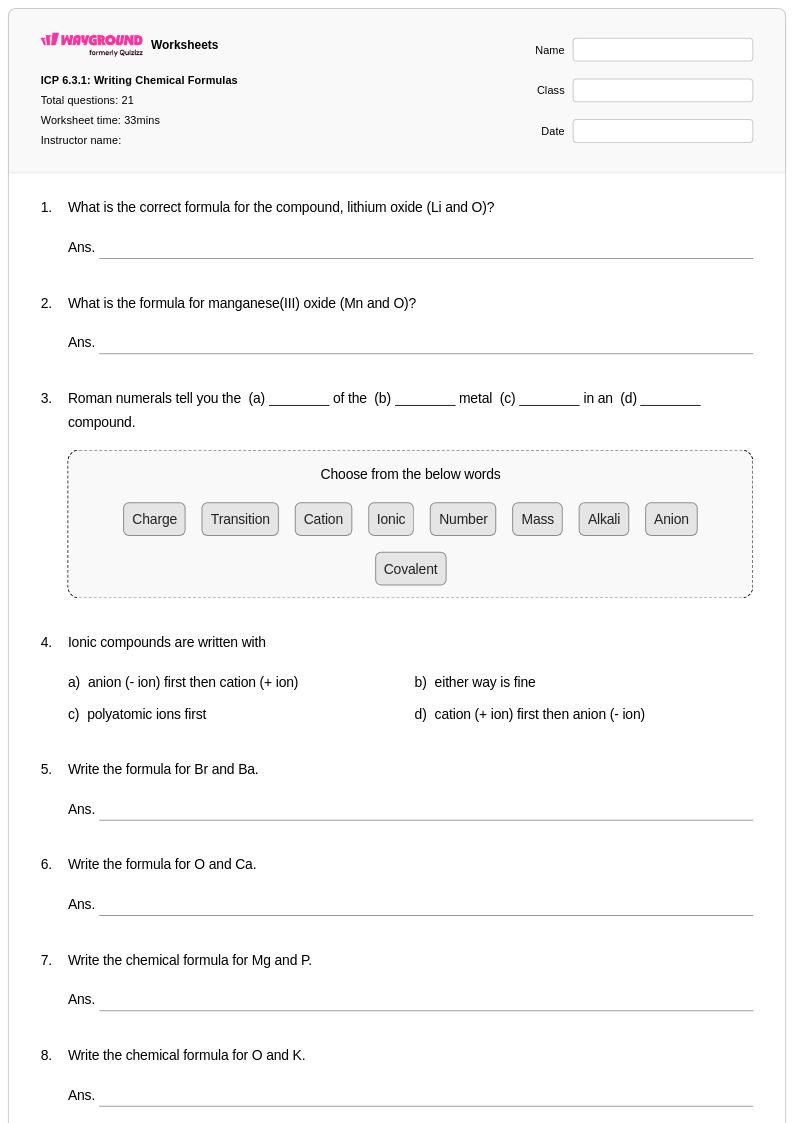
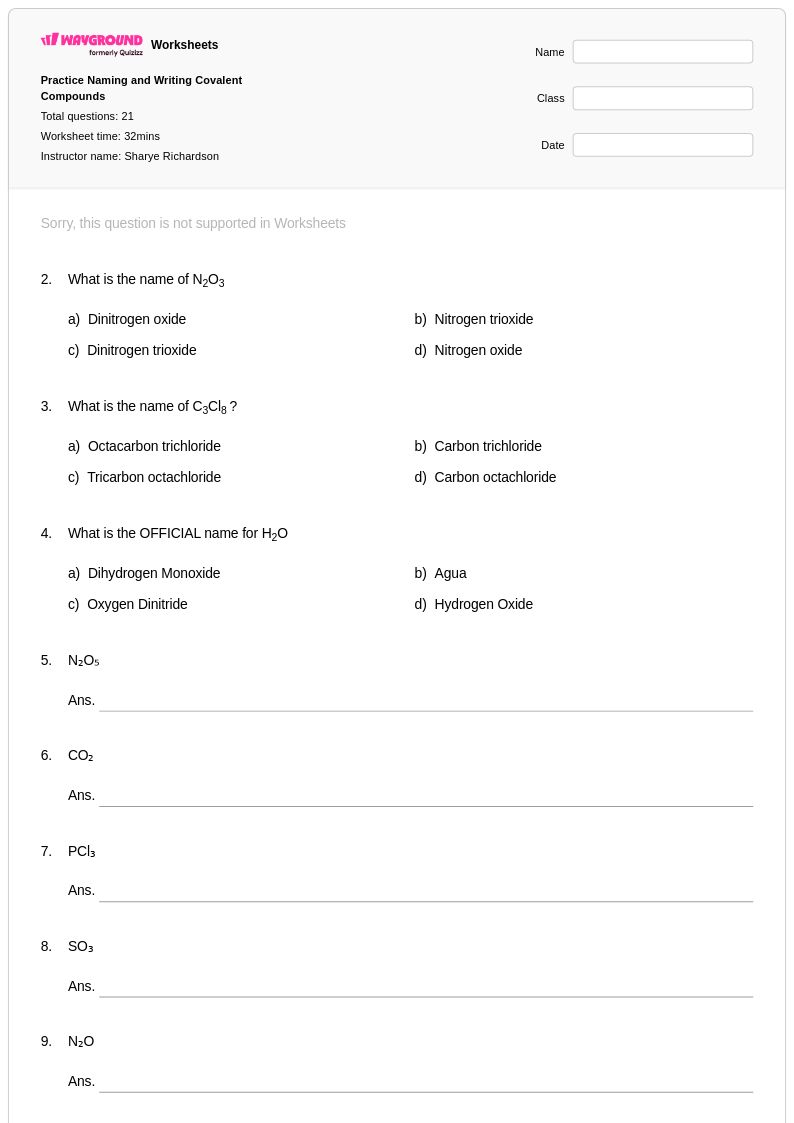
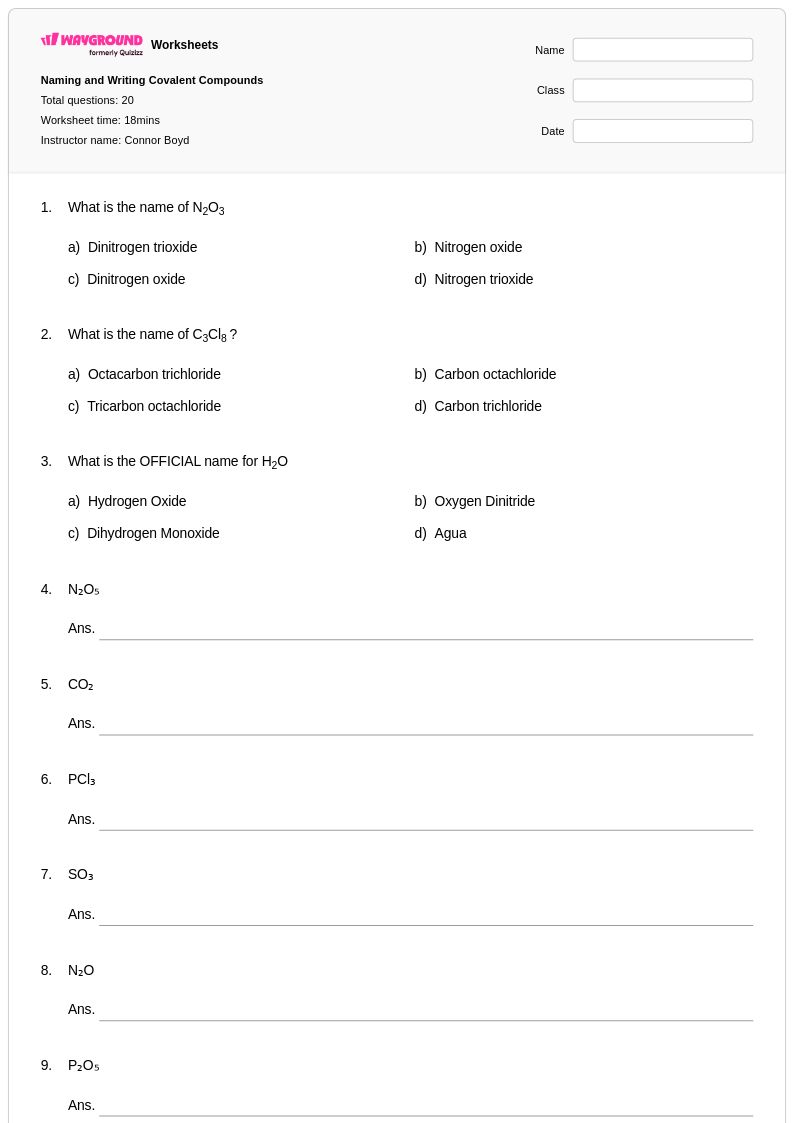
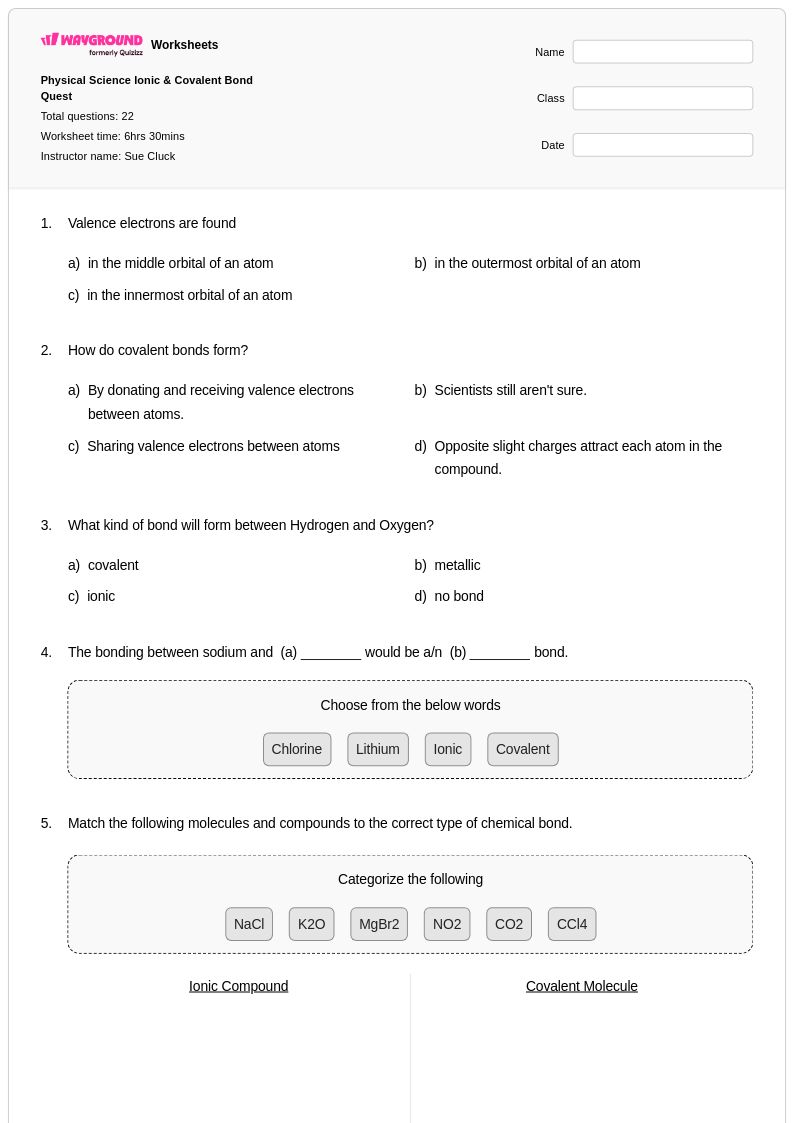
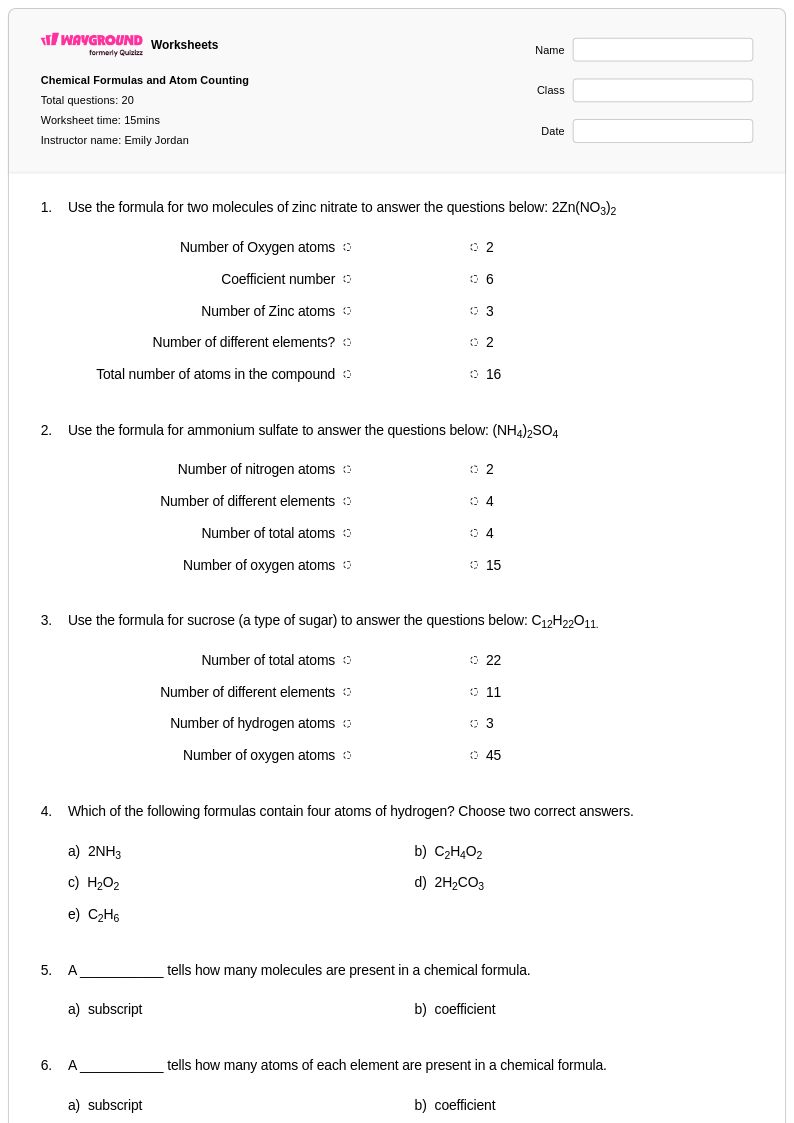
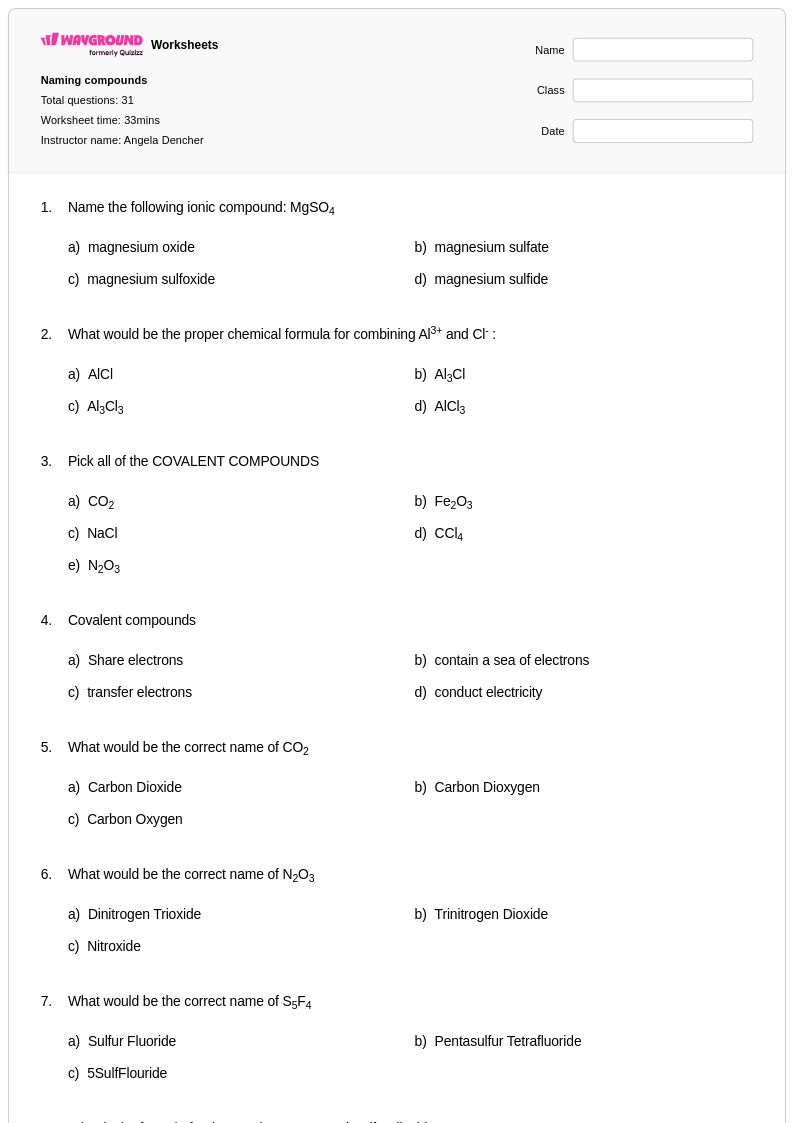
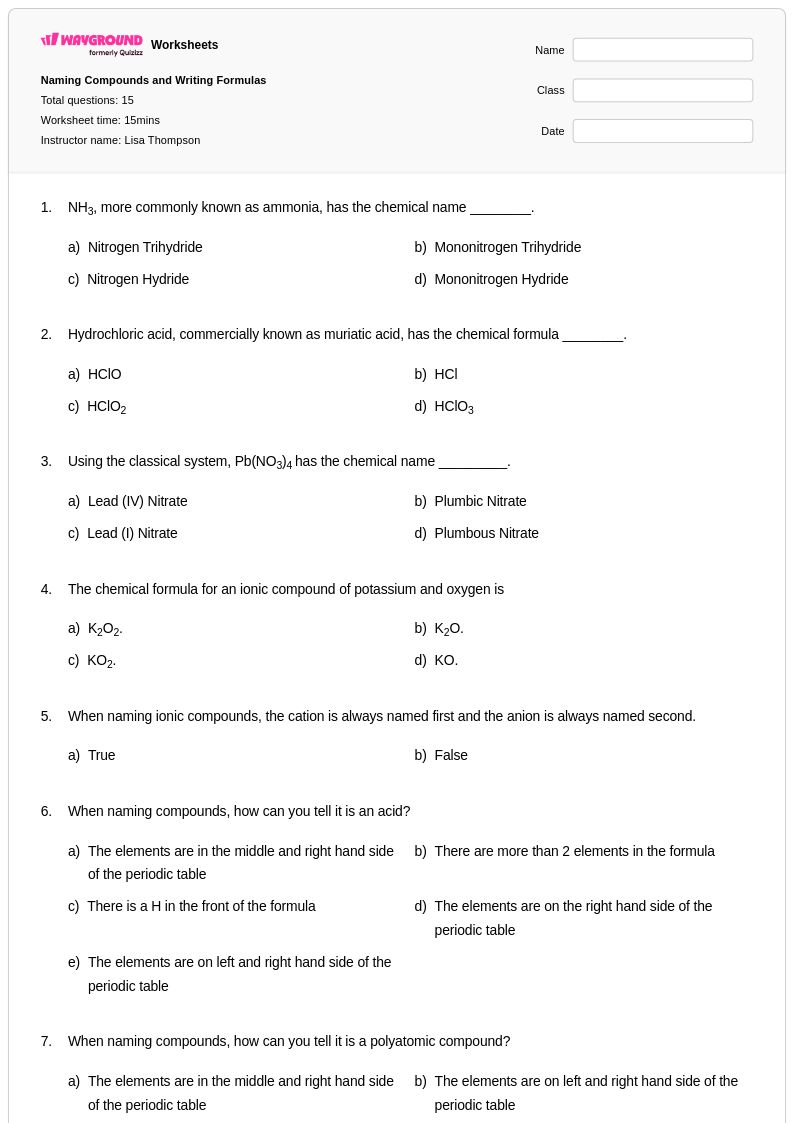
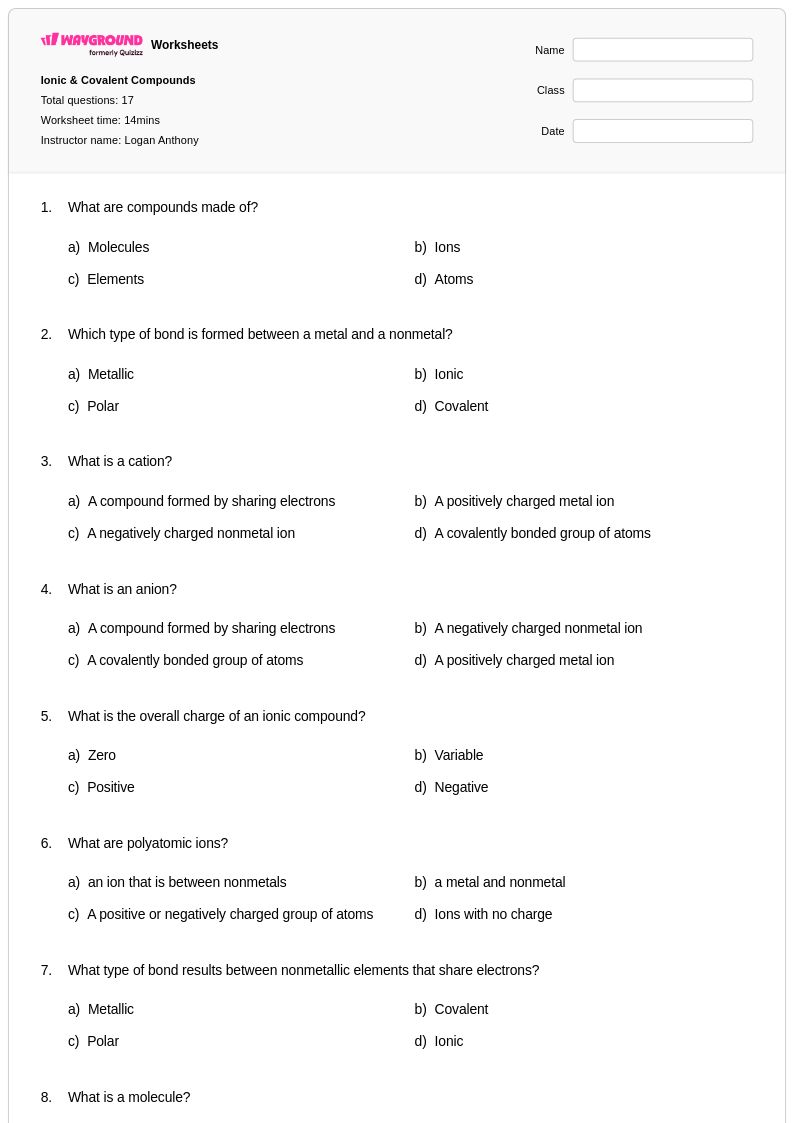
Free Printable Writing Formulas for Covalent Compounds worksheets
Master writing formulas for covalent compounds with Wayground's comprehensive collection of free worksheets, featuring printable PDFs with practice problems and detailed answer keys to strengthen your chemistry skills.
Explore printable Writing Formulas for Covalent Compounds worksheets
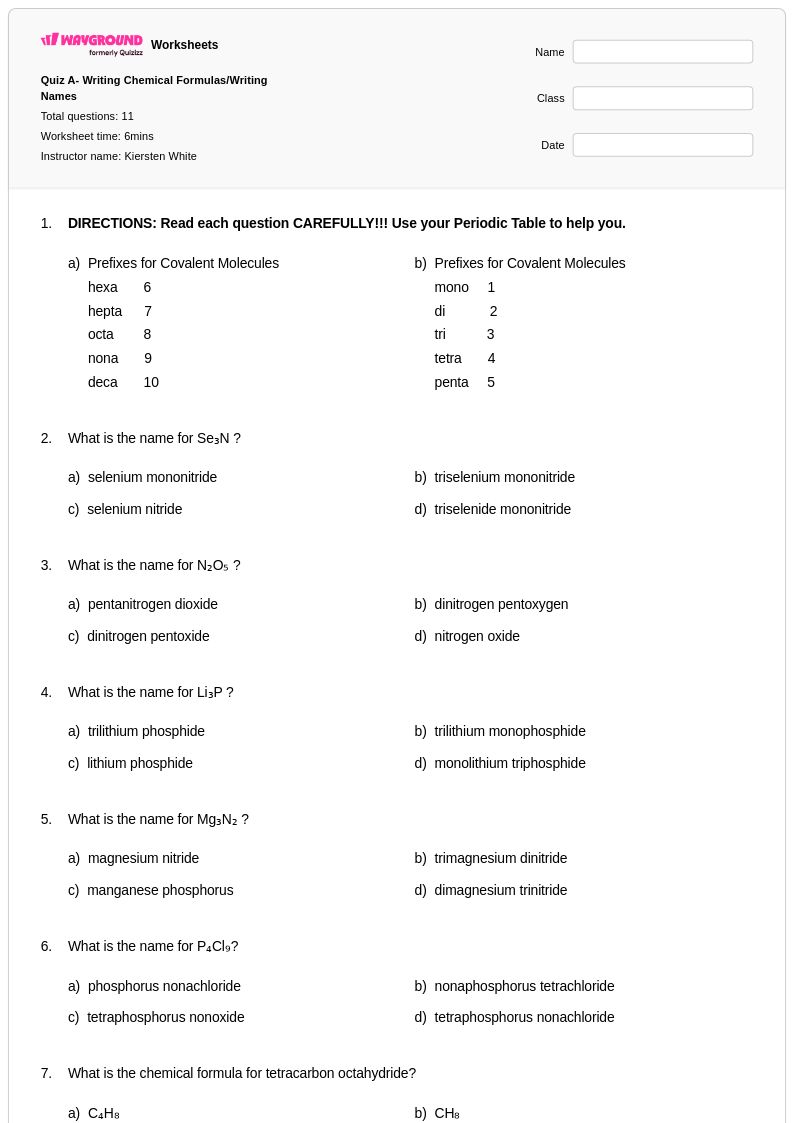
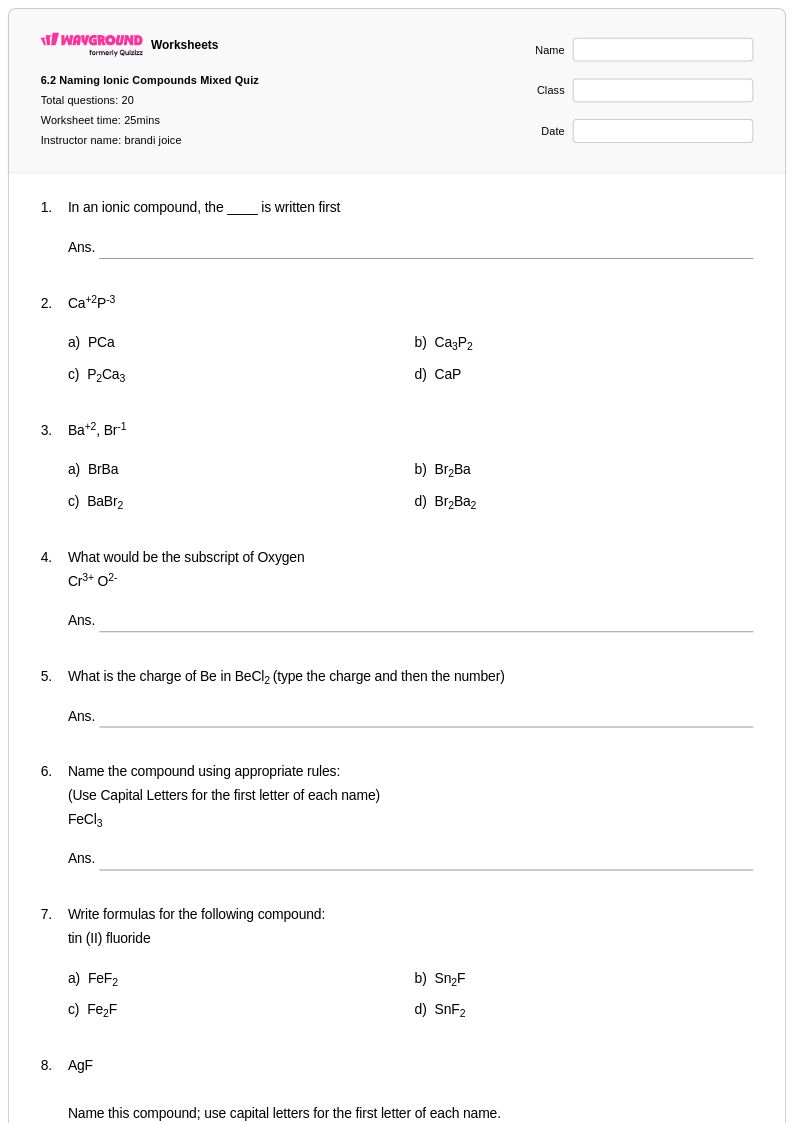
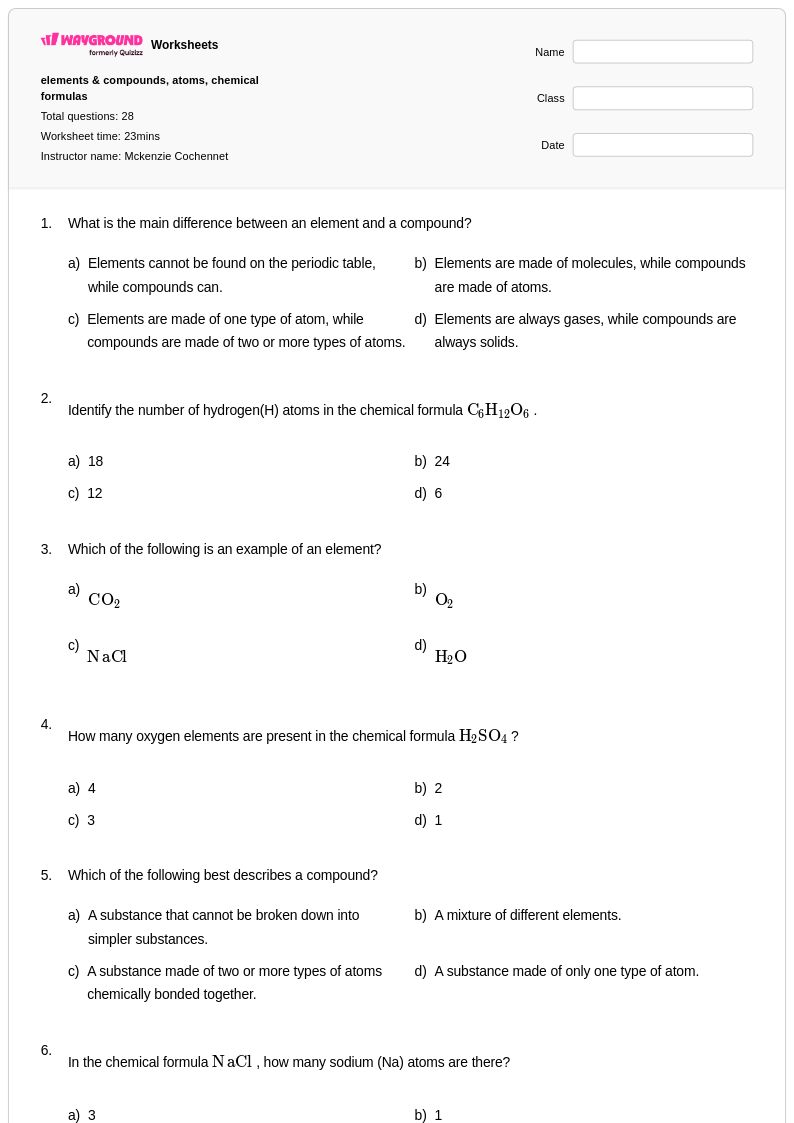
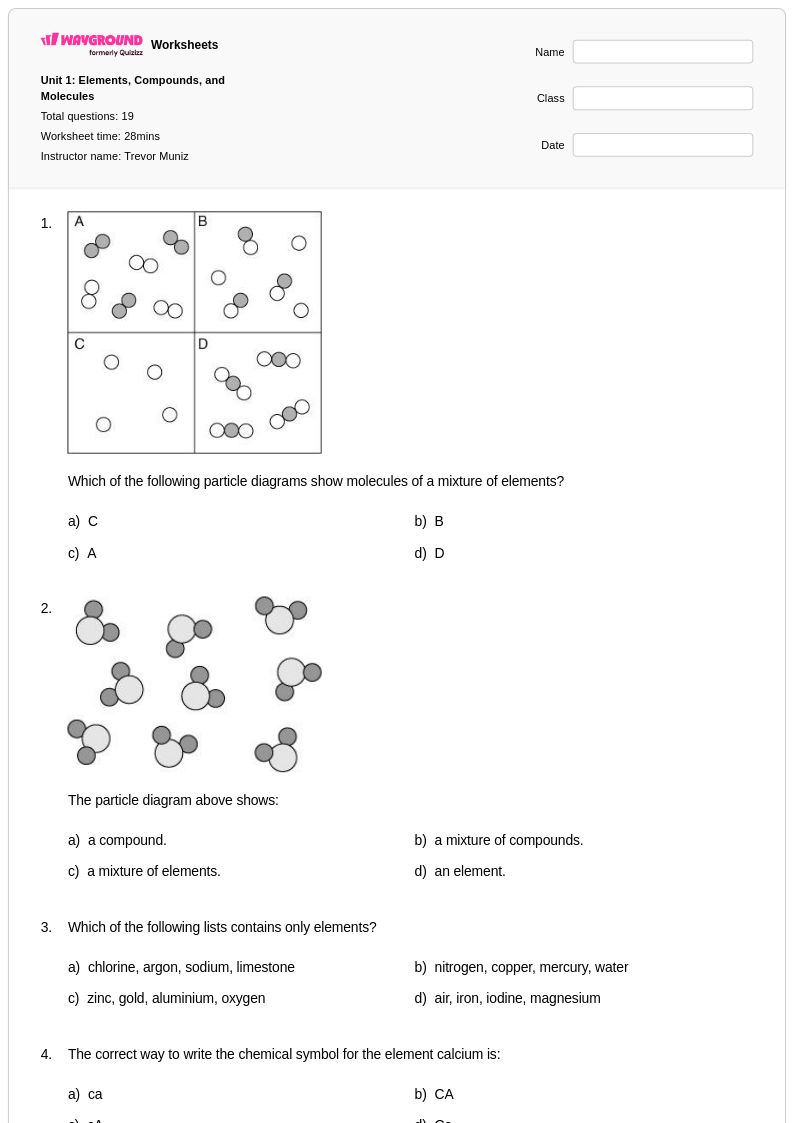
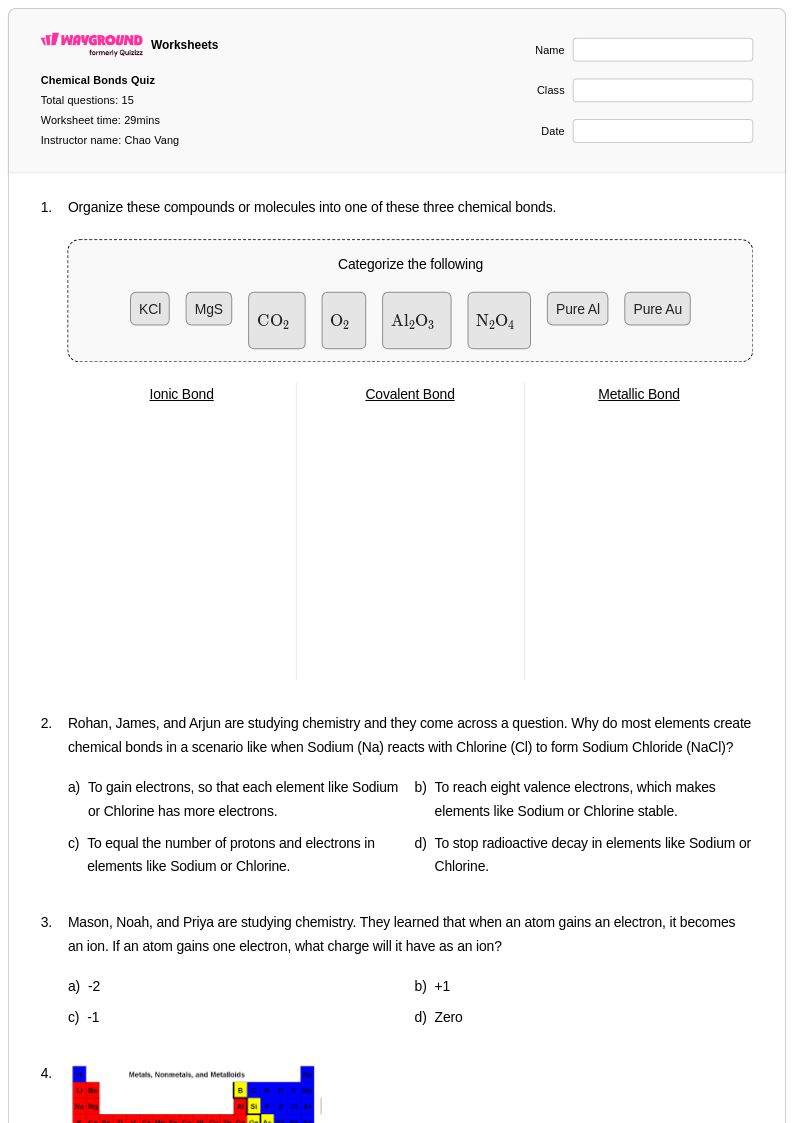
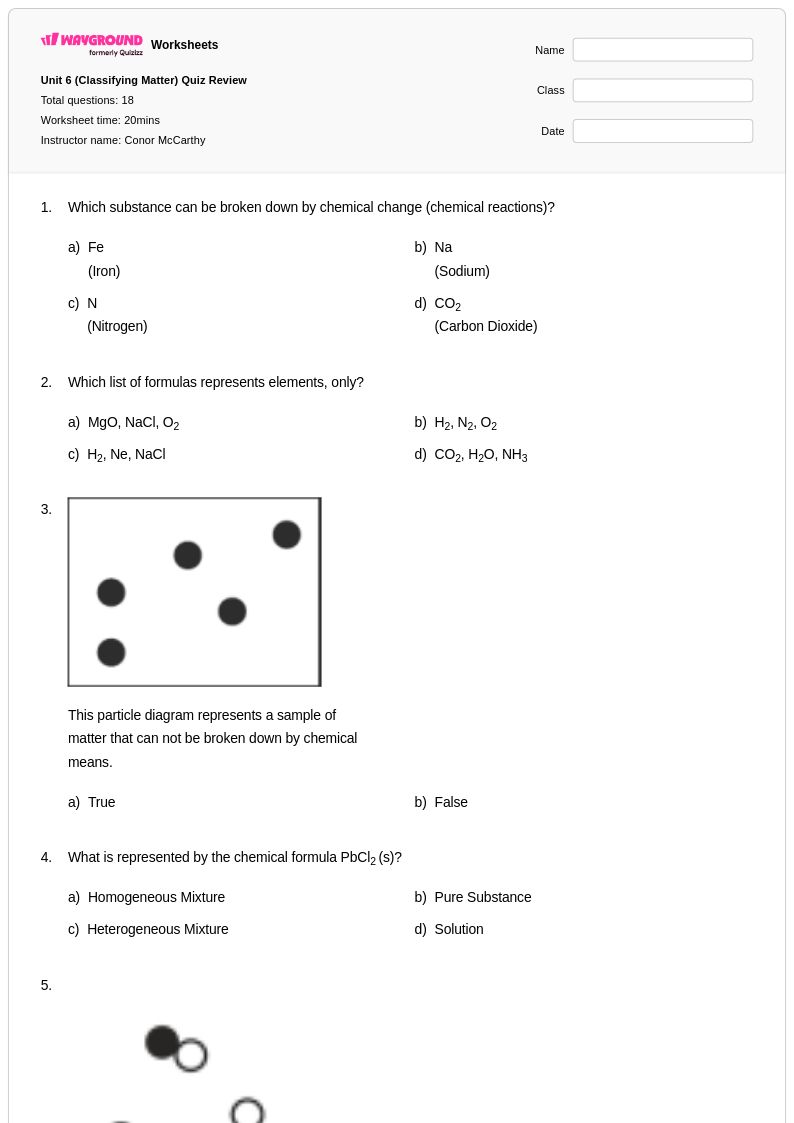
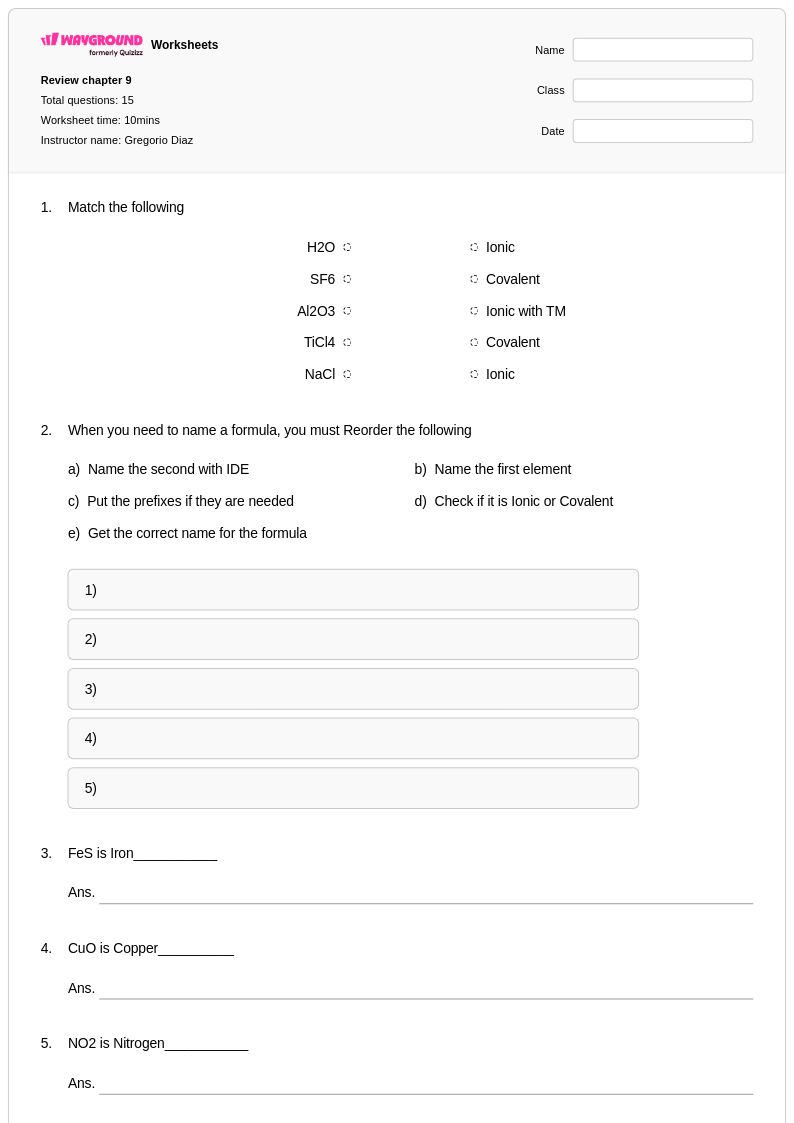
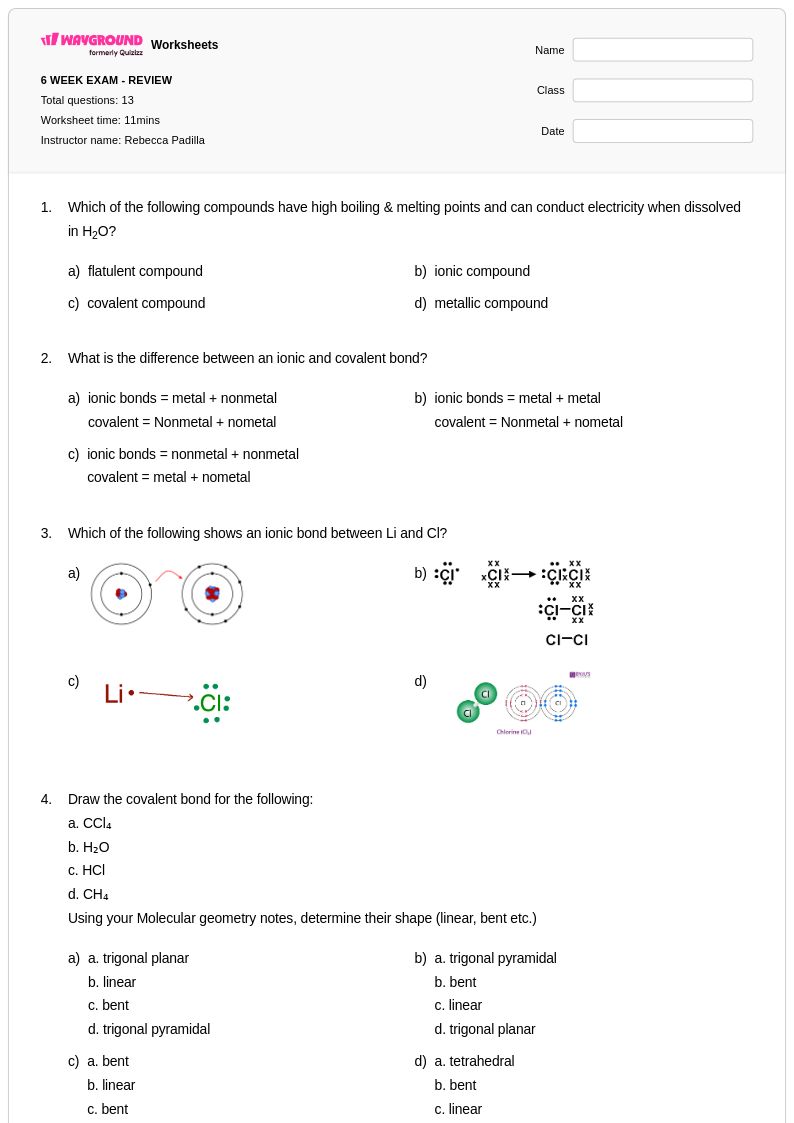
Writing formulas for covalent compounds worksheets available through Wayground (formerly Quizizz) provide students with comprehensive practice in one of chemistry's fundamental skills. These educational resources focus on teaching students how to construct accurate chemical formulas by understanding electron sharing between nonmetal atoms, applying prefixes like mono-, di-, tri-, and tetra- to indicate the number of atoms present, and recognizing common molecular compounds such as carbon dioxide, water, and ammonia. The worksheets strengthen critical thinking abilities as students learn to analyze compound names and translate them into proper chemical notation, while practice problems guide learners through systematic approaches to formula writing. Each printable resource includes detailed answer keys that help students verify their work and understand any errors, making these free materials invaluable for both classroom instruction and independent study in pdf format.
Wayground (formerly Quizizz) supports chemistry educators with an extensive collection of teacher-created resources specifically designed for writing formulas for covalent compounds instruction. The platform's millions of educational materials can be easily located through robust search and filtering capabilities that allow teachers to find worksheets perfectly matched to their curriculum needs and standards alignment requirements. These differentiation tools enable instructors to customize content for diverse learning levels, whether providing additional support for struggling students or offering enrichment opportunities for advanced learners. The flexible format options, including both printable pdf versions and interactive digital worksheets, accommodate various classroom environments and teaching preferences, making lesson planning more efficient while ensuring students receive targeted practice in this essential chemistry skill through remediation exercises and progressive skill-building activities.
FAQs
How do I teach students to write formulas for covalent compounds?
Start by ensuring students understand that covalent compounds form between nonmetal atoms that share electrons rather than transfer them. Introduce the Greek prefix system (mono-, di-, tri-, tetra-, etc.) as the primary tool for translating a compound's name into its formula, and have students practice with familiar examples like carbon dioxide (CO₂) and dinitrogen pentoxide (N₂O₅) before moving to less recognizable names. Consistent repetition with name-to-formula conversion problems helps students internalize the pattern before they apply it independently.
What exercises help students practice writing covalent compound formulas?
The most effective practice exercises present students with a compound name and require them to write the corresponding formula using prefix cues, then reverse the process by providing a formula and asking for the IUPAC name. Mixing in common exceptions like water (H₂O) and ammonia (NH₃), which do not follow standard prefix naming, ensures students recognize when memorization is needed alongside rule application. Progressive difficulty, starting with two-element compounds before introducing more complex molecules, builds confidence and accuracy.
What mistakes do students commonly make when writing covalent compound formulas?
The most frequent error is omitting the prefix 'mono-' for the first element when it appears only once, even though convention dictates it is typically dropped for the first element but retained for the second (e.g., carbon monoxide, not monocarbon monoxide). Students also confuse covalent prefix naming with ionic compound rules, incorrectly trying to balance charges instead of reading the prefix directly. A third common error is misreading prefixes under pressure, conflating 'tetra-' (4) and 'penta-' (5), which produces formulas with the wrong atom counts.
How do I differentiate covalent compound formula instruction for mixed-ability chemistry classes?
For students who need additional support, reduce the complexity by limiting initial practice to binary compounds with straightforward prefixes and provide a prefix reference chart. For advanced learners, remove scaffolding and introduce naming challenges that require students to distinguish covalent from ionic compounds before applying the correct naming system. On Wayground, teachers can apply individual accommodations such as read aloud support, reduced answer choices, and extended time to specific students while the rest of the class receives standard settings, keeping differentiation seamless and unobtrusive.
How do I use Wayground's covalent compound formula worksheets in my chemistry class?
Wayground's writing formulas for covalent compounds worksheets are available as printable PDFs for traditional classroom use and in digital formats for technology-integrated environments, giving teachers flexibility in how they assign practice. Teachers can distribute the PDF version for in-class or homework use, or host the worksheet as a digital quiz directly on Wayground, where student responses are collected and scored automatically. Each worksheet includes a complete answer key, so students can self-check their work and identify specific errors in their formula writing.
How do covalent compound naming rules differ from ionic compound naming rules, and why does it matter for formula writing?
Covalent compounds use Greek prefixes to indicate the exact number of each atom in the formula, whereas ionic compounds rely on charge balance and do not use prefixes at all. This distinction is critical because applying ionic rules to a covalent compound, or vice versa, produces an entirely wrong formula. When teaching formula writing, explicitly contrasting the two systems with side-by-side examples prevents students from defaulting to whichever rule they learned first.