Master balancing nuclear reactions with Wayground's comprehensive collection of free worksheets, featuring printable PDFs with practice problems and answer keys to help students understand nuclear equation fundamentals.
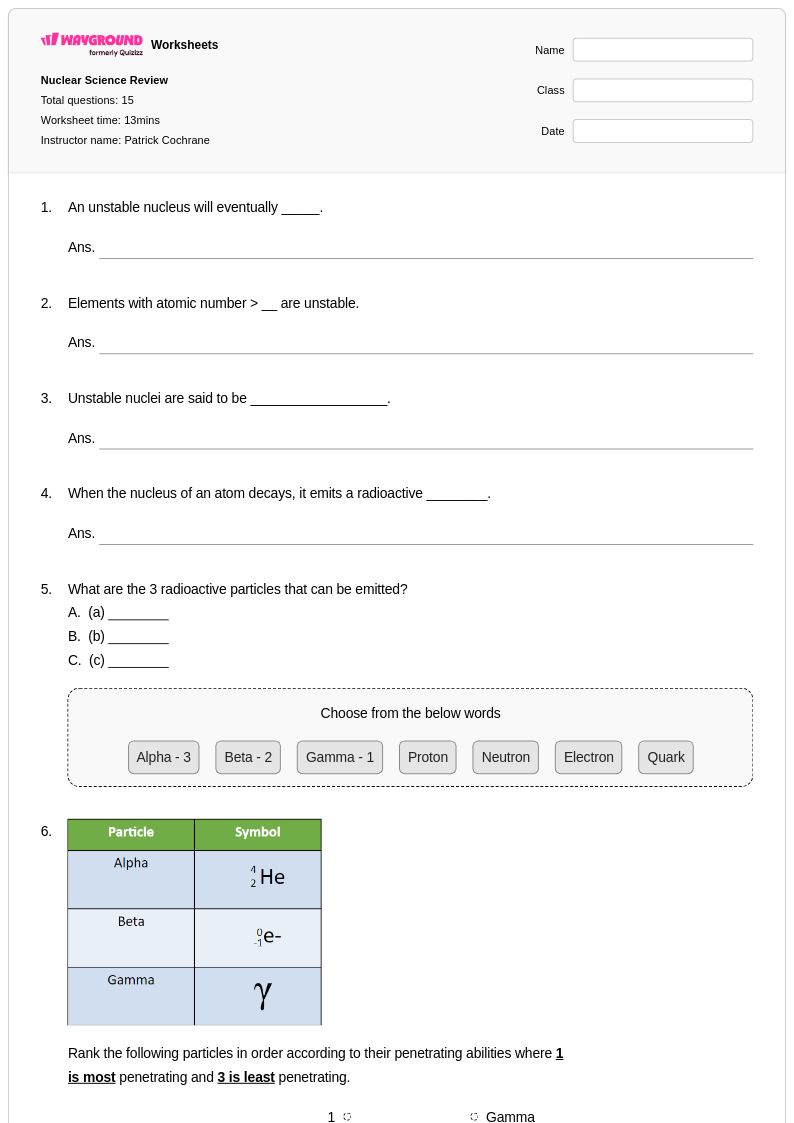
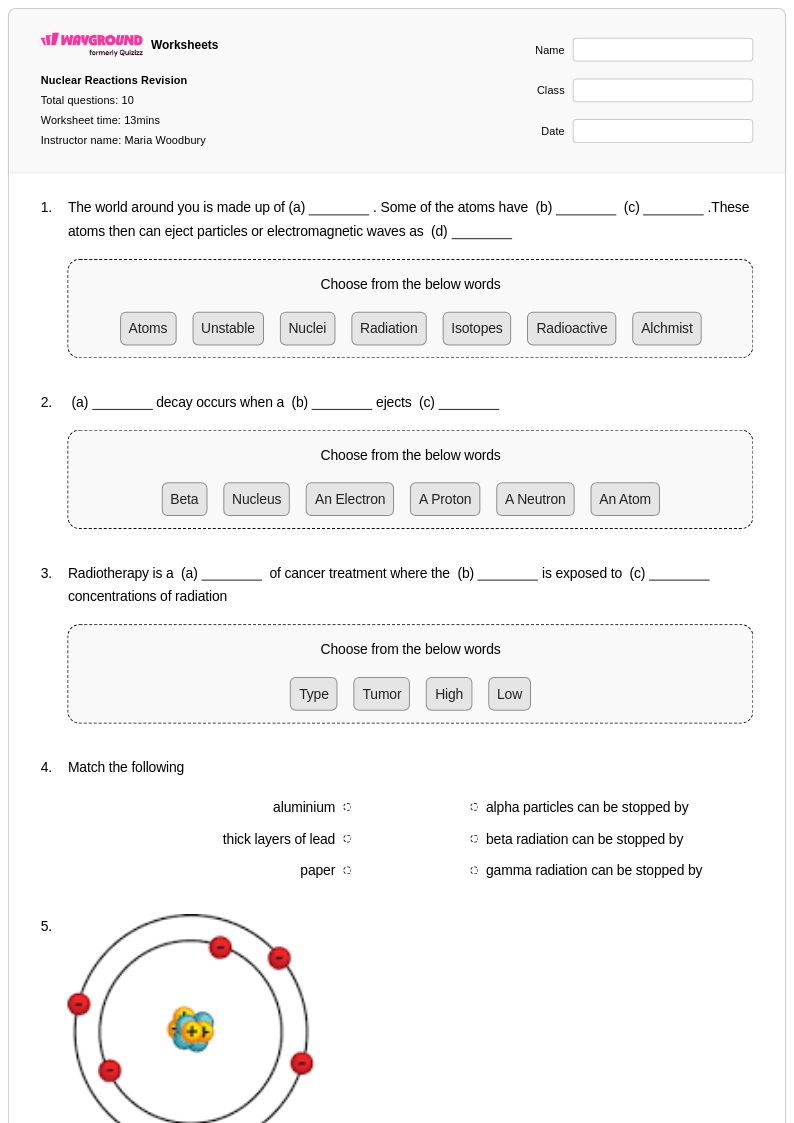
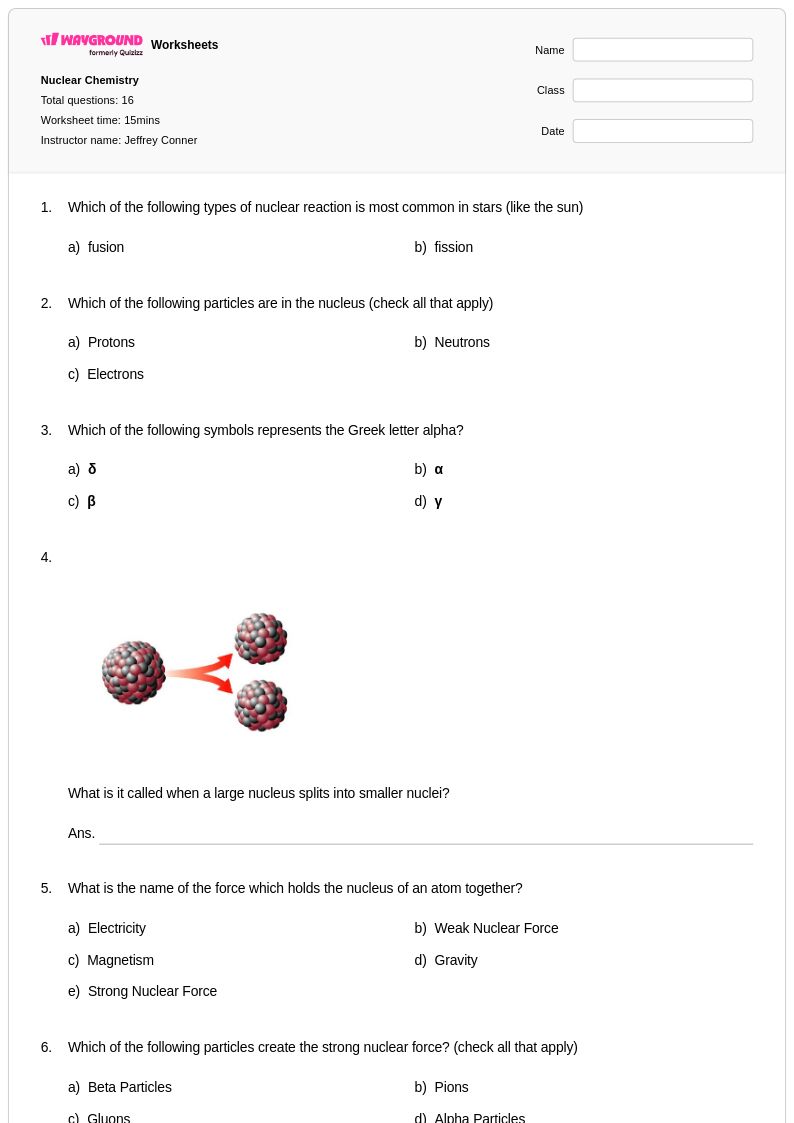
Balancing nuclear reactions worksheets available through Wayground (formerly Quizizz) provide comprehensive practice materials that help students master the fundamental principles of nuclear chemistry and radioactive decay processes. These expertly designed resources focus on developing critical skills in identifying parent and daughter nuclei, applying conservation laws for mass number and atomic number, and understanding different types of nuclear decay including alpha, beta, and gamma emissions. Students work through systematic practice problems that reinforce their ability to balance nuclear equations by ensuring proper conservation of nucleons and charge, while answer keys and detailed solutions support independent learning and self-assessment. The collection includes free printable worksheets in convenient pdf format that cover essential concepts from basic radioactive decay to more complex nuclear reactions, providing scaffolded instruction that builds confidence in nuclear equation balancing techniques.
Wayground (formerly Quizizz) empowers educators with millions of teacher-created resources specifically designed for nuclear chemistry instruction, featuring robust search and filtering capabilities that allow quick access to materials aligned with curriculum standards and learning objectives. Teachers can easily customize worksheets to match their students' proficiency levels, selecting from differentiated practice sets that range from introductory nuclear decay problems to advanced nuclear reaction scenarios involving particle bombardment and nuclear fusion processes. The platform's flexible format options support both digital classroom integration and traditional printable assignments, enabling seamless adaptation for various teaching environments and student needs. These comprehensive tools facilitate targeted skill practice, effective remediation for struggling learners, and enrichment opportunities for advanced students, while streamlined planning features help educators efficiently organize nuclear chemistry units and assess student mastery of this challenging but essential chemistry subtopic.
FAQs
How do I teach students to balance nuclear reactions?
Start by teaching the two conservation laws that govern all nuclear equations: conservation of mass number (nucleons) and conservation of atomic number (charge). Have students practice identifying the parent nucleus, the emitted particle, and the daughter nucleus before attempting to balance equations. Introducing alpha, beta, and gamma decay as distinct cases helps students build a mental framework before moving to more complex reactions like particle bombardment or fusion. Using worked examples alongside guided practice problems reinforces the systematic approach required to balance nuclear equations accurately.
What types of problems help students practice balancing nuclear equations?
Effective practice problems progress from identifying missing particles in single-step decay equations to balancing multi-step nuclear reactions. Students benefit from exercises that isolate each decay type, such as alpha decay, beta decay, and gamma emission, before mixing them in a single problem set. Problems that require students to write the complete nuclear equation from a written description, rather than fill in a blank, build deeper procedural fluency. Including a mix of naturally occurring decay and induced reactions ensures students can apply conservation laws across different contexts.
What mistakes do students commonly make when balancing nuclear equations?
The most common error is confusing mass number with atomic number, which leads students to apply the conservation rules to the wrong values. Students also frequently misidentify the charge of beta particles, writing beta decay equations with incorrect sign conventions for the emitted electron or positron. Another persistent misconception is treating gamma emission as a particle that carries mass, when in fact it carries only energy and does not change the mass number or atomic number of the nucleus. Targeted practice that requires students to explicitly label each conservation check reduces all three of these error patterns.
How do I differentiate nuclear reaction balancing practice for students at different skill levels?
For introductory learners, start with single-step alpha or beta decay problems where only one unknown particle must be identified. Intermediate students can work through problems involving multiple decay steps or positron emission. Advanced students benefit from problems that include particle bombardment and nuclear fusion reactions, which require the same conservation laws applied to less familiar particles. On Wayground, teachers can assign differentiated practice sets and apply individual accommodations such as reduced answer choices or extended time to support students who need additional scaffolding.
How do I use Wayground's balancing nuclear reactions worksheets in my classroom?
Wayground's balancing nuclear reactions worksheets are available as printable PDFs for traditional classroom use and in digital formats for technology-integrated environments, including the option to host the worksheet as a quiz directly on Wayground. Printable versions with answer keys allow students to work independently and self-assess, while digital formats enable real-time progress monitoring. Teachers can use the search and filtering tools to quickly find problems aligned to specific curriculum standards or decay types. Accommodations such as read aloud or extended time can be applied to individual students through the Students tab or session settings page without disrupting the rest of the class.
How do I assess whether students have mastered balancing nuclear reactions?
Mastery of nuclear equation balancing is best assessed through problems that require students to produce the full balanced equation rather than choose from multiple-choice options, since guessing can mask gaps in understanding. Look for whether students consistently apply both conservation laws simultaneously and whether they correctly identify particle symbols and charge. A useful formative check is to present an intentionally unbalanced equation and ask students to identify and correct the error. This requires students to apply their understanding analytically rather than procedurally, which is a stronger indicator of true mastery.