

Wayground
Algebra II - Unit 2 Polynomials - Printable Mathematics Worksheets year 11 - Wayground

Algebra II - Unit 2 Polynomials

23 questions

11th - 11th Grade

Mathematics

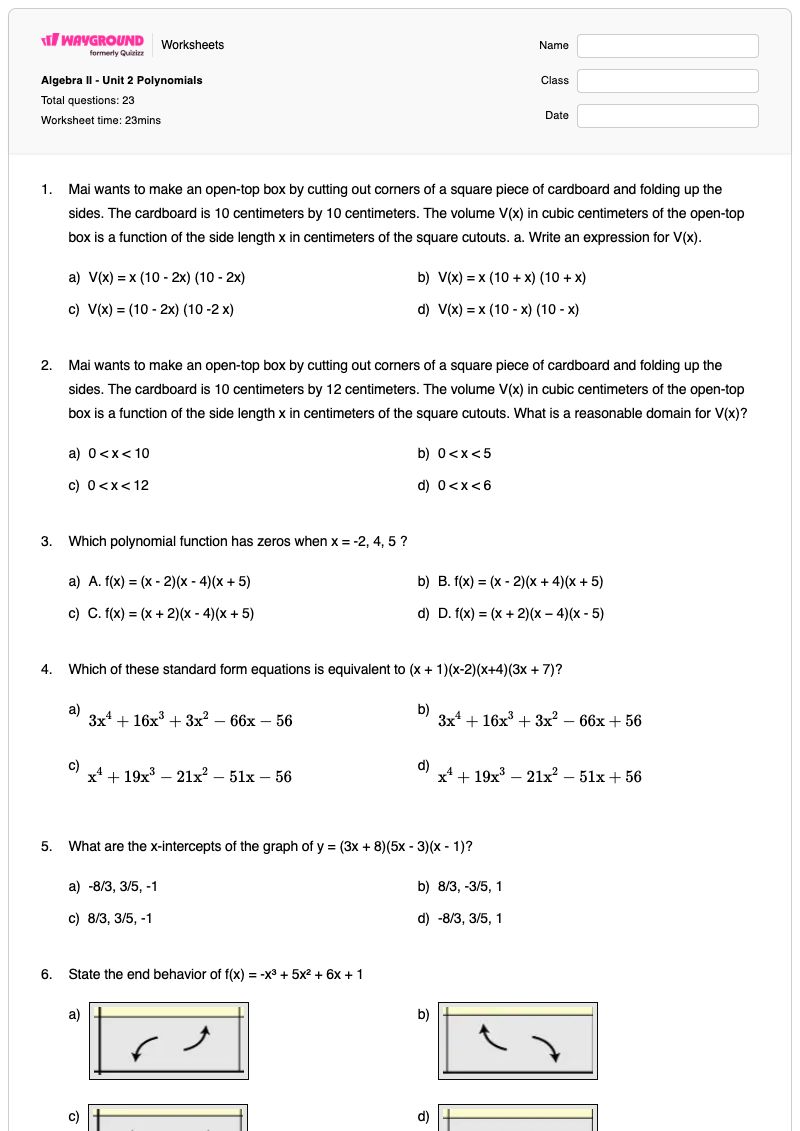
Algebra II – Unit 2 Polynomials is a Grade 11 mathematics worksheet that develops students’ ability to analyze, write, factor, and interpret polynomial functions. Its 23 mixed-format items include multiple-choice and multiple-select questions, graphing, classification, dropdown, matching, and drag-and-drop tasks. Students model polynomial volume functions and identify reasonable domains, connect zeros and x-intercepts to factors, rewrite polynomials in equivalent forms, use synthetic division, and determine end behavior and polynomial degree from equations or graphs. The worksheet also asks students to read polynomial graphs, plot zeros and a y-intercept, recognize factors and special-product forms, and match end-behavior descriptions with graphs. These varied tasks require students to move between symbolic, graphical, and applied representations rather than relying on one procedure. It is a free printable worksheet with a complete answer key, suitable for Algebra II practice, review, or an assessment of polynomial-function skills.

Worksheet settings

Font size

S
M
L
XL
Worksheets

Algebra II - Unit 2 Polynomials

Total questions: 23

Name
Class
Date
1.

Mai wants to make an open-top box by cutting out corners of a square piece of cardboard and folding up the sides. The cardboard is 10 centimeters by 10 centimeters. The volume V(x) in cubic centimeters of the open-top box is a function of the side length x in centimeters of the square cutouts. a. Write an expression for V(x).

a)

V(x) = x (10 - 2x) (10 - 2x)

b)

V(x) = x (10 + x) (10 + x)

c)

V(x) = (10 - 2x) (10 -2 x)

d)

V(x) = x (10 - x) (10 - x)

2.

Mai wants to make an open-top box by cutting out corners of a square piece of cardboard and folding up the sides. The cardboard is 10 centimeters by 12 centimeters. The volume V(x) in cubic centimeters of the open-top box is a function of the side length x in centimeters of the square cutouts. What is a reasonable domain for V(x)?

a)

0 < x < 10

b)

0 < x < 5

c)

0 < x < 12

d)

0 < x < 6

3.

Which polynomial function has zeros when x = -2, 4, 5 ?

a)

A. f(x) = (x - 2)(x - 4)(x + 5)

b)

B. f(x) = (x - 2)(x + 4)(x + 5)

c)

C. f(x) = (x + 2)(x - 4)(x + 5)

d)

D. f(x) = (x + 2)(x − 4)(x - 5)

4.

Which of these standard form equations is equivalent to (x + 1)(x-2)(x+4)(3x + 7)?

a)

3x4+16x3+3x2−66x−563x^4+16x^3+3x^2-66x-56

b)

3x4+16x3+3x2−66x+563x^4+16x^3+3x^2-66x+56

c)

x4+19x3−21x2−51x−56x^4+19x^3-21x^2-51x-56

d)

x4+19x3−21x2−51x+56x^4+19x^3-21x^2-51x+56

5.

What are the x-intercepts of the graph of y = (3x + 8)(5x - 3)(x - 1)?

a)
-8/3, 3/5, -1
b)
8/3, -3/5, 1
c)
8/3, 3/5, -1
d)
-8/3, 3/5, 1
6.

State the end behavior of f(x) = -x³ + 5x² + 6x + 1

a)

b)

c)

d)

7.

The polynomial function B(x) = x³ + 8x² + 5x − 14 has a known factor of (x + 2).

Rewrite B(x) as a product of linear factors. Hint...Use Synthetic Division.

a)
(x + 2)(x + 7)(x + 1)
b)
(x + 2)(x - 7)(x - 1)
c)
(x - 2)(x + 7)(x - 1)
d)
(x + 2)(x + 7)(x - 1)
8.

Which polynomial function's graph is shown here?

a)

f(x) = (x + 1)(x+3)(x+4)

b)

f(x) = (x + 1)(x − 3)(x+4)

c)

f(x) = (x - 1)(x+3)(x-4)

d)

f(x) = (x - 1)(x-3)(x-4)

9.

Given g(x) = (x-3)(x + 1)(x-2)

Place a point on each of the zeros and the y-intercept

10.

Which of the following graphs is a third degree polynomial?

a)

b)

c)

d)

e)

11.

Here is the graph of a polynomial function with degree 4. Select ALL of the statements that are true about the function.

a)

The leading coefficient is positive.

b)

The constant term is negative.

c)

It has 2 relative maximums.

d)

One of the zeros is x=2

e)

One of the factors is

(x-1)

12.

Kyle has three polynomials

A=2x2−3x−1A=2x^2-3x-1 B=−x2+3B=-x^2+3 C=2x+4C=2x+4 Match the following

Categorize the following

x2−3x+2x^2-3x+2  

2x2−5x−52x^2-5x-5  

x2+2x+1x^2+2x+1  

2x2−x+32x^2-x+3  

A + B
A - C
C - B
C + A
13.

The binomial that can be rewritten by using the formula for the difference of two perfect squares is (a)   .

Choose from the below words
4x2+44x^2+4
8x2−168x^2-16
25x2−1625x^2-16
x2+16x^2+16
14.

Which of the following is a factor of x2−6x−16x^2-6x-16 Select two answers.

a)

x + 2

b)

x - 2

c)

x - 8

d)

x - 4

e)

x + 16

15.

Match the following End Behavior to their Graphs

Degree is Odd, Leading Coefficient is Negative

Degree is Odd, Leading Coefficient is Positive

Degree is Even, Leading Coefficient is Negative

Degree is Even, Leading Coefficient is Positive

16.

Which graphs shares at least one zero with the function f(x)=(x+2)(x−6)f\left(x\right)=\left(x+2\right)\left(x-6\right)

a)

b)

c)

d)

e)

17.

The graph shows the overhead view of a dog walking path. Which statement is true about the polynomial model.

a)
Leading Coefficient Positive
Degree - Even
b)
Leading Coefficient Positive
Degree - Odd
c)
Leading Coefficient Negative
Degree - Even
d)
Leading Coefficient Negative
Degree - Odd
18.

f(x)=x2+x−6f\left(x\right)=x^2+x-6 , One of the zeros is ​ (a)   since the factored form of ​ (b)  

Choose from the below words
2

f(x)=(x+3)(x−2)f\left(x\right)=\left(x+3\right)\left(x-2\right)  

3
-6
19.

Judy correctly factored 3x3+3x2−603x^3+3x^2-60 as 3x(x−4)(x+5)3x\left(x-4\right)\left(x+5\right)  . She claimed that the zeros of the quadratic function are located at x = -4 and x = 5. Did Judy correctly find the zeros of the function?

a)

YesYes

b)

No, the zeros are x=4 and x=−5No,\ the\ zeros\ are\ x=4\ and\ x=-5

c)

  No, the zeros are  x=4, x=−5, x=0No,\ the\ zeros\ are\ \ x=4,\ x=-5,\ x=0

d)

  No, the zeros are x=−4, x=0 and x=5No,\ the\ zeros\ are\ x=-4,\ x=0\ and\ x=5

20.

Match the following graph with an equation that has the same End Behaviors

f(x)=5x3+x2−15f\left(x\right)=5x^3+x^2-15

f(x)=8x4+x−18f\left(x\right)=8x^4+x-18

f(x)=−3x4+12x3+8x2+60f\left(x\right)=-3x^4+12x^3+8x^2+60

f(x)=−x+3f\left(x\right)=-x+3

21.

Which of the following could be a graph of an equation of the form y=x3+ax2+bx+cy=x^3+ax^2+bx+c for some real numbers a, b, and c?

a)

b)

c)

d)

22.

Factor the following

Hint - Difference of 2 perfect squares

81x4−181x^4-1

a)

(9x−1)(9x+1)\left(9x-1\right)\left(9x+1\right)

b)

(9x2−1)2\left(9x^2-1\right)^2

c)

(3x−1)4\left(3x-1\right)^4

d)

(9x2+1)(3x−1)(3x+1)\left(9x^2+1\right)\left(3x-1\right)\left(3x+1\right)

23.

What are all the zeros of the function f(x)=x2−9xf\left(x\right)=x^2-9x

a)

x = 3 and x=-3

b)

x = 0 and x = 9

c)

x = 0, x=-3 ans x=3

d)

x = 0 and x = -9

Answer Key

Algebra II - Unit 2 Polynomials

Total questions: 23

1.
a)

V(x) = x (10 - 2x) (10 - 2x)

2.
b)

0 < x < 5

3.
d)

D. f(x) = (x + 2)(x − 4)(x - 5)

4.
a)

3x4+16x3+3x2−66x−563x^4+16x^3+3x^2-66x-56

5.
d) -8/3, 3/5, 1
6.
b)

7.
d) (x + 2)(x + 7)(x - 1)
8.
b)

f(x) = (x + 1)(x − 3)(x+4)

9.
10.
c)

11.
a)

The leading coefficient is positive.

, d)

One of the zeros is x=2

12.
A + B

x2−3x+2x^2-3x+2  

A - C

2x2−5x−52x^2-5x-5  

C - B

x2+2x+1x^2+2x+1  

C + A

2x2−x+32x^2-x+3  

13.
25x2−1625x^2-16
14.
a)

x + 2

, c)

x - 8

15.
 - 

Degree is Odd, Leading Coefficient is Negative

,  - 

Degree is Odd, Leading Coefficient is Positive

,  - 

Degree is Even, Leading Coefficient is Negative

,  - 

Degree is Even, Leading Coefficient is Positive

16.
b) , d)
17.
b) Leading Coefficient Positive
Degree - Odd
18.
2,

f(x)=(x+3)(x−2)f\left(x\right)=\left(x+3\right)\left(x-2\right)  

19.
c)

  No, the zeros are  x=4, x=−5, x=0No,\ the\ zeros\ are\ \ x=4,\ x=-5,\ x=0

20.

 - 

f(x)=5x3+x2−15f\left(x\right)=5x^3+x^2-15

, 

 - 

f(x)=8x4+x−18f\left(x\right)=8x^4+x-18

, 

 - 

f(x)=−3x4+12x3+8x2+60f\left(x\right)=-3x^4+12x^3+8x^2+60

, 

 - 

f(x)=−x+3f\left(x\right)=-x+3

21.
d)

22.
d)

(9x2+1)(3x−1)(3x+1)\left(9x^2+1\right)\left(3x-1\right)\left(3x+1\right)

23.
b)

x = 0 and x = 9

FAQs

What does this Algebra II polynomials worksheet cover?

This worksheet covers polynomial functions through 23 mixed-format tasks, including modeling volume and domain, identifying zeros and x-intercepts, rewriting and factoring expressions, using synthetic division, analyzing end behavior, and interpreting graphs. Its graphing, matching, multiple-select, and other question types require students to connect equations, factors, zeros, intercepts, degree, and graphical features.

How can I use this worksheet to teach polynomial functions?

Begin with the open-top box items to discuss how a polynomial can model volume and how physical dimensions limit its domain. Then have students connect factored equations to zeros and x-intercepts before moving to synthetic division, end behavior, and graph interpretation. Ask students to explain how a sign in a factor changes the corresponding zero and how the leading term affects a graph’s end behavior.

What mistakes should I watch for when students complete this polynomial worksheet?

Watch for sign errors when students convert zeros into factors, such as using x − 2 for a zero of −2, and for choosing a domain larger than the shorter usable side in the box model. Students may also confuse x-intercepts with y-intercepts, reverse end behavior for a negative leading coefficient, or select a factor without completing the synthetic-division or factor check. In graphing and matching items, check that plotted zeros and the y-intercept come from the correct equation.

How do I assign and grade this polynomial worksheet?

The Algebra II – Unit 2 Polynomials worksheet is available as a printable PDF and as a digital quiz on Wayground, and it includes a complete answer key for its mixed-format questions. For printable submissions, you can grade student work by scanning it with the Wayground for Teachers app.

How can I differentiate this polynomial worksheet for my students?

Use the worksheet’s Advanced Settings to adjust font spacing and font size so polynomial expressions, answer choices, and graph-based prompts are easier to read. You can also apply a dyslexia-friendly font or translate the worksheet into another language, which can support access to its factoring, graphing, and matching tasks.

Where can I find more worksheets like this on Wayground?

Wayground offers a comprehensive collection of free printable worksheets and practice problems across subjects, with downloadable PDFs and answer keys to help students master essential skills and concepts. Browse more resources at https://wayground.com/en-us/worksheets.