

Wayground
Chemical vs. Physical Changes - Printable Science Worksheets year 7 - Wayground

Chemical vs. Physical Changes

20 questions

7th - 8th Grade

Science

Chemical vs. Physical Changes is a Grade 7–8 science worksheet that helps students distinguish changes that form new substances from changes in form, appearance, or state. Across 20 questions—17 multiple choice and 3 multiple select—students identify precipitates, phase changes, combustion, chemical reactions, and physical changes, then classify examples such as rusting, tearing paper, leaves changing color, and melting ice. The worksheet also asks students to apply the distinction to familiar scenarios, including baking a cake, dissolving sugar in water, and combining baking soda with vinegar. Several items require students to use evidence such as fizzing, color change, formation of a new substance, or the absence of a new substance to support scientific reasoning. This free printable worksheet is designed for middle school science practice, review, or assessment and includes a complete answer key.

Worksheet settings

Font size

S
M
L
XL
Worksheets

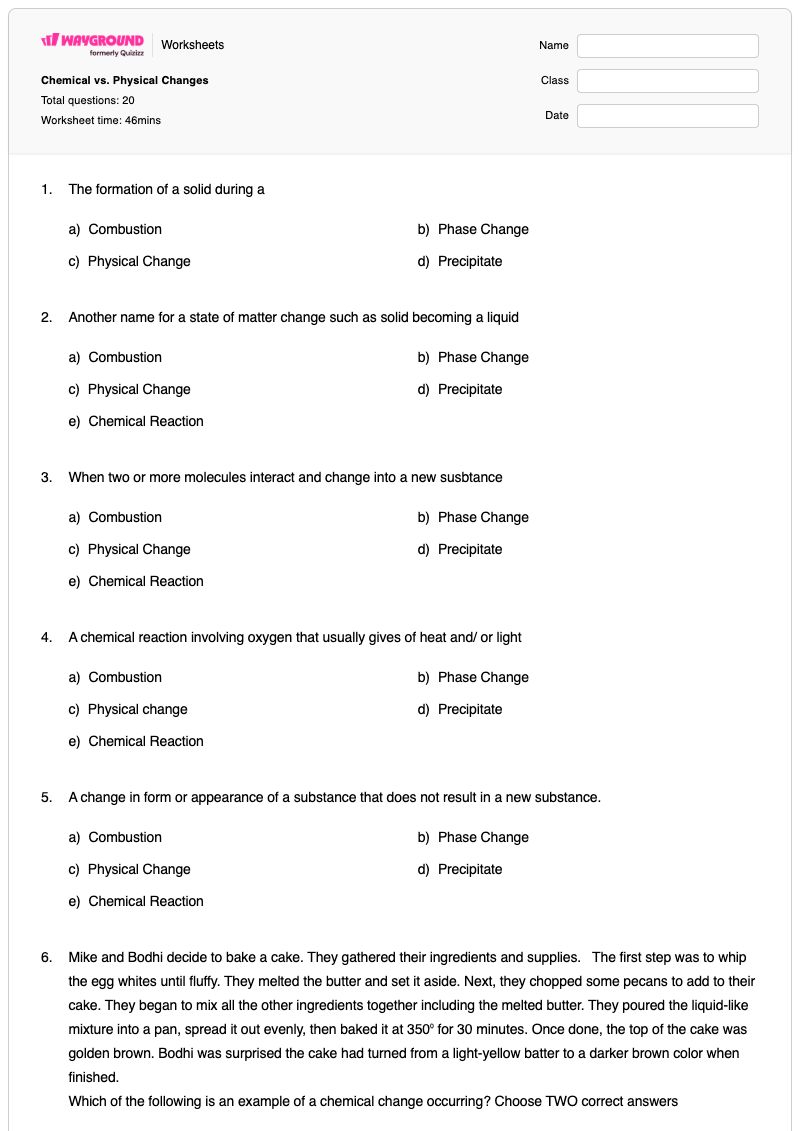
Chemical vs. Physical Changes

Total questions: 20

Name
Class
Date
1.

The formation of a solid during a  

a)

Combustion

b)

Phase Change

c)

Physical Change

d)

Precipitate

2.

Another name for a state of matter change such as solid becoming a liquid

a)

Combustion

b)

Phase Change

c)

Physical Change

d)

Precipitate

e)

Chemical Reaction

3.

When two or more molecules interact and change into a new susbtance

a)

Combustion

b)

Phase Change

c)

Physical Change

d)

Precipitate

e)

Chemical Reaction

4.

A chemical reaction involving oxygen that usually gives of heat and/ or light

a)

Combustion

b)

Phase Change

c)

Physical change

d)

Precipitate

e)

Chemical Reaction

5.

A change in form or appearance of a substance that does not result in a new substance.

a)

Combustion

b)

Phase Change

c)

Physical Change

d)

Precipitate

e)

Chemical Reaction

6.

Mike and Bodhi decide to bake a cake. They gathered their ingredients and supplies.   The first step was to whip the egg whites until fluffy. They melted the butter and set it aside. Next, they chopped some pecans to add to their cake. They began to mix all the other ingredients together including the melted butter. They poured the liquid-like mixture into a pan, spread it out evenly, then baked it at 350⁰ for 30 minutes. Once done, the top of the cake was golden brown. Bodhi was surprised the cake had turned from a light-yellow batter to a darker brown color when finished.

Which of the following is an example of a chemical change occurring? Choose TWO correct answers

a)

Whipping the egg until fluffy

b)

Melting the butter

c)

Baking the cake at a high temperature

d)

Chopping the pecans

e)

The golden-brown color of the top of the cake

7.

Mike and Bodhi decide to bake a cake. They gathered their ingredients and supplies.   The first step was to whip the egg whites until fluffy. They melted the butter and set it aside. Next, they chopped some pecans to add to their cake. They began to mix all the other ingredients together including the melted butter. They poured the liquid-like mixture into a pan, spread it out evenly, then baked it at 350⁰ for 30 minutes. Once done, the top of the cake was golden brown. Bodhi was surprised the cake had turned from a light-yellow batter to a darker brown color when finished.

Which of the following is evidence of a chemical reaction occurring during this activity? Choose TWO correct answers

a)

The mixed ingredients changed to a new substancce when baked.

b)

The butter cchanged from a solid to a liquid.

c)

The texture of the eggs changed from a gel-like substance to a fluffy substance.

d)

The top of the cake changed to a new color.

e)

The shape of the pecans changed after they were chopped.

8.

Mike and Bodhi decide to bake a cake. They gathered their ingredients and supplies.   The first step was to whip the egg whites until fluffy. They melted the butter and set it aside. Next, they chopped some pecans to add to their cake. They began to mix all the other ingredients together including the melted butter. They poured the liquid-like mixture into a pan, spread it out evenly, then baked it at 350⁰ for 30 minutes. Once done, the top of the cake was golden brown. Bodhi was surprised the cake had turned from a light-yellow batter to a darker brown color when finished.

Which of the following is an example of a physical change occurring? Choose THREE correct answers

a)

Heating the over 350 degrees

b)

Chopping the pecans

c)

Melting the butter

d)

Baking the cake at a high temperature

e)

Gathering all the ingredients and supplies

9.

Short Answer: Respond to each item with complete sentences.

During a lab investigation, students followed this procedure:

1.Measure the mass of the baking soda.

2.Place the baking soda in a small beaker or glass container

3.Using the graduated cylinder, measure 50 mL of vinegar.

4.Add 3 drops of liquid dish soap to the graduated cylinder.

5.Slowly pour the vinegar mixture into the beaker containing the baking soda.

6.Record your observations.

Students observed that the baking soda fizzed, and the liquid expanded to overflow the beaker. After the bubbles stopped, students observed there was very little baking soda left in the bottom of the beaker.

QUESTION: What kind of change occurred? Support your answer using evidence and reasoning.

a)

A chemical change occurred. A chemical change occurring is evident when the vinegar was poured into the baking soda mixture, and bubles or fizzing appeared. When fizzing was done, there was little baking soda left in the beaker.

b)

A physical change. A physical change occurring is evident when the vinegar was poured into the baking soda mixture, and bubles or fizzing appeared. When fizzing was done, there was little baking soda left in the beaker.

10.

Short Answer: Respond to each item with complete sentences.

QUESTION: What type of change occurs when you dissolve sugar in water? Use scientific reasoning to support your answer.

a)

Chemical change: A chemical change occurs. When sugar is mixed with water, the sugar dissolves in the water, but no new substances are created. If the water evaporates, the water changes state of matter from liquid to gas, yet the sugar remains unchanged.

b)

Physical change: A physical change occurs. When sugar is mixed with water, the sugar dissolves in the water, but no new substances are created. If the water evaporates, the water changes state of matter from liquid to gas, yet the sugar remains unchanged.

11.

QUESTION: What type of change occurs when you bake a cake with flour, water, sugar, and other ingredients? Explain your reasoning.

a)

A physical change occurs. The evidence of a physical change occurs when the combined ingredients are changed into a new substance when baked at a high temperature. The new substance has new physical properties.

b)

A chemical change. The evidence of a chemical change occurs when the combined ingredients are changed into a new substance when baked at a hight temperature. The new substance has new chemical properties.

12.

Physical or Chemical Change: Iron Rusting

a)

Chemical Change

b)

Physical Change

13.

Physical or Chemical Change: Tearing Paper

a)

Chemical Change

b)

Physical Change

14.

Physical or Chemical Change: Leaves changing color

a)

Chemical Change

b)

Physical Change

15.

Physical or Chemical Change: Ice Melting

a)

Chemical Change

b)

Physical Change

16.

Physical or Chemical Change: Silver Tarnishing ( to dull or destroy the luster of by or as if by air, dust, or dirt : soil, stain.)

a)

Chemical Change

b)

Physical Change

17.

Physical or Chemical Change: Food digesting

a)

Chemical Change

b)

Physical Change

18.

Physical or Chemical Change: Bread Rising

a)

Chemical Change

b)

Physical Change

19.

Physical or Chemical Change: Chopping Vegetables

a)

Chemical Change

b)

Physical Change

20.

Physical or Chemical Change: Wood Burning

a)

Chemical Change

b)

Physical Change

Answer Key

Chemical vs. Physical Changes

Total questions: 20

1.
d)

Precipitate

2.
b)

Phase Change

3.
e)

Chemical Reaction

4.
a)

Combustion

5.
c)

Physical Change

6.
c)

Baking the cake at a high temperature

, e)

The golden-brown color of the top of the cake

7.
a)

The mixed ingredients changed to a new substancce when baked.

, d)

The top of the cake changed to a new color.

8.
a)

Heating the over 350 degrees

, b)

Chopping the pecans

, c)

Melting the butter

9.
a)

A chemical change occurred. A chemical change occurring is evident when the vinegar was poured into the baking soda mixture, and bubles or fizzing appeared. When fizzing was done, there was little baking soda left in the beaker.

10.
b)

Physical change: A physical change occurs. When sugar is mixed with water, the sugar dissolves in the water, but no new substances are created. If the water evaporates, the water changes state of matter from liquid to gas, yet the sugar remains unchanged.

11.
b)

A chemical change. The evidence of a chemical change occurs when the combined ingredients are changed into a new substance when baked at a hight temperature. The new substance has new chemical properties.

12.
a)

Chemical Change

13.
b)

Physical Change

14.
a)

Chemical Change

15.
b)

Physical Change

16.
a)

Chemical Change

17.
a)

Chemical Change

18.
a)

Chemical Change

19.
b)

Physical Change

20.
a)

Chemical Change

FAQs

What does this Chemical vs. Physical Changes worksheet cover?

This worksheet helps Grade 7–8 students distinguish chemical changes, which produce new substances, from physical changes, which alter form, appearance, or state without producing a new substance. Its 20 multiple-choice and multiple-select questions use examples such as cake baking, baking soda reacting with vinegar, sugar dissolving, rusting, and ice melting, requiring students to identify evidence such as fizzing, color change, and formation of a new substance.

How can I use this worksheet to teach chemical and physical changes?

Introduce the distinction with the key question, “Did a new substance form?” Then have students apply that test to the worksheet’s examples, comparing melting butter, chopping pecans, and dissolving sugar with baking a cake or combining baking soda and vinegar. After students complete the multiple-select items, ask them to explain why an observation such as fizzing or a new color supports a chemical-change classification.

What mistakes should I watch for when students complete this worksheet?

Students may classify every visible change as chemical, even though melting ice, melting butter, chopping pecans, and dissolving sugar do not create new substances. They may also select only one answer on the cake and lab multiple-select questions or confuse evidence of a reaction—such as fizzing, a new color, or a new substance—with a physical change. Check that their reasoning distinguishes a change in state or form from the formation of new substances.

How do I assign and grade this Chemical vs. Physical Changes worksheet?

You can assign it as a printable PDF or as a digital quiz on Wayground. The worksheet includes a complete answer key for checking the multiple-choice and multiple-select responses, and printable submissions can be graded by scanning student work with the Wayground for Teachers app. The printable format also gives schools an option for reducing screen time.

How can I differentiate this worksheet for my students?

Use the worksheet’s Advanced Settings to adjust font spacing and font size so the vocabulary and scenario-based questions are easier to read. You can also enable a dyslexia-friendly font or translate the worksheet into another language, which may support access to terms such as precipitate, combustion, phase change, and chemical reaction.

Where can I find more free worksheets like this on Wayground?

Wayground offers a broad collection of free printable worksheets and practice problems across subjects, with downloadable PDFs and answer keys to help students build essential skills and concepts. Browse more resources at https://wayground.com/en-us/worksheets.