Ratios and Tape Diagrams is a Grade 6 mathematics worksheet with 14 multiple-choice questions focused on representing, comparing, and solving ratio problems. Students identify ratio notation using a colon or the word “to,” determine part-to-part and part-to-whole ratios, recognize equivalent ratios, and use tape diagrams to find missing quantities and totals. The worksheet also includes a comparison of two prices for equivalent-ratio reasoning.
This resource helps students connect visual models with numerical ratio relationships. Questions use familiar contexts such as classroom preferences, animals, fruit, toy cars, coins, and groups of boys and girls, giving students practice identifying the correct quantities before writing or interpreting a ratio. It is a free printable worksheet for Grade 6 math instruction, independent practice, review, or assessment, and it includes a complete answer key for efficient checking.
Worksheet settings
Font size
S
M
L
XL
Worksheets
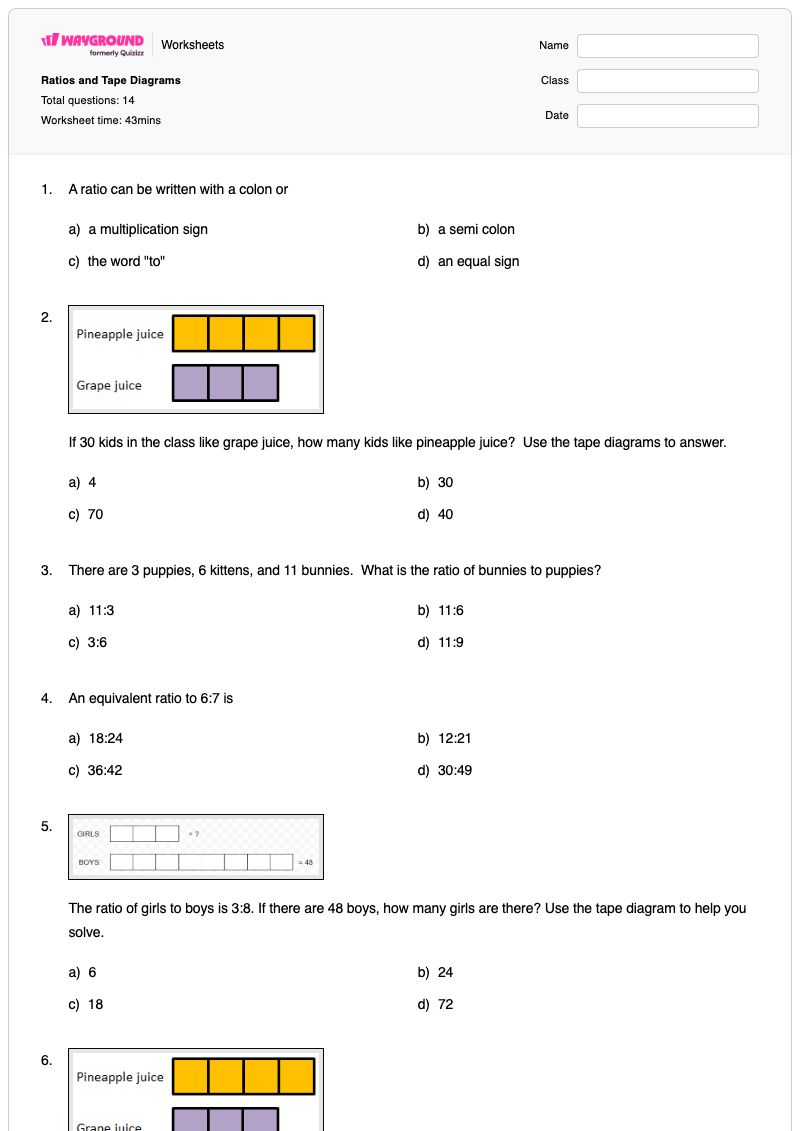
Ratios and Tape Diagrams
Total questions: 14
Name
Class
Date
1.
A ratio can be written with a colon or
a)
a multiplication sign
b)
a semi colon
c)
the word "to"
d)
an equal sign
2.
If 30 kids in the class like grape juice, how many kids like pineapple juice? Use the tape diagrams to answer.
a)
4
b)
30
c)
70
d)
40
3.
There are 3 puppies, 6 kittens, and 11 bunnies. What is the ratio of bunnies to puppies?
a)
11:3
b)
11:6
c)
3:6
d)
11:9
4.
An equivalent ratio to 6:7 is
a)
18:24
b)
12:21
c)
36:42
d)
30:49
5.
The ratio of girls to boys is 3:8. If there are 48 boys, how many girls are there? Use the tape diagram to help you solve.
a)
6
b)
24
c)
18
d)
72
6.
If 30 kids in the class like grape juice, how many kids are there total? Use the tape diagrams to answer.
a)
4
b)
30
c)
70
d)
40
7.
What is the ratio of red apples to green apples
a)
7 apples to 3 green
b)
4 red apples to 7 apples
c)
4 red apples to 3 green apples
d)
3 green apples to 4 red apples
8.
$15 for 5 pairs of socks; $25 for 10 pairs of socks
a)
yes, equivalent
b)
no, not equivalent
9.
Patrick has 2 black, 3 red, and 5 white toy cars. What is the ratio of red toy cars to all the toy cars?
a)
3:5
b)
1:3
c)
3:11
d)
3:10
10.
Which ratio is equivalent to 5 to 4
a)
25 to 20
b)
10 to 12
c)
4 to 5
d)
15 to 8
11.
If you have 3 pennies, 4 nickels, and 5 dimes which represents the following ratio: nickels to total number of coins?
a)
4:5
b)
3:12
c)
4:12
d)
5:12
12.
ΔΔΔΔΔ 00000000 What is the ratio of triangles to circles?
a)
8 to 5
b)
8:5
c)
5 to 8
d)
5 to 10
13.
a)
4
b)
12
c)
3
d)
36
14.
If there are 120 boys in the group, how many boys and girls are there TOTAL? Use the tape diagrams to solve.
a)
150
b)
270
c)
250
d)
360
Answer Key
Ratios and Tape Diagrams
Total questions: 14
1.
c) the word "to"
2.
d) 40
3.
a) 11:3
4.
c) 36:42
5.
c)
18
6.
c) 70
7.
c) 4 red apples to 3 green apples
8.
b) no, not equivalent
9.
d) 3:10
10.
a) 25 to 20
11.
c) 4:12
12.
c) 5 to 8
13.
a) 4
14.
b)
270
140 %
Browse by subjects
Browse by grades
Browse by format
FAQs
What does the Ratios and Tape Diagrams worksheet help Grade 6 students learn?
This worksheet builds ratio reasoning through 14 multiple-choice questions on ratio notation, part-to-part and part-to-whole comparisons, equivalent ratios, and tape-diagram problems. Students must identify the quantities being compared, select the correct ratio order, and use visual parts to determine missing values or totals.
How can I use this worksheet to teach ratios with tape diagrams?
Introduce the worksheet by modeling how a tape diagram represents equal ratio parts, then connect the diagram to ratio notation using a colon or the word “to.” As students work through the multiple-choice items, ask them to explain whether each ratio compares two categories or one category with the total, and have them justify equivalent-ratio choices by scaling both terms by the same factor.
What mistakes should I watch for when students complete this ratio worksheet?
Watch for students reversing the order of the quantities, such as writing puppies to bunnies instead of bunnies to puppies, or using a category count as the denominator when the question asks for the total. Students may also choose ratios that look similar without scaling both terms equally, or misread tape diagrams by counting sections instead of using the value represented by each section.
How do I assign and grade this Ratios and Tape Diagrams worksheet?
The worksheet is available as a printable PDF and as a digital quiz on Wayground, with a complete answer key for all items. You can grade printable submissions by scanning student work with the Wayground for Teachers app, while the digital quiz supports online completion and grading.
How can I differentiate this ratios and tape diagrams worksheet for my students?
Under the worksheet’s Advanced Settings, adjust font spacing or choose a larger font size to make the multiple-choice prompts and tape-diagram questions easier to read. You can also apply a dyslexia-friendly font or translate the worksheet text into another language while keeping the ratio and visual-model tasks intact.
Where can I find more worksheets like this on Wayground?
Wayground offers a comprehensive collection of free printable worksheets and practice problems across subjects, including downloadable PDFs and answer keys to support essential skills and concepts. Browse more resources at https://wayground.com/en-us/worksheets.

 Worksheets


