

Wayground
Compare & Contrast - Printable English Worksheets - Wayground

Compare & Contrast

10 questions

9th - 9th Grade

English

Compare & Contrast is a Grade 9 English worksheet that builds students’ ability to identify similarities and differences and use compare-and-contrast vocabulary accurately. The 10 multiple-choice questions cover the meanings of compare, contrast, similar, and different, then check students’ understanding of how Venn Diagrams organize shared and unique characteristics. Students apply these skills to short informational passages about reptiles and amphibians, personal details about Stella and Tim, and the physical differences between poison ivy and poison oak. This free printable worksheet provides focused practice in distinguishing similarities from differences, locating supporting details, and selecting an appropriate comparison conclusion. It includes a complete answer key for efficient review, independent practice, or classroom assessment.

Worksheet settings

Font size

S
M
L
XL
Worksheets

Compare & Contrast

Total questions: 10

Name
Class
Date
1.

to explain how something is similar to something else

a)

contrast

b)

compare

c)

similar

2.

to explain how something is different from something else

a)

compare

b)

contrast

c)

specific

3.

very much the same as something

a)

contrast

b)

similar

c)

compare

4.

not the same as another thing; unlike

a)

different

b)

contrast

c)

specific

5.

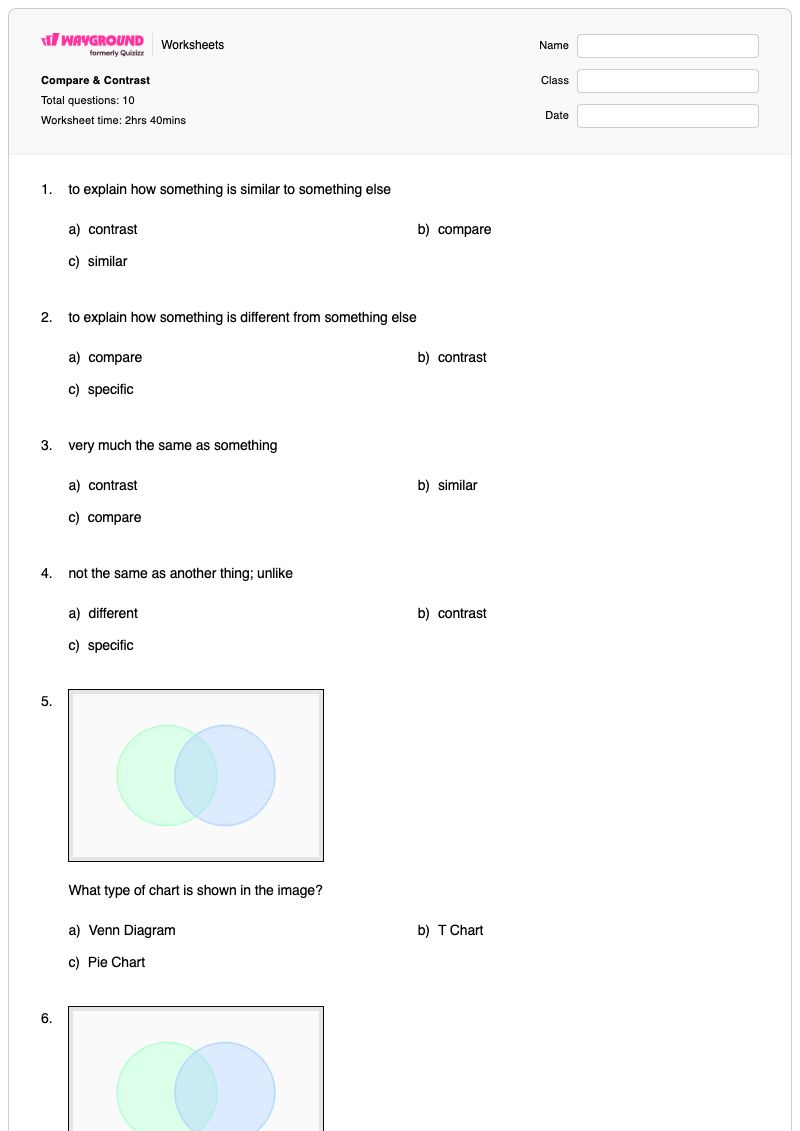
What type of chart is shown in the image?

a)

Venn Diagram

b)

T Chart

c)

Pie Chart

6.

What do you put in the outer circles of a Venn Diagram?

a)

similiarities

b)

differences

7.

What do you put in the inner circle of a Venn Diagram?

a)

similiarities

b)

differences

8.

Reptiles have scales and their toes have claws; amphibians have moist skin and their toes do not have claws. Both reptiles and amphibians lay eggs. However, reptile eggs have a thick hard shell and are laid on land, but amphibian eggs have no shell and are laid in water. Young reptiles are miniature replicas of their parents and are born with lungs, but young amphibians start out with gills. Once amphibians have matured to adults they have lungs.


When comparing reptiles and amphibians:

a)

Reptiles and amphibians both have lungs as adults.

b)

Reptiles and amphibians both have toes on their claws.

c)

Reptiles and amphibians have gills when babies.

9.

Stella was born in Poland. She lived with her family in a small house near the Oder River. Both Stella's parents are teachers. Stella's friend Tim was born in Mexico. He likes to play soccer. Tim lived in a big house by the Rio Grande River. Tim's parents are doctors.What is different about Stella and Tim?

a)

Their parents have different jobs.

b)

They both live by water.

c)

Stella likes Tim.

10.

Poison ivy and poison oak are woody plants that grow in almost any habitat and are very similar in appearance. Both poison oak and poison ivy have berrylike fruit and brown stems. But poison ivy acts more like a vine than a bush and can grow high in trees. The fruit of poison ivy is gray and smooth. On the other hand, poison oak acts more like a bush than a vine. The fruit of poison oak is hairy instead of smooth.


How are poison ivy and poison oak different?

a)

Poison ivy has smooth fruit, poison oak has hairy fruit.

b)

Poison oak can live in almost any habitat, poison ivy cannot.

c)

Poison oak has a brown stem and poison ivy has a green stem.

Answer Key

Compare & Contrast

Total questions: 10

1.
b)

compare

2.
b)

contrast

3.
b)

similar

4.
a)

different

5.
a)

Venn Diagram

6.
b)

differences

7.
a)

similiarities

8.
a)

Reptiles and amphibians both have lungs as adults.

9.
a)

Their parents have different jobs.

10.
a)

Poison ivy has smooth fruit, poison oak has hairy fruit.

FAQs

What does this Compare & Contrast worksheet cover?

This Grade 9 English worksheet uses 10 multiple-choice questions to assess compare-and-contrast vocabulary, the purpose of Venn Diagram sections, and the identification of similarities and differences in short passages. Students apply the skill by comparing reptiles with amphibians, Stella with Tim, and poison ivy with poison oak, building accuracy in selecting shared traits and distinguishing details.

How can I use this worksheet to teach students to compare and contrast?

Introduce compare, contrast, similar, and different before having students explain how the inner and outer sections of a Venn Diagram represent shared and unique traits. After modeling one comparison, ask students to underline shared details and circle differences in the reptile-and-amphibian, Stella-and-Tim, and poison ivy-and-poison oak passages before completing the multiple-choice questions.

What mistakes should I watch for when students complete this worksheet?

Students may confuse compare with contrast or treat similar as a verb, so check that they match each term to its correct meaning. They may also reverse the Venn Diagram sections by placing similarities in the outer circles and differences in the inner circle, or choose a detail that is true of only one subject when a question asks for a shared characteristic.

How do I assign and grade this Compare & Contrast worksheet?

Wayground provides this 10-question worksheet as a printable PDF and as a digital quiz, and it includes a complete answer key. For printed submissions, scan student work with the Wayground for Teachers app to support grading and review.

How can I differentiate this compare-and-contrast worksheet for my students?

In the worksheet’s Advanced Settings, adjust font spacing or choose a larger font size to make the vocabulary items and comparison passages easier to follow. You can also apply a dyslexia-friendly font or translate the worksheet into another language while keeping the Venn Diagram and passage-based multiple-choice format.

Where can I find more worksheets like this on Wayground?

Wayground offers a broad collection of free printable worksheets and practice problems across subjects, with downloadable PDFs and answer keys to help students master essential skills and concepts. Browse more resources at https://wayground.com/en-us/worksheets.