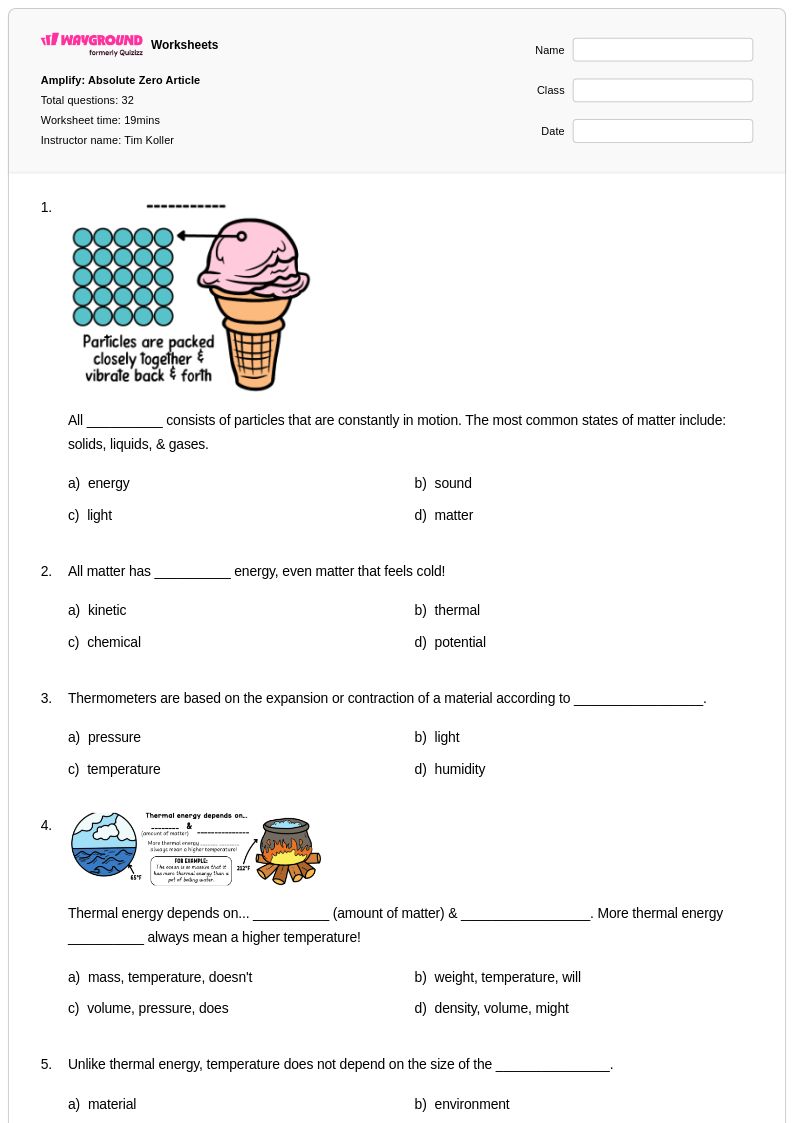
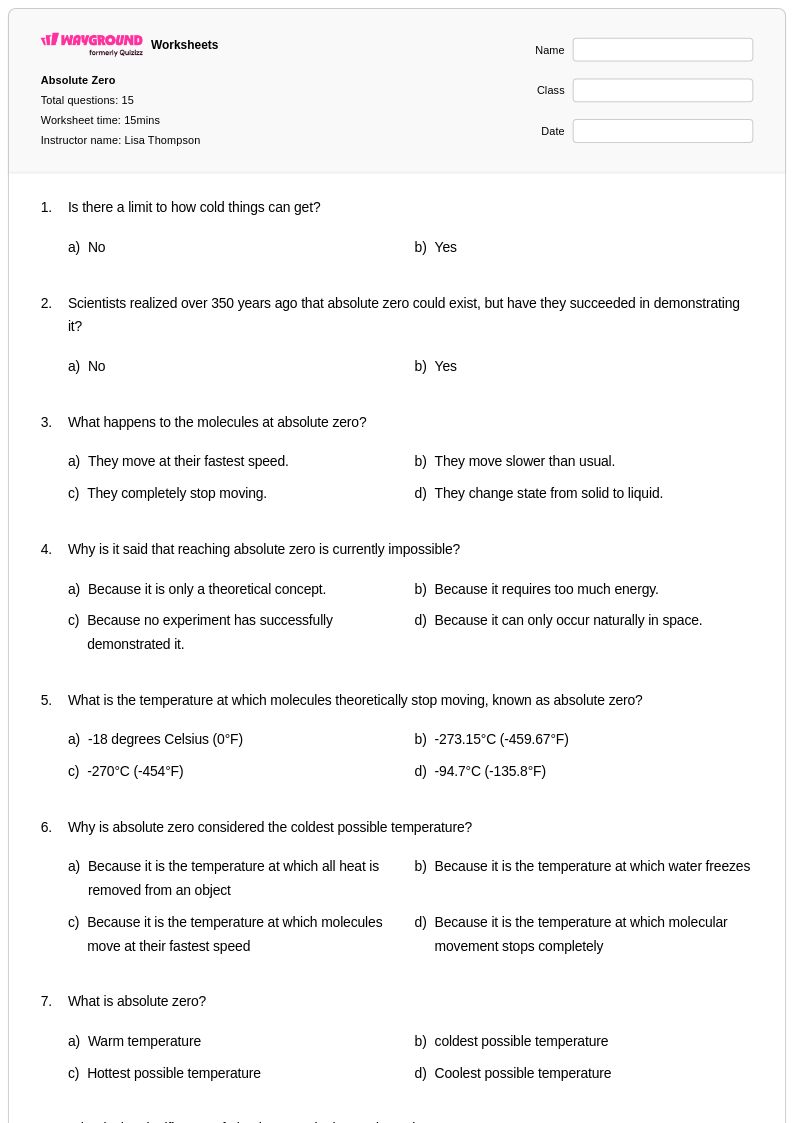
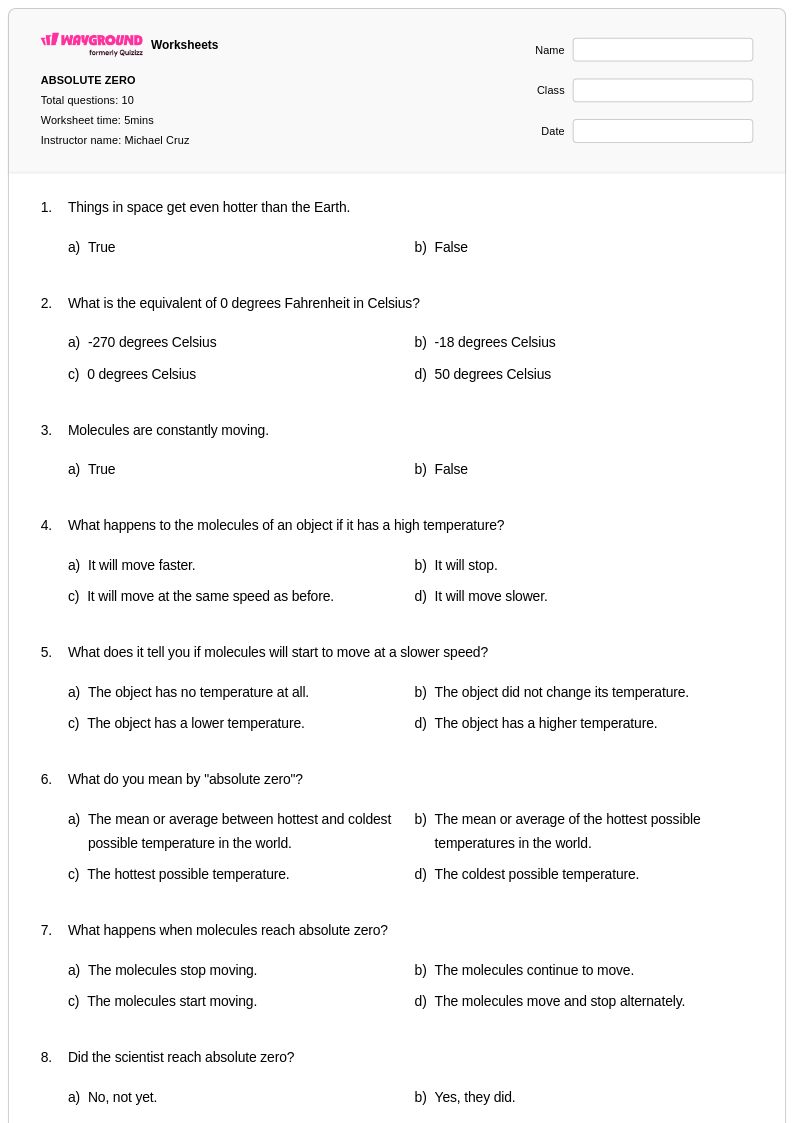
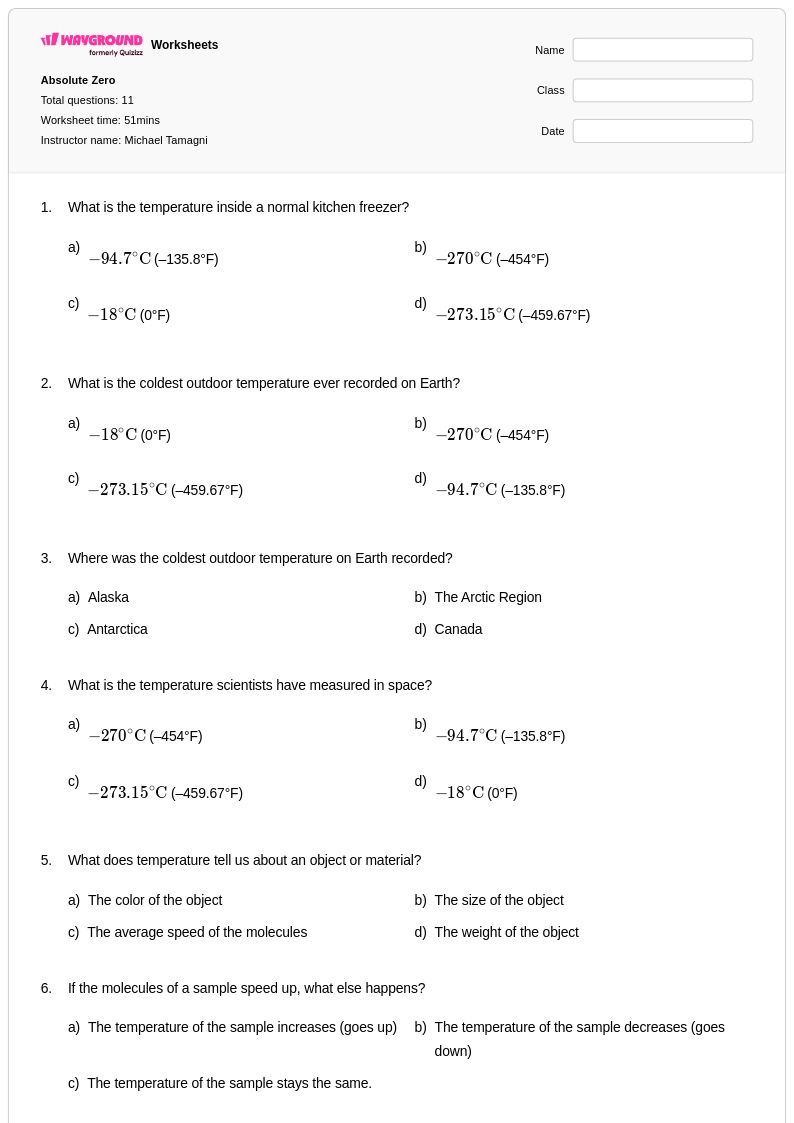
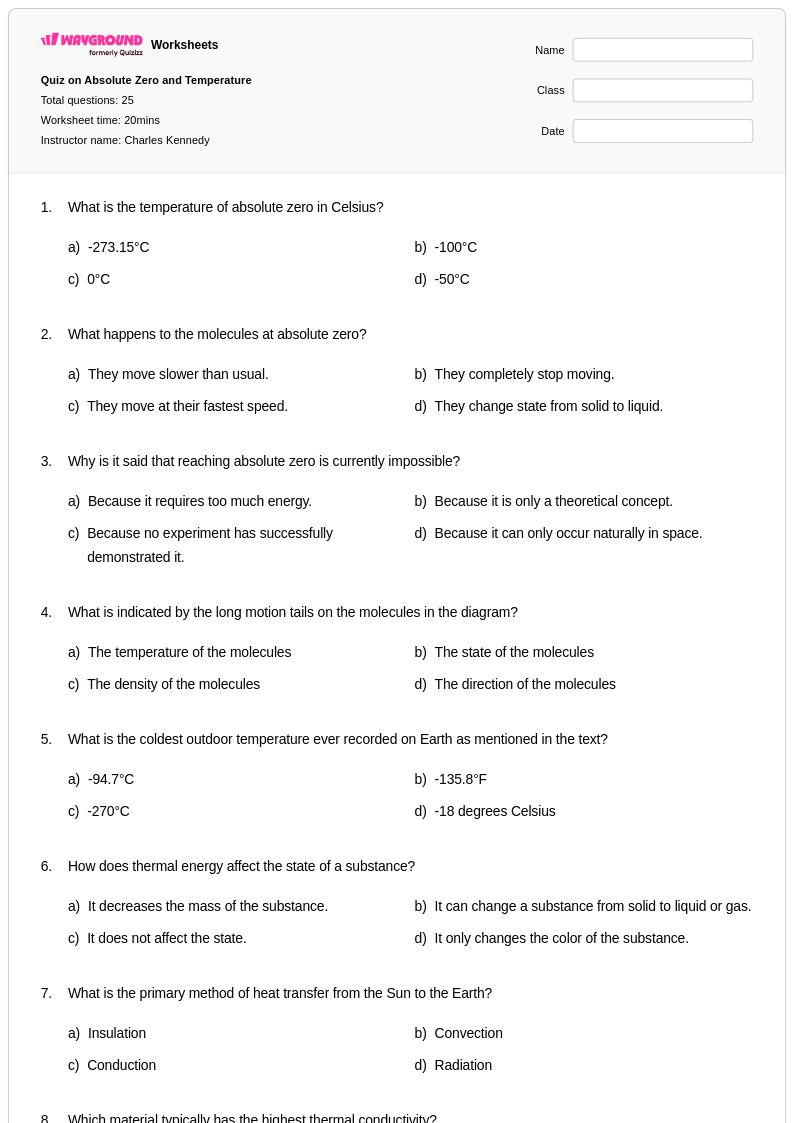
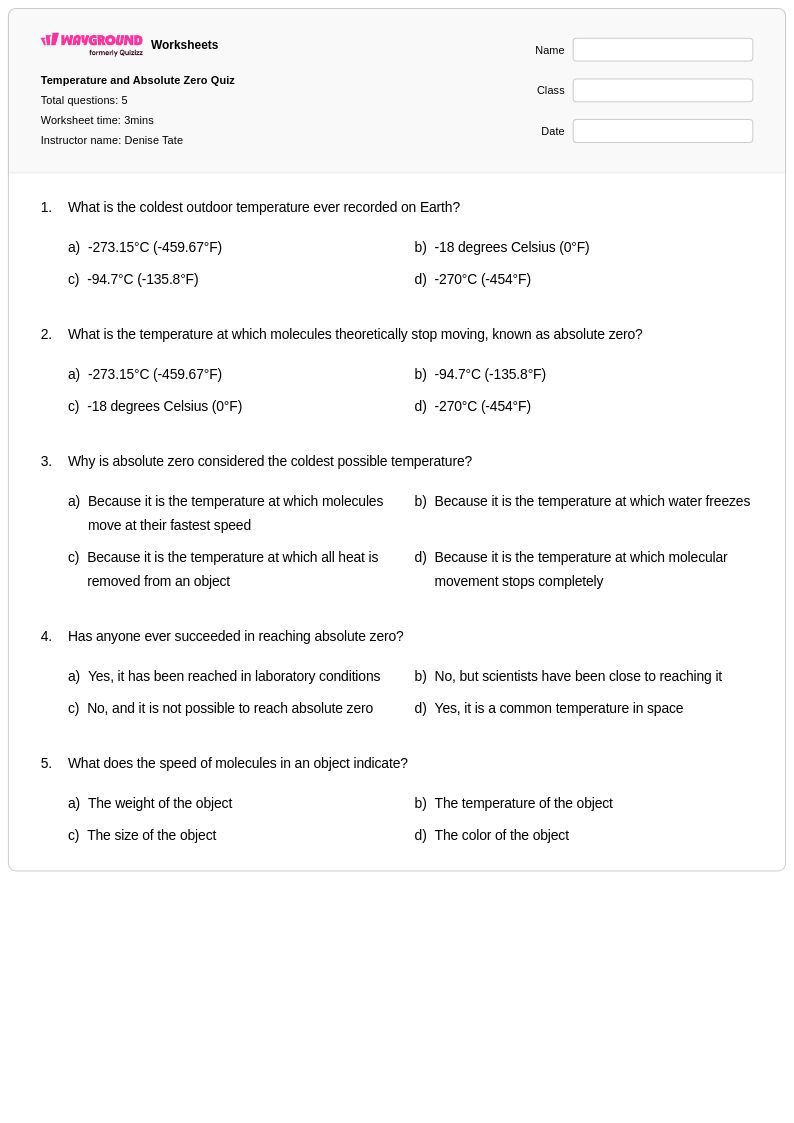
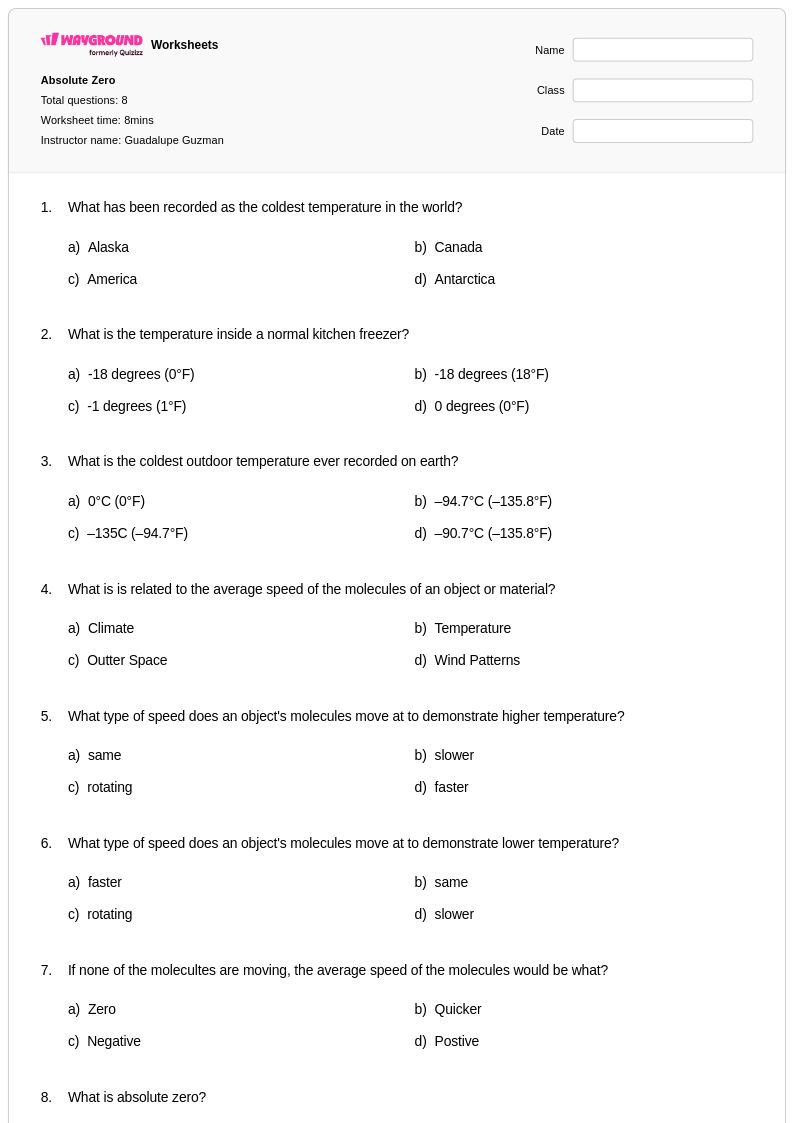
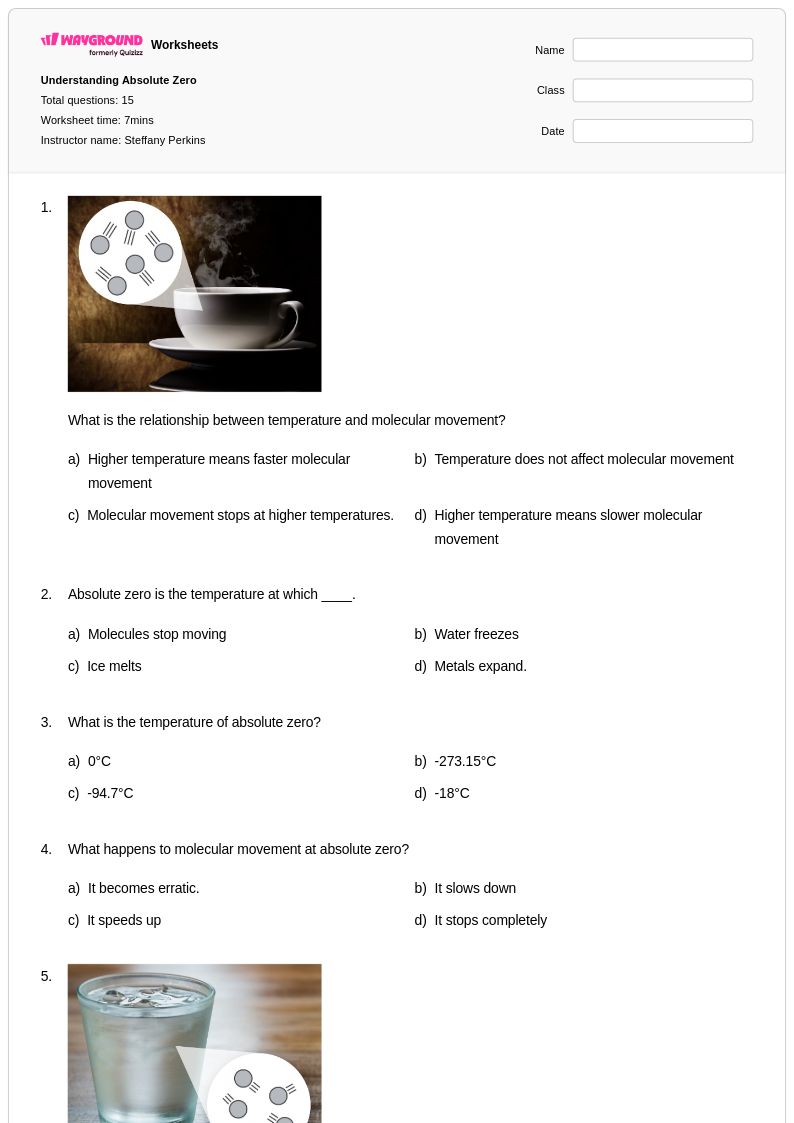
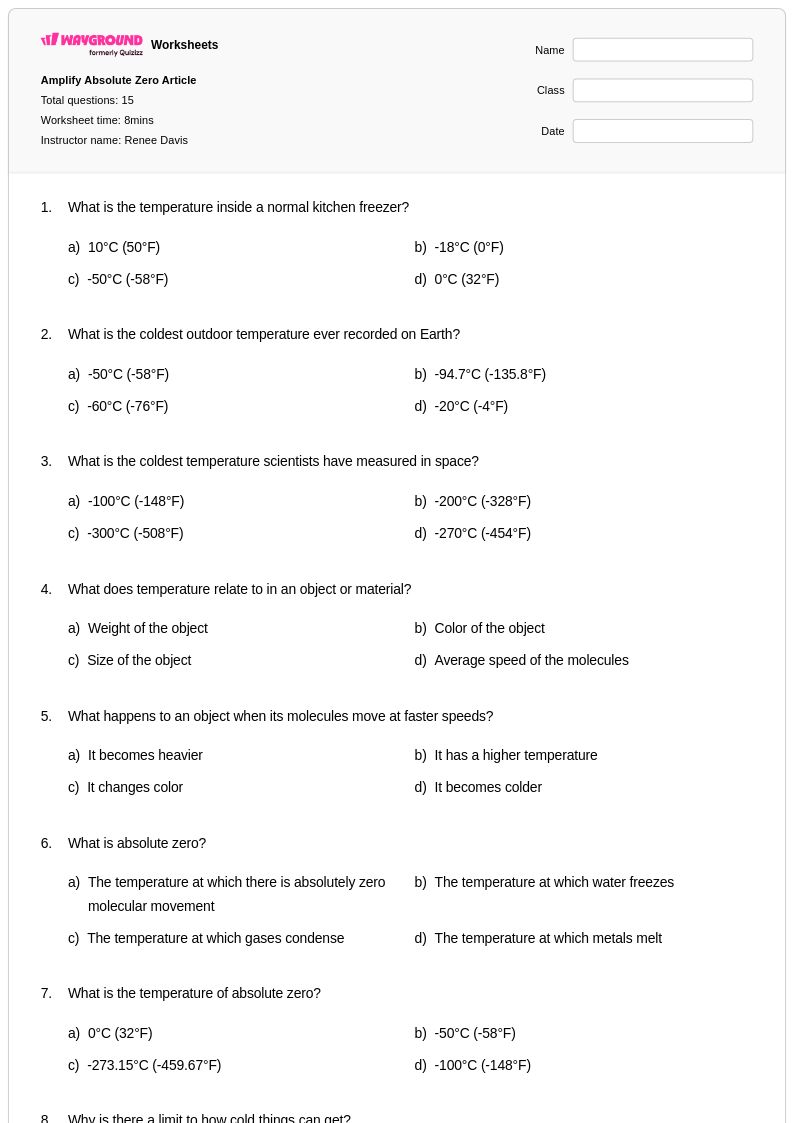
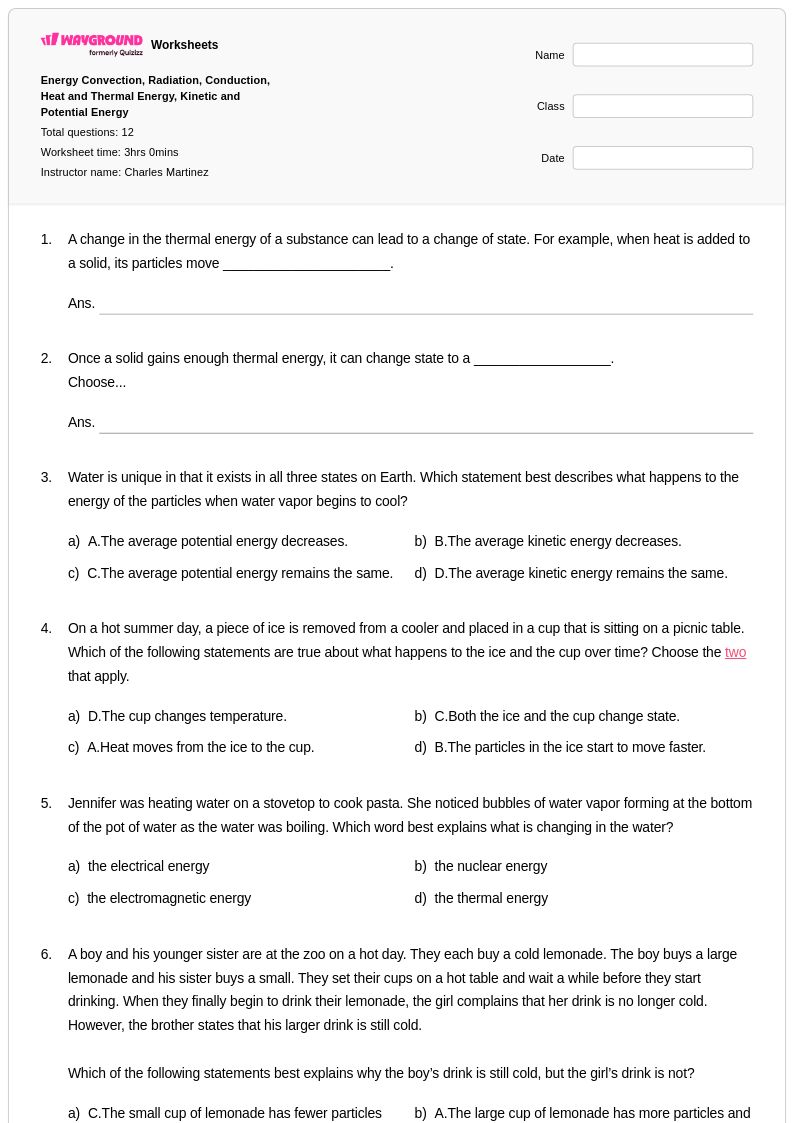
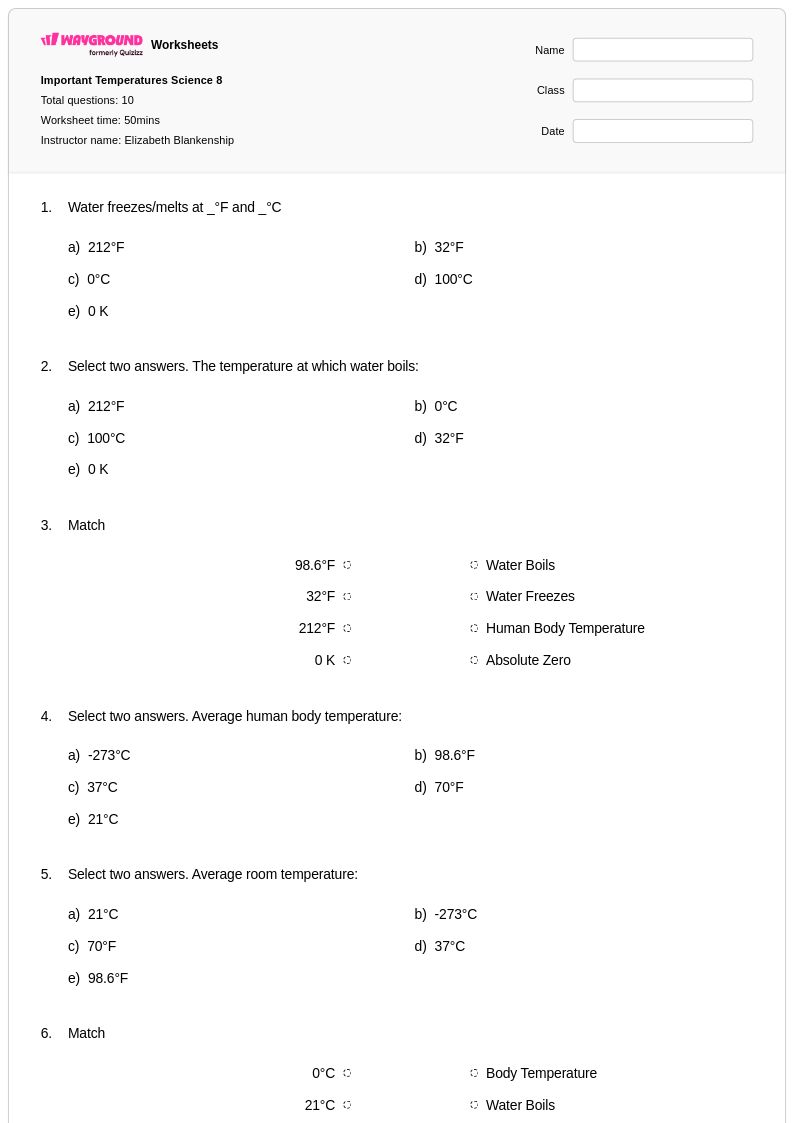
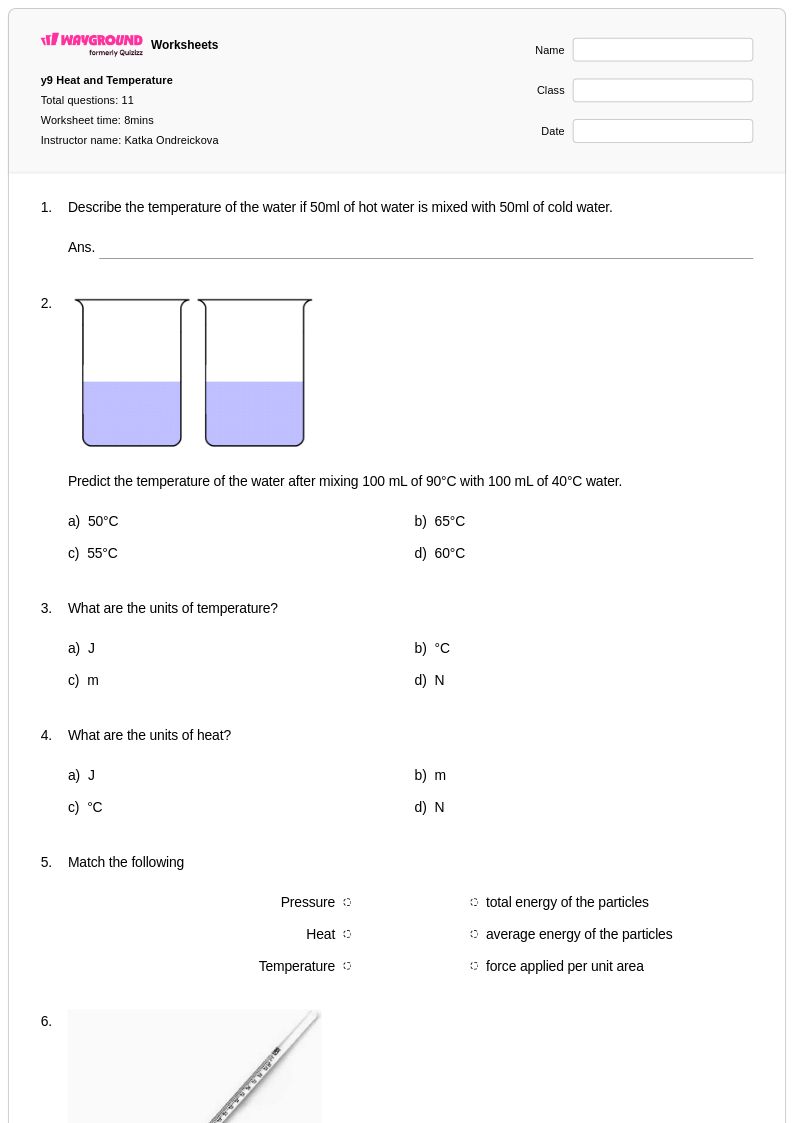
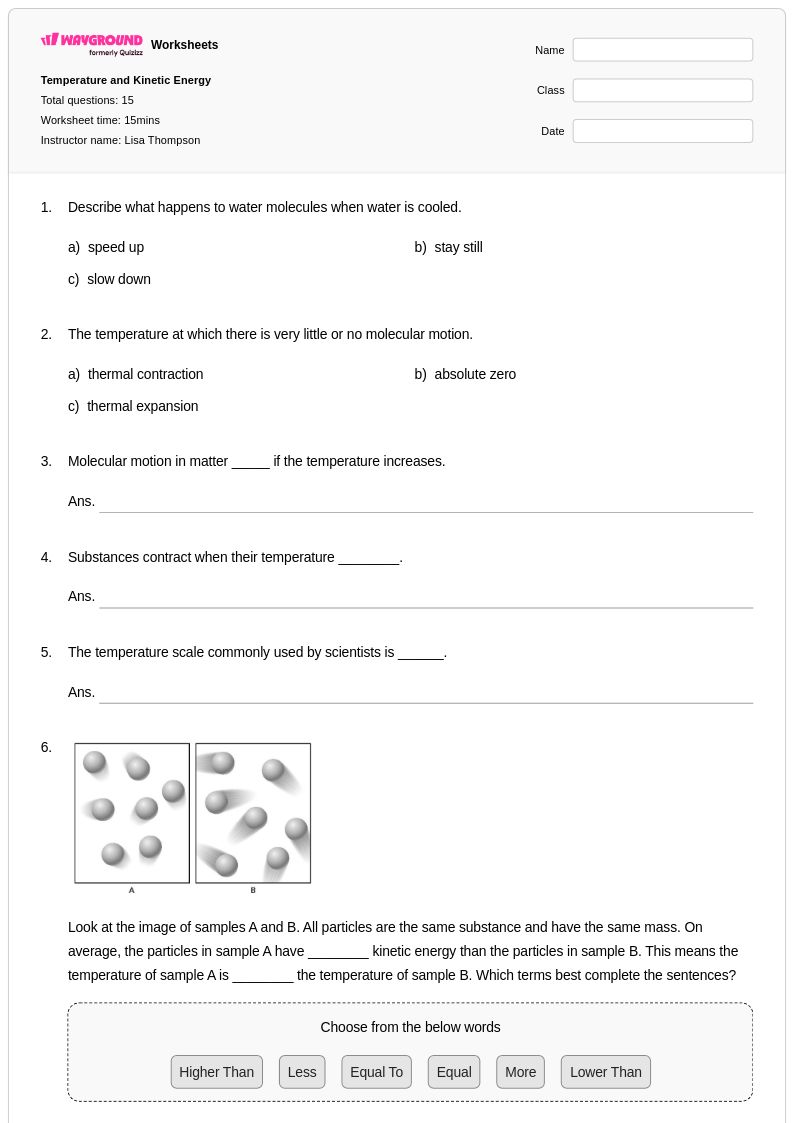
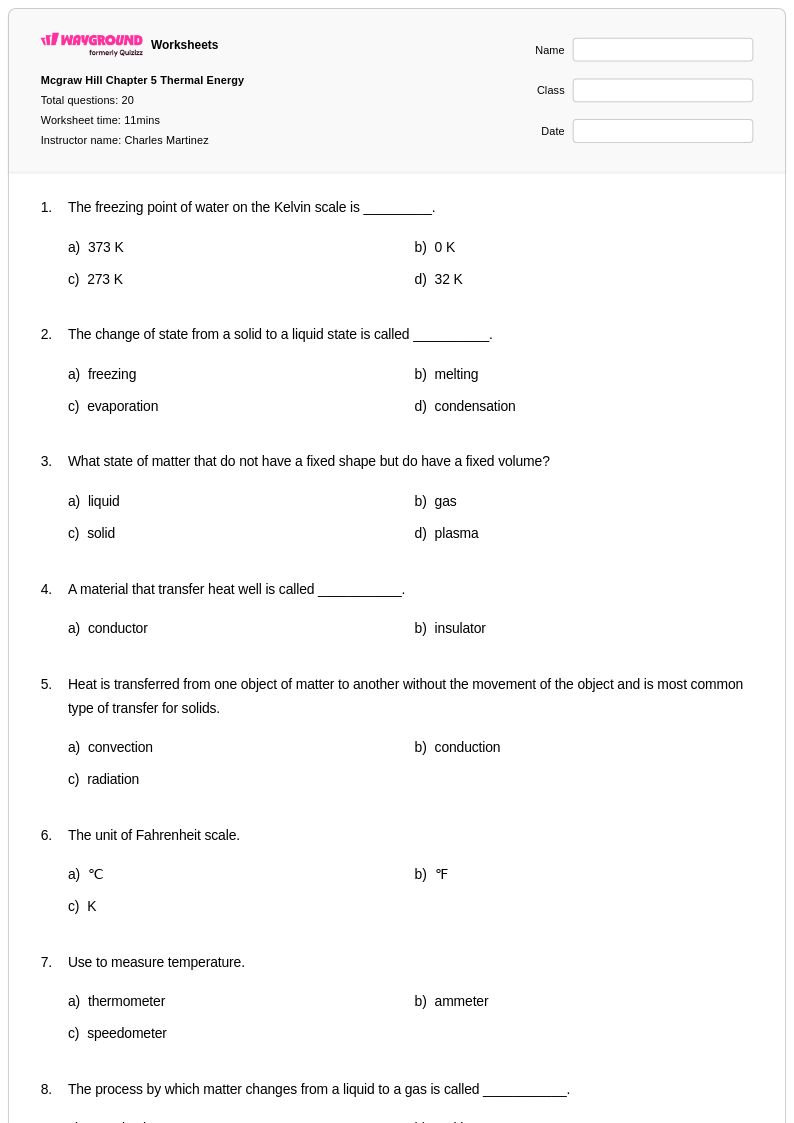
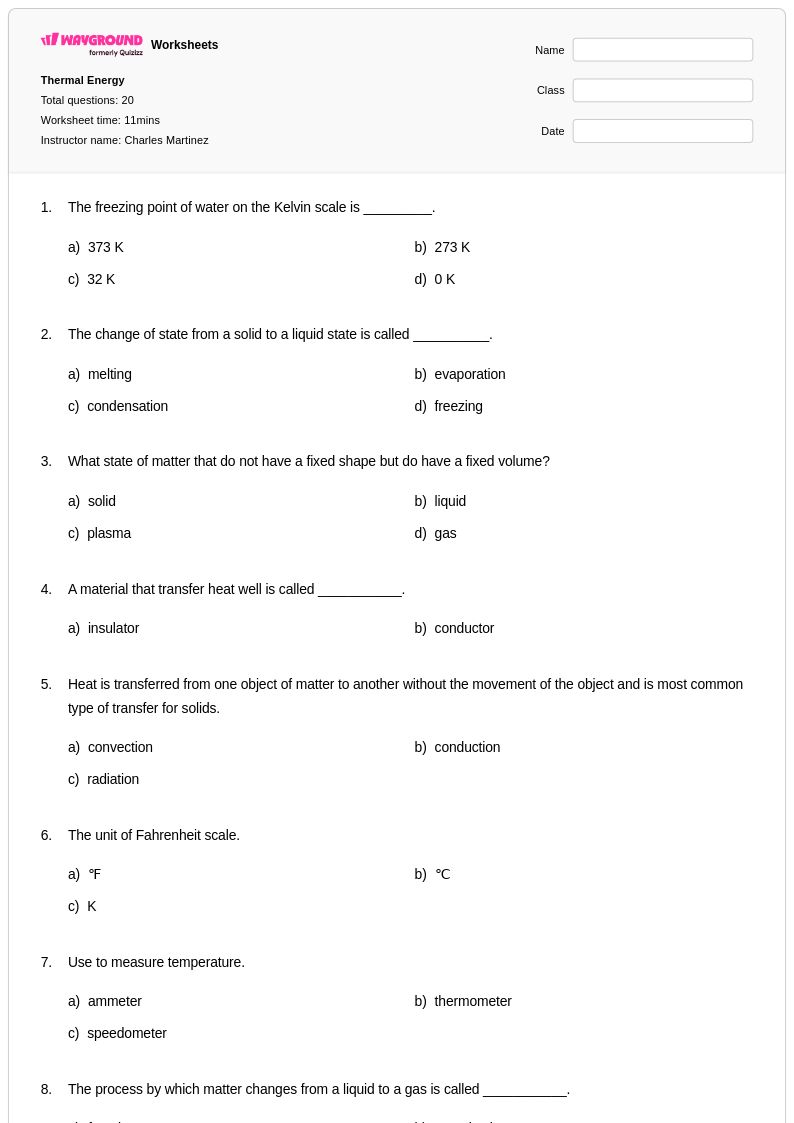
Explore Wayground's free absolute zero worksheets and printables that help students master temperature scales, kelvin measurements, and the theoretical concept of absolute zero through engaging practice problems with complete answer keys.
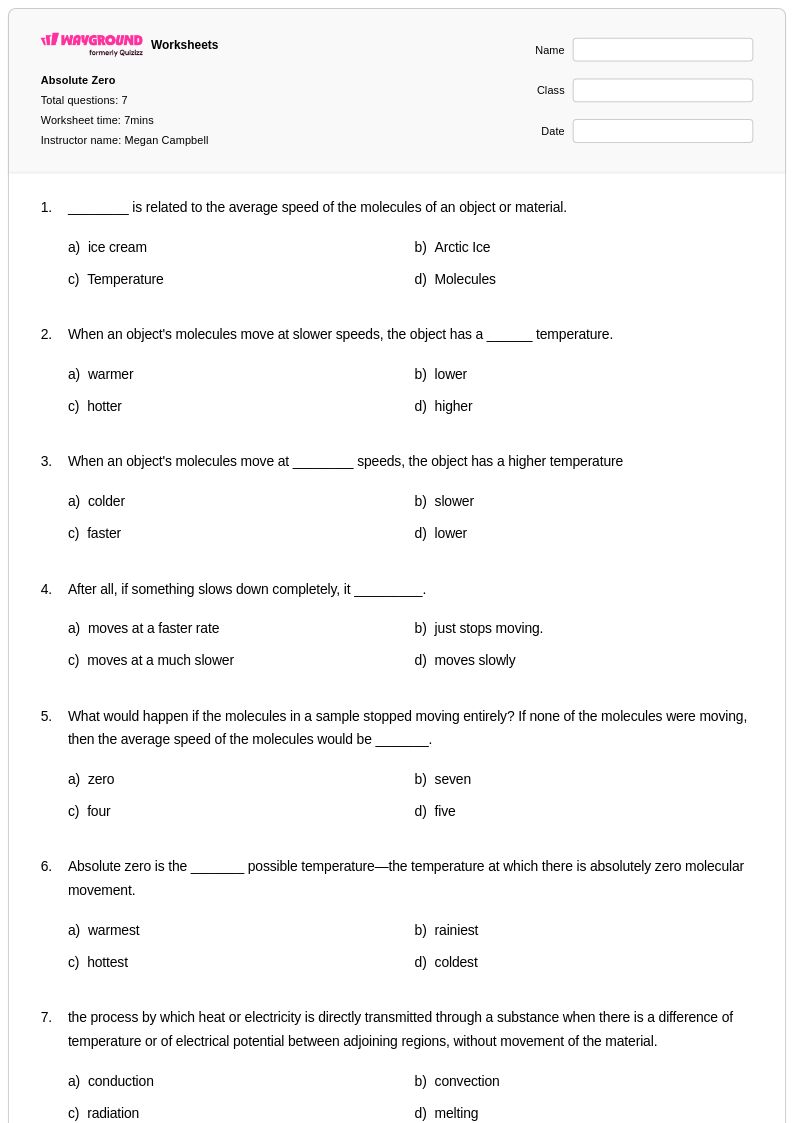
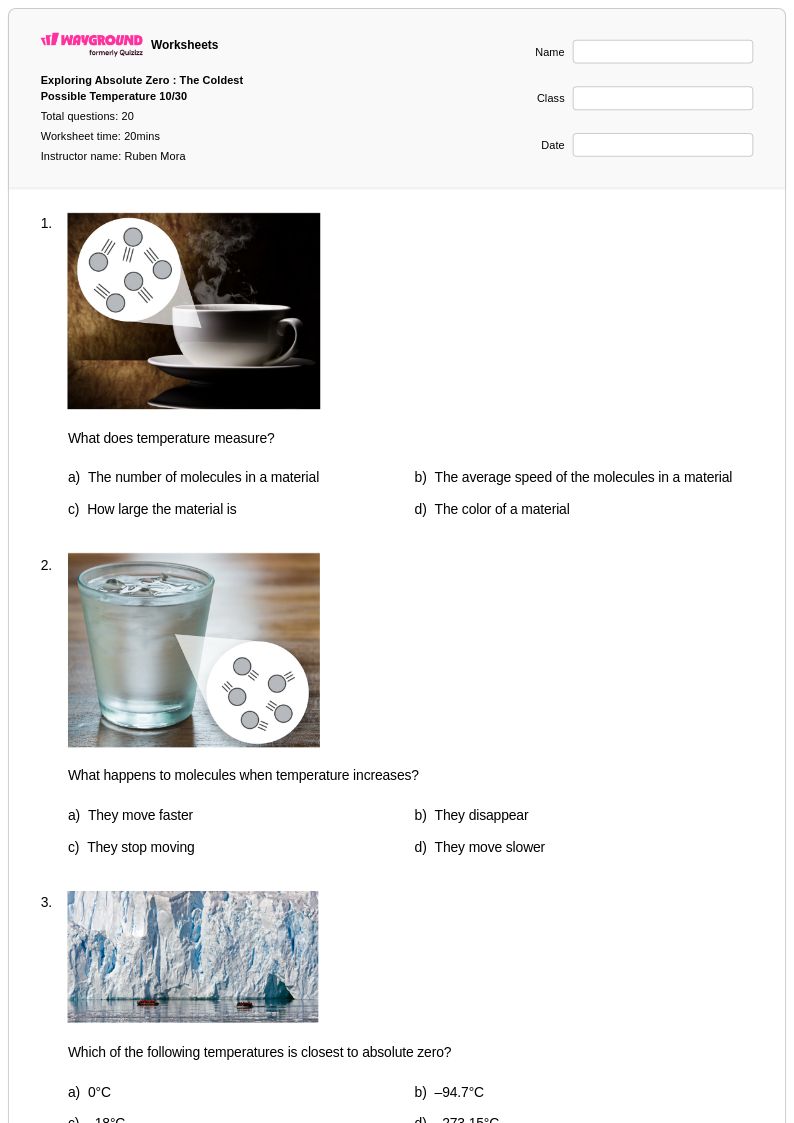
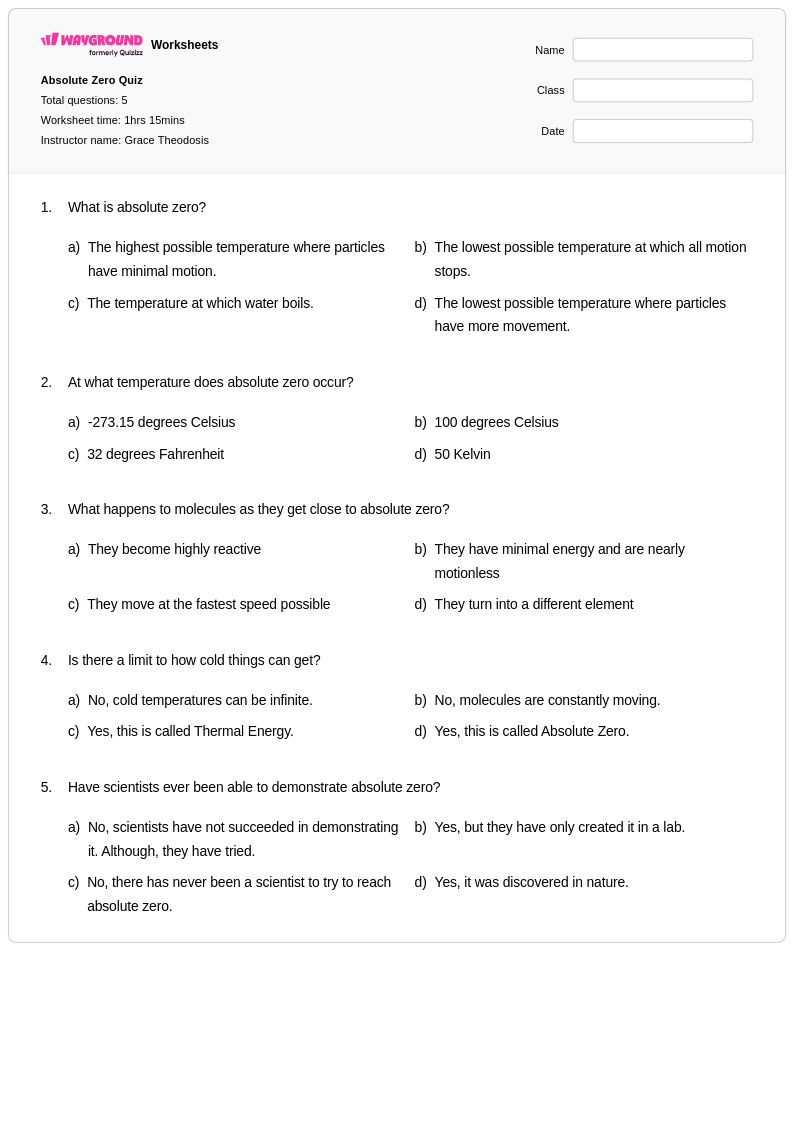
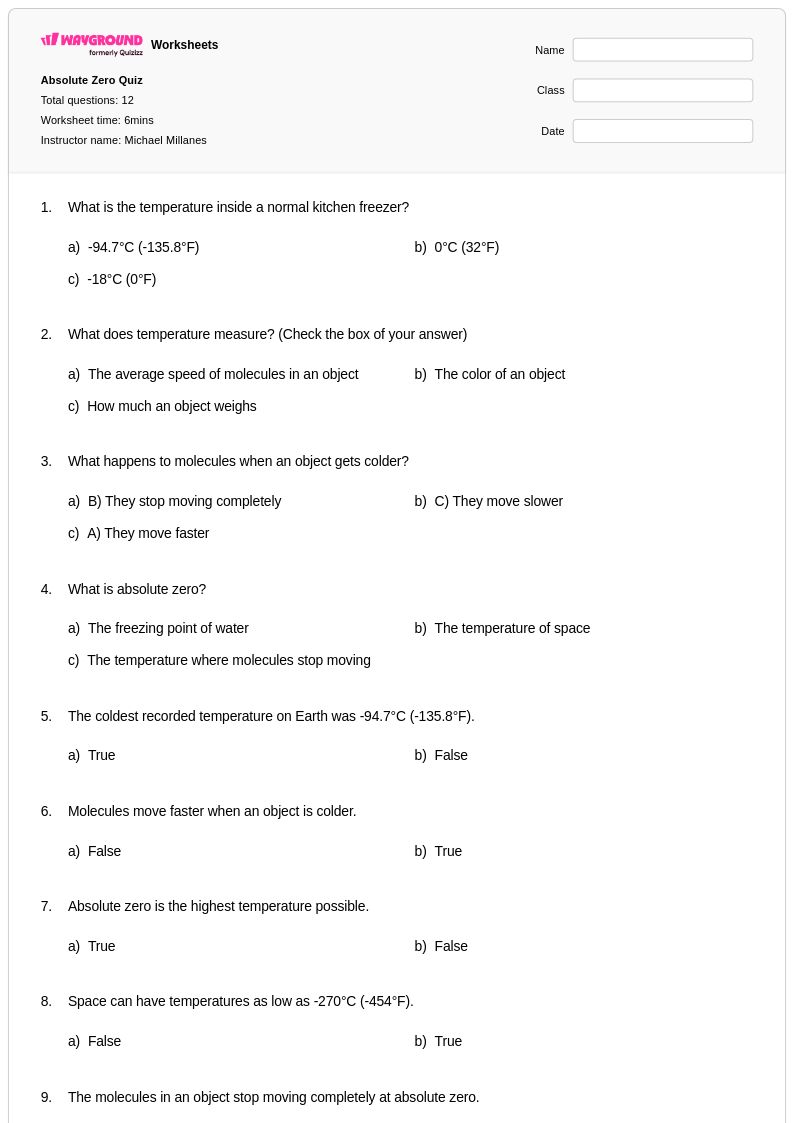
Absolute zero worksheets available through Wayground (formerly Quizizz) provide students with comprehensive practice materials to master this fundamental concept in thermodynamics and temperature measurement. These expertly crafted worksheets strengthen critical scientific skills including unit conversions between temperature scales, understanding the relationship between molecular motion and thermal energy, and applying absolute zero principles to real-world scenarios. Students work through practice problems that explore the theoretical temperature limit of -273.15°C or 0 Kelvin, where molecular motion theoretically ceases entirely. Each worksheet collection includes detailed answer keys and is available as free printables in pdf format, allowing students to develop proficiency in calculating temperature conversions and understanding the significance of absolute zero in scientific measurements and gas law applications.
Wayground (formerly Quizizz) empowers teachers with access to millions of teacher-created absolute zero worksheet resources, featuring robust search and filtering capabilities that align with national science standards for units and measurement instruction. The platform's differentiation tools enable educators to customize worksheets based on individual student needs, while flexible formatting options provide both printable pdf versions and interactive digital alternatives for diverse classroom environments. These comprehensive worksheet collections support strategic lesson planning by offering varied difficulty levels for skill practice, targeted remediation materials for students struggling with temperature scale concepts, and enrichment activities that challenge advanced learners to explore absolute zero's role in quantum mechanics and materials science. Teachers can seamlessly integrate these resources into their units and measurement curriculum to reinforce understanding of this essential scientific principle.
FAQs
How do I teach absolute zero to middle or high school students?
Start by grounding the concept in molecular motion — explain that temperature is a measure of how fast molecules are moving, and absolute zero (0 Kelvin, or -273.15°C) is the theoretical point where that motion stops entirely. From there, connect it to the Kelvin scale and why scientists use it instead of Celsius or Fahrenheit for thermodynamic calculations. Using temperature conversion problems and gas law examples helps students see why absolute zero matters beyond theory.
What exercises help students practice temperature scale conversions involving absolute zero?
The most effective practice problems ask students to convert between Celsius, Fahrenheit, and Kelvin — particularly conversions that involve values near absolute zero or that require applying the formula K = °C + 273.15. Problems tied to gas law scenarios, such as calculating pressure or volume at extremely low temperatures, also reinforce why the Kelvin scale must be used in scientific contexts. Repeated exposure to unit conversion in varied problem types builds fluency and reduces common arithmetic errors.
What misconceptions do students commonly have about absolute zero?
A frequent misconception is that absolute zero is simply 'the coldest temperature ever recorded' rather than a theoretical limit that has never been fully achieved in practice. Students also often confuse 0 Kelvin with 0°C, not realizing that 0°C is the freezing point of water, while 0 K represents the complete absence of thermal energy. Another common error is applying negative Kelvin values in gas law calculations, which produces physically meaningless results.
How does absolute zero connect to gas laws?
Absolute zero is the foundation of the Kelvin temperature scale, which is required for all gas law calculations. In Charles's Law, for example, volume is directly proportional to temperature in Kelvin — using Celsius or Fahrenheit would produce incorrect results because those scales have arbitrary zero points that don't reflect true thermal energy. Teaching absolute zero alongside gas laws helps students understand why Kelvin exists and how to use it correctly in pressure-volume-temperature relationships.
How can I use absolute zero worksheets in my classroom?
Absolute zero worksheets on Wayground are available as printable PDFs for traditional classroom use and in digital formats for technology-integrated or blended learning environments. Teachers can also host the worksheets as a live quiz on Wayground, making them suitable for formative assessment or review sessions. The included answer keys make it straightforward to use these materials for independent practice, homework, or small-group work without requiring additional prep time.
How do I support students who are struggling with temperature scale conversions?
Students who struggle with temperature conversions typically need more scaffolded practice — starting with single-step conversions between just two scales before moving to multi-step problems. On Wayground, teachers can apply accommodations such as reduced answer choices to lower cognitive load for individual students, or enable the Read Aloud feature for students who benefit from hearing questions read to them. Targeting remediation specifically at the Celsius-to-Kelvin conversion, since it's the most critical for gas law work, tends to yield the fastest gains.