Free Printable Building Atoms Worksheets for Class 7
Discover free Class 7 building atoms worksheets and printables from Wayground that help students master atomic structure through engaging practice problems and comprehensive answer keys in PDF format.
Explore printable Building Atoms worksheets for Class 7
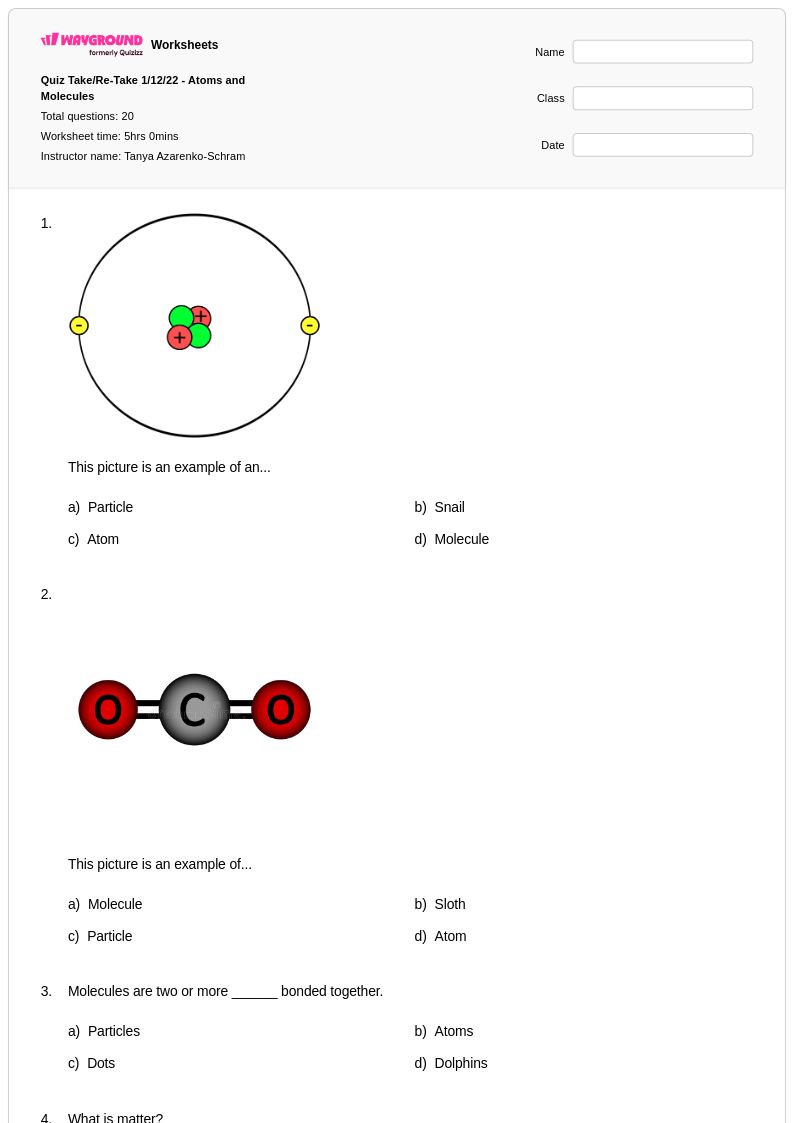
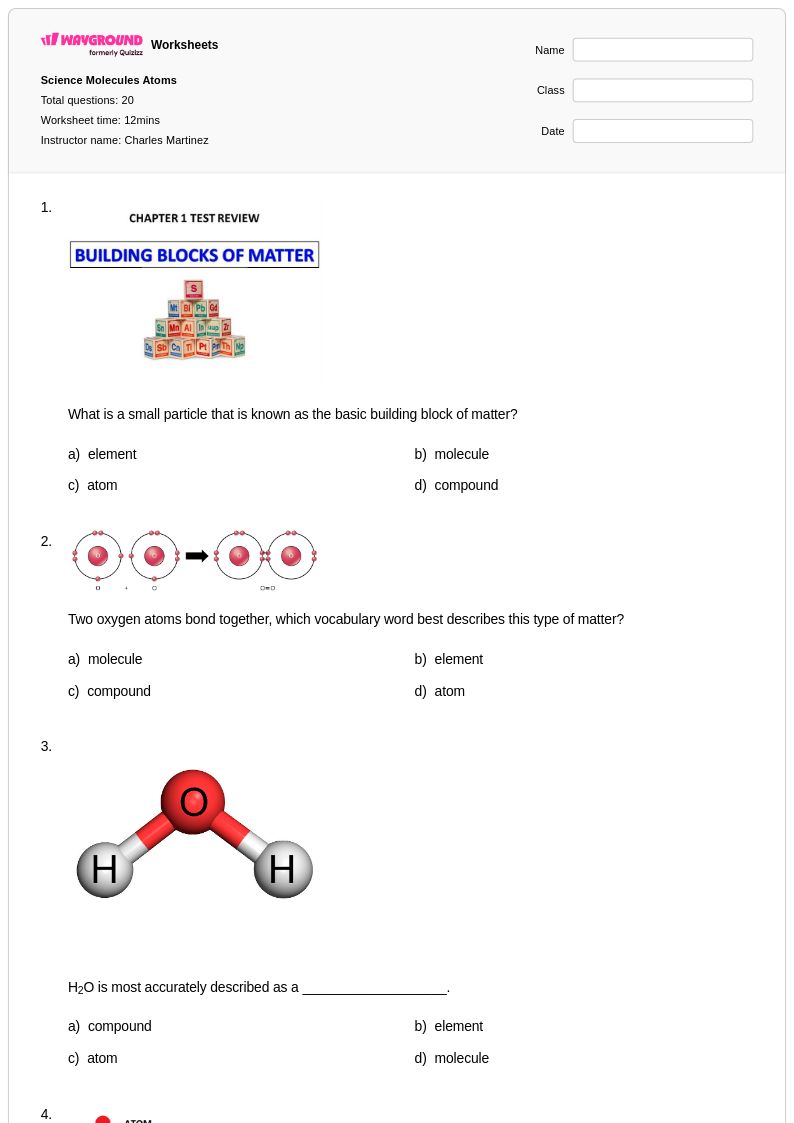
Building atoms worksheets for Class 7 students available through Wayground (formerly Quizizz) provide comprehensive practice with atomic structure fundamentals that form the foundation of chemistry education. These carefully designed printables guide seventh-grade learners through the essential components of atoms, including protons, neutrons, and electrons, while developing critical skills in interpreting atomic models, understanding electron configuration, and applying knowledge of the periodic table to construct accurate atomic representations. Students engage with practice problems that reinforce concepts such as atomic number, mass number, and isotope identification, with each worksheet including a detailed answer key to support independent learning and self-assessment. The free pdf resources systematically build understanding of how subatomic particles combine to form different elements, preparing students for more advanced chemistry concepts in subsequent grade levels.
Wayground (formerly Quizizz) empowers educators with an extensive collection of millions of teacher-created building atoms worksheets specifically aligned to Class 7 science standards and curriculum requirements. The platform's robust search and filtering capabilities enable teachers to quickly locate age-appropriate materials that match their specific instructional goals, whether targeting foundational skill development, remediation for struggling learners, or enrichment activities for advanced students. Each worksheet collection offers flexible customization options, allowing educators to modify content, difficulty levels, and format preferences while maintaining access to both printable and digital versions in convenient pdf format. These comprehensive differentiation tools streamline lesson planning by providing ready-to-use resources that support varied learning styles and academic needs, ensuring all seventh-grade students can successfully master the fundamental principles of atomic structure through targeted skill practice and reinforcement activities.
FAQs
How do I teach students to build atoms from scratch?
Start by ensuring students understand the three subatomic particles: protons (which define the element), neutrons (which contribute to mass), and electrons (which determine charge). Introduce the periodic table as a reference tool, showing students how atomic number directly tells them the number of protons and, in a neutral atom, the number of electrons. From there, students can calculate neutron count using the mass number minus the atomic number. Using physical or drawn models to place particles reinforces the spatial logic of atomic structure before students attempt abstract notation.
What exercises help students practice building atoms?
Effective practice includes filling in atomic structure diagrams where students must correctly place protons and neutrons in the nucleus and arrange electrons in shells, as well as completing tables that require deriving atomic number, mass number, and particle counts from partial information. Problems that ask students to identify an element based solely on its subatomic composition are especially valuable because they reinforce the relationship between proton count and elemental identity. Systematic practice problems that vary the given information force students to work flexibly with all components of atomic structure.
What mistakes do students commonly make when building atoms?
The most frequent error is confusing atomic number with mass number, leading students to miscalculate the number of neutrons. Students also commonly assume that the number of electrons always equals the number of protons without recognizing that ions carry a charge because electron count has shifted. Another persistent misconception is placing all particles in the nucleus, failing to distinguish that electrons occupy energy levels outside it. Targeted practice that isolates each particle type and its role helps students self-correct these errors before they become entrenched.
How do I use Building Atoms worksheets from Wayground in my classroom?
Building Atoms worksheets on Wayground are available as printable PDFs for traditional classroom distribution and in digital formats for technology-integrated or hybrid learning environments, including the option to host them as a quiz directly on Wayground. All worksheets include complete answer keys, which makes them practical for independent practice, homework, or quick formative checks without requiring additional teacher preparation. The platform also supports student-level accommodations such as extended time, read aloud, and reduced answer choices, so the same worksheet can be deployed to a mixed-ability class with differentiated settings applied individually.
How can I differentiate Building Atoms worksheets for students at different skill levels?
For students who are still building foundational understanding, begin with worksheets that provide the element name and ask students to identify only one or two particle counts at a time, reducing the cognitive load. More advanced students benefit from problems that introduce isotopes or ions, requiring them to adjust electron or neutron counts beyond the default neutral atom. On Wayground, teachers can apply accommodations such as reduced answer choices or read aloud settings to individual students without affecting the experience of the rest of the class, making it straightforward to run one assignment across varying skill levels simultaneously.