Free Printable History of Atomic Models Worksheets for Class 7
Explore Wayground's free Class 7 chemistry worksheets and printables covering the history of atomic models, featuring practice problems and answer keys to help students understand how scientific understanding of atomic structure evolved over time.
Explore printable History of Atomic Models worksheets for Class 7
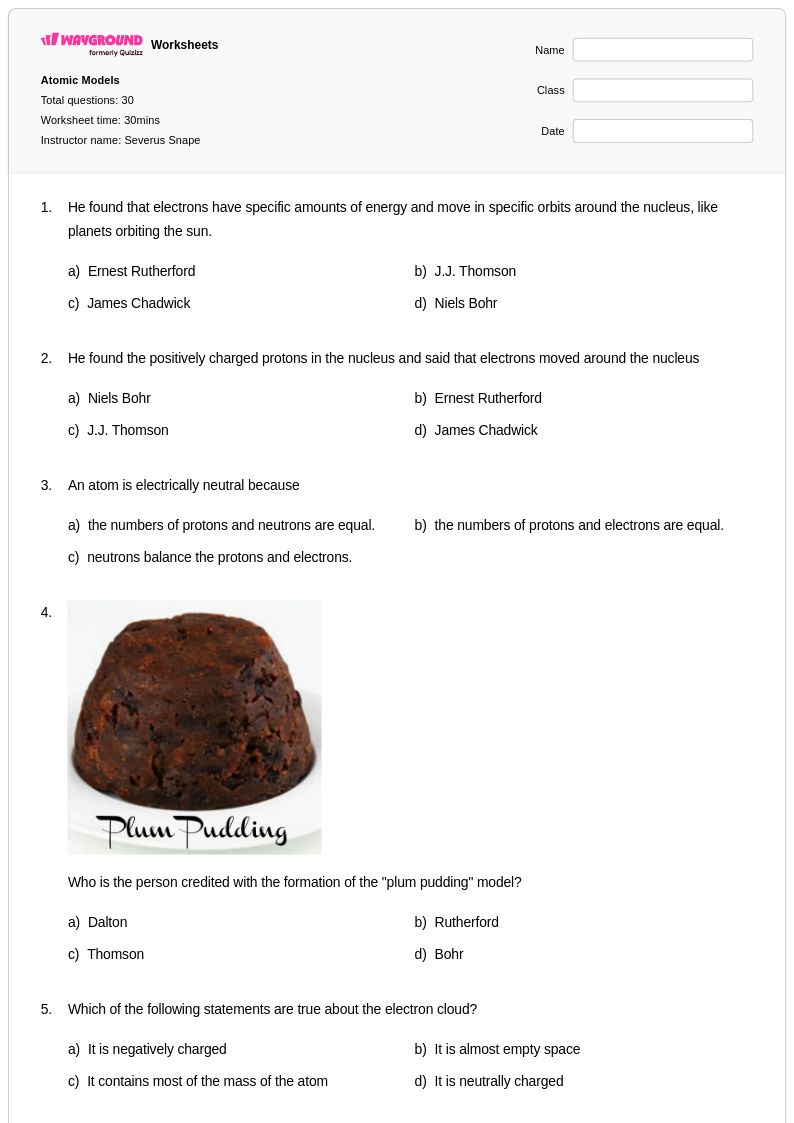
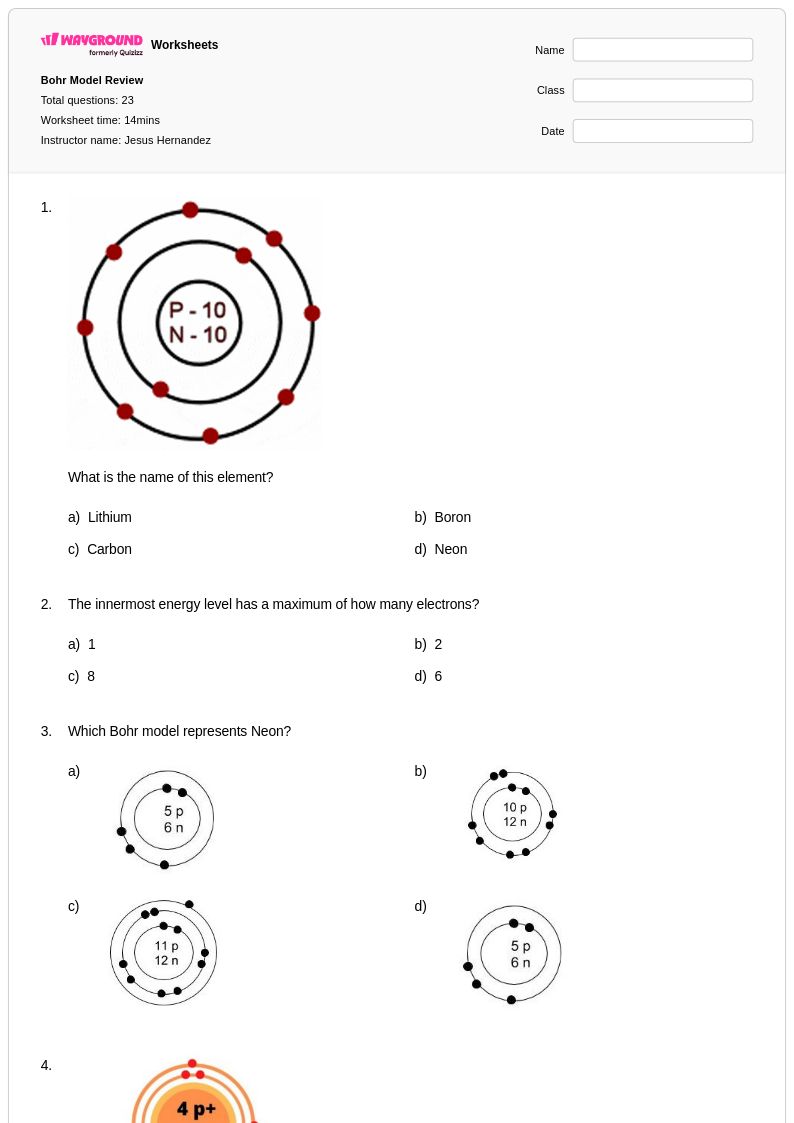
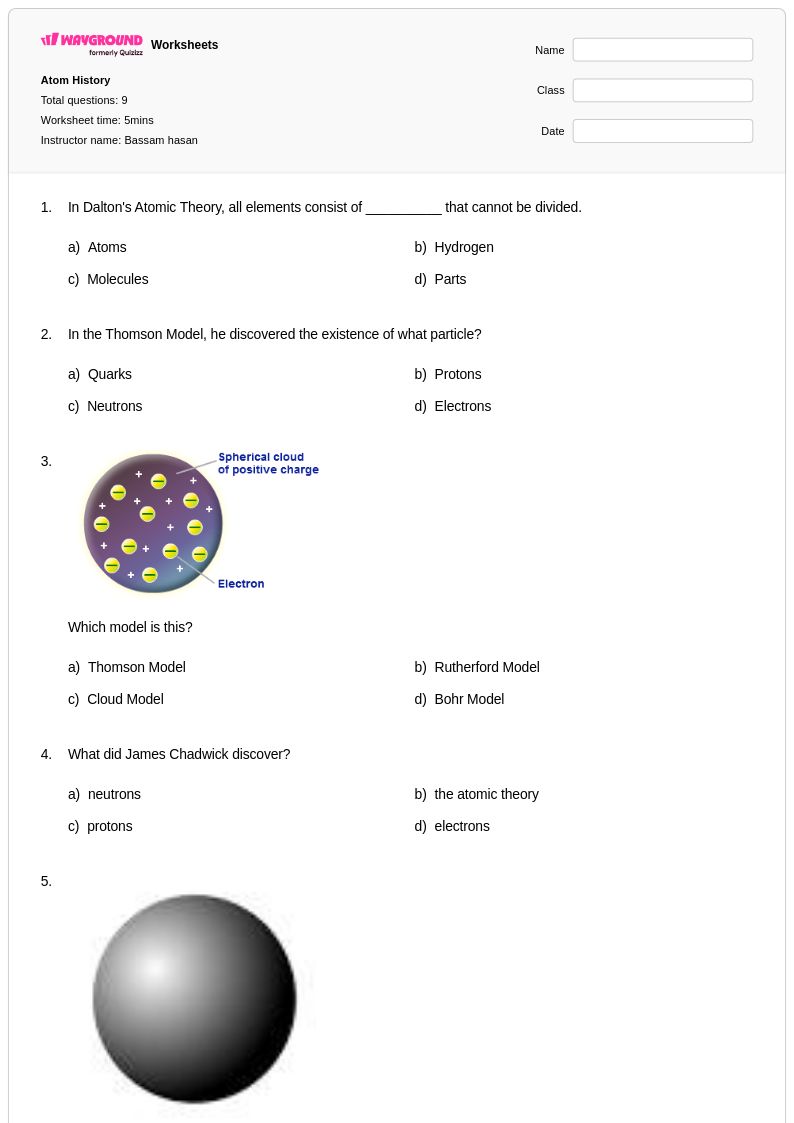
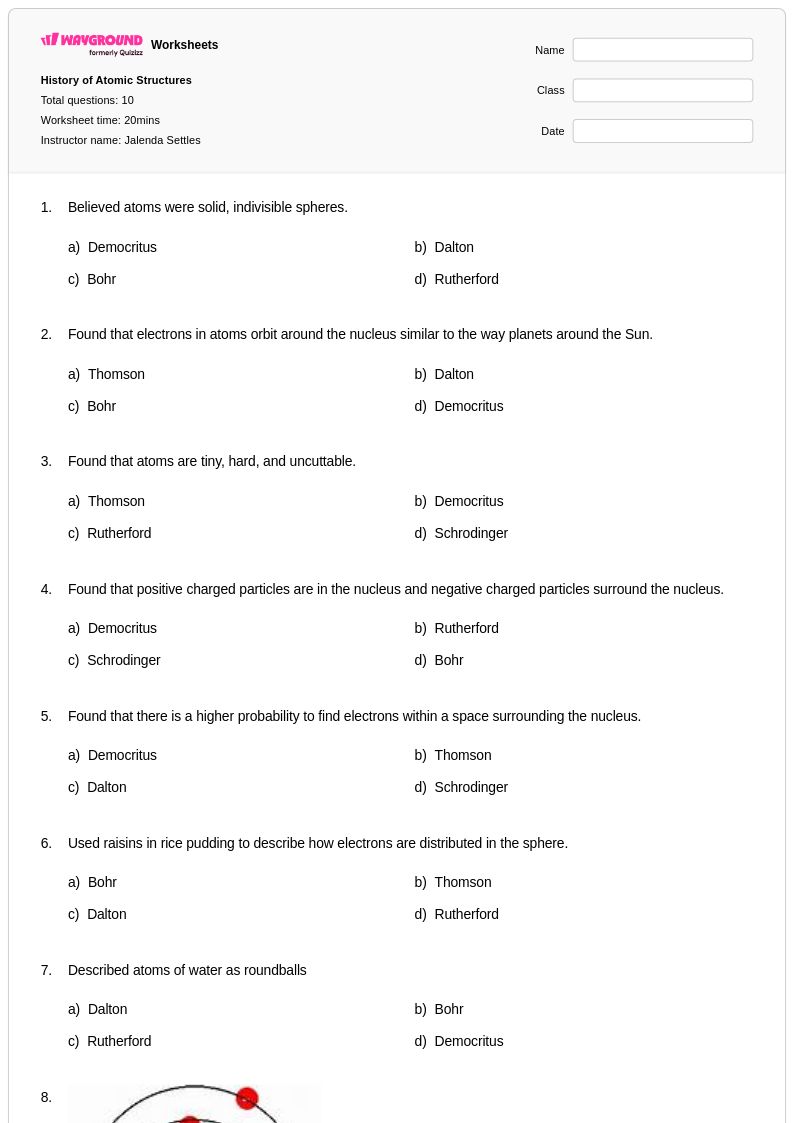
The history of atomic models represents a fascinating journey through scientific discovery that Class 7 students explore through comprehensive worksheets available on Wayground (formerly Quizizz). These educational resources guide middle school learners through the evolution of atomic theory, from Democritus's early philosophical concepts to modern quantum mechanical models, including the groundbreaking work of scientists like Dalton, Thomson, Rutherford, and Bohr. The worksheets strengthen critical thinking skills by having students analyze how scientific understanding progresses through experimentation and evidence, while practice problems reinforce their ability to compare and contrast different atomic models. Each worksheet comes with a detailed answer key to support independent learning, and teachers can access these materials as free printables in convenient PDF format, making it easy to distribute both digitally and in traditional classroom settings.
Wayground (formerly Quizizz) empowers educators with an extensive collection of millions of teacher-created resources specifically designed for chemistry instruction, including comprehensive worksheet sets covering atomic model history that align with middle school science standards. The platform's robust search and filtering capabilities allow teachers to quickly locate materials that match their specific curriculum needs, while differentiation tools enable customization for students with varying ability levels. These flexible resources are available in both printable and digital formats, including downloadable PDFs, giving teachers the versatility to adapt their instruction for in-person, remote, or hybrid learning environments. Whether used for initial skill practice, targeted remediation, or enrichment activities, these atomic model worksheets support comprehensive lesson planning and help teachers provide students with multiple opportunities to master this foundational chemistry concept through varied practice opportunities.
FAQs
How do I teach the history of atomic models in a chemistry class?
Teaching the history of atomic models works best as a chronological narrative that emphasizes how each model emerged in response to new experimental evidence. Start with Democritus's philosophical concept of the atom, then walk students through Dalton's solid sphere model, Thomson's plum pudding model, Rutherford's nuclear model, Bohr's planetary model, and finally Schrödinger's quantum mechanical model. Framing each transition as a scientific problem-solving event — rather than a simple correction — helps students understand how scientific knowledge is built and revised over time.
What exercises help students practice comparing atomic models?
Comparison activities are among the most effective for this topic because they force students to articulate specific structural and conceptual differences between models. Effective exercises include filling in comparison charts that list each model's key features, the experimental evidence that supported it, and the evidence that eventually challenged it. Having students analyze the gold foil experiment or cathode ray tube results and then explain which model those results support or refute builds both content knowledge and scientific reasoning skills.
What mistakes do students commonly make when studying the history of atomic models?
One of the most common misconceptions is that earlier atomic models were simply wrong rather than incomplete approximations that explained the evidence available at the time. Students also frequently confuse Thomson's and Rutherford's models, mixing up where electrons and the nucleus are located in each. Another error is treating Bohr's model as the current accepted model, when in fact Schrödinger's quantum mechanical model supersedes it for describing electron behavior.
How do I use History of Atomic Models worksheets from Wayground in my classroom?
Wayground's History of Atomic Models worksheets are available as printable PDFs for traditional classroom use and in digital formats for technology-integrated environments, including the option to host them as a quiz directly on Wayground. Teachers can use them to introduce a new atomic model at the start of a unit, as guided practice during instruction, or as remediation for students who need additional support with abstract atomic theory. Each worksheet includes an answer key, making them suitable for independent student work, homework assignments, or formative assessment.
How can I differentiate History of Atomic Models instruction for students at different levels?
For students who struggle with abstract theory, focus first on the visual and physical analogies embedded in early models like Dalton's solid sphere or Thomson's plum pudding before introducing the more abstract quantum mechanical model. Advanced learners can be challenged with enrichment tasks that explore the mathematical basis of Bohr's energy levels or the probabilistic nature of Schrödinger's electron cloud. On Wayground, teachers can apply accommodations such as read aloud support, reduced answer choices, and extended time to individual students, ensuring all learners can access the same core content without disrupting the rest of the class.
What experimental evidence should students understand when learning about atomic model transitions?
Students should be able to connect specific experiments to the model changes they produced. Thomson's cathode ray tube experiments demonstrated the existence of negatively charged particles (electrons), disproving Dalton's indivisible atom. Rutherford's gold foil experiment revealed a dense, positively charged nucleus, overturning Thomson's uniform charge distribution model. Spectral line evidence from hydrogen then challenged Rutherford's model and provided the foundation for Bohr's quantized energy levels.