Free Printable Conservation of Energy Worksheets for Class 12
Class 12 Conservation of Energy worksheets and printables help students master energy transformations through practice problems, free PDF exercises, and comprehensive answer keys for effective physics learning.
Explore printable Conservation of Energy worksheets for Class 12
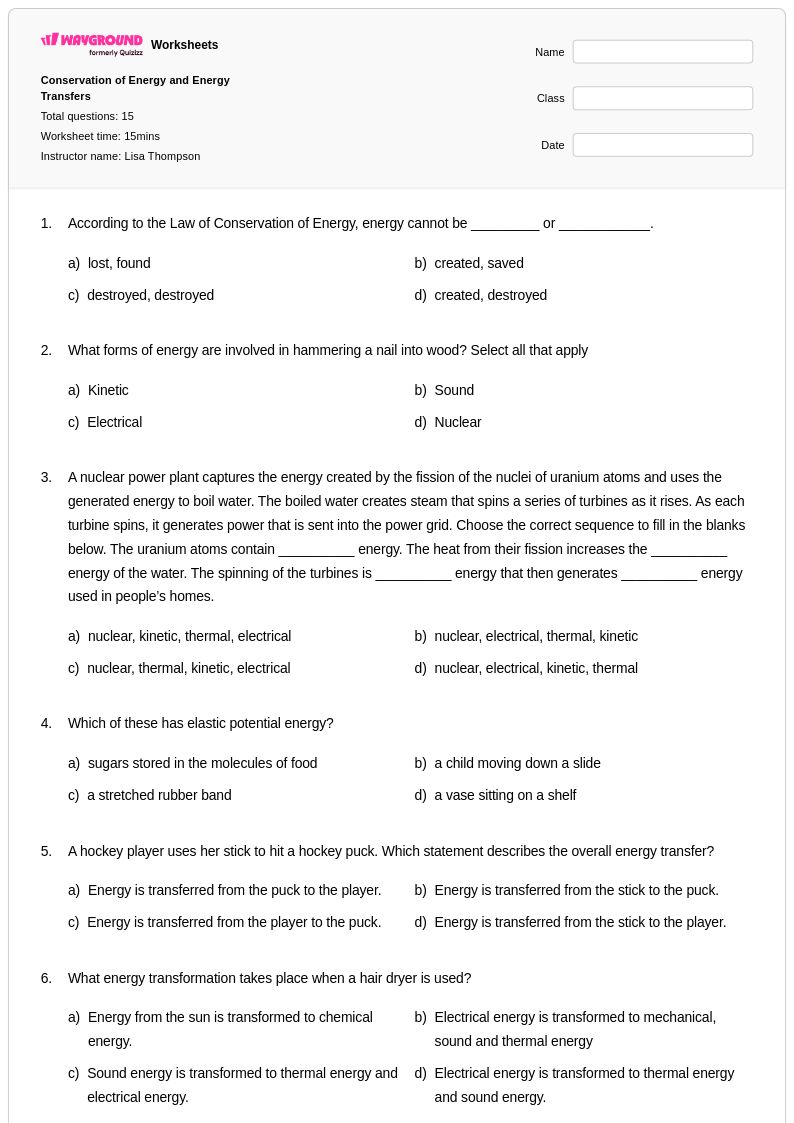
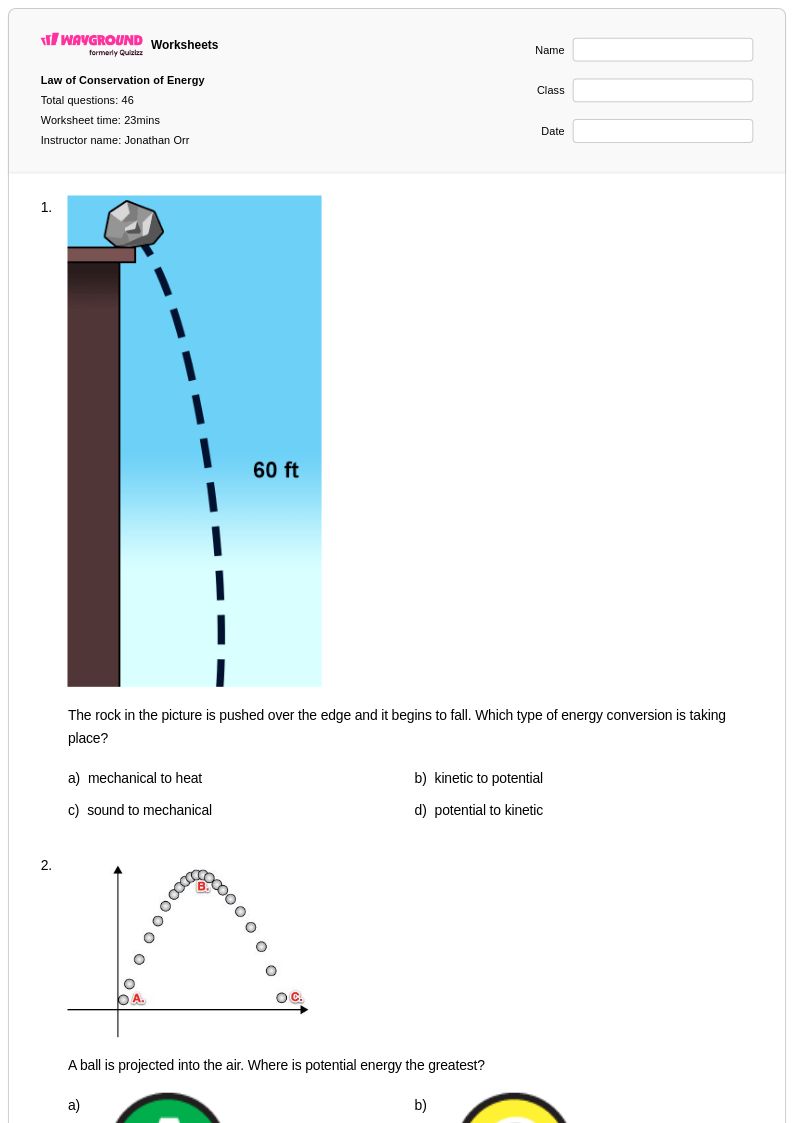
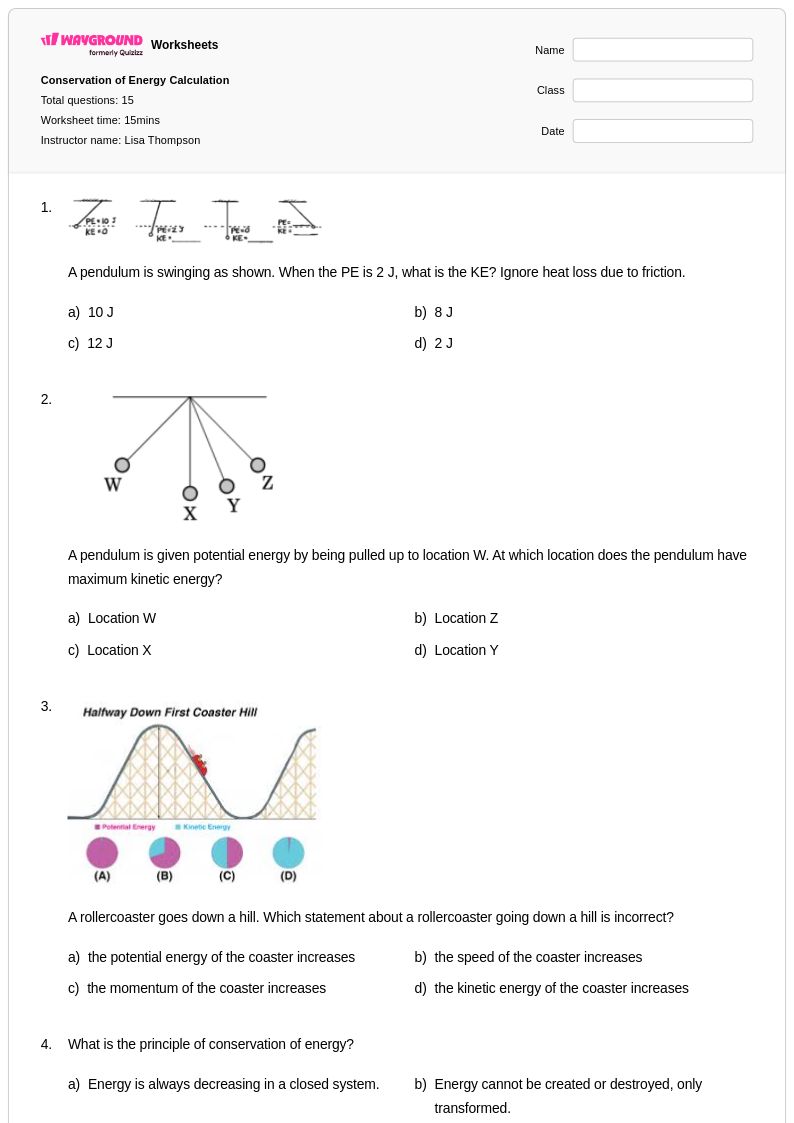
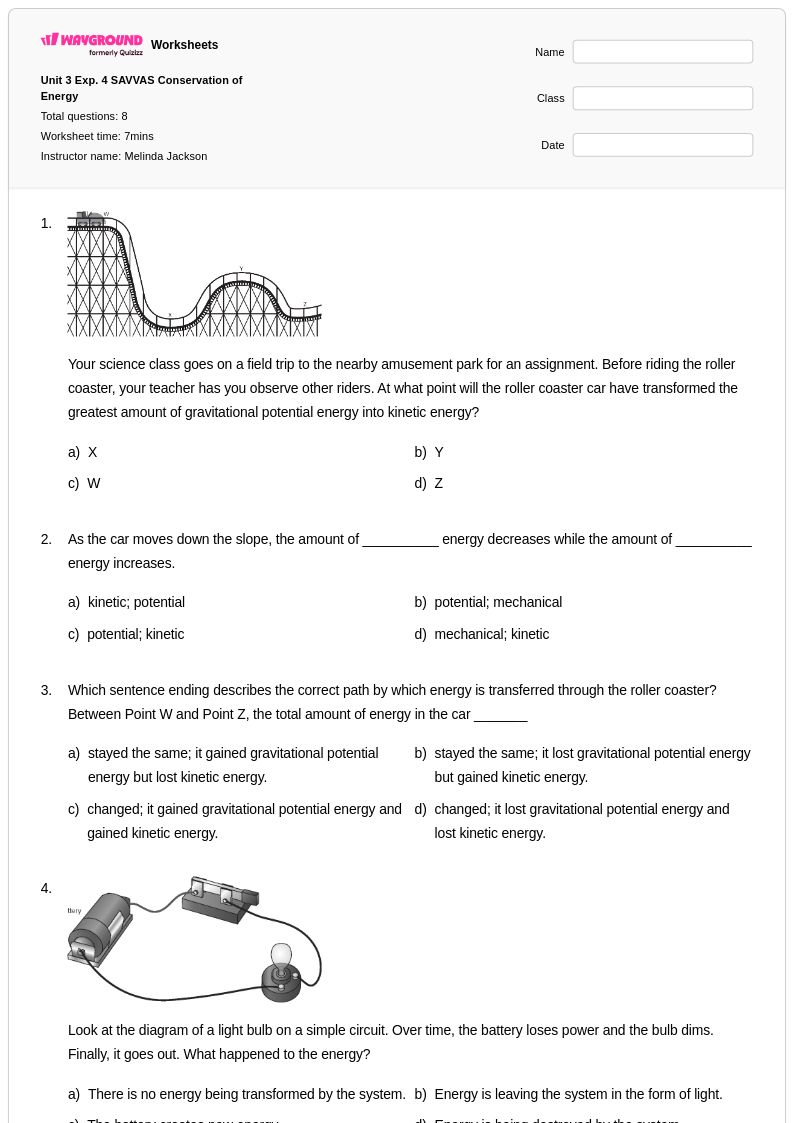
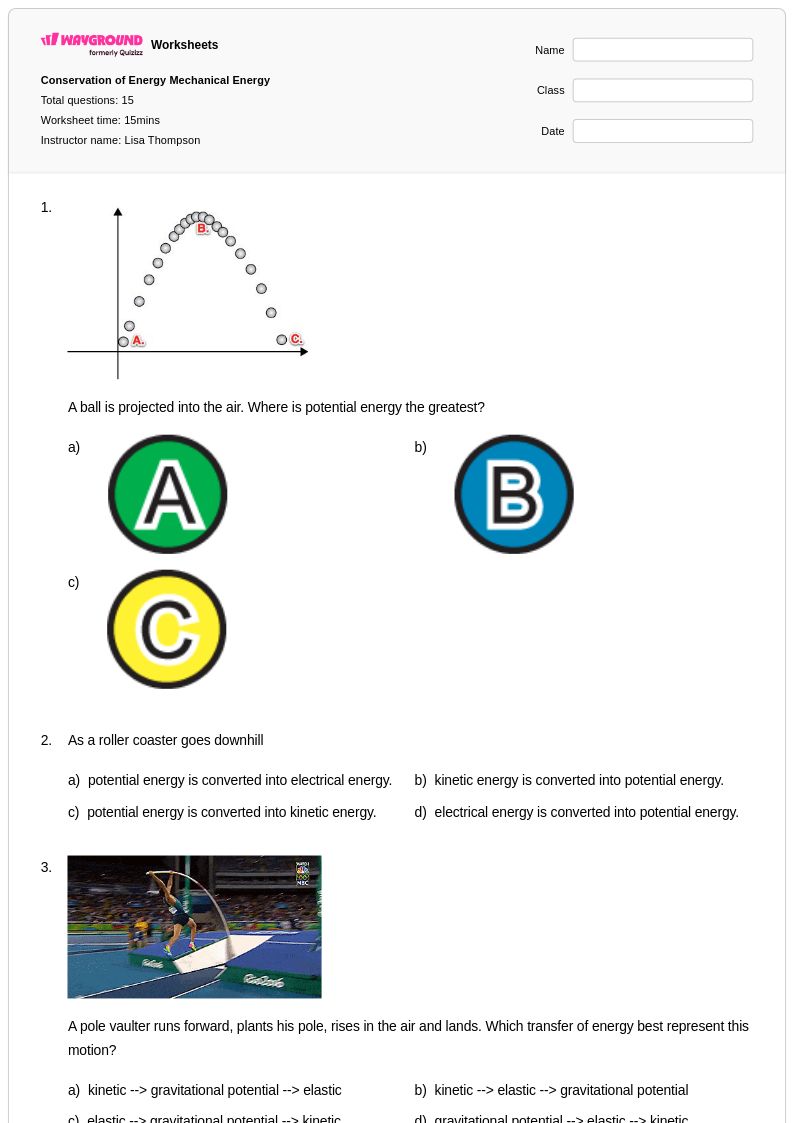
Conservation of Energy worksheets for Class 12 students available through Wayground (formerly Quizizz) provide comprehensive practice with one of physics' most fundamental principles. These expertly designed resources help students master the mathematical relationships between kinetic energy, potential energy, and mechanical energy while developing problem-solving skills essential for advanced physics coursework. Students work through practice problems involving pendulums, roller coasters, springs, and projectile motion, learning to apply conservation laws to complex multi-step scenarios. Each worksheet includes detailed answer keys that guide students through proper problem-solving techniques, and the printable pdf format ensures easy access for both classroom instruction and independent study. These free resources strengthen students' ability to analyze energy transformations, calculate work done by conservative and non-conservative forces, and recognize when mechanical energy is conserved versus when it is not.
Wayground (formerly Quizizz) empowers educators with millions of teacher-created Conservation of Energy worksheet collections that streamline lesson planning and differentiated instruction. The platform's robust search and filtering capabilities allow teachers to quickly locate resources aligned with specific physics standards and learning objectives, while customization tools enable modification of existing worksheets to match individual classroom needs. Teachers can seamlessly integrate these materials into their curriculum for skill practice, remediation sessions with struggling students, or enrichment activities for advanced learners. The flexibility of both printable and digital formats, including downloadable pdfs, accommodates diverse teaching environments and learning preferences. This extensive resource library supports physics educators in providing targeted practice opportunities that help Class 12 students build confidence with energy conservation concepts before advancing to college-level coursework.
FAQs
How do I teach conservation of energy in a physics class?
Start by establishing the distinction between kinetic and potential energy using concrete, visual examples like pendulums or roller coasters before introducing the mathematical relationship. Build student understanding progressively: begin with closed, frictionless systems where total mechanical energy is constant, then layer in real-world complexity like thermal energy losses due to friction. Connecting abstract equations to physical scenarios students can visualize significantly improves conceptual retention.
What types of practice problems help students master conservation of energy?
Effective practice problems for conservation of energy move from single-step calculations, such as finding the speed of a falling object at a given height, to multi-step scenarios involving springs, pendulums, and roller coasters where students must track energy transformations across multiple points. Problems that require students to set up energy equations from diagrams, rather than plugging numbers into a formula, build the analytical skills needed for higher-level physics. Scaffolded problem sets that gradually increase in complexity are particularly effective at reinforcing the principle across varied contexts.
What mistakes do students commonly make when applying conservation of energy?
The most common error is treating kinetic and potential energy as independent quantities rather than as interchangeable forms of a single conserved total. Students frequently forget to account for reference points when calculating gravitational potential energy, which leads to sign errors and incorrect final answers. Another persistent misconception is assuming that energy is "lost" in systems involving friction, rather than understanding it transforms into thermal energy that exits the mechanical system.
How can I differentiate conservation of energy instruction for students at different skill levels?
For students who are still building fluency, focus on single-variable problems where only one unknown needs to be solved and provide labeled energy diagrams to scaffold setup. Advanced learners benefit from multi-step problems involving combined spring, gravitational, and kinetic energy, or scenarios where they must derive an expression rather than calculate a numeric answer. On Wayground, teachers can apply accommodations such as reduced answer choices or read-aloud support to individual students, allowing the rest of the class to work with standard settings without disruption.
How do I use Wayground's conservation of energy worksheets in my classroom?
Wayground's conservation of energy worksheets are available as printable PDFs for traditional classroom use and in digital formats for technology-integrated or remote learning environments. Teachers can also host the worksheets as an interactive quiz directly on Wayground, enabling real-time student responses and automatic grading. Each worksheet includes a complete answer key, making them suitable for independent practice, guided review, or formative assessment.
How do I assess whether students truly understand conservation of energy versus just memorizing formulas?
True understanding shows when students can identify which energy forms are present at each stage of a scenario and explain why total energy remains constant without being prompted by a formula. Assess this by giving problems with unfamiliar contexts, such as a ball rolling up a ramp or a bungee jumper, where formula memorization alone is insufficient. Asking students to justify each step in writing, or to identify the error in a worked example that violates conservation principles, is an effective diagnostic strategy.