Free Printable Light and Optics Worksheets for Class 12
Enhance Class 12 students' understanding of light and optics with Wayground's comprehensive collection of free worksheets, featuring printable PDFs with practice problems and answer keys covering reflection, refraction, and wave properties.
Explore printable Light and Optics worksheets for Class 12
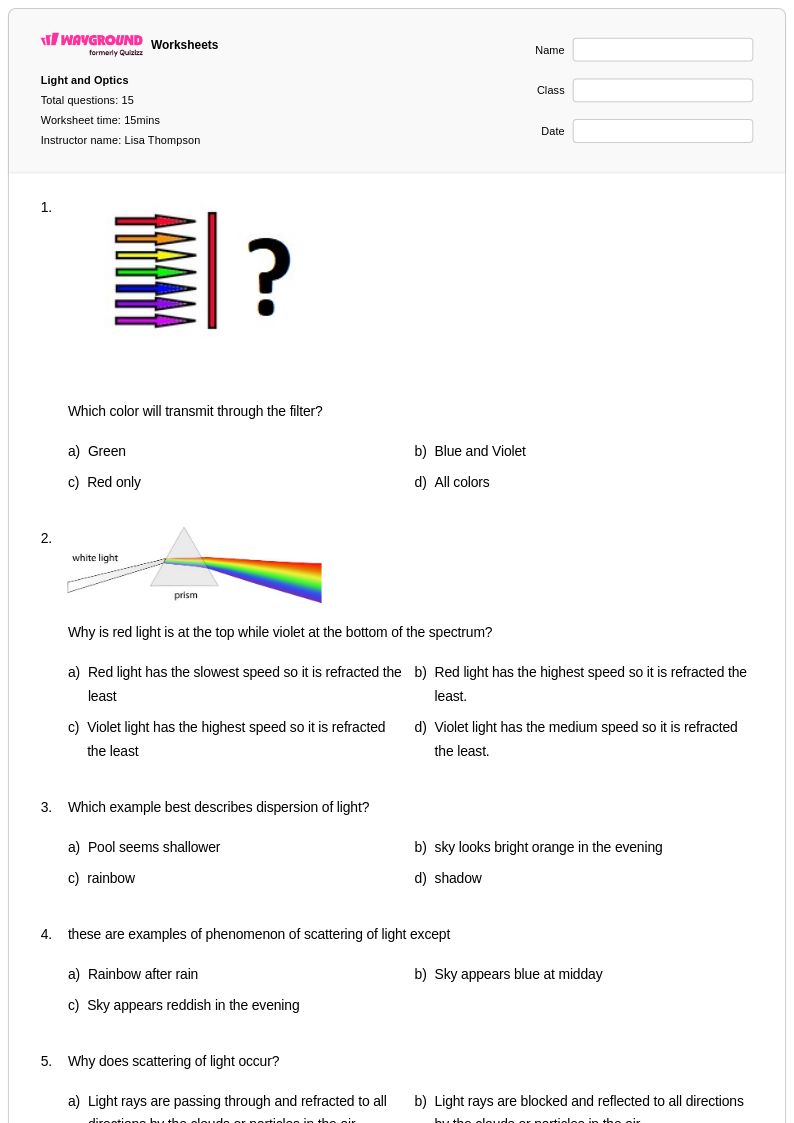
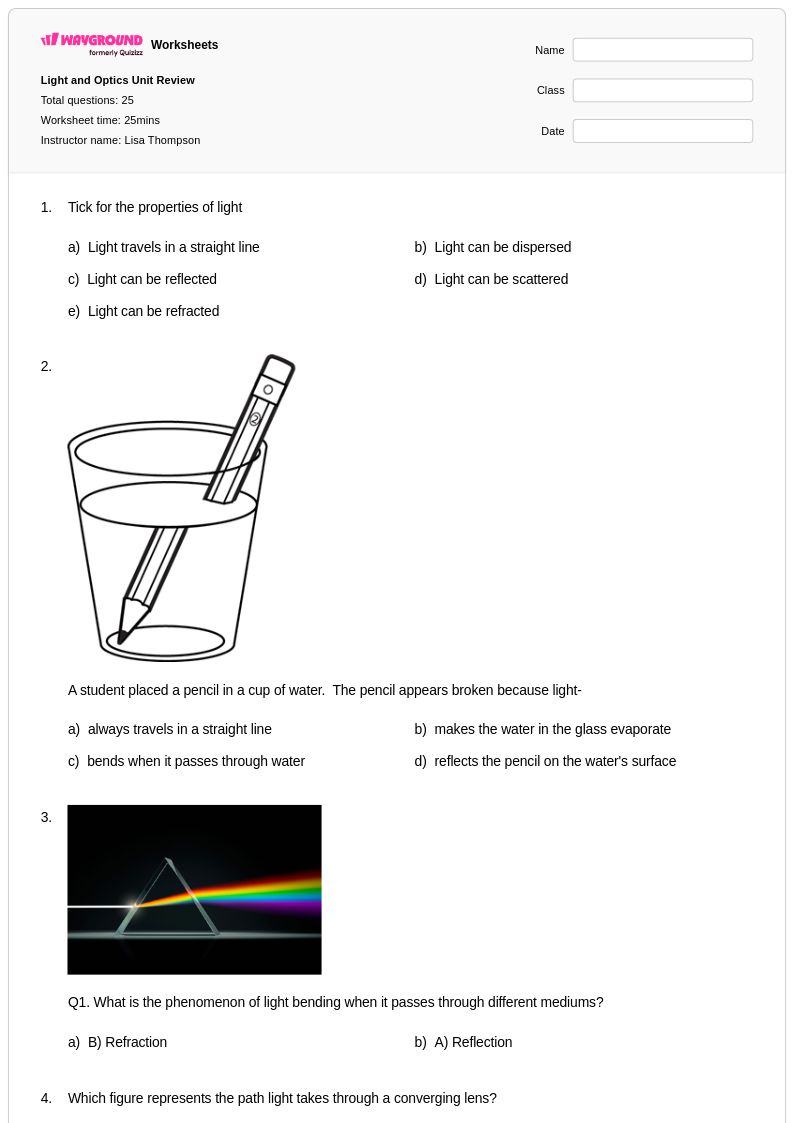
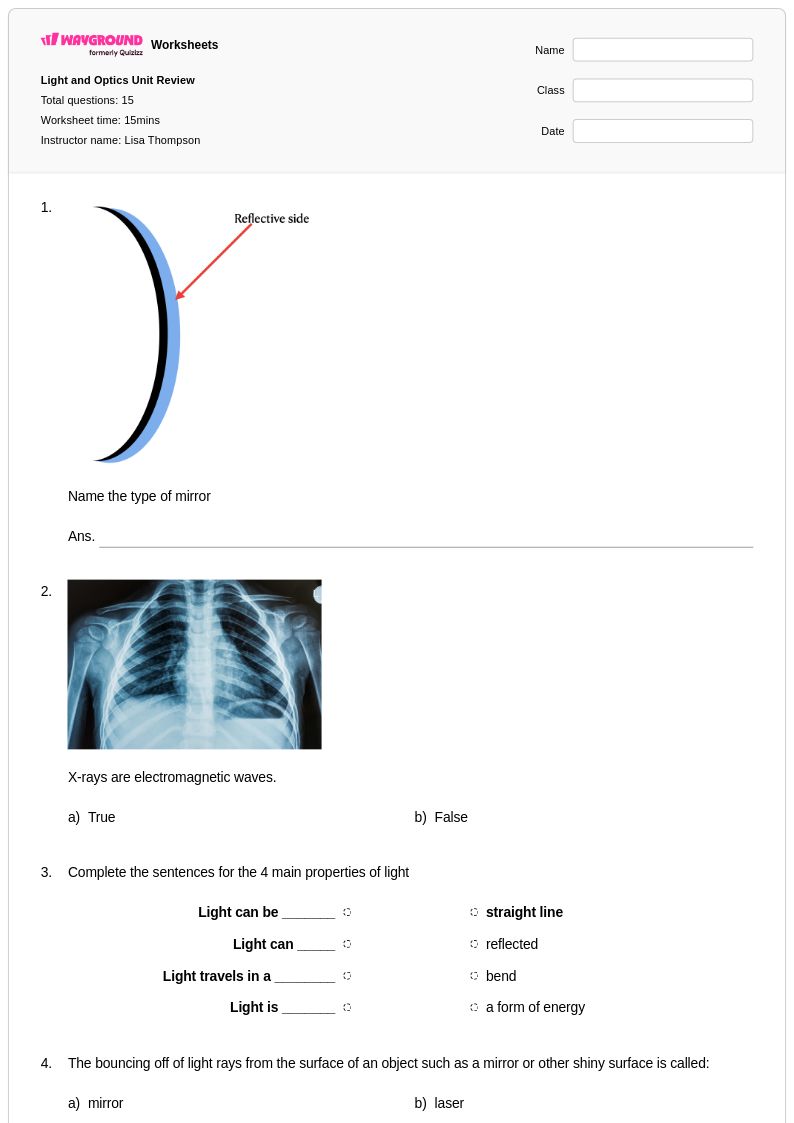
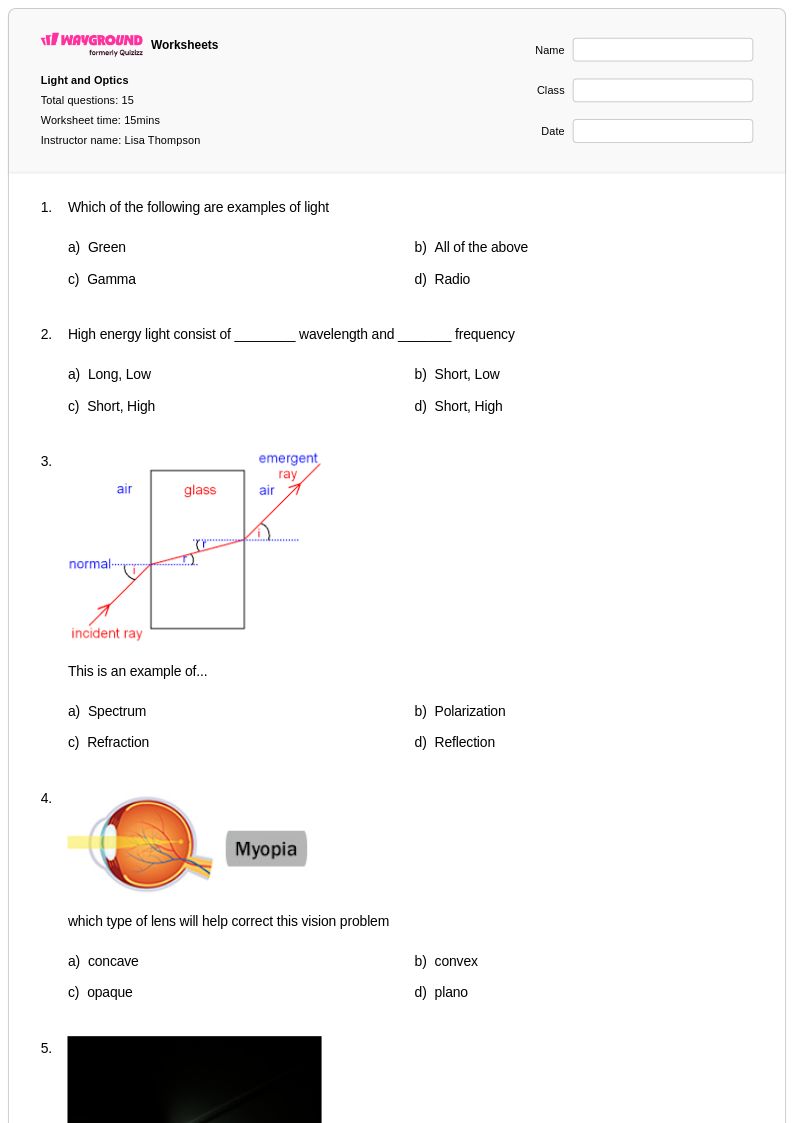
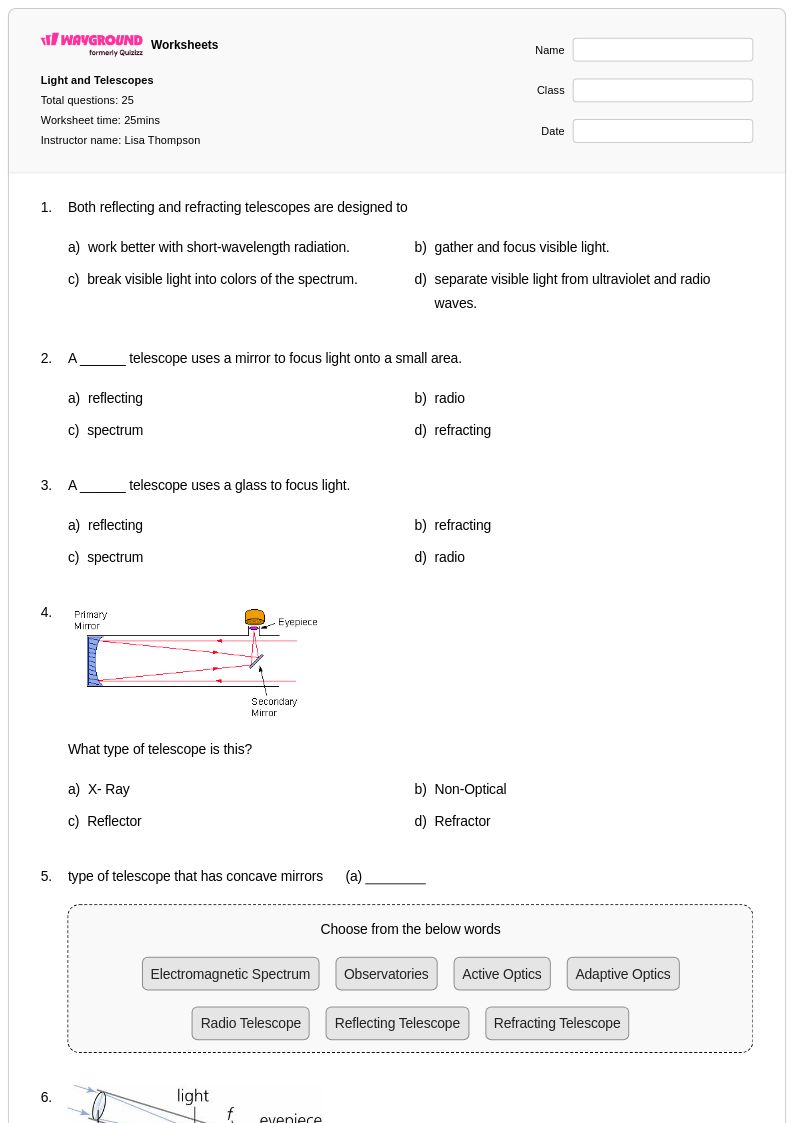
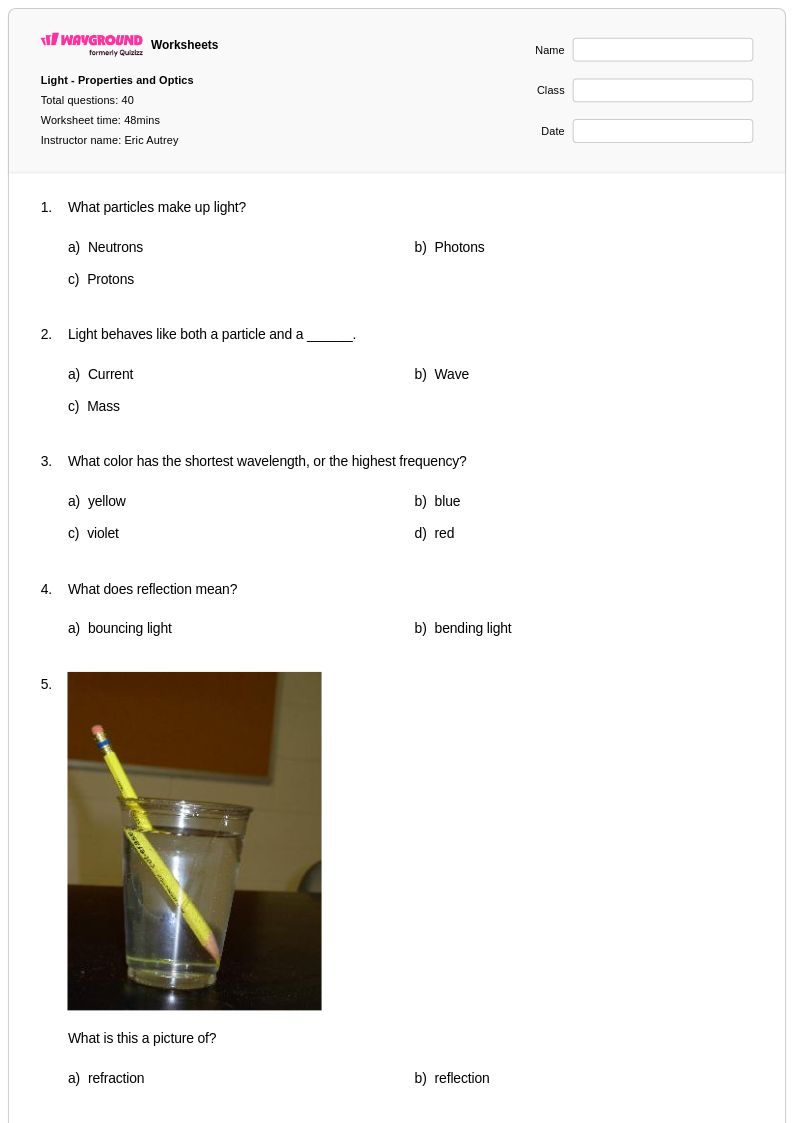
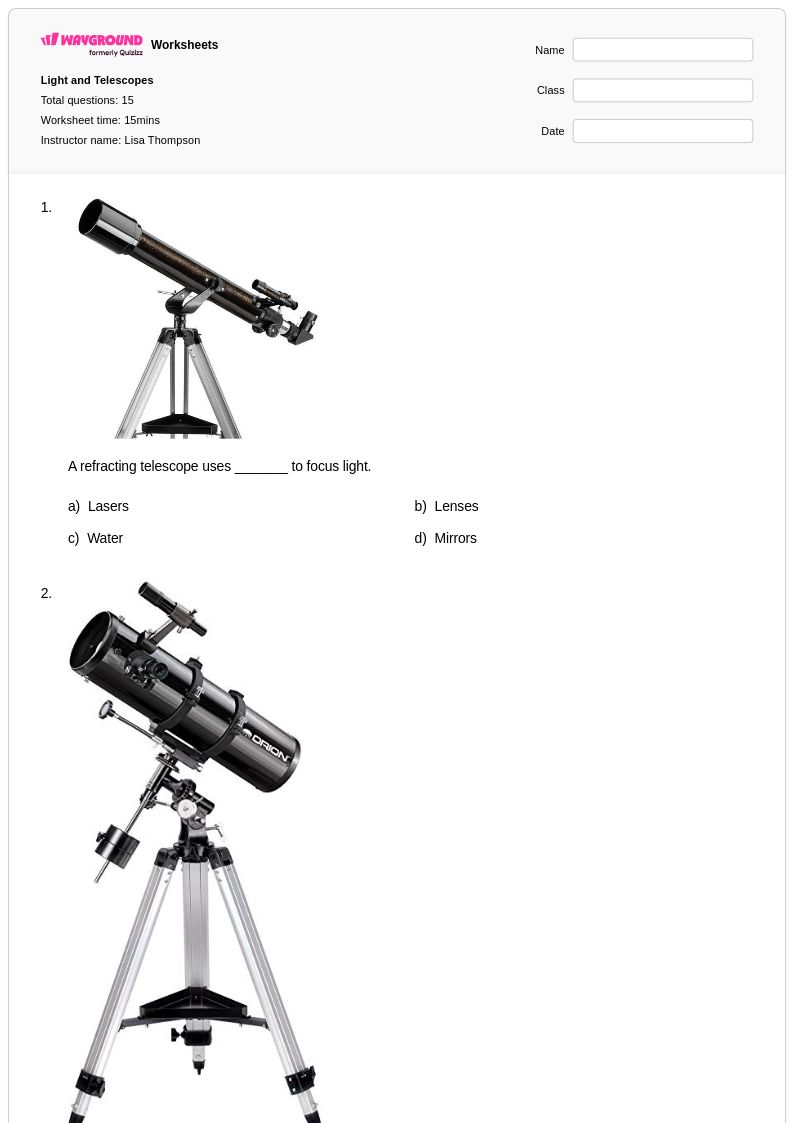
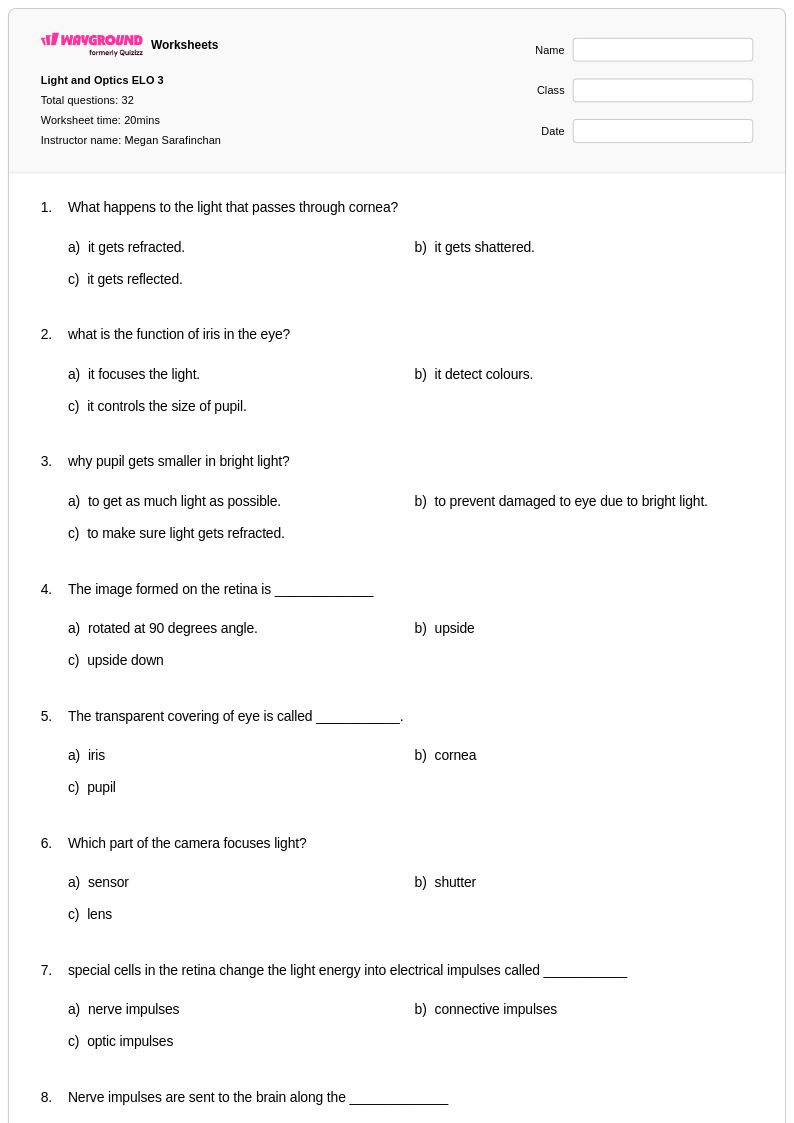
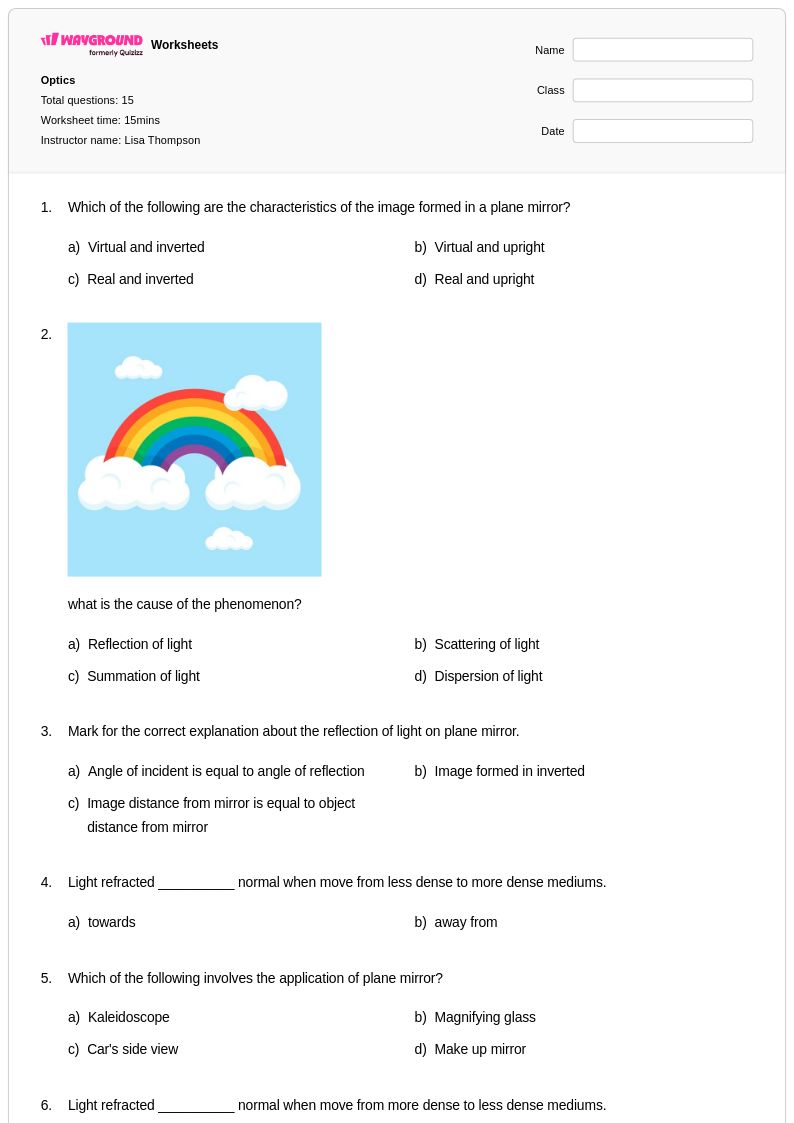
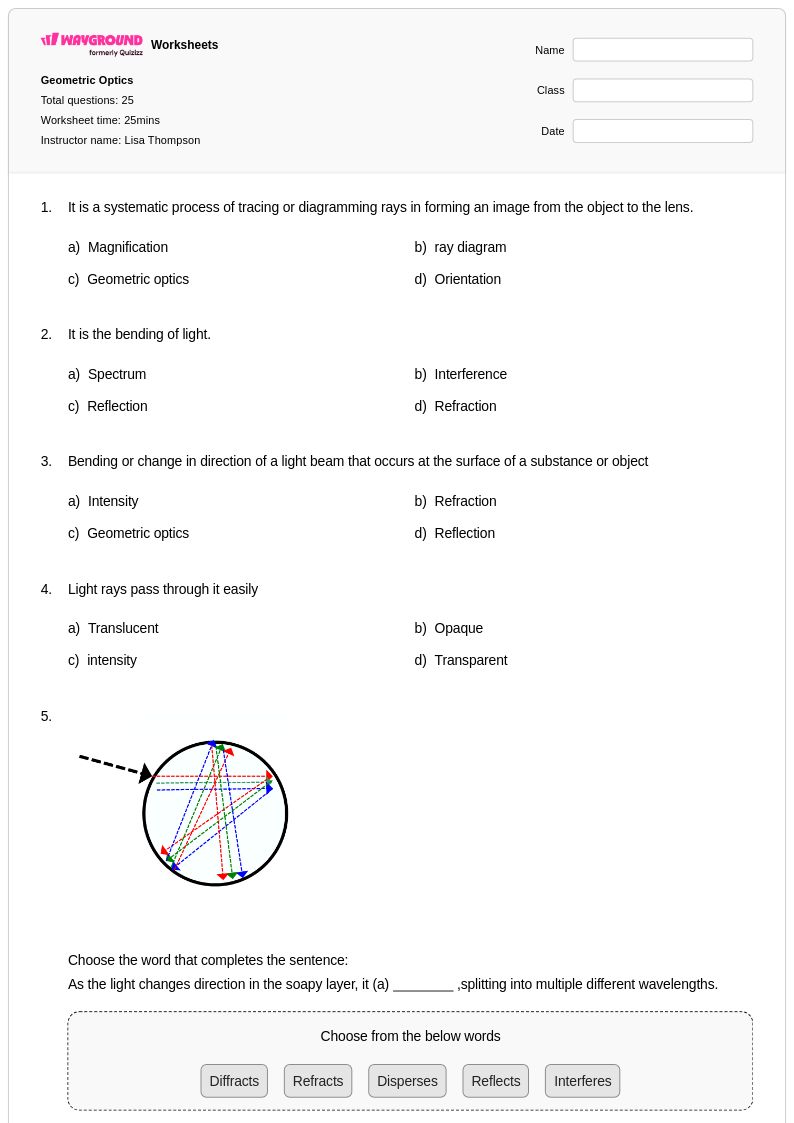
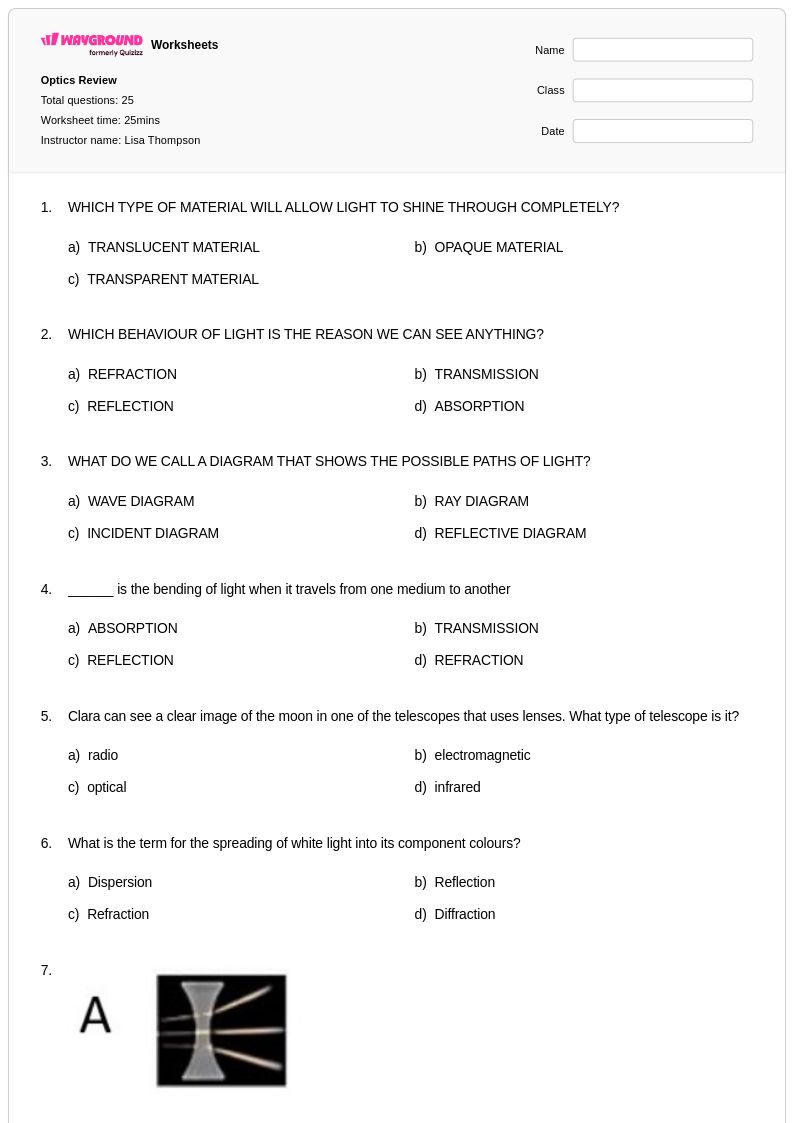
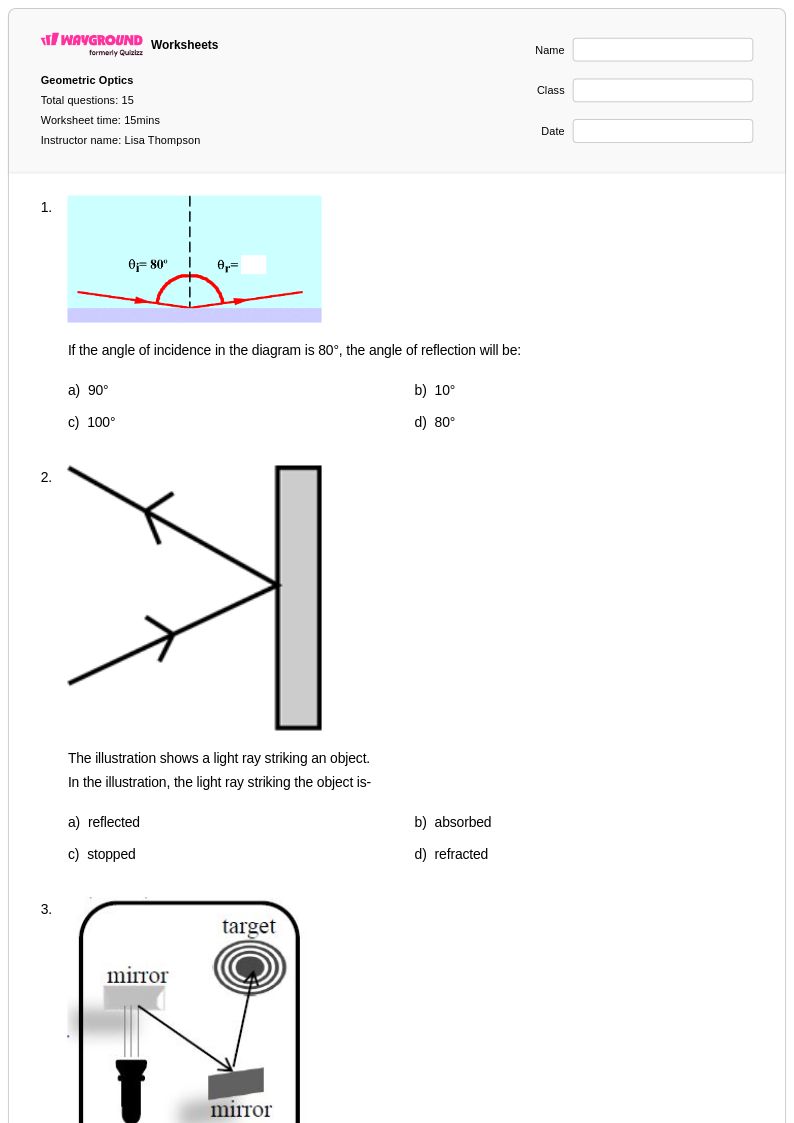
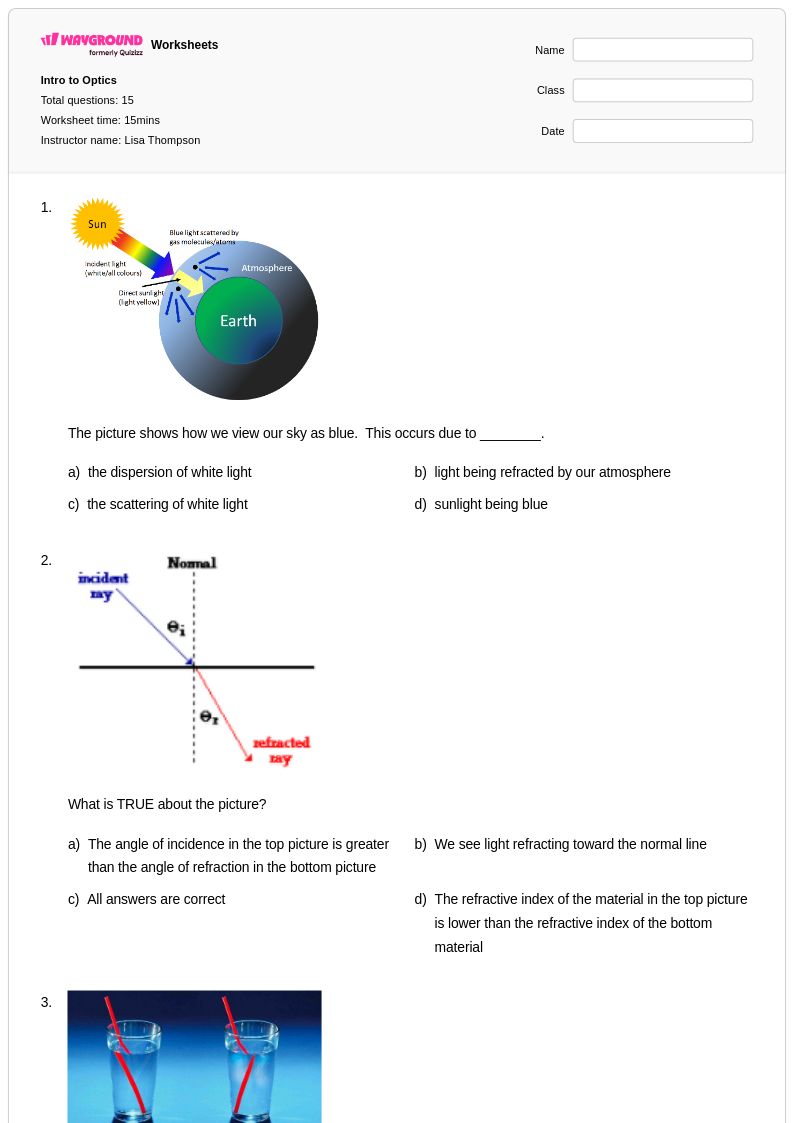
Light and optics worksheets for Class 12 students available through Wayground (formerly Quizizz) provide comprehensive coverage of advanced optical principles essential for college-bound physics students. These carefully crafted practice problems strengthen critical skills in wave theory, electromagnetic spectrum analysis, reflection and refraction calculations, interference and diffraction patterns, and polarization phenomena. Students work through challenging scenarios involving Snell's law applications, lens and mirror equations, optical instrument design, and quantum optics concepts that bridge classical and modern physics. Each worksheet collection includes detailed answer keys that guide students through complex problem-solving methodologies, while printable pdf formats ensure accessibility for both classroom instruction and independent study sessions.
Wayground (formerly Quizizz) empowers physics educators with millions of teacher-created light and optics resources that streamline curriculum planning and enhance student engagement. The platform's robust search and filtering capabilities allow teachers to quickly locate worksheets aligned with specific physics standards, whether focusing on geometric optics fundamentals or advanced topics like wave-particle duality and laser principles. Differentiation tools enable educators to customize problem difficulty levels and modify content to meet diverse learning needs, supporting both remediation for struggling students and enrichment opportunities for advanced learners. Available in both digital and printable formats, these versatile worksheet collections facilitate flexible implementation across traditional classrooms, laboratory settings, and remote learning environments, ensuring consistent skill practice and mastery of complex optical concepts.
FAQs
How do I teach reflection and refraction to middle or high school students?
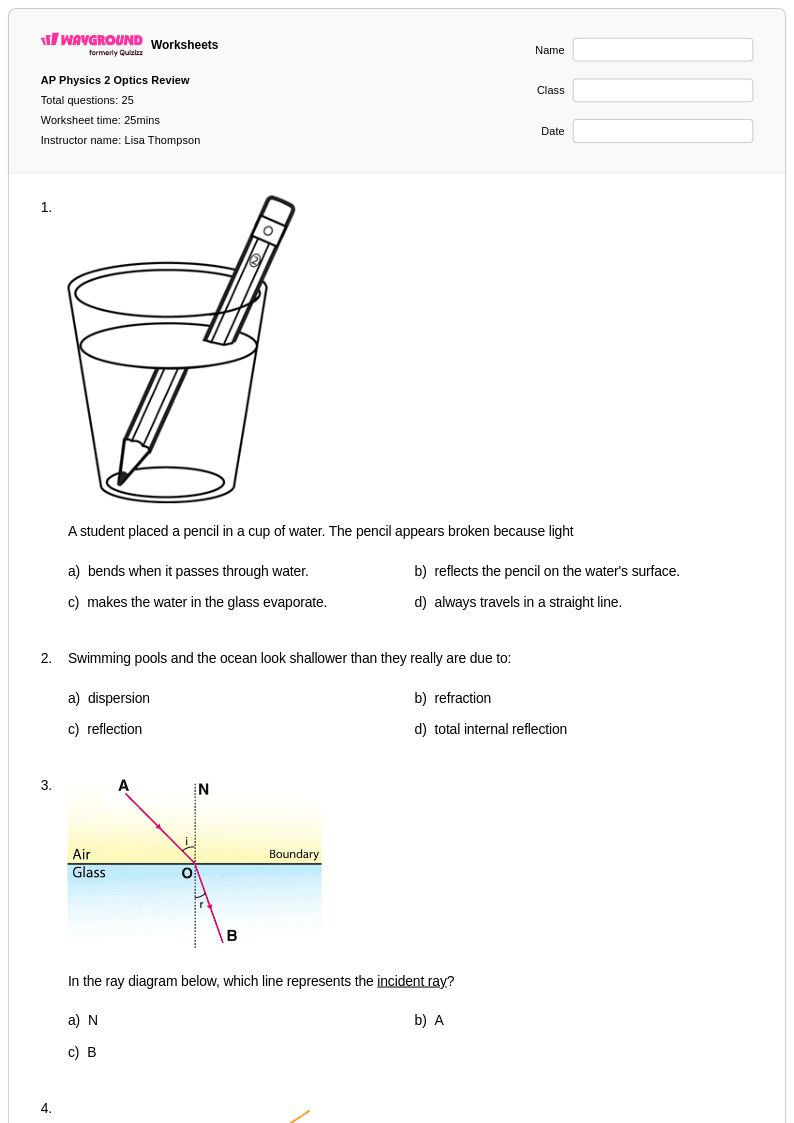
Start by establishing that light travels in straight lines, then introduce reflection using the law of angle of incidence equals angle of reflection with ray diagrams. For refraction, use Snell's law (n₁sinθ₁ = n₂sinθ₂) and connect it to real-world examples like a straw appearing bent in water or the design of eyeglass lenses. Hands-on activities with ray boxes or laser pointers help students visualize both phenomena before moving to mathematical problem solving. Building from qualitative observation to quantitative application reduces the abstraction that makes these concepts difficult.
What practice problems help students get better at applying Snell's law and lens equations?
Students benefit most from problems that progress from identifying the denser medium and predicting the direction of bending, to calculating exact refraction angles using Snell's law. For lens equations, practice should include finding image distance, object distance, and focal length using 1/f = 1/do + 1/di, paired with ray diagram sketching to verify answers visually. Mixed problem sets that combine both skills reinforce the connection between geometric optics and mathematical modeling. Light and Optics worksheets on Wayground provide structured practice problems with answer keys so students can check their reasoning at each step.
What misconceptions do students commonly have about how light behaves?
One of the most persistent misconceptions is that we see objects because light travels from our eyes to the object, rather than the reverse. Students also frequently confuse reflection and refraction, or assume that light always bends toward the normal when crossing a boundary, regardless of which medium it enters. Another common error is treating lenses as simply magnifying glasses without understanding that concave lenses diverge light and produce virtual images. Addressing these misconceptions explicitly with diagram-based questions and counterexamples is more effective than re-explaining the rule.
How does the electromagnetic spectrum connect to a light and optics unit?
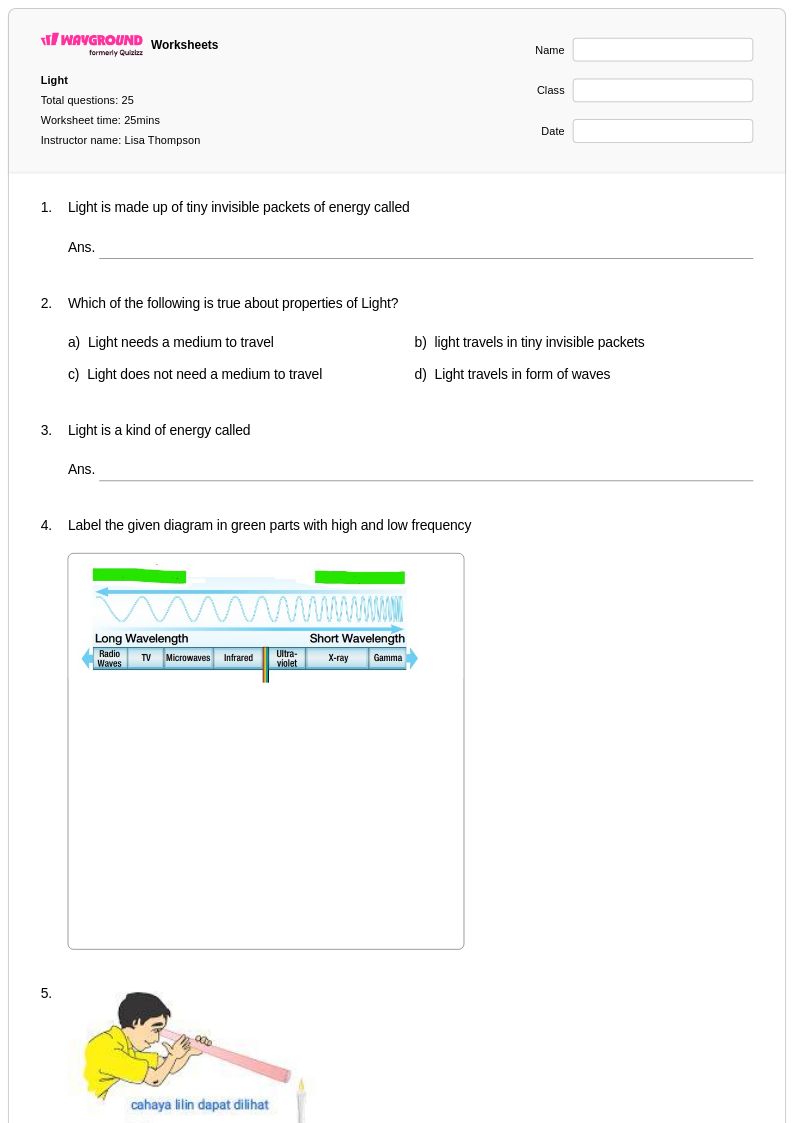
Visible light is just a narrow band of the broader electromagnetic spectrum, so situating a light and optics unit within the full spectrum helps students understand why different wavelengths behave differently when reflected, refracted, or absorbed. Teaching the spectrum reinforces wave properties such as frequency, wavelength, and energy, which are foundational to understanding phenomena like dispersion through a prism or why the sky appears blue. Students who understand the spectrum also find it easier to grasp how optical instruments like telescopes and cameras are designed to capture specific ranges of light.
How do I use Wayground's Light and Optics worksheets in my classroom?
Wayground's Light and Optics worksheets are available as printable PDFs for traditional classroom distribution and in digital formats for technology-integrated or remote learning environments. Teachers can also host worksheets directly as a quiz on Wayground, giving students an interactive experience while automatically collecting responses. All worksheets include answer keys, making them efficient for guided practice, independent review, or homework assignments. For students who need additional support, Wayground's accommodation tools allow teachers to enable read aloud, extended time, or reduced answer choices on an individual basis without disrupting the rest of the class.
How can I differentiate light and optics instruction for students at different skill levels?
For students who are still building foundational understanding, focus on qualitative ray diagrams and conceptual questions before introducing any calculations. Advanced students can be extended with multi-step problems involving lens combinations, critical angle and total internal reflection, or wave interference and diffraction. On Wayground, teachers can apply individual accommodations such as reduced answer choices or read aloud to specific students, while the rest of the class receives the standard version, allowing one worksheet to serve multiple readiness levels simultaneously.