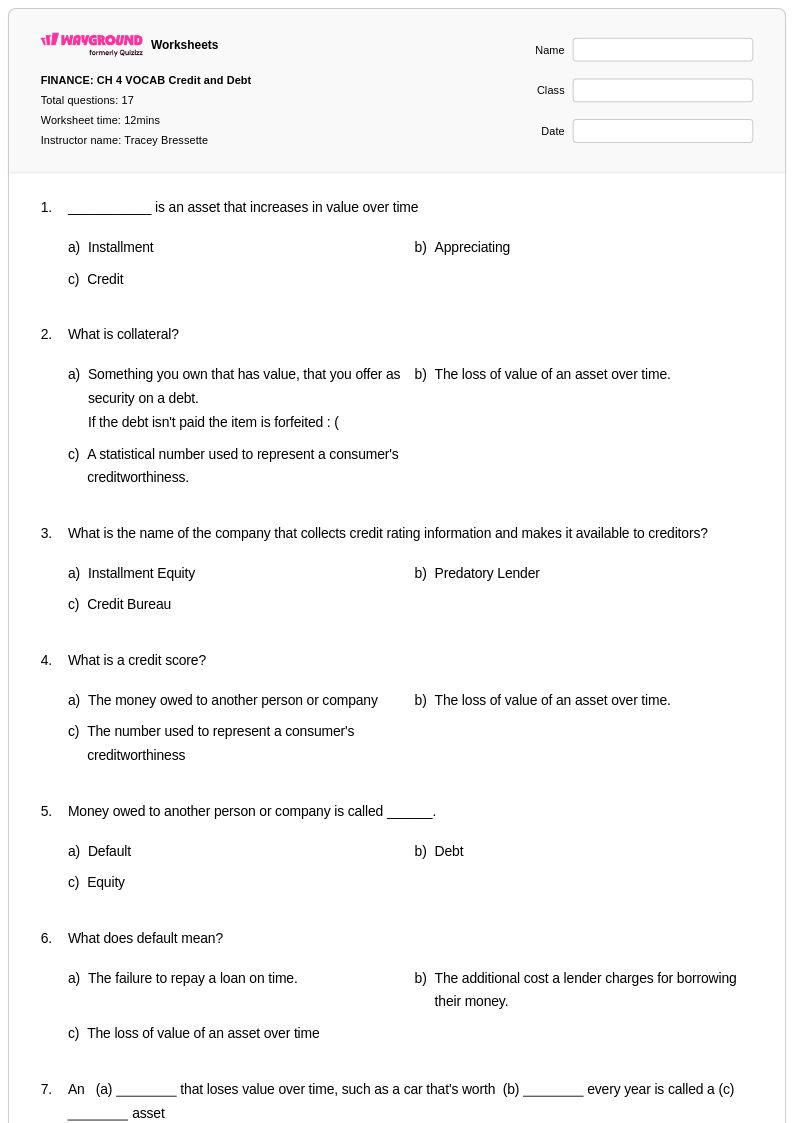
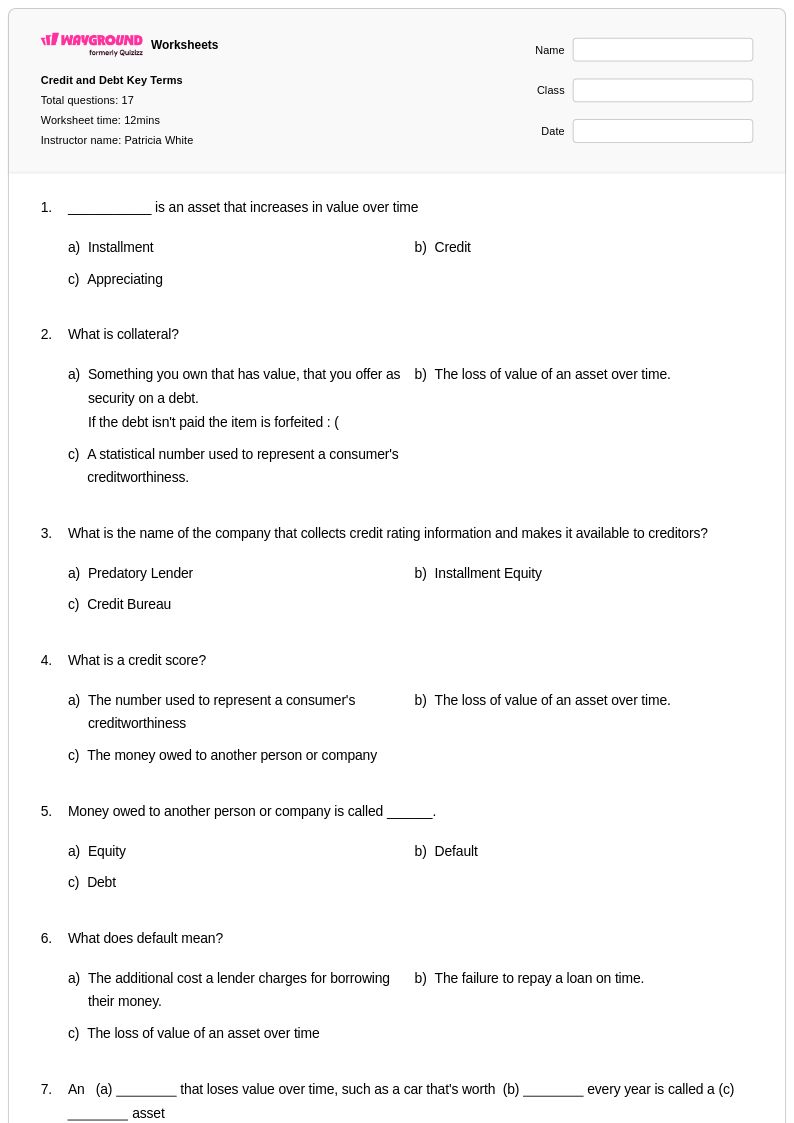
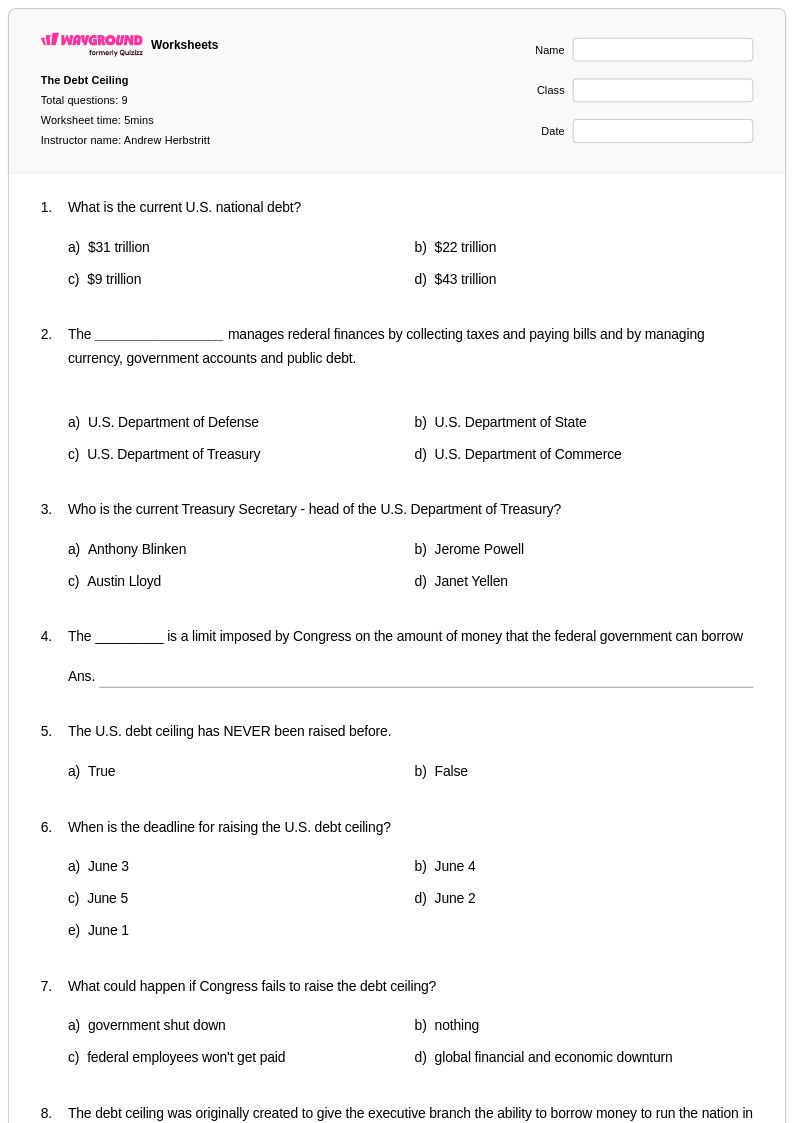
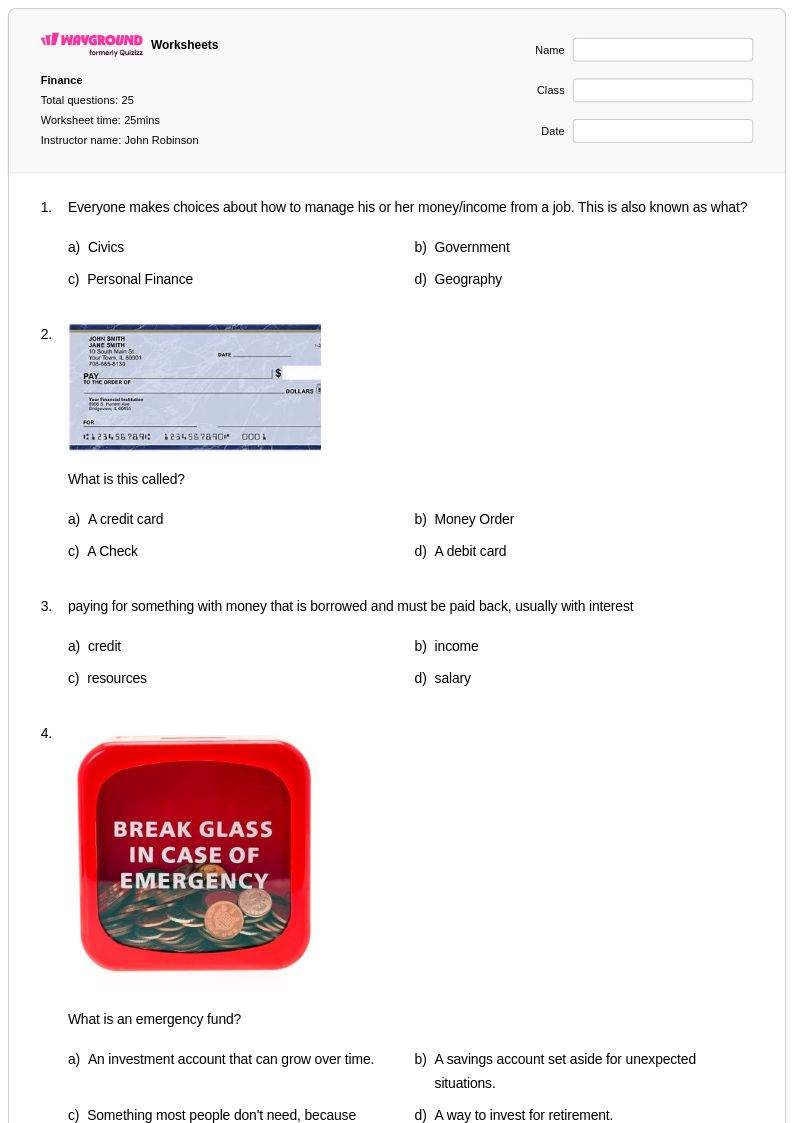
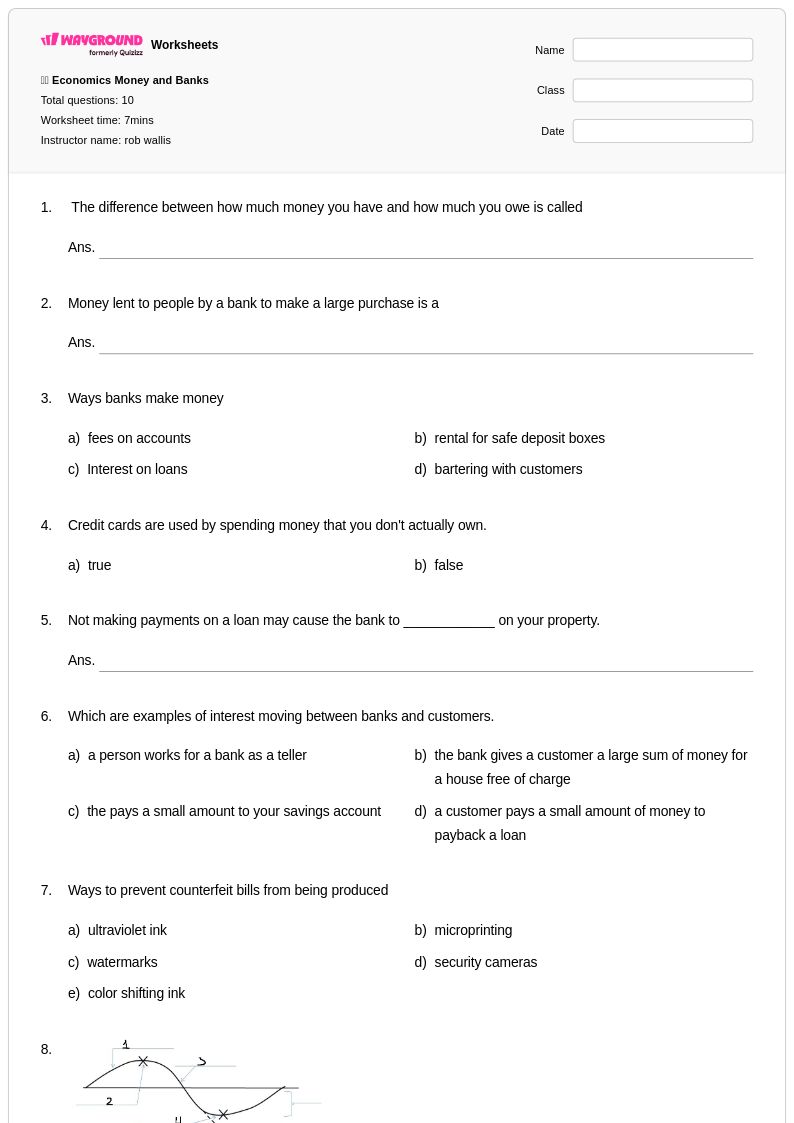
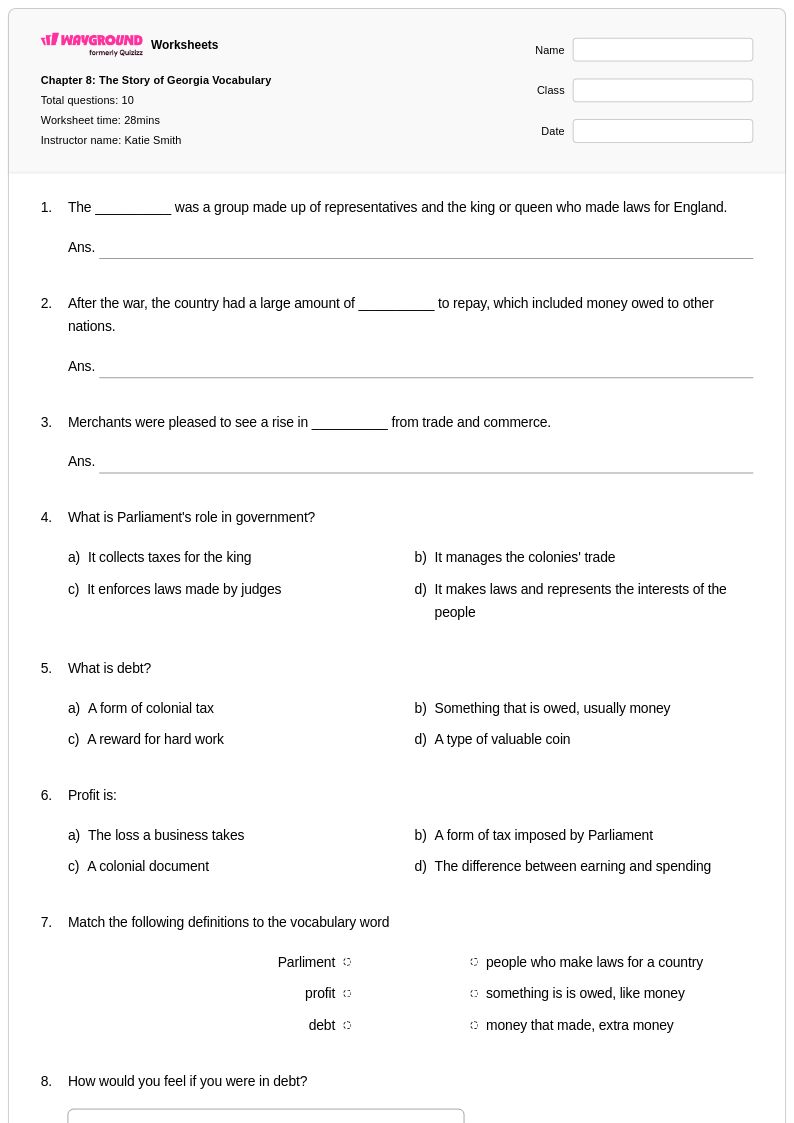
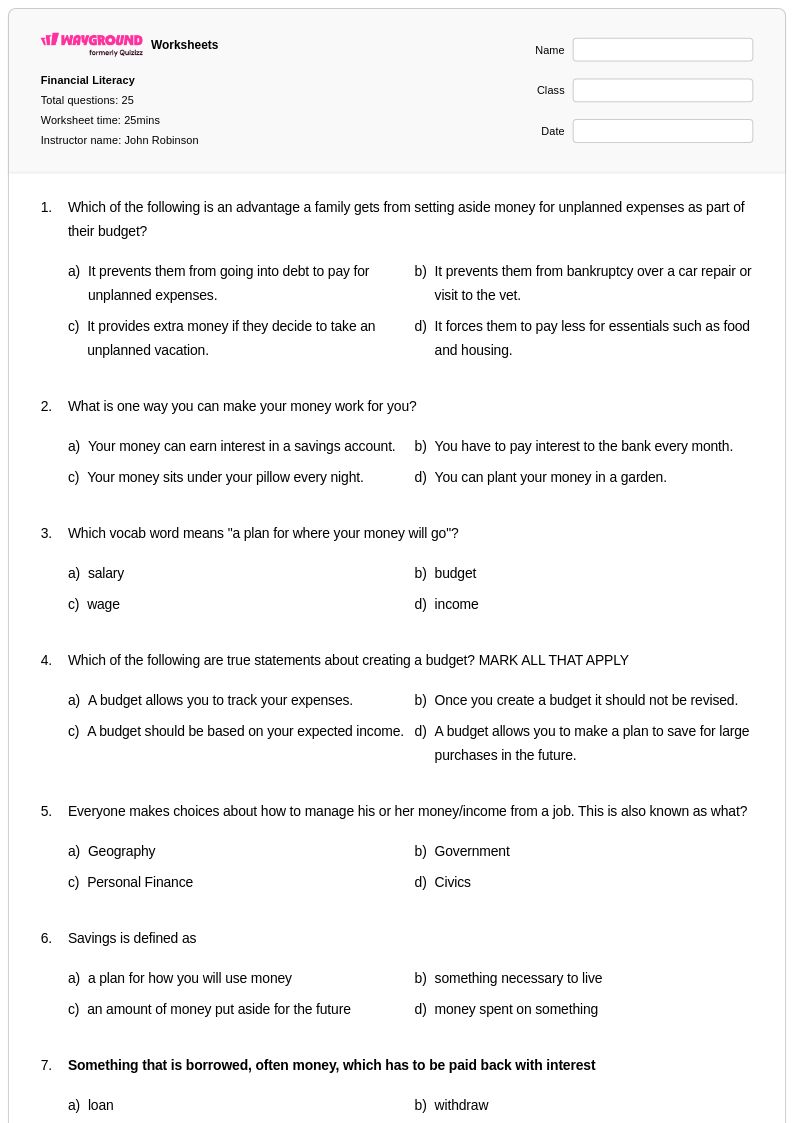
Explore Wayground's free Class 6 debt worksheets and printables that help students understand borrowing, lending, and financial responsibility through engaging practice problems and comprehensive answer keys.
Debt worksheets for Class 6 students available through Wayground (formerly Quizizz) provide comprehensive practice opportunities that help young learners understand this fundamental economic concept within their social studies curriculum. These carefully designed printables introduce sixth graders to the basics of borrowing, lending, and financial obligations through age-appropriate scenarios and practice problems that connect to their everyday experiences. Students explore different types of debt, including personal loans, credit cards, and mortgages, while developing critical thinking skills about financial decision-making and responsibility. Each worksheet includes a complete answer key and is available as a free pdf download, allowing teachers to seamlessly integrate debt education into their economics lessons while reinforcing essential mathematical skills through real-world financial calculations.
Wayground (formerly Quizizz) supports educators with an extensive collection of teacher-created debt worksheets that can be easily customized to meet diverse classroom needs across Class 6 social studies programs. The platform's robust search and filtering capabilities allow teachers to quickly locate resources aligned with specific learning standards and differentiate instruction for various skill levels within their economics units. These printable and digital materials, available in convenient pdf format, provide flexible options for lesson planning, targeted remediation, and enrichment activities that deepen students' understanding of financial literacy concepts. Teachers can modify existing worksheets or combine multiple resources to create comprehensive practice sets that address individual student needs while building foundational knowledge about debt management and economic decision-making that will serve students throughout their academic and personal lives.
FAQs
How do I teach debt and credit concepts to students who have no financial background?
Start with concrete, relatable examples like borrowing lunch money or financing a bicycle before introducing formal terms like principal, interest, and credit scores. Building from familiar scenarios helps students grasp why debt carries a cost and how repayment timelines affect total amount owed. From there, structured practice problems that simulate real loan decisions or credit card payments give students a practical framework for understanding debt in adult life.
What exercises help students practice calculating debt and interest payments?
Effective practice exercises include calculating simple and compound interest on hypothetical loans, comparing total repayment costs across different interest rates, and analyzing minimum payment schedules on credit card balances. Problems that ask students to evaluate borrowing decisions based on loan terms, monthly payments, and long-term cost build both mathematical reasoning and critical thinking. Ranging from basic debt calculation to more sophisticated loan analysis ensures students at different skill levels are appropriately challenged.
What mistakes do students commonly make when learning about debt and interest rates?
A frequent misconception is that only the amount borrowed matters, with students consistently underestimating the compounding effect of interest over time. Students also tend to confuse simple interest with compound interest, which leads to significant errors when projecting loan costs or credit card balances. Another common error is misreading the relationship between credit scores and borrowing terms, often assuming credit history has no impact on interest rates offered.
How can I use debt worksheets to support students with different skill levels?
Debt worksheets can be tiered so that foundational problems focus on identifying types of debt and calculating simple interest, while advanced problems require students to model multi-year repayment plans or compare loan products. On Wayground, teachers can apply accommodations to individual students, including reduced answer choices to lower cognitive load, read-aloud support for students who need audio assistance, and extended time settings, all without other students being notified.
How do I use Wayground's debt worksheets in my classroom?
Wayground's debt worksheets are available as printable PDFs for traditional classroom use and in digital formats for technology-integrated learning environments, making them adaptable for in-person, hybrid, or remote instruction. Teachers can also host worksheets directly as a quiz on Wayground, enabling real-time student response tracking. Each worksheet includes a detailed answer key, supporting both independent student study and teacher-led instruction.
How do debt worksheets connect to broader personal finance and economics curriculum?
Debt is a foundational concept in both personal finance and economics because it connects to credit management, budgeting, consumer behavior, and macroeconomic policy. Worksheets that cover types of debt, interest rates, credit scores, and debt management strategies give students the vocabulary and analytical tools to engage meaningfully with broader economic topics. This cross-curricular relevance makes debt worksheets effective as standalone lessons or as part of a larger financial literacy unit.